Temporary: When a Rule Becomes a Favour
Italy suspended free movement with Spain. Spain retaliated. Italy has had twice Spain's irregular arrivals. Nine countries now have "temporary" checks.

On 1 August, Italy suspended free movement with Spain. On 8 August, Spain suspended free movement with Italy. Twenty-two member states signed a letter backing Rome. Both measures are described as temporary emergency responses to a crisis that ended within forty-eight hours, in a walled city on the African coast that was never inside the free movement area to begin with. Nine European countries now have internal border checks in force. This is a piece about what the word temporary is doing.
By A. Kade
Start with a queue, because the queue is the only real thing in this entire story.
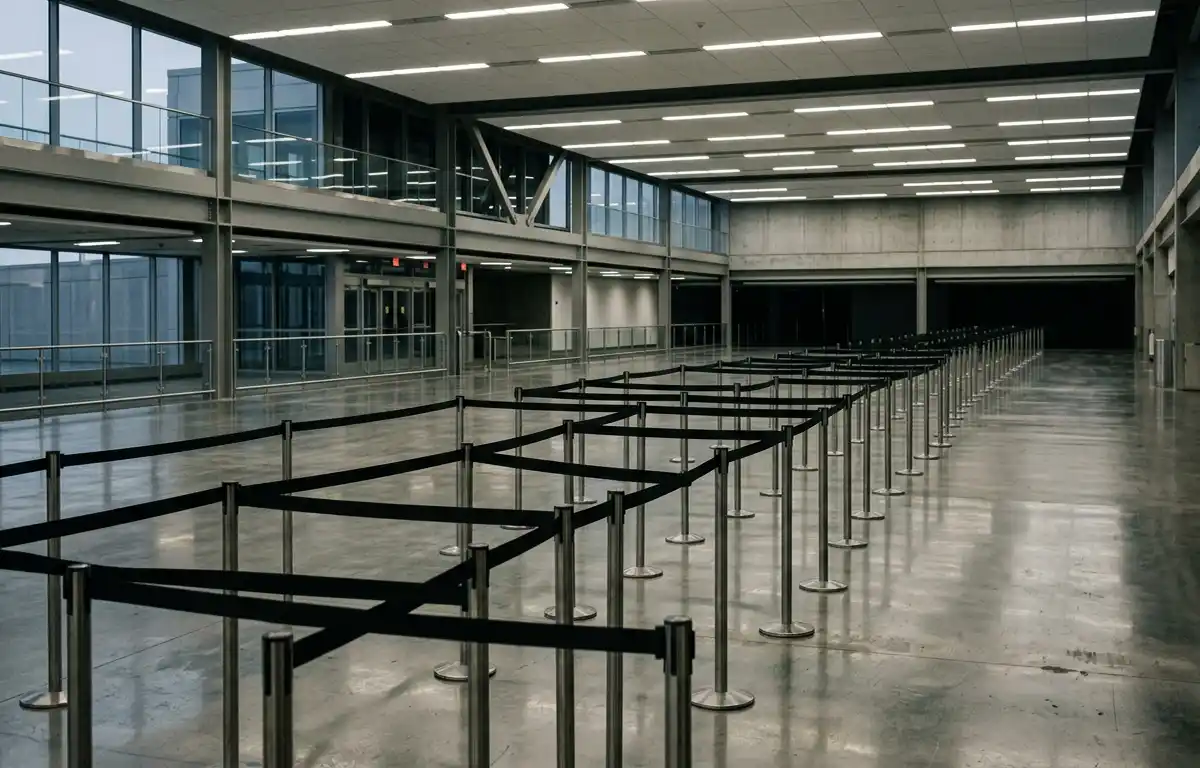
It is at an airport, or a ferry terminal, in Genoa or Barcelona or Palermo or Alicante. It is August, so the queue contains a great many people with children and folding pushchairs and too much luggage, going to see a grandmother, or coming back from three days they saved eleven months for. Somebody in that queue is a Moroccan-born Spanish citizen who has been asked for documents twice already this trip. Somebody else is a Spanish lorry driver on a ferry route he has run for nine years without ever once being stopped.
They are being checked because of something that happened in a city none of them have been to, which is on a different continent, which was never in Schengen in the first place, and which was fully reversed within two days.
Nobody in that queue did anything. Nobody in that queue was consulted. And every one of them is now personally paying a small tax, in minutes and irritation and the specific indignity of proving who you are in a union whose central promise was that you would never have to, so that two governments can each look decisive to their own newspapers.
That is the whole of it. Everything below is just detail.
•••
What actually happened, stripped of the theatre
On 30 and 31 July, somewhere between fifty thousand and more than seventy thousand people crossed from Morocco into Ceuta, the estimates vary widely by source and none of them is firm. Ceuta is a Spanish enclave on the North African coast, surrounded entirely by Morocco, with its own permanent border controls with the Spanish mainland. More than forty-eight thousand of those who crossed returned within about forty-eight hours. At least seventy-two people died, mostly by drowning or crushing at the breakwater. Ceuta's president, Juan Jesús Vivas, estimated that between three and five thousand remained.
Not one of them reached mainland Europe. The border they would have had to cross to do so, the one between Ceuta and Spain proper, held, because it always holds, because it exists precisely to hold. The Schengen Borders Code contains specific provisions for Ceuta and Melilla, and Spain maintains identity checks on flights and ferries leaving them for anywhere else in the zone. A European Commissioner said so publicly.
So: an incursion into a walled city outside the free travel area, reversed in two days, with no onward movement.
On 31 July, Italy announced it was suspending Schengen with Spain.
Italian opposition politicians pointed out at the time that no evidence had emerged of anyone leaving Ceuta for Italy. No evidence has emerged since.
•••
The numbers Sánchez published, which ended the argument and changed nothing
Spain's response was to post the Frontex data.
Irregular entries into the European Union between 2021 and 2026: 478,600 through Italy. 340,600 through the Western Balkans. 259,800 through Greece. 234,760 through Spain.
Italy has had more than double Spain's irregular arrivals over the same five years. Italy suspended free movement with the country that has had less than half its own numbers, on the grounds of an irregular migration emergency.
Solidarity and empathy are optional, Sánchez wrote. Respect for European treaties and the facts is not.
There is no reading of those figures which survives contact with arithmetic. It is not a policy response. It is not even a bad policy response. It is a performance, and the audience is Italian, and the timing is not a coincidence: Giorgia Meloni's coalition is under pressure from a newer party to its right led by the former army general Roberto Vannacci, and there is an election coming.
Chiara Catelli of PICUM, the migrants' rights platform, put it about as plainly as anyone has managed. Italy's reintroduction of border controls with Spain, she told Al Jazeera, is nothing more than political theatre. It's a savvy manipulation of EU law to show that the government is "tough on migration", while effectively only causing problems to tourists and other people travelling from Spain to Italy.
Within days, twenty-two member states signed a joint letter aligning themselves with Rome's position.
Twenty-two. Against the arithmetic. On the record.
Brussels, to its credit, refused the wider demand, there had been calls to strip Spain of Schengen membership altogether, and the Commission declined, because the treaties contain no such mechanism and Spain had broken nothing.
•••
What the analysts actually think it was for
Here is the assessment that should worry anyone who cares about this union lasting, and it comes from people who study it for a living rather than from me.
Davide Colombi, a researcher in the Justice and Home Affairs unit at the Centre for European Policy Studies, told Al Jazeera that neither he nor his colleague read the measure as a response to Ceuta at all. They read it as a template, a demonstration that a member state can invoke Schengen's emergency provisions over a crisis unfolding in another member state's territory, for reasons that are more political than operational.
Sit with that for a moment, because it is a considerably harder claim than the one I set out to make.
This was not a panicked overreaction to an emergency. It was a proof of concept. Somebody has now established, in public, with twenty-two governments applauding, that the mechanism designed to let free movement survive genuine shocks can be pointed at a neighbour whose politics you dislike, over something happening on a different continent, and that nothing whatsoever will happen to you.
That precedent does not expire on 1 September. It is available to everyone now, permanently, and the next government to reach for it will be able to point at this one.
•••
The comparison that should have ended careers
Here is the part that made me angry enough to write this, and I want to lay it out slowly, because it is not complicated and almost nobody has said it out loud.
In March 2025, Poland suspended the right to claim asylum at its border with Belarus. Not border checks, the right to claim asylum, which is not a courtesy but a legal obligation under EU and international law. The Asylum Information Database described it as a clear breach.
There was no joint letter. No member state suspended free movement with Poland. Nobody summoned the Polish ambassador. Instead, the European Union proposed a regulation to help Warsaw manage the situation.
Now hold that against Spain, which broke nothing. Spain did not suspend asylum rights. Spain did not breach the Borders Code. Spain had an enclave overwhelmed by an event it did not cause and could not have prevented, held the actual border, returned more than forty-eight thousand people in two days, and buried seventy-two.
Poland breached the law and was assisted. Spain complied with the law and was punished by twenty-two governments.
The researchers Al Jazeera spoke to were more diplomatic than I am prepared to be. They observed that the difference was probably explained by the general political positions Spain holds relative to most other member states.
Say that plainly. The rule was applied one way to a government the others liked and the opposite way to a government they didn't. That is not a rule. A rule that bends to the politics of the person breaking it is not a rule at all. It is a favour, and the price of the favour is your alignment.
Every Spanish and Italian passenger standing in an August queue right now is paying for that, and none of them were told that was what they were buying.
And note, because it is almost funny: Emmanuel Macron responded to the same events by strengthening controls on France's land border with Spain while simultaneously offering the Spanish authorities support to manage the emergency in Ceuta. Sanctioning and assisting, in the same statement, on the same afternoon. Nobody found this contradictory, which tells you how far the vocabulary has drifted from the actions it is supposed to describe.
•••
The word
Both measures are temporary.
Italy's runs from 1 August to 1 September. Spain's, imposed at midnight on 8 August in direct retaliation after Italy refused to lift its own, runs until 7 September. Meloni called hers "an extraordinary measure adopted to protect national security." Antonio Tajani called it "a necessary choice... a measure provided for by the treaties and made unavoidable today." The Spanish interior ministry called its own version a temporary measure that will remain in effect unless circumstances change.
Now look at the rest of the continent, and at what the word is actually doing.
By mid-August, according to immigration practitioners tracking the notifications, the countries with internal Schengen border checks in force running into September, October, November and December of 2026 were: Austria, France, Germany, Italy, the Netherlands, Norway, Poland and Sweden, plus Spain, following Ceuta. Nine countries. Germany has controls on all its land borders and has signalled it will extend them past mid-September with no new end date announced. Italy has separately maintained controls on its Slovenian border through repeated five-month extensions since 2023.
Every one of these is temporary. Every one has been extended. Several have been renewed continuously for years, in six-month increments, each renewal accompanied by a fresh declaration of the exceptional and time-limited nature of the measure.
There is a word for a temporary condition that has lasted years and is renewed automatically by everyone involved. The word is not temporary. The word is normal, and the reason nobody uses it is that using it would require a vote, and a debate, and someone standing up in a parliament and saying: we are ending the thing we told you was the point of the whole project.
Far easier to renew the emergency. Emergencies do not need consent. That is what they are for.
•••
The case for the other side, and I mean it
I am going to make the strongest version of the argument against everything above, because a piece that doesn't is a rant with footnotes.
Article 25 exists. The Schengen Borders Code explicitly permits the temporary reintroduction of internal border controls where there is a serious threat to public policy or internal security. Italy invoked it and notified the Commission, as required. Spain did the same. Neither government broke the treaty; both used a mechanism the treaty deliberately provides, precisely so that free movement can survive shocks rather than shatter under them. A flexible rule is more durable than a brittle one.
Secondary movement is a real phenomenon. Italy's stated concern was not that people in Ceuta would swim to Sicily. It was that some proportion of the three to five thousand who remained could eventually move onward through the Schengen area. That is not a fantasy. It is how the system has actually behaved before, and Italy has spent a decade being the country everyone else expected to absorb it.
And Italy's grievance is genuine. Those Frontex numbers cut both ways. 478,600 irregular entries through Italy in five years is not nothing. It is an enormous burden, borne by a country that has repeatedly asked for a functioning common asylum system and repeatedly not been given one, while northern member states quietly reintroduced their own controls to keep those arrivals from moving further. Italy has been the continent's waiting room for a decade and has been told, throughout, that solidarity is coming.
I think that last point is entirely fair, and it is the reason this piece is not simply about Italian bad faith.
But none of it explains the target. If the concern is secondary movement, the response is checks on the routes secondary movement takes, or a functioning relocation mechanism, or pressure on the Commission. It is not a suspension of free movement with the single member state whose irregular arrivals are half your own, announced by press conference, before your election, and endorsed within seventy-two hours by twenty-two governments who did not lift a finger when a different member state suspended asylum rights outright.
The mechanism was legal. The aim was domestic. The cost was distributed to people in a queue.
•••
What is actually being spent
I want to be precise about the damage, because it is not the queue.
The queue is an inconvenience. Ten extra minutes, a document check, a lorry driver's afternoon. Nobody died of it and I am not going to pretend otherwise.
What is being spent is the assumption underneath. For an entire generation, free movement was the one part of the European project that ordinary people could actually feel, not a directive, not a subsidy, not a communiqué, but the physical experience of driving from one country into another without stopping, and the slow, unremarkable knowledge that you were not going to be asked. It was the promise the whole enterprise made to individuals rather than to states, and it was kept for thirty years, which is long enough for people to stop noticing it and start assuming it.
That assumption is the asset. It cannot be rebuilt in a term of office. And it is being drawn down, six months at a time, by governments who each calculate, correctly, individually, that the domestic benefit of looking firm exceeds the diffuse continental cost of one more renewal.
Nobody is deciding to end free movement. That is the point. Nobody has to. It is being ended by accumulation, by people who would each sincerely deny that this is what they are doing, and who will each be gone before the bill arrives.
•••
The shitty part
I have written a good deal this year about architecture, and about anger being aimed at the wrong target, and I have been careful throughout not to blame populations for what is done to them.
I am going to make an exception for the specific people who did this, because this one is not structural. This one is a choice, made by named individuals, in the open, with the arithmetic publicly available to them at the time.
They knew the crossing was reversed within two days. They knew nobody reached the mainland, and that no evidence has ever emerged of a single person travelling from Ceuta to Italy. They knew Ceuta has its own controls and that the Commission had said so. They knew, because Sánchez published it, that their own country had recorded twice the irregular arrivals of the one they were sanctioning. And they did it anyway, because there is an election coming, and because a border check is a photograph, and because seventy-two people who drowned off an African beach were, for about a week, extremely useful to be seen to be responding to.
Twenty-two governments then signed a letter agreeing.
And the thing that will remain, when the election is over and the measure has quietly lapsed and the ministers have moved on to whatever the next fortnight requires, is a template, available to any government, at any time, aimed at any neighbour, and a continent that got slightly more used to being asked for its papers.
That is what was traded. That is what it was traded for.
•••
A. Kade writes The Kade Frequency, an investigative publication on institutional power, financial capture, and the long project of making democracy something real.
No sponsors. No filters. No propaganda.
•••
Sources and references
The suspensions. Italy notified the European Commission that it would reintroduce controls on its internal Schengen air and sea borders with Spain from 1 August to 1 September 2026, citing a serious risk to public order and internal security connected to events in Ceuta and the possibility of secondary movements of third-country nationals within the Schengen area. The measure was announced on the evening of 30 July by Prime Minister Giorgia Meloni with Deputy Prime Ministers Antonio Tajani and Matteo Salvini, and approved at a meeting at the Viminale chaired by Interior Minister Matteo Piantedosi acting on assessments by Italy's Committee for Migration Analysis and Border Security. Reported by Euronews, trans.info and IMI Daily. Tajani's characterisation of the measure as "a necessary choice to safeguard the security of our citizens and defend the European borders," provided for by the treaties and made unavoidable, is from his post on X as reported by Euronews. Meloni's description of it as "an extraordinary measure adopted to protect national security and prevent possible repercussions for our country" was widely reported. Because Italy and Spain share no land border, the measure affects air and maritime arrivals only.
Spain introduced reciprocal checks on travellers arriving from Italy at midnight on Saturday 8 August 2026, after Italy rejected a Spanish demand to lift its controls. The Spanish Interior Ministry stated the measure would apply until 7 September 2026. Reported by France 24 and Agence France-Presse.
Ceuta. Estimates of the number who crossed from Morocco into Ceuta on 30 and 31 July 2026 vary substantially by source: IMI Daily reported roughly 50,000 in the twenty-four hours from Thursday morning, citing Spain's Interior Ministry; Al Jazeera reported more than 60,000; France 24 reported more than 70,000. More than 48,000 returned to Morocco within approximately forty-eight hours. At least seventy-two people died. Ceuta's president Juan Jesús Vivas told Telecinco that between 3,000 and 5,000 remained in the enclave. The Schengen Borders Code contains special provisions applying to Ceuta and Melilla under which Spain maintains identity checks on flights and ferries departing for elsewhere in the zone, an arrangement that exists because Moroccan nationals resident in the neighbouring provinces of Tétouan and Nador may enter the enclaves without a visa. European Commissioner Magnus Brunner confirmed publicly that these checks remained in force. Italian centre-left opponents dismissed the order as a symbolic gesture pitched at Italian voters, noting that no evidence had emerged of anyone leaving Ceuta for Italy; reported by IMI Daily.
The Frontex figures. Prime Minister Pedro Sánchez published Frontex data on irregular entries between 2021 and 2026, 478,600 through Italy, 340,600 through the Western Balkans, 259,800 through Greece and 234,760 through Spain, alongside his statement that "solidarity and empathy are optional; respect for European treaties and the facts is not," and a call for "a strong and united European Union." Reported by Euronews and IMI Daily. Spanish Foreign Minister José Manuel Albares condemned Tajani's call to suspend Schengen and summoned Italy's ambassador to Madrid.
The analysts. Davide Colombi, researcher in the Justice and Home Affairs unit at the Centre for European Policy Studies, told Al Jazeera that media claims Meloni was "suspending Schengen" or that Spain could be removed from it described options that were not actually available. Al Jazeera reported that neither of the analysts it consulted saw the measure as a response to Ceuta itself so much as a template to demonstrate that a member state can invoke Schengen's emergency provisions over a crisis unfolding in another territory, for reasons more political than operational. Chiara Catelli, advocacy officer at the Platform for International Cooperation on Undocumented Migrants (PICUM), described the measure as "nothing more than political theatre... a savvy manipulation of EU law to show that the government is 'tough on migration', while effectively only causing problems to tourists and other people travelling from Spain to Italy." IMI Daily reported that Meloni's coalition faces pressure from a newer party on its right led by former army general Roberto Vannacci, and that Brussels rejected the wider demand to strip Spain of Schengen membership.
The twenty-two member states. The joint letter signed within days by twenty-two EU member states aligning with Italy's position was reported by Al Jazeera on 4 August 2026.
Poland. Poland's suspension of the right to claim asylum at its border with Belarus in March 2025, described by the Asylum Information Database as a clear breach of EU and international law, and the contrasting European response, no comparable show of member-state solidarity against Warsaw, and instead a proposed EU regulation to assist it, were set out by researchers quoted by Al Jazeera, who attributed the differing treatment to Spain's general political positions relative to other member states.
Other internal controls. As of mid-August 2026, the immigration practice Fragomen recorded internal Schengen border checks in effect running into September to December 2026 in Austria, France, Germany, Italy, the Netherlands, Norway, Poland and Sweden, in addition to the reciprocal Spanish and Italian measures. Germany's intention to extend controls on all its land borders beyond mid-September 2026 without an announced end date is from trans.info. Italy's repeated five-month extensions of controls on its Slovenian border since October 2023 are documented in contemporaneous Reuters reporting. President Emmanuel Macron announced strengthened controls on France's land border with Spain while offering support to the Spanish authorities to manage the situation in Ceuta; reported by Euronews. The legal basis for temporary reintroduction of internal border controls is Articles 25 and 28 of Regulation (EU) 2016/399, the Schengen Borders Code.
The piece's central analytical claim, that the differing European responses to Poland's asylum suspension and Spain's Ceuta crisis demonstrate that free movement is being administered as a political favour rather than as a rule, and that the language of temporary emergency has become the permanent condition across nine member states, is the piece's own. The facts on which it rests are in the public record.
By the same author
Two books in restrained literary nonfiction
A. Kade's companion volumes, a meditation on thinking and character, and a meditation on love, real and imagined.
View the books →