Saved: Who Pays When Leaders Save Democracy?
Every leader in 2026 is saving democracy from someone. From Warsaw to Paris to Jerusalem, the rescue looks the same, and it's always us who pay.
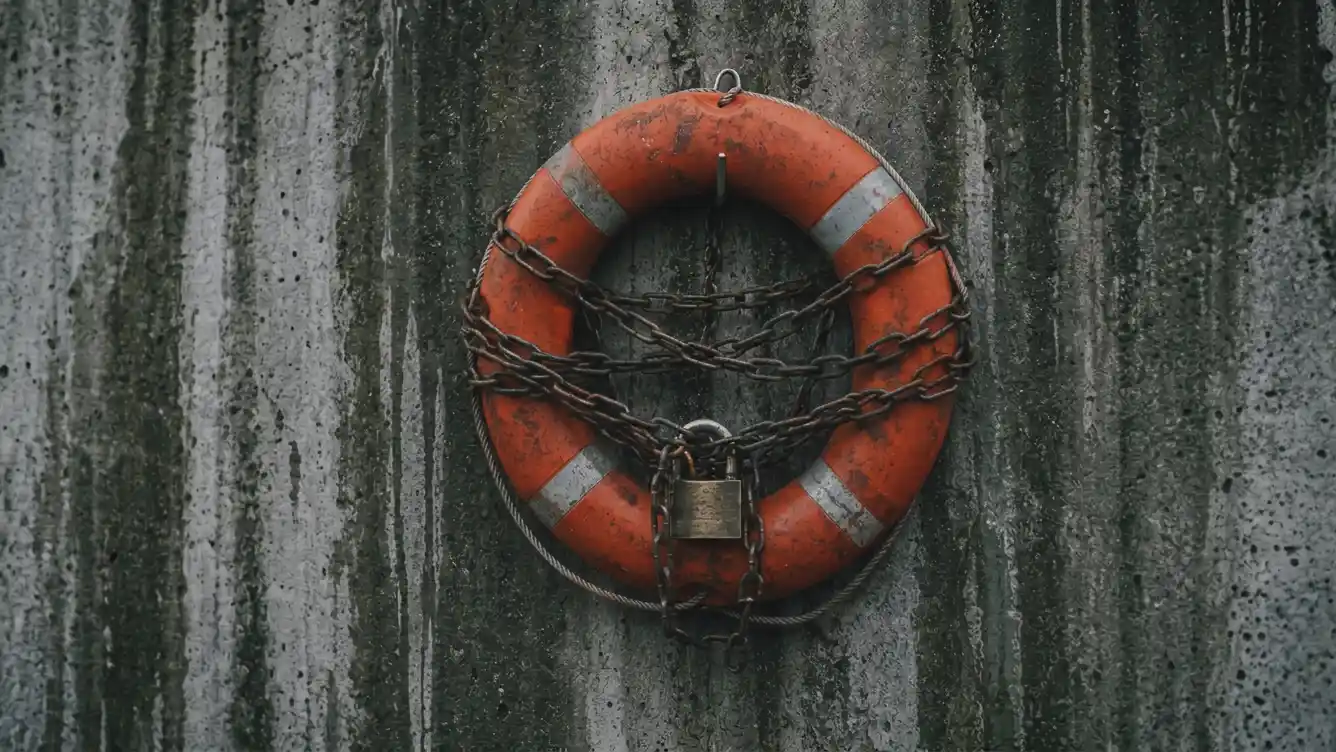
Every leader in 2026 is saving democracy from someone. Have you noticed that it's always you who pays for the rescue?
By A. Kade · Sunday 1 November 2026
I'm tired of being saved.
I don't think I'm the only one. I think a lot of us feel it, and we can't quite say it, because it sounds ungrateful. Who complains about being protected? Who argues with democracy, the rule of law, security, the Republic, the nation?
But look at this month. Look at it properly, the whole of it at once, not one headline at a time. Then tell me you don't feel it too.
•••
On Friday night in Warsaw, riot police stood around Poland's constitutional court. Supporters of the court's chief justice cut the fence with a power tool. The government's judges were walked in through a side gate by state security, in the dark. The Prime Minister said it was to restore the rule of law: "There is no other way." The leader of the opposition stood outside and said Poland had become a police state. The President turned his plane around in mid-air to come home and push his way in.
All of them were saving democracy. From each other.
Ten days before that, the same country learned that its previous government had bought spyware that could take everything from a phone, and pointed it at opposition politicians, prosecutors, and the current Prime Minister's wife and daughter. Why? To fight crime and protect national security. To save the country.
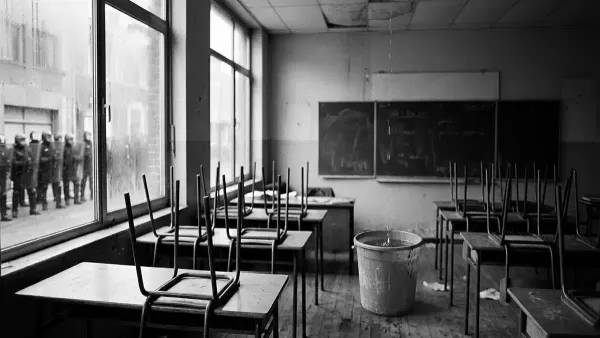
In France, children walked out of their schools asking for heating and a school nurse. The state saved the Republic from them. It sent seventy thousand police to watch them march and put several cities under curfew. It rushed a bill through the Senate that lets the state collect damages from anyone who "knowingly took part" in a crowd, up to ten thousand euros each, out of their families' housing benefit and child allowance. The government called it "a form of collective responsibility." The President went on television and told the children he'd "heard" them.
Across the Atlantic, a man who has never stood in a French classroom saved France from an invasion that wasn't happening. "Close your borders and take control before it is too late." Somebody, somewhere, made the pictures to prove it with a machine: an elderly couple stripped by migrants, Paris burning under Palestinian flags. None of it happened.
In Israel, two gunmen killed two soldiers. The government saved the country by sealing a city of hundreds of thousands. By its own Defence Minister's count, two thousand people were ordered out of their homes over loudspeakers in the night, and the crossings were closed on election day. On election morning, the Prime Minister warned that Arab citizens were "racing to the ballots," as if voting were a raid. That night, having lost fifteen seats, he announced a "decisive majority among the Zionist public." He counted the democracy, then subtracted the parts of it he didn't like.
And over all of it, Europe is saving itself from Russia. The threat is real, and I'll come back to that. EU countries spent €218 billion on defence in 2021. By 2025 it was €381 billion, and they've promised far more. In Germany, every eighteen-year-old boy now gets a military service survey. In the same countries, one young person in seven who wants a job can't find one, and one in four is at risk of poverty. In Rome, a hundred thousand of them marched behind a single sentence: spend money on schools, not war.
•••
Do you see it?
It isn't one country or one party, and it isn't left or right. It's a method.
First, name a threat. The other party. The ultra-left. Migrants. Arab voters. Russia. Islam. "Them."
Then, ask for a sacrifice. Never from the people asking. From you. Your children's right to march. Your mother's child allowance. Your neighbourhood, your home, your vote, your phone, your son's eighteenth birthday.
Finally, tell you it was for your own good. You should be grateful. Democracy is fragile, and these are serious times.
And it works, because the threats are real enough. That's the trick. Russia really is dangerous. PiS really did capture that court. Some protesters really did burn a city hall in Limoges. Hamas really does praise the men who shoot soldiers. Nobody is inventing the danger. They're using it. Every real danger is an invoice, and it's always addressed to the same people.
Notice who never gets the bill.
The minister who drafted the bill that makes mothers pay doesn't lose his allowance. The general who signs the order to seal a city doesn't sleep on the street. The politician who says "close your borders" doesn't live near one. The leader who calls for more defence spending doesn't send his son to fill in the survey. The judges fighting over which of them are real judges will all, whichever side wins, be paid.
The saving always happens to us. It's never done by us, and never asked of us.
•••
There's a word for a relationship like that, and it isn't "democracy."
Democracy was supposed to be the thing that belonged to people. The arrangement where the powerful have to ask. Where you lose an election and go home. Where a child can stand outside her school and shout, and the worst that happens is she gets heard.
What I watched this month was the opposite. Democracy has become something that's done to people, on their behalf, for their protection, by people who've decided they know better. It's a word you say at a press conference, right before announcing a curfew.
I grew up in Eastern Europe, close enough to remember queues before dawn for a bottle of milk. There, too, everything was done for the people, in the name of the people, by people who never stood in the queue. The posters said it, and the speeches said it. Nobody believed it, and everyone pretended to.
I'm not saying 2026 is that. It isn't. We have elections, newspapers, courts (sort of) and the right to write a piece like this. But I recognise the tone. The tone of a government explaining why the thing it's taking from you is a gift. The patient voice of the people who never queue.
And I recognise the feeling it leaves behind, which is the worst part. It isn't anger exactly. It's loneliness. The sense that every institution above you has a reason for what it's doing to you, and nobody, on any side, is actually on yours.
•••
I can already hear the replies.
So you're defending PiS? No. They broke that court, deliberately, for years.
So you're defending Tusk? No. Walking judges in through a side gate, on a law even his allies say doesn't apply, is how the next government learns to do it to him.
So you want Europe defenceless against Russia? No. I want a continent that can find €381 billion for defence to find a nurse for a school in Créteil. If it can't, that's not a budget problem. It's a statement about who matters.
So you're on the side of the rioters? The gunmen? The migrants? No. Arrest the man who burned the city hall. Arrest whoever armed the gunmen, every one of them. But stop punishing three million people, or a hundred thousand schoolchildren, or every mother on child benefit, for what a few people did. That isn't security. It's the cheapest available target.
I'm not on anyone's side. That's the point. When every side uses the same method, the only side left is the people the method is used on.
•••
So here's what I'd like to say, to every one of them: Warsaw and Paris, Washington and Jerusalem, Brussels, Berlin and Tirana. To everyone who's spent this month saving us.
Stop saving us. Start asking us.
Ask the children what their school needs before you ask the police how many vans they have. Ask Arab citizens what they voted for before you subtract them. Ask the eighteen-year-olds what future they're being asked to defend before you send them a survey. Ask the people camped outside the court, on both sides, what kind of court they'd trust, then build that one, not yours.
And if you can't ask, because asking means you might hear an answer you don't like, then at least have the honesty to stop calling it democracy.
Call it what it is. Management. Power with good manners and a press office.
Democracy isn't something they do for us.
It's us.
They keep forgetting that.
We shouldn't.
•••
A. Kade writes The Kade Frequency, an investigative publication on institutional power, financial capture, and the long project of making democracy something real.
No sponsors. No filters. No propaganda.
•••
Sources and references
Poland
- Notes from Poland, on the Constitutional Tribunal, 30 October 2026
- Euronews, on Nawrocki's response, 31 October 2026
- Notes from Poland, on Pegasus findings, 12 October 2026
France
- France 24, 70,000 police deployed
- Le Club des Juristes, on the casseurs-payeurs bill
- LCP, Bregeon's "collective responsibility"
- Public Sénat, "Le Sénat adopte le projet de loi « casseurs-payeurs » après l'avoir largement durci"
- Brut, on Macron's address
- ABC News, Trump's "close your borders" and Macron's reply
- Full Fact, AI images
Israel
- Al Jazeera, Hebron lockdown and displacement
- Times of Israel, election day and Netanyahu's statements
- Times of Israel, near-final results
Europe
- European Parliament Think Tank, EU defence budgets
- TBS News / Reuters, youth protests, unemployment and conscription
Earlier Kade Frequency pieces: Compatible, Solidairement, Terms and Conditions, Schools, Not War
By the same author
Two books in restrained literary nonfiction
A. Kade's companion volumes, a meditation on thinking and character, and a meditation on love, real and imagined.
View the books →