The Drift
The map you've been given doesn't match the territory. Every institution designed to tell you truth about power has been captured by power. Media is bought. Parliament is compromised. Regulators serve industries. This manifesto explains what I've documented.
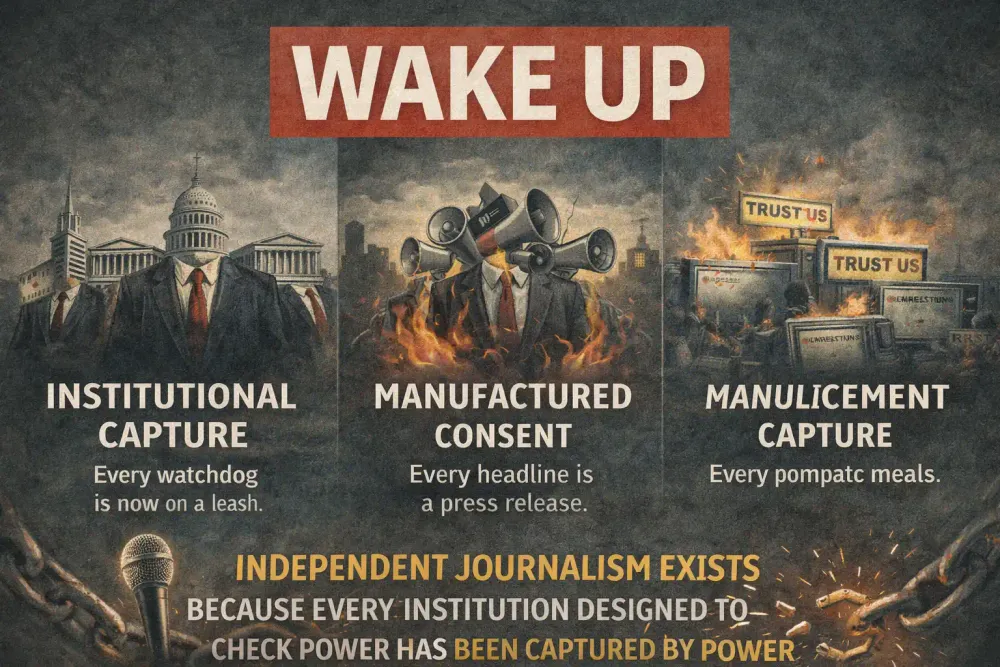
Why the institutions built to check power keep ending up serving it
Nobody has to be corrupt for this to happen. That is the first thing to understand, and it is the thing most accounts of institutional failure get wrong in both directions, the comfortable version that says the system basically works and the lurid version that says it is a conspiracy. Neither describes what actually occurs, which is stranger and harder to fix than either.
What occurs is this. An institution is created to constrain a form of power. A regulator for an industry, a press to watch a government, a commission to run an election, a committee to oversee a budget. It is staffed by people who are, on the whole, no worse than anyone else. And over years, without a single decision that could be called criminal, the institution's centre of gravity migrates toward the thing it was built to constrain, until one day it is functionally an extension of it, still holding the hearings, still issuing the reports, still described in every official document as independent.
The economist George Stigler gave this its name in the 1970s: regulatory capture. His observation was structural rather than moral. An agency depends on the industry it regulates for its technical expertise, its future employment, its political air cover, and its daily working relationships. The public the agency exists to protect supplies none of those things. One side is organised, permanent, well-resourced and present in the room. The other is diffuse, distracted, temporary and absent. Run that asymmetry for twenty years and you do not need anyone to be bribed. You need only for people to behave normally.
Once you have the concept, its shape shows up well outside the agency it was named for. A press corps financially dependent on the institutions it is meant to scrutinise. An oversight committee staffed by people who will spend the second half of their careers inside the industry they are currently overseeing. An election commission that can be left without a quorum by removing three people. The mechanism repeats because the underlying asymmetry repeats, and the asymmetry repeats because it is a feature of how modern institutions are financed and staffed, not an aberration within it.
That repetition is this publication's subject. Not the claim that everything is captured, a slogan, too total to be true and too vague to act on, but the specific traceable process, one case at a time, and the recognition that the same shape occurs often enough to be structural rather than accidental.
•••
Why it stays invisible
If this is as ordinary as I am claiming, the obvious question is why it is not obvious. Four reasons, none requiring a plot.
Scale. Capture operates in quantities too large to feel. A hand in a till produces outrage because you can picture it. A transfer spread across millions of people, dozens of institutions and several years produces nothing, because there is no image to attach it to. The harm is real and the reaction is absent, and that gap is comfortable habitat.
Complexity. Some of it is manufactured, jargon that makes an extraction sound like a technical adjustment, euphemism that makes a hard policy sound humane. But much of it is genuine. These systems are intricate, and following how a subsidy becomes a profit becomes a lobbying budget becomes a favourable rule takes patience almost nobody has for almost any subject. Complexity does not have to be a strategy to work like one.
Diffusion. There is rarely a villain, which is precisely why the pattern is durable. Capture is the aggregate of thousands of individually reasonable decisions, the official who takes the job that pays four times as much, the regulator who defers to the only people who understand the technical detail, the reporter whose outlet depends on the funding. None of them is a criminal. All of them are responding sensibly to what is in front of them. It is harder to be angry at a structure than at a face, and structures benefit from that.
Comfort. The story that the institutions basically work is reassuring, and its alternative is destabilising. If the ordinary channels can be trusted, your problems are soluble through them and you can get on with your life. Noticing that a channel has been captured costs something, it asks you to hold a more complicated and less hopeful picture, and most people most of the time decline to pay it. That is not stupidity. It is triage.
•••
What is not being claimed
This terrain attracts overreach, so the boundaries are worth marking plainly.
Not that every institution is captured. Some hold. Courts still rule against the governments that appointed their judges, this publication has documented specific cases where exactly that happened. Elections still remove governments. Regulators sometimes regulate. Capture is common and structural; it is not total. And the cases where an institution holds matter as much as the failures, because they are the evidence that the outcome is not inevitable.
Not that the people inside are wicked. Most are not. The argument throughout is architectural, that decent people inside a badly built incentive structure will on average produce captured outcomes, and locating the fault in individual character is one of the ways capture protects itself, by converting a structural question into a morality play.
Not that there is a programme here. This publication names what is. It does not design what should replace it. No shortage of institutions produce blueprints for a better order, and the architecture has proceeded regardless of all of them. Accurate diagnosis is the rarer and more useful thing.
And not despair. Despair is passive, and passivity is the single response that asks nothing of the structure. The point of seeing clearly is not to feel better about it. It is to stop participating quite so willingly in arrangements that depend on your not understanding them.
•••
The standard
Everything above is only worth anything if the work meets a standard, so here is the standard, stated so it can be held against me.
Claims are sourced to something checkable: a court filing, a budget document, a company's own disclosure, an official's own words. Where a figure is contested, it is marked as contested. Where an inference is mine rather than a fact on the record, it is marked as mine. Shocking numbers of uncertain provenance circulate constantly in this territory, and they are a trap, they feel powerful, they are easy to puncture, and once someone punctures one number they stop listening to the true ones. The discipline is to prefer the claim that can be defended to the claim that lands hardest.
Where a counter-argument is strong, it appears in full and is credited as strong. Where the evidence supports a narrow charge rather than a sweeping one, the narrow charge is what gets made. And the anger is aimed at architecture, never at populations, the people who end up voting for arsonists were abandoned long before they were wrong, and contempt for them is the mechanism, not the diagnosis.
None of this is a claim to virtue. It is a set of things you can verify line by line, which is worth more than any declaration.
•••
The gap
There is a map, and there is a territory.
The map is the account of how we are governed that most of us carry: institutions constrain power, imperfectly but genuinely, and failures are bugs to be fixed through the ordinary channels. That map is not a lie. It was drawn by people, at a particular time, for real reasons, and much of it was once accurate.
But the territory has moved. And the space between what the institutions are described as doing and what they now actually do is where most of what matters is currently happening, quietly, legally, in offices nobody can name, under statutes nobody has read.
The facts are usually reported. The pattern is not.
Closing that gap is the long project of making democracy something real.
•••
A. Kade writes The Kade Frequency, an investigative publication on institutional power, financial capture, and the long project of making democracy something real.
No sponsors. No filters. No propaganda.