Solidairement: France's Bill to Make Protesters' Families Pay
Teenagers marched for heating and teachers. France's answer: a bill making every protester liable up to €10,000, payable from family allowances.

France's teenagers marched together for chairs, heating and teachers. The state's answer is a law that will make them pay together, out of the money the Republic once swore it would never touch: the rent and the children.
By A. Kade
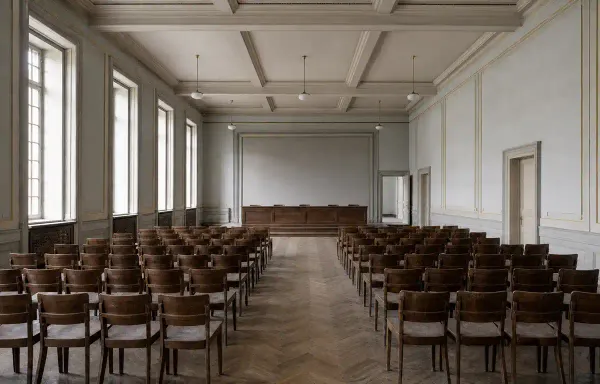
They asked for chairs.
That is where this started, and it should be said first, because by the time the Senate sits down on 27 October nobody in the chamber will remember it. In the last week of September, teenagers across France walked out of their schools and stood in front of the gates. They wanted classes with fewer than thirty-five people in them. They wanted heating that works in January. They wanted the ceiling tiles that fell last spring put back up, and teachers who don't vanish in February and never get replaced. The Education Minister, Édouard Geffray, later said there were "no national demands. It all started with local demands." He meant it as a dismissal. It is the most accurate thing any minister has said about this movement. The demands were local because the cold was local. The leak was over one particular classroom, and the missing teacher was missing from one particular timetable.
They were fifteen, sixteen, seventeen. They chanted the way French students have chanted since 1968. Some of them did terrible things, and we will come to those, honestly and in full. But most of them did what teenagers in a republic are supposed to do when the adults have stopped listening. They made noise in public, together.
The state has now found a word for that. The word is solidairement.
•••
The bill that was already waiting
The projet de loi "casseurs-payeurs" was presented to the Council of Ministers on 16 September 2026.
Look at that date again. The first blockades came at the end of September. This bill was not written in anger at burning schools. It was written before, sitting in a drawer and waiting for the right footage. When the footage came, the government took it out. On 5 October, the government spokeswoman, Maud Bregeon, announced that the Senate would take it up on 27 October under the accelerated procedure, which means fewer readings and less time for anyone to look closely. Prime Minister Sébastien Lecornu said the timetable would be sped up so that those who cause damage pay for it. The Conseil d'État has already given its favourable opinion.
Here is what it does, in plain words, as the legal commentary describes it (Le Club des Juristes; LCP; Banque des Territoires):
- Anyone who knowingly took part in a group in which violence, theft or damage was committed can be made to pay for the repairs. They pay solidairement, jointly and severally, up to €10,000 each.
- Nobody has to prove you broke anything. Being in the group is enough. The lawyers call this alternative causation. French courts have used it before for victims of a toxic drug and of hospital infections, where nobody could say which pill or which ward did the harm. Now it is coming for a broken window.
- If you stay after the police order the crowd to disperse, you become co-responsible. "Co-responsibility is engaged for every participant in a violent movement," Bregeon said, "even after a police warning."
- If you are a minor, your parents pay.
- To make sure the money can actually be collected, the bill creates a new exception to one of the oldest protections in French social law. Housing benefit (APL) and family allowances, payments the law has always treated as untouchable because they are for the roof and the children, become seizable.
The spokeswoman called it "a form of collective responsibility."
Write that phrase down. You will need it later in this piece.
•••
Who "knowingly took part"
Picture a street outside a lycée in Seine-Saint-Denis, or Tours, or Lens, at ten in the morning on a Tuesday.
There are four hundred kids. Thirty of them are pushing a bin toward the gate. Twelve of them, maybe, are setting it on fire. The rest are doing what four hundred teenagers do. Some are chanting. Some are filming. Some are standing at the back waiting for a friend. One girl came because her whole class came and she did not want to be the only one in the empty classroom. One boy is there because his little brother is at the front and his mother told him to bring the brother home.
Then the police issue the order to disperse.
Have you ever heard a sommation through a megaphone over four hundred screaming people and tear gas? Most adults couldn't tell you what it sounds like. The fifteen-year-old filming on his phone at the back certainly couldn't. Under this bill, that does not matter. He was in the group, and he was still there.
The law asks if he knowingly took part. He knowingly stood in a street with his classmates. That was the whole point of standing there. A protest is a group, and a crowd is a group. The bill takes the one thing that makes a demonstration a demonstration, people being there together, and turns it into the evidence against them.
Mathilde Panot, who leads La France insoumise in the Assembly, called the bill "a weapon of mass repression against all demonstrations," arguing that people will now have to prove they didn't break anything. You don't have to vote for her party to see the problem she is pointing at. Under this text, the burden moves. The state no longer has to find the person who smashed the window. You have to explain why you were near it.
•••
Where the money comes from
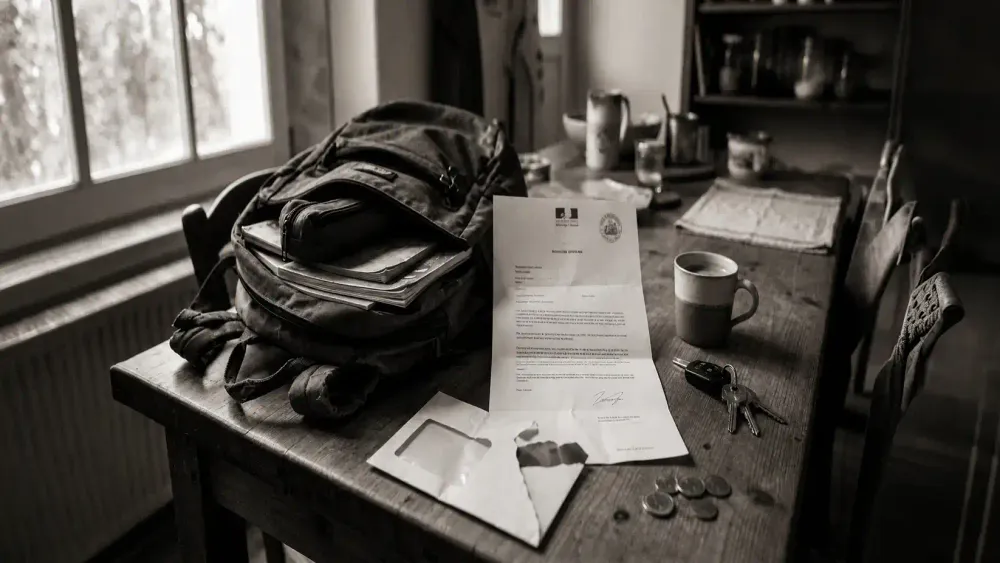
Now go to the kitchen of the family who will receive the bill.
The Justice Minister, Gérald Darmanin, says that 90% of the roughly two thousand people taken into custody at the time he spoke were minors. The Justice Ministry's later count was 5,060 detained, 87% of them minors, and 1,802 prosecuted, 1,483 of them minors. Darmanin has also instructed prosecutors to go after the parents' civil liability (Banque des Territoires). So when this law talks about who pays, it does not mean the kids. Kids don't have €10,000. It means their mothers and fathers.
Which mothers and fathers? There's a detail in the commentary by Amandine Cayol, a law professor at the University of Caen, that most of the coverage has skipped (Le Club des Juristes). Parents' civil liability is normally covered by home insurance. But under Article L.121-8 of the Insurance Code, insurers do not cover damage from riots or popular movements unless the contract says otherwise, and contracts almost never do.
So the insurer walks away and the bill lands on the family.
That is why the APL and the family allowances are in the text. The government knows exactly who it is reaching. A family with a good lawyer and savings doesn't need its benefits seized, because it pays and moves on. A family whose rent is half covered by the APL, whose children's allowance is what buys the winter coats, is the family this clause exists for. Those are also the families whose children go to the schools with the broken heating and the classes of thirty-five. The bill reaches straight into the homes where the protest came from.
Do the arithmetic. At the basic rate, family allowances for a household with two children come to roughly €150 a month. The ceiling in this bill is €10,000 per person. That is more than five years of the money France gives a family to raise two children. Or think of it as the price of one afternoon on the wrong street at sixteen, owed by a woman who wasn't there.
The French Republic built these protections on purpose. It decided, long ago and correctly, that whatever a family owes, you do not take the rent and you do not take the children's money. That money is not really the parents'. It belongs to the child. Now a fast-track bill will hand it over to pay for a window, because the child stood with the wrong group of children.
•••
The other ledger
Let me be fair to the government. Its case deserves to be put at full strength, and I'll do that in a moment. First, look at the other columns of the account, the ones that do not appear in the bill.
Tours. Maël, a schoolboy, lost the use of an eye during a blockade. The prosecutor's word for his injury and the police weapon was compatible. We wrote about that word two weeks ago in Compatible, and it has not moved since. There has been no published IGPN finding and no name. Nobody has been asked to pay anything, solidairement or otherwise.
Saint-Ouen-l'Aumône. A fourteen-year-old's jaw was broken in two places. According to his lawyer, every one of his upper teeth was broken. The lawyer says a police officer fired a launcher into his face at close range. The prosecutor says the boy struck an officer first. A teacher who was there gave a different account, in which the boy was filming. The Défenseur des droits has opened its own inquiry (Le Courrier de l'Atlas). The facts are disputed and will be decided, we're told, case by case and person by person, by an investigation into one officer's individual act.
Lens. A fifteen-year-old lost his hand. A police union source says he appeared to have picked up a grenade fired by riot police, and it exploded. The prefect says an investigation has been opened (ABC News). Again it is one case, one inquiry, and proof required.
Do you see it?
When a child is hurt, France suddenly remembers every principle it has. Individual responsibility applies, and so do the presumption of innocence and the need to establish exactly who did what, when and why. Officers are not "co-responsible" for what the unit next to them did. A riot company is not a "group in which violence was committed." Nobody has proposed seizing a police officer's family allowance because he stayed in a street where an eye was lost.
When a window is broken, all of that disappears. Then being in the crowd is enough, and the mother pays.
That is the real shape of this law. It doesn't stand for "collective responsibility" as a principle. It is collective responsibility for one side of the street.
•••
The case for the bill, at full strength
The schools did burn. The Education Minister says twenty-four were burned or ransacked. Those are schools the next class of children will have to learn in, or won't. Behind every one of them there's a caretaker, a canteen worker and a teacher who walked into a room that smelled of smoke.
In La Ciotat, a fifty-nine-year-old teacher was doused in petrol and beaten during a pupils' demonstration (Euronews). There is no "context" for that. Whoever did it should face the full weight of the law, as an individual, in a court.
According to the Interior Ministry, hundreds of police officers and gendarmes have been injured. Shopkeepers have had their windows put in, and towns have had buses torched. Those people did nothing wrong, and right now many of them will not be compensated. Cayol's analysis makes the same point. With insurers excluding riots and the actual culprits rarely identified, victims are often left with nothing. The 2019 law already allowed the state to recover damages from those responsible, and it is barely used because nobody can find the person who did it.
That is a real problem, and anyone who pretends otherwise has never had a shop.
But look at what the government chose to do with a real problem. It could have created a public compensation fund for victims of collective violence, the way France already compensates victims of terrorism and certain crimes. It could have required insurers to stop excluding riots, or funded more investigators to find the people who actually set the fires. Instead it chose the one solution that needs no investigation, collects from the poorest families first, and turns every teenager in every future demonstration into a potential debtor.
It is the cheapest option and the cruellest one, and so of course it is the one on the fast track.
•••
France has tried this before
None of this is new. That's the worst of it.
In June 1970, two years after May '68, the government passed the original loi anti-casseurs, which made organisers and participants answerable for violence committed during a demonstration whether or not they had committed it themselves. It was so widely despised that one of the first things the left did after it came to power was repeal it, in 1981.
In 2019, at the height of the Yellow Vest movement, came another loi anti-casseurs. The Conseil constitutionnel struck out its most aggressive clause, which allowed prefects to ban individuals from protesting by administrative order. According to AFP's fact-checking desk, twenty-three people lost an eye during that movement. Five years later, as we set out in Compatible, not one of them had obtained the conviction of the person who injured them.
In 2010, the Ciotti law let the state suspend family allowances for parents whose children skipped school. It was supposed to make parents responsible. It mostly punished the families who were already drowning, and it was repealed in 2013.
So the state has tried collective responsibility for protesters, and it has tried taking the children's money to discipline the parents. Both were tried, both failed and both were repealed. Now the Republic is trying them together, on the fast track, on teenagers.
•••
What the children will learn
Think about what a sixteen-year-old is being taught this autumn.
She learned in éducation civique that the right to demonstrate is a constitutional freedom. She learned it in a classroom with a bucket under the leak. She went outside with her friends to ask, loudly, for a better classroom. Then she watched the state's answer arrive in three parts.
First came the riot police. Then came the numbers: 5,060 detained, most of them her age. Then the Republic, which could not find five weeks to fix the heating, found five weeks to fast-track a law that will let it collect from her mother's housing benefit.
Lecornu has promised a five-point roadmap and "first decisions before the end of the month." Maybe they will come, and maybe some classrooms will be warm by Christmas. But look at which promise came with a date and which one came with a procedure. The demands have a "roadmap". The bill has 27 October.
She won't learn from this that violence is wrong. She knew that already. Most of the people around her in that street knew it too, and stayed peaceful anyway. What she'll learn is that standing next to people is dangerous. When you hear the megaphone, run, whatever your reason for being there. The safest place for a young citizen is alone. That is the lesson. You wouldn't put it on the curriculum, but the bill teaches it more efficiently than any teacher.
It is not only France. In the same week, students in Liège were tear-gassed while protesting cuts to French-speaking Belgium's education budget (Brussels Times). Across the border, in a different language, the order is the same: cut the schools, then gas the children who notice.
•••
The word
Solidairement. In French law it means jointly and severally, so each person can be made to pay for the whole. In ordinary French it means together, in solidarity.
The kids already knew the second meaning. That was the whole point of their protest. One school's leaking ceiling became another school's cause, and a boy in Lens marched for a classroom in Tours. They did the thing every republic says it wants from its young people. They stopped thinking only about themselves.
Now the state has borrowed their word and handed it back to them as an invoice. You stood together, so you'll pay together. You noticed that you were all in the same building, so you'll all be in the same debt.
On 27 October the Senate will begin to debate it. Somewhere that week a fourteen-year-old with a broken jaw will be learning to eat again. A fifteen-year-old in Lens will be learning to write with the other hand. A schoolboy in Tours will be looking at the world through one eye, still waiting for someone to tell him who did it.
None of them will get a bill for that.
Their mothers might get one for the window.
•••
A. Kade writes The Kade Frequency, an investigative publication on institutional power, financial capture, and the long project of making democracy something real.
No sponsors. No filters. No propaganda.
•••
Sources and references
- Le Club des Juristes, Amandine Cayol, "Lycées dégradés : quand les parents doivent-ils payer pour leur enfant ?", 7 October 2026
- Le Club des Juristes, "Examen de la loi « casseurs-payeurs » en procédure accélérée", 5 October 2026
- LCP, "Lycées bloqués : le projet de loi 'casseurs-payeurs' examiné fin octobre au Sénat"
- Banque des Territoires, "Le projet de loi 'casseurs-payeurs' examiné au Sénat le 27 octobre"
- Public Sénat, on the 6 October mobilisation and the union position
- Le Courrier de l'Atlas, on Saint-Ouen-l'Aumône and the Défenseur des droits
- ABC News, on Lens
- Brussels Times, on Liège
- France 24 (Justice and Interior Ministry figures), Euronews (La Ciotat), The Hill (Geffray quote), as cited in Compatible and its update.
By the same author
Two books in restrained literary nonfiction
A. Kade's companion volumes, a meditation on thinking and character, and a meditation on love, real and imagined.
View the books →