The Tribute: What Was Actually Signed at Ankara
A gold-lettered chart called "The Trump Trillion." A president who said he wanted loyalty, not money. At Ankara, he collected both.
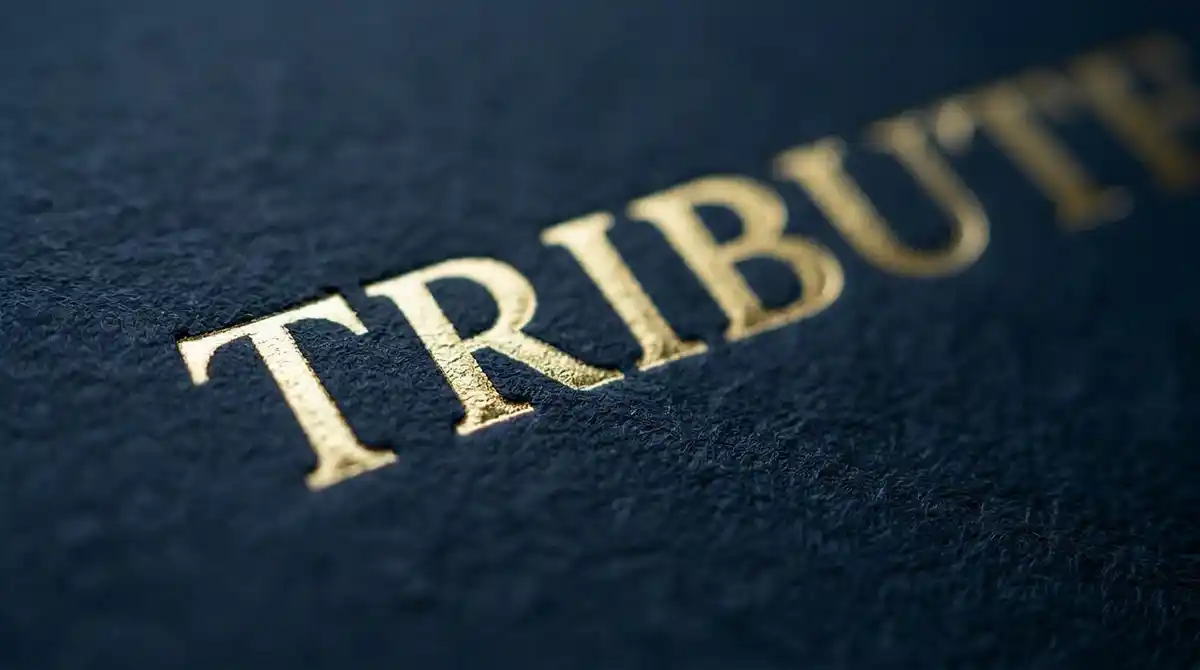
Last month, to keep the President of the United States committed to NATO, the alliance's Secretary General brought a chart to the Oval Office. It was lettered in gold. It was titled "The Trump Trillion." This week in Ankara, the arrangement the chart described was formalized in a summit declaration. There is an older word for the arrangement. The publication has used it before.
By A. Kade
The scene is worth setting precisely, because it will be studied later.
In June 2026, NATO Secretary General Mark Rutte visited the White House. He brought easels. On the easels were charts prepared for an audience of one, and the centrepiece chart carried a title in gold lettering: The Trump Trillion. It documented approximately $1.2 trillion in additional defence spending by European allies and Canada since 2017, the largest rearmament of the European continent since the Cold War, presented to the American president as a personal achievement, in a format chosen because the format was known to please him.
The president looked at the trillion dollars and was unmoved. His response, as reported at the time:
"I just want loyalty."
Sit with that exchange. The head of a military alliance of thirty-two democracies performed tribute, the word is precise, and this piece will justify it, to the leader of the alliance's largest member, crediting him by name, in gold, with a trillion dollars extracted from the budgets of the other thirty-one. And the leader declined the money as the point. The money was assumed. What he wanted, he said in plain English, was the thing tribute has always actually been about, beneath the money, in every century it has been collected: submission, personally rendered.
Five weeks later, in Ankara, the arrangement was formalized.
•••
The Ankara Summit Declaration, adopted Wednesday, is a short document and most of it is boilerplate. The operative content is financial. The allies reaffirm "The Hague defence commitment", the pledge, extracted at last year's summit, to spend five per cent of GDP on defence. The declaration records that European allies and Canada increased core defence investment by more than $139 billion in 2025 alone. It announces over $50 billion in new procurements agreed at Ankara itself. It pledges €70 billion in military assistance to Ukraine for 2026, with commitments to sustain at least equivalent levels in 2027, a burden the declaration notes now falls overwhelmingly on European allies and Canada, who "finance the vast majority" of it.
And it contains one sentence of genuine documentary value, the sentence in which the architecture describes what is happening in its own preferred grammar: European allies and Canada, working with the United States, are "assuming greater responsibility" for the alliance's defence.
Read the sentence the way this publication reads regulations. A trillion dollars has been transferred from European domestic budgets, from the hospitals, pensions, schools, and cooling infrastructure this publication has spent the spring documenting the absence of, to defence procurement, under sustained public threat from the alliance's dominant member, who has spent the same period threatening to withdraw his troops, publicly musing about annexing the territory of a member state, and punishing individual governments by name when they hesitate. The declaration's word for this is responsibility. The transfer of cost, extracted under threat, is narrated as the maturation of the payer.
The euphemism is the policy. It always is.
•••
What makes Ankara worth a piece rather than a paragraph is that the summit displayed, in a single forty-eight-hour window, the complete mechanics of a tribute system, collection, enforcement, and reward, with a clarity the participants made no effort to disguise.
Collection is the declaration itself: the five per cent path, the $139 billion, the fresh $50 billion, the €70 billion for Ukraine with next year's instalment pre-committed.
Enforcement was performed live, on camera. The President of the United States singled out Spain, the ally that has moved slowest on the spending target and declined base access for the Iran campaign, and called it a "terrible partner in NATO," coupling the insult with a threat to cut off trade. The Spanish prime minister's response was a study in the physics of the arrangement: he told reporters that relations with the United States were very positive. The Czech Republic, under its new government, quietly opted out of the €70 billion Ukraine package; it was small enough to ignore. Spain was not, and so Spain was named. That is how tribute systems police themselves: not by punishing everyone, but by punishing someone, publicly, so that the others can watch. Compliance is praised as unity. Hesitation is named as betrayal. The list of who is a good partner and who is a terrible one is maintained by the protector, updated aloud, and every government in the room understands that its place on the list is the actual agenda of the meeting.
The standing threats behind the enforcement need no reconstruction, because they are all from the past nine weeks. Five thousand troops ordered out of Germany in May, not for strategy, but as punishment after the German chancellor said the United States was being humiliated in Iran. Threatened withdrawals from Italy and Spain over base access. And on the summit's opening day, over Greenland, the offer to "remove all of our soldiers out of Europe", protection, dangled and retracted, according to the payer's obedience. The protection and the threat are the same troops. This publication made that observation about the Strait of Hormuz two weeks ago, when the White House was weighing a fee-based Navy escort for tankers. The mechanism has not changed in the fortnight since. It has simply scaled from a shipping lane to a continent.
And reward, the third movement of any tribute system, was dispensed at the same summit, on the sidelines, to the host. The president of Turkey, who staged the gathering with cannon fire and honour guards and was described by his guest as a great friend who had helped in so many different ways, collected his payment in the currency such systems actually run on: an inclination, stated publicly, to readmit Turkey to the F-35 programme despite a congressional ban; American defence sanctions, in Erdogan's telling, largely lifted; joint shipbuilding discussed, frigates and submarines and corvettes. On the same margins, the president of Syria met the president of the United States and left with a notification to Congress rescinding his country's designation as a state sponsor of terrorism. Loyalty in, favours out. The summit's communiqué speaks of an alliance of values. The summit's transactions describe a court.
It should be recorded, in the same cold register, where the court convened. The alliance of free and democratic nations met in a capital under a comprehensive ban on demonstrations, in force from June 28 to July 10, after a pre-summit crackdown in which, by Human Rights Watch's accounting, more than two hundred people were detained, journalists and lawyers among them. The declaration reaffirms the foundation of peace and freedom for a billion citizens. The city it was signed in had suspended the right of assembly for the duration.
•••
There is one figure from Ankara who deserves a paragraph to himself, because his cameo closes a circle this publication drew four days ago.
Keir Starmer attended the summit as the outgoing Prime Minister of the United Kingdom, a man with roughly a week of office remaining, destroyed, as Sunday's piece documented, by precisely the bind that Ankara formalised: a government that could not fund both the alliance's spending demands and the domestic programme its voters elected it to deliver, and that lost its defence ministers, its backbenches, and finally its leader to the gap between the two. Asked in Ankara whether NATO was emerging stronger and more united, Starmer told reporters: "the answer is yes."
The trap consumed him, and on his way out of public life he endorsed the trap. This is not weakness of character. It is the final duty of the custodian, to affirm the arrangement even in the moment of being destroyed by it, because affirming the arrangement is what the office is. His successor inherits the same declaration, the same five per cent path, the same pound that cannot be spent twice, and a summit communiqué with his country's signature already on it. The names rotate. The tribute compounds.
•••
The president's own verdict on the summit, delivered at his closing press conference, was that there had been "tremendous unity."
For once the word can be taken at face value, provided one is precise about what was unified. Thirty-one governments were unified in payment. A trillion dollars, collected over a decade and lettered in gold; $139 billion added in a single year; $50 billion more announced in a single Turkish week; five per cent of everything, pledged out to the horizon. Unified in payment, unified in the public gratitude that payment now requires, and unified in watching what happens to the one government that was named a terrible partner for hesitating.
The chart in the Oval Office had it right, and the man it flattered had it righter. The trillion was never the point. Tribute is not a price; it is a relationship. The money merely keeps the relationship legible, a ledger of who has submitted, maintained by the protector, presented on easels by the protected.
He said he didn't want their money. He said he wanted loyalty.
At Ankara, he collected both.
•••
A. Kade writes The Kade Frequency, an investigative publication on institutional power, financial capture, and the long project of making democracy something real.
No sponsors. No filters. No propaganda.
By the same author
Two books in restrained literary nonfiction
A. Kade's companion volumes, a meditation on thinking and character, and a meditation on love, real and imagined.
View the books →Sources and references
The Ankara Summit Declaration is published in full by NATO, including the Hague commitment reaffirmation, the $139 billion figure, the $50 billion in new procurements, and the €70 billion Ukraine pledge. The Congressional Research Service's pre-summit report documents the $1.2 trillion decade figure, the trajectory from three allies at 2% of GDP in 2014 to all thirty-two in 2025, and Secretary General Rutte's framing of the summit's priorities. The Oval Office presentation of "The Trump Trillion" chart, and the president's response, were reported by the Associated Press and carried by NPR, PBS, and others in June 2026. The president's post-summit remarks, the unity verdict, the criticism of Spain, the F-35 inclination toward Turkey, were reported in the summit live coverage of Al Jazeera and France 24 on July 8, 2026, along with the Czech opt-out from the Ukraine package, the Syria designation notification to Congress, and the outgoing British Prime Minister's assessment. The pre-summit demonstration ban and detentions in Türkiye are documented by Human Rights Watch and Turkish press reporting from late June 2026. The May troop withdrawal from Germany and its context are documented in Associated Press and Council on Foreign Relations reporting from May 2026.