The Protection Tax: When the Navy Becomes a Subscription
On June 17, POLITICO reported that the White House has been considering a fee-based "VIP pass" that would entitle paying shipping companies to a US Navy escort through the Strait of Hormuz. Pay the fee, get the protection. Do not pay, take your chances.

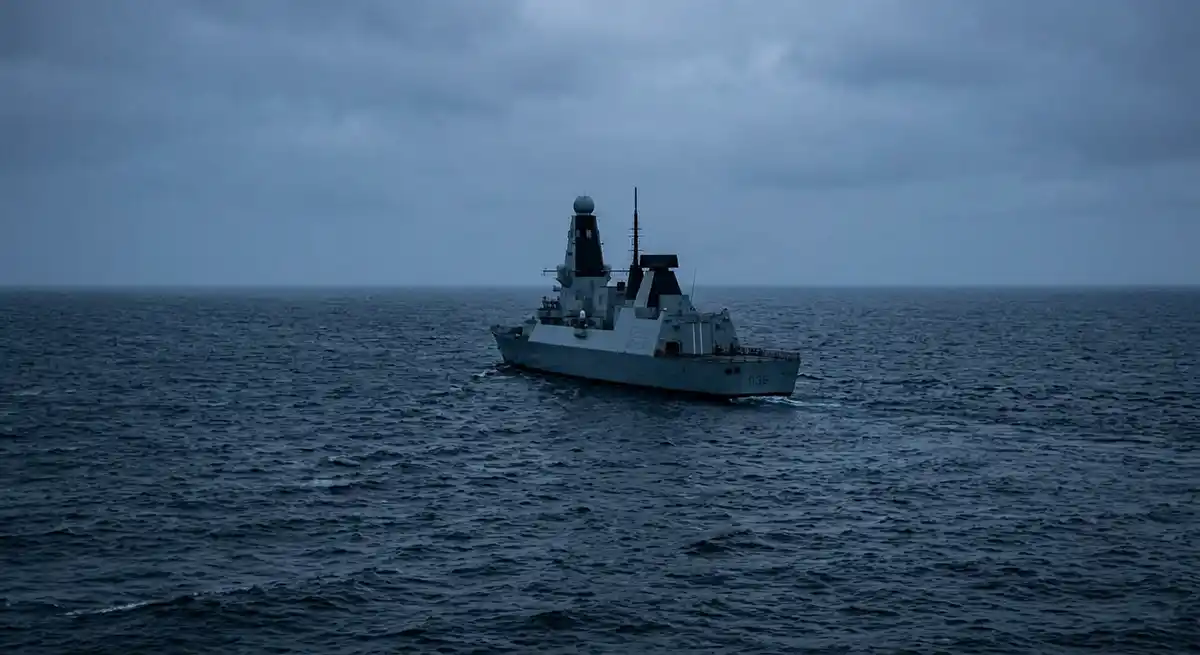
A proposal currently in front of the White House would let the US Navy escort commercial ships through the Strait of Hormuz for a fee. The euphemism in the draft is "VIP pass." There is an older word for the arrangement. The word has been in the historical record for at least two thousand years.
By A. Kade
On Wednesday, June 17, 2026, POLITICO reported that President Trump and White House Chief of Staff Susie Wiles had called for ideas on how to convince shipowners to take the risk of transiting the Strait of Hormuz. About one fifth of the world's oil moves through the strait. Insurance markets had begun to refuse coverage on transits during the recent war with Iran. Shipping was slowing. Energy markets were nervous.
The proposals under discussion included, according to three sources quoted by POLITICO, a fee-based "VIP" pass that would entitle a paying shipping company to a United States Navy escort through the strait. Ships that paid the fee would receive armed naval protection. Ships that did not pay the fee would not. The Navy that the United States taxpayer pays for would, in plain operational terms, be sold to commercial shipping interests on a transaction-by-transaction basis.
This is the proposal currently sitting in a White House staff conversation as one option among several. It has been reported in one major outlet. Almost no other coverage has surfaced what the proposal actually represents.
This piece is about what it represents.
•••
The proposal has an older name. The name is protection tax. The arrangement of pay us and we will protect you; do not pay us and the protection becomes the threat has been in the historical record for at least two thousand years.
The Roman empire collected protection tax from merchants moving goods through its provinces. The medieval European feudal lord collected tribute from villages and merchants who passed through his territory; the tribute paid for the lord's continued willingness not to send his retainers against the village. The Sicilian pizzo system, which has been in continuous operation for several centuries, collects from shopkeepers and businesses in exchange for the silent guarantee that nothing will be broken, burned, or stolen, and the equally silent understanding that if the protection money is not paid, something will be. The American urban protection rackets of the 1920s, immortalised in fiction but also extensively documented by federal prosecutors and historians of organised crime, operated on the same model. The Chicago bootleggers, the New York mob families, the Boston Irish gangs all ran protection systems alongside their other enterprises. A merchant who paid was safe. A merchant who did not pay was not.
The structural shape is identical in each case across the centuries. An armed actor extracts a fee from a commercial actor in exchange for not being harmed by that armed actor or by the harms that armed actor will, conveniently, not prevent. The fee is the protection. The protection is the absence of the threat that the protector simultaneously embodies.
The modern English word for this arrangement, when it occurs domestically and is run by criminal organisations, is extortion. The modern English word for it when it occurs internationally and is run by states is, by historical convention, tribute. The Roman state collected tribute. The medieval feudal state collected tribute. The Sicilian organised-crime state-within-the-state collects pizzo. The mid-twentieth-century urban racket collected protection money. The phrase that the United States White House has reportedly been considering in 2026 is VIP pass. The arrangement is the same.
•••
There is a specific reason the United States Navy was, until this proposal, not the operator of such a system. The reason is the post-1945 international maritime order, and it is worth slowing down to name because most coverage of the VIP-pass proposal does not.
For most of recorded human history, the seas were not free. Merchants moving goods by water paid tribute to coastal sovereigns, to pirate kingdoms, to the navies of strong states that demanded right of inspection and toll collection, to private actors holding letters of marque from one government or another that authorised them to seize ships and cargoes for profit. The Mediterranean was a particularly active protection market for centuries; the Barbary corsairs of North Africa operated a tribute system against European shipping well into the early nineteenth century. The English Channel was patrolled by privateers operating under royal charter. The Caribbean was a tribute-and-extortion economy that lasted from the Spanish colonial period through the early American republic.
The Declaration of Paris of 1856, signed at the close of the Crimean War by France, Britain, Russia, Prussia, Austria, the Ottoman Empire, and Sardinia, did something specific. It abolished privateering, the system by which states had licensed private actors to seize ships at sea in exchange for a share of the proceeds. The Declaration was the moment the international order formally rejected the protection-and-tribute model as a legitimate way to operate international commerce at sea.
The principle the Declaration established took the next century to consolidate. The various twentieth-century maritime conventions, the establishment of the freedom-of-navigation regime, the 1982 United Nations Convention on the Law of the Sea, all of these were the slow institutional construction of an alternative to the protection-tax model that had governed maritime commerce for most of human history.
The United States Navy was, after 1945, the institutional enforcer of the alternative. The Navy's central peacetime function for seventy years has been to make protection tax impossible on the world's oceans by making protection unnecessary. International waters are international. Ships move through them without paying tribute to anyone. The Navy's presence is what makes that statement operationally true rather than merely aspirational.
This was not free for the American taxpayer. The Navy is the most expensive single military branch in human history. The American public has paid for it, on the understanding that it is being paid for as a public good, that the freedom of the seas is the kind of thing a great power maintains as part of its responsibility to the international order rather than as a service its citizens charge for separately.
The VIP-pass proposal would, in operational terms, end that arrangement. The Navy would stop being the institutional enforcer of free navigation and would become a vendor of premium navigation services. Shipping companies that paid the fee would have free passage. Shipping companies that did not pay would not. The 1856 Declaration's principle, that no actor extracts tribute for safe passage at sea, would be reversed by the post-1945 institutional enforcer of that very principle.
The protection racket would return. It would return wearing the uniform of the very institution that was created to make it impossible.
•••
The structural reading of this matters because most public commentary on the VIP-pass proposal is treating it as a procedural detail. How do we restart Gulf shipping after a war? is being treated as a logistics question with a logistics answer. The VIP pass is one option among several. Negotiating insurance terms is another. Diplomatic guarantees from Iran are a third. The choices are being framed as practical alternatives to be evaluated on their efficiency.
The choices are not equivalent on this dimension. Three of them attempt to restart commerce within the post-1945 maritime framework. One of them ends that framework. The VIP-pass proposal is not a variant of the others. It is a regression of about eight hundred years in how the international order organises commercial shipping.
The architecture is no longer pretending that the Navy is a public good. The architecture is openly proposing that the Navy is a service to be subscribed to. The companies that can pay get the Navy. The companies that cannot, do not. National security itself, the protection of commerce, the freedom of the seas, the responsibility a great power was understood to bear toward the global commercial order, is being repackaged in plain documentary writing as a fee-based subscription product.
This is the same structural move I described in a piece earlier this week called The Return Hub, applied to a different domain. In that piece, the European Union formalised the use of detention centres in third countries and called them, in the regulation's own language, return hubs. The phrase was the policy. The administrative euphemism was the architecture's confession of what it was doing. The same move is happening here. The phrase VIP pass is the dressing. The arrangement underneath is the oldest extortion model in human history, returning to operational status under the very institution that was created to end it.
•••
It is worth saying clearly that the proposal has not yet been adopted as policy. The reporting indicates that the White House is considering it among several options. It may be rejected. It may be adopted in modified form. It may be implemented and quietly walked back if commercial-shipping reception is negative. The decision today is the decision today.
What the decision is, however, is not the structural point. The structural point is that the proposal is in the conversation. The protection-tax model that human civilisation has spent two millennia trying, and over the past century largely succeeding, to displace from international commerce, that model is, in 2026, sitting in a White House staff meeting as a serious option for one of the world's most important shipping lanes. The proposal has been costed. The proposal has been discussed by named senior officials. The proposal has been reported by a major US political outlet as an active item under consideration.
That this is the conversation is the news.
It is the same observation a Threads post in this publication made earlier this week about the White House debate over habeas corpus. The proposals do not need to be adopted to tell the structural reader what is happening. The conversations themselves are the architecture making visible what the architecture is now willing to consider. The fig leaf has been dropping across multiple institutional domains throughout the spring of 2026. Each proposal is its own confirmation of the same underlying shift.
The state, once an institution that disciplined protection-tax economies into a more sophisticated model of taxation and public goods provision, is regressing toward the protection-tax model in plain view. The state is rediscovering its own earliest extraction mechanism and proposing to deploy it openly. The dressing on the regression is the language of administrative innovation, VIP pass, return hub, enhanced cooperation, acting director, but the substance is the older substance, the substance the slow institutional development of modern statehood was supposed to have moved beyond.
It has not moved beyond it. It has only moved beyond pretending.
•••
The Strait of Hormuz is, in physical terms, a strip of water about thirty-three kilometres wide at its narrowest point. About one fifth of the world's oil and a significant share of the world's container traffic moves through it daily. The strait has been an international waterway under the freedom-of-navigation regime for most of the post-1945 period. It has cost the American taxpayer immense sums to keep it open. Its openness is not a market product. Its openness is a public good that successive American administrations, of both parties, committed to maintain on the understanding that the alternative, a return to the protection-tax model, would be worse for the international order than the cost of preventing it.
In June 2026, the alternative is being considered. In an administrative meeting. As one option among several. With a euphemism applied. With a fee structure proposed.
The protection tax is the oldest extraction model in human history. It is what the modern state was supposed to have replaced. It is what the international maritime order was specifically designed to render obsolete. It is what the United States Navy was, until the present moment, the institutional enforcer against.
It is what the United States is, in June 2026, considering becoming.
The VIP pass is the dressing.
The protection tax is the policy.
•••
A. Kade writes The Kade Frequency, an investigative publication on institutional power, financial capture, and the long project of making democracy something real.
No sponsors. No filters. No propaganda.
By the same author
Two books in restrained literary nonfiction
A. Kade's companion volumes, a meditation on thinking and character, and a meditation on love, real and imagined.
View the books →