The Other Front
On May 26, 2026, Israel expanded its ground war into Lebanon while the President of the United States announced the Iran peace deal was "largely negotiated." The same week, US forces struck Iran on at least three separate days. The Iran war is being narrated as ending.

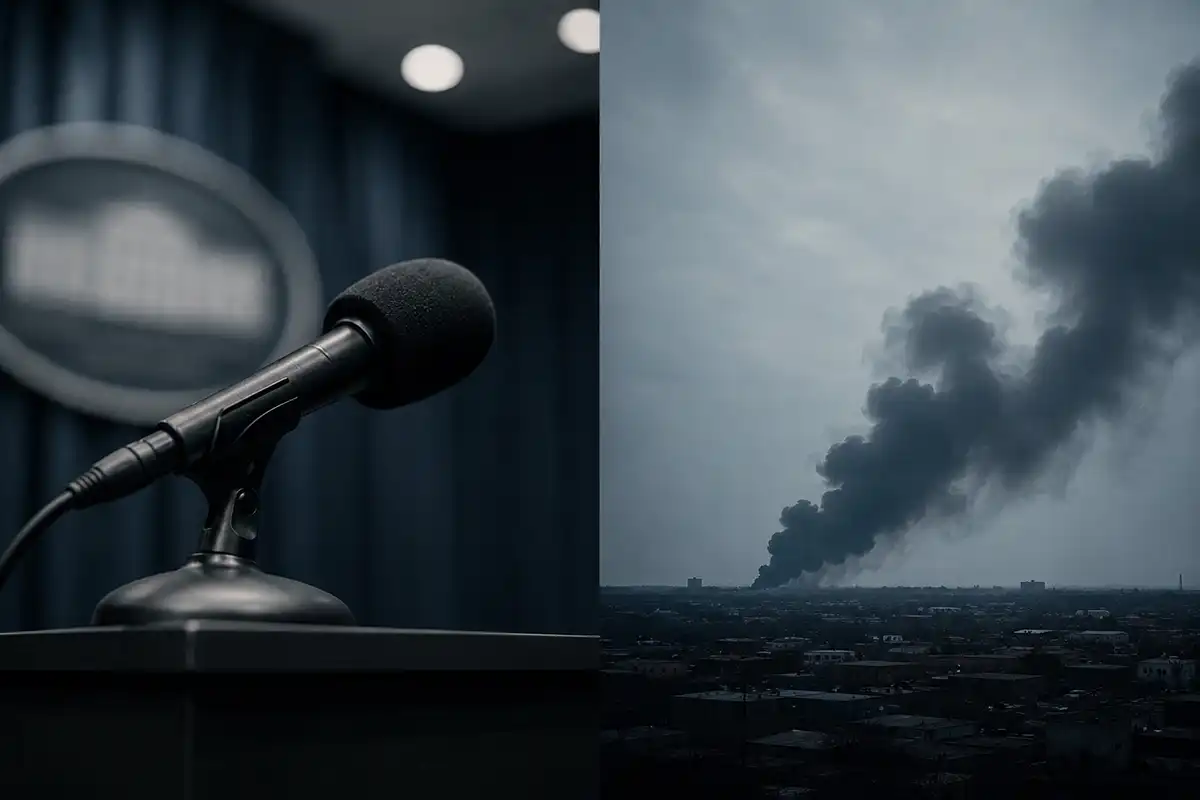
The Iran war is being announced as ending. The Lebanon war is being expanded the same week. Both governments are the same governments. The negotiation is the cover. The strike is the policy. This is how modern wars do not end, they get re-narrated while another front opens beside them.
By A. Kade
Update - Wednesday, June 4, 2026: Israel and Lebanon today announced
agreement to "implement" a renewed ceasefire, contingent on Hezbollah halting
attacks. Within hours, Israel and Hezbollah were trading strikes. The
pattern described below is, eight days later, still operating exactly as
described. The negotiation continues. The strikes continue. The two are
still being narrated separately.
Update - Sunday, May 31, 2026: Overnight, a missile fired from Lebanon toward Israel struck Kiryat Shmona in northern Israel, causing damage, per the Jerusalem Post, Hezbollah's apparent response to the IDF expansion north of the Litani River described below. Cumulative figures across the wider conflict, per Lebanese and regional reporting, now stand at more than 2,000 killed in Lebanon and over one million displaced since fighting intensified in late February. The April 17 Lebanon ceasefire was formally extended by three weeks on April 23, the framework against which the May 26 escalation has been conducted. The pattern the article describes is, if anything, sharpening. The negotiation continues. The strikes continue. The two are still being narrated separately.
This is a developing story. The facts below are drawn from public reporting as of late May 2026; the ceasefire framework is unresolved and the Lebanon escalation is ongoing. This piece will be updated as more becomes known.
On Tuesday morning, May 26, the Prime Minister of Israel was sitting in a Tel Aviv courtroom giving evidence in his own corruption trial.
He left early. His office explained that he had diplomatic obligations. Those obligations, as reported by the Times of Israel and confirmed across regional outlets, were a security consultation at the Kirya military headquarters with his Defense Minister and the IDF Chief of Staff. The night before, he had instructed the army to intensify operations against Hezbollah in Lebanon. By the time he reached the meeting, ground forces were already moving north of the Litani River, beyond the "yellow line" that had defined Israeli positions since the April 17 ceasefire. Smoke was rising from the village of Rmadiyeh in the Tyre district. Evacuation warnings were being issued for Nabatieh, a city of more than seventy thousand people.
The same day in Washington, the President of the United States held a cabinet meeting and said that the peace deal with Iran was "largely negotiated." Markets responded. Oil eased. Expectations around the reopening of the Strait of Hormuz firmed.
The same week, on at least three separate days, the United States military struck Iran. NPR's framing, on May 28: "The U.S. says it has struck Iran again as peace talks continue to end the conflict."
Hold those facts side by side. They are reported as separate stories. They are not separate. They are happening in the same week, conducted by the same governments, against the same enemies, while the public is being told that the war is ending. The headline manages the attention. The policy continues underneath it.
This piece is about the gap.
•••
What is being announced
According to reporting consolidated from regional and international outlets, the ceasefire framework now being negotiated through mediators Qatar and Pakistan would involve a full ceasefire of at least thirty days, possibly sixty, covering both Iran and Lebanon. The reopening of the Strait of Hormuz. The lifting of the US naval blockade. Some unfreezing of Iranian assets, or the suspension of oil sanctions, or both. The sequencing of these steps remains, in the words of the analyst Derek Davison, "in flux", and the principle that nothing is agreed until everything is agreed applies, as it always does in negotiations of this kind.
What is striking is not the framework itself, which is conventional. What is striking is the disjunction between the way it is being narrated and what is actually happening on the ground in the same hours.
The narration is of an ending. Largely negotiated. Peace talks continue. Tempering expectations. These are the verbs of a conflict winding down, the lexicon a public absorbs as it stops paying attention. The story is being prepared for the file marked resolved.
What is happening on the ground is not an ending. It is a re-organization. One front is being closed down for the cameras while another front is being opened beside it.
•••
What is happening underneath
On May 26, as reported by Jason Ditz at Antiwar.com and confirmed by Israeli outlets including the Times of Israel and the Jerusalem Post, Israeli ground troops expanded the war in Lebanon, conducting offensives north of the Litani River and moving beyond the yellow line established at the April 17 ceasefire. The IDF did not specify how deep it intended to push. The Israeli cabinet, in the days before, had been pressing for "a substantial escalation of the war and occupations deeper into Lebanon." The IDF Chief of Staff, Lt. Gen. Eyal Zamir, had reportedly been pushing for this offensive for some time. Airstrikes accompanied the ground movement: Rmadiyeh in Tyre district, evacuation warnings for Nabatieh, multiple villages in eastern and southern Lebanon. Reuters images from earlier in the week showed a boy inspecting damage at the site of an Israeli strike in the southern city of Tyre.
This is not the first time the pattern has repeated. On April 8, shortly after the announcement of the original Iran war ceasefire and after Hezbollah had signaled a pause in attacks against Israel within the ceasefire's terms, Israel launched what it described as its "most powerful attacks" on Lebanon. The Lebanese Ministry of Health reported at least 357 people killed and 1,223 injured. The IDF claimed it had killed 250 militants. The disparity between those two figures, which is to say, the people killed who were not the people Israel said it was killing, was reported and then receded from the international press.
That April attack happened on the same logic the May 26 escalation is following: the announcement of one ceasefire becomes the cover for the conduct of another war. Hezbollah had signalled it would honor the pause. Israel struck during the pause, and the strikes were absorbed by the public as part of "the conflict" generally, rather than what they were specifically, a military operation conducted under the diplomatic cover of a ceasefire announcement that applied to the very party being struck.
Meanwhile, on the American side, the strikes on Iran have continued through the negotiation. Sunday May 25, hours after Trump's comments on normalization. Tuesday May 26. Thursday May 28. Each described by the US military as defensive. Each occurring while peace was, according to the President, "largely negotiated."
If the war is ending, the bombs do not appear to have been informed.
•••
The architecture this exposes
There is a particular form of warfare that has emerged in our period, and it requires being named because it does not have a name in the public vocabulary yet.
It is the conduct of war as narrative management. The war does not end through victory or surrender, because victory and surrender require a clarity that contemporary conflicts no longer aim for. The war ends through re-narration. The fighting is allowed to continue, sometimes intensify, sometimes shift fronts, but the public story is moved from the file marked active war to the file marked winding down or largely negotiated. The attention budget required to maintain public concern is withdrawn. The bombs become routine. The deaths become local news in countries the metropolitan reader has stopped tracking.
This is not a conspiracy. It does not require coordination. It is the natural product of a political-media architecture that runs on attention as its primary resource. A war that is "ending" generates a different attention demand than a war that is ongoing. The same officials, the same outlets, the same algorithms, all calibrate to the announced frame. The strike that happens during peace talks is reported, but it is reported as an exception, a flare-up, a violation, a complication, rather than as what it actually is, which is the policy.
The policy and the announcement diverge, and the announcement wins the audience. The policy keeps running.
This is the architecture this publication has been describing across other domains. In The Captured Class, the alignment was between officials and the financial interests they served. In The President's Portfolio, the alignment was between the office of the presidency and the private wealth of the office-holder, with the formal firewall reduced to a piece of disclosure paper. In both cases, the damning conduct was legal, and the legality was the point. Here the alignment is between the announced narrative and the conducted policy, with the announcement performing the role the firewall once performed: the visible thing that lets the invisible thing proceed.
In Washington and Brussels, the firewall was a document. In the Levant this week, the firewall is a press conference.
•••
The Lebanon front almost no one is reading about
There is something worth saying plainly about the Lebanon escalation, because the geographic and linguistic structure of the international press is concealing it more than it would conceal an equivalent escalation in Iran itself.
The Iran war has had global headline coverage for months. Hormuz, oil prices, supertankers, nuclear concerns, the killing of senior Iranian officials, the killing of US service members in the original triggering attacks, all of it has been front-page material across English-language outlets. The Lebanon front has been covered, but in a different register: regional outlets carry it, specialist analysts track it, but it does not dominate the morning news in New York or London or Stockholm in the way the Iran story has.
This means that when the Iran war is announced as winding down, the public registers that the war is winding down. Lebanon, which has its own death toll, its own displaced civilians, its own escalating ground operations, simply does not enter the calculation of most readers. It is filed under "regional tensions" or "ongoing situation." The April 8 attack that killed 357 people received a fraction of the coverage that a comparable strike inside Iran would have received the same week.
This is not, again, conspiracy. It is the ordinary functioning of a press whose attention is shaped by what it considers the main event. The Iran-US standoff is the main event. Lebanon is a secondary theater. And so the secondary theatre becomes the place where the war that is officially ending can be continued, expanded, and even escalated, with very little public friction in the countries whose governments are paying for it.
A war you are no longer hearing about is not the same as a war that has stopped.
•••
What it costs
The cost is not abstract. It is being borne, this week, in Tyre and Nabatieh and the villages north of the Litani River. It is being borne in Iran by people whose names will not appear in the English-language coverage of strikes described as "self-defense." It is being borne, structurally, by every future episode in which a public will be told that a war is ending while the war is being relocated rather than concluded.
There is a longer cost, too, and it is the one this publication keeps returning to. Each time the public absorbs a "wind-down" while the actual fighting continues, the calibration of its attention shifts. The threshold for what counts as warrises. Strikes that would have been front-page news in another era become routine bulletins. The architecture learns what the public will not notice, and then it operates inside that range. This is not a conspiracy. It is feedback. The system updates on what it can get away with, and the answer keeps being: more.
By the time anyone agrees on what the Iran war was, what its objectives were, what it accomplished, who paid for it and in what currency, the conversation will be unrecoverable. The forgetting is already underway. By summer, most readers will not be able to tell you what the war was for. By autumn, the Lebanon escalation now being conducted under the cover of its ending will be a footnote in a history nobody is keeping.
That forgetting was always the point. Not because someone planned it. Because a system organized around attention, and around the narration of conflict rather than the conduct of it, produces forgetting as its natural exhaust.
•••
What remains available
Naming the gap is most of what remains available, and it sounds small. It is small. But it is also the prerequisite for everything else.
The architecture's most effective move is the conviction it instills in the watching public that nothing can be done, that this is simply how power works, that wars have always been narrated to the public after the fact, that the gap between announcement and conduct is timeless. This is partly true and entirely misleading. Wars have always involved propaganda; not all wars have been conducted under the open and contemporaneous announcement of their own ending. There is something specific to this period, and to the architecture this publication keeps describing, in the brazenness of the gap. The strike happens on the same day as the press conference. Both are reported. Neither contradicts the other in the public mind, because the public mind has been trained to file them in separate categories.
The category-merging is the work. Reading the strike and the press conference together, as a single combined event, with the press conference performing its role and the strike performing its role, is the act of refusal the architecture is least equipped to accommodate. It does not stop the strikes. It changes what they mean to the person who has noticed them.
This is not a heroic posture. It is closer to a discipline of attention, the same discipline the philosophical book that accompanies this publication is about. To remain, daily, capable of seeing what is in front of you, including the parts the architecture would prefer you absorb into background. The strike during the peace talks is in front of you. Lebanon is in front of you. The 357 dead from April 8 are in front of you, attributed and dated and on the public record.
You can let them recede into "the situation," and the situation will continue, and the next escalation will be conducted under the cover of the next announced ending, and the cycle will renew on a schedule the architecture has perfected.
Or you can refuse the recession.
That refusal is small. But it is the only thing this publication has ever claimed to offer. Naming the architecture out loud, with sources, while it is still operating. Holding the strike and the press conference in the same frame. Treating the war that is officially ending and the war that is openly intensifying as what they are, which is one war, conducted by the same governments, against the same population, in the same week, with the press conference held in the morning and the airstrikes carried out in the afternoon.
•••
There will be a peace deal, or there will not. Markets will respond, or they will not. The strait will reopen, or it will reopen on schedule and then close again under another pretext, and the cycle will repeat. None of that changes the thing this week has demonstrated.
The narration of a war ending and the conduct of a war continuing are now, routinely, the same event, divided only by which microphone is being spoken into and which front the cameras are not pointed at.
The Iran war is being announced as ending. The Lebanon war is being expanded the same week. Both governments are the same governments.
The negotiation is the cover.
The strike is the policy.
We will update this piece as the situation develops.
•••
F.A.Q.
What is the Iran-Lebanon ceasefire framework being negotiated in May 2026?
Why has the US continued striking Iran during peace negotiations?
What is the "yellow line" the IDF crossed in Lebanon on May 26, 2026?
What happened in Lebanon on April 8, 2026, and how does it relate to the current escalation?
What is the article's central argument?
How does this connect to The Kade Frequency's earlier work on institutional capture?
What does the article propose can be done?

From the author
Where Are You, Aurelius?
A meditation on thinking, character, and becoming human inside a captured age.
Read on Amazon →A. Kade writes The Kade Frequency, an investigative publication on institutional power, financial capture, and the long project of making democracy something real.
No sponsors. No filters. No propaganda.
•••
Sources: Foreign Exchanges newsletter by Derek Davison (Qatar/Pakistan ceasefire framework, May 26 roundup); NPR (US strikes May 25, May 28; Trump cabinet remarks May 27); Times of Israel (May 26 liveblog, Netanyahu corruption trial, IDF Kirya consultation); Jerusalem Post (IDF operations beyond the yellow line, April 17 ceasefire reference); Antiwar.com / Jason Ditz (Lebanon ground war expansion north of the Litani River, May 26); Reuters (Tyre district airstrikes); Wikipedia / multiple outlet citations (April 8 2026 Israeli attacks on Lebanon, 357 killed per Lebanese Health Ministry, 250 militants killed per IDF claim); UK Government Country Bulletin (April 17 ceasefire framework, yellow line establishment).