The Electric Vehicle Con: How You Subsidize Rich People's Teslas While They Lecture You About the Planet
European governments spend €8-12 billion annually subsidizing electric vehicles for wealthy buyers earning €78-85K while working families earning €30-45K pay the taxes. Meanwhile lithium mining destroys Chilean aquifers, 40,000 Congolese children mine cobalt for batteries.

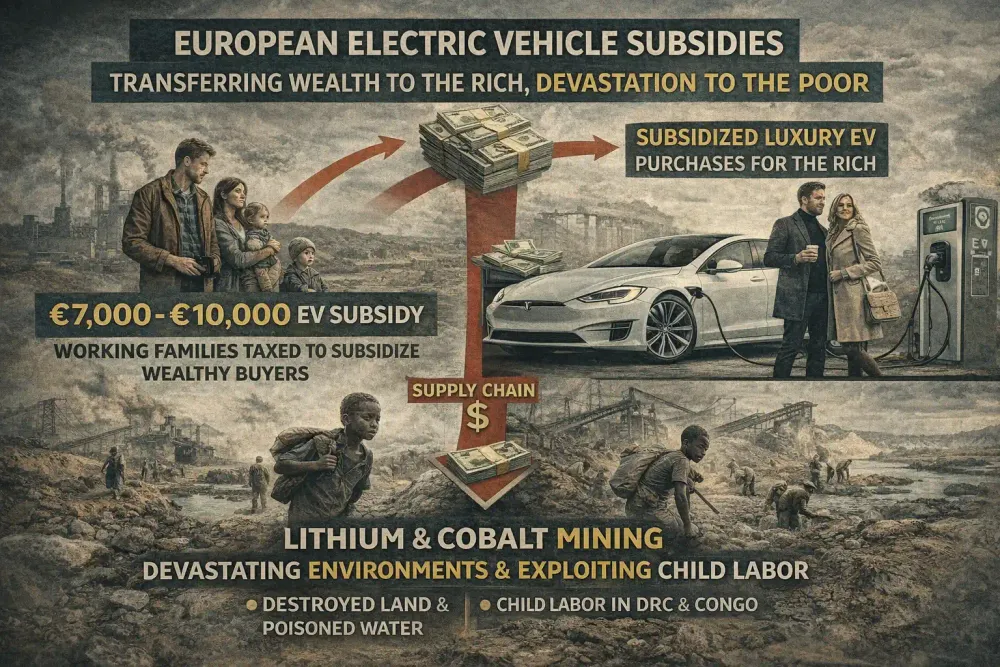
Electric vehicles are sold as saving the planet. The reality: you're subsidizing luxury cars for the wealthy while lithium mines destroy the developing world, battery production emits more CO2 than years of gas driving, and a 2035 combustion ban forces you into a market rigged for corporate profit. This isn't environmentalism. This is class warfare disguised as climate policy.
They call it the green transition. You're supposed to feel guilty about your ten-year-old diesel while your neighbor who makes three times your salary gets €8,000 in government subsidies to buy a €50,000 Tesla. You're supposed to celebrate the death of the combustion engine while ignoring that the lithium for those batteries comes from mines where eight-year-old children work twelve-hour shifts in the Congo.
You're supposed to believe electric vehicles save the planet while the coal-fired power plants generating the electricity to charge them pump out the same emissions as the cars they replaced. You're supposed to accept that by 2035, your perfectly functional car will be illegal to sell, forcing you into a market where Chinese manufacturers dominate because European companies spent decades building EVs nobody wants to buy, then begged Brussels for tariffs to protect their incompetence.
This is the electric vehicle transition: a subsidy scheme that transfers wealth from working families to upper-middle-class early adopters, an environmental disaster disguised as sustainability, and a regulatory capture operation that forces consumers into purchases benefiting specific manufacturers while calling it climate leadership.
The emissions math doesn't work. The mining is catastrophic. The infrastructure doesn't exist. The costs are prohibitive for most families. And every single policy choice, from subsidies to mandates to tariffs, serves corporate interests while being marketed as planetary salvation.
Let me show you the receipts. Because once you see how the electric vehicle scam actually works, you'll understand it's not about the environment. It's about profit, control, and making you pay for both while feeling virtuous about it.
By A. Kade
The Subsidy Scam Funding Rich People's Virtue Signaling
Start with who's actually benefiting from electric vehicle subsidies because that reveals the entire con.
Germany offers up to €6,750 in direct purchase subsidies for electric vehicles under €65,000. France provides up to €7,000 for EVs under €47,000. Italy offers €5,000 for new EVs. Spain provides €7,000. The Netherlands offered €4,000 until the program got so expensive they had to cut it.
Across the EU, member states are spending approximately €8-12 billion annually on direct EV purchase subsidies. That's public money, your tax contributions, handed to car buyers to reduce the purchase price of electric vehicles.
Who's buying these vehicles? The average EV buyer in Europe has a household income in the top 20% of earners. The median household income for EV purchasers in Germany is €85,000 annually. In France it's €78,000. These aren't working families. These are upper-middle-class households that could afford the vehicles without subsidies.
The subsidy doesn't make EVs accessible to average families. It makes luxury consumption cheaper for people who were buying expensive cars anyway. A household earning €45,000 annually, roughly median income across much of Europe, cannot afford a €40,000 electric vehicle even with a €7,000 subsidy. The remaining €33,000 is still beyond their means, especially with electricity costs, insurance, and the risk that battery degradation tanks resale value.
But that same household making €45,000 is paying taxes that fund the €7,000 subsidy going to someone making €85,000 who's buying a car they'd have purchased regardless. This is wealth transfer from working families to wealthy consumers, disguised as environmental policy.
The truth doesn’t trend. It survives because a few still care enough to keep it alive.
Keep The Kade Frequency transmitting.
The program is regressive by design. Sales taxes, VAT, and payroll taxes that fund these subsidies are paid by everyone. The subsidies benefit only those wealthy enough to buy expensive vehicles. The bottom 60% of earners pay into the subsidy pool but can't access it because they can't afford EVs even with subsidies.
It gets worse when you examine total cost of ownership. EV purchase prices are 40-60% higher than equivalent combustion vehicles. Insurance costs are 15-25% higher because repair costs are extreme, a minor accident can require complete battery replacement costing €15,000-20,000. Depreciation is brutal because battery degradation means used EVs lose value faster than combustion vehicles.
For a household on median income, the total five-year cost of EV ownership exceeds combustion vehicle ownership by €8,000-12,000 even after subsidies. The subsidy doesn't close the affordability gap, it just reduces how much richer you need to be to participate in electric vehicle ownership.
And who manufactures the vehicles receiving these subsidies? Volkswagen, BMW, Mercedes, Stellantis, Tesla. The same corporations posting record profits documented in the systematic wealth extraction from European households during the energy crisis. Volkswagen's profit margin increased to 7.2% in 2023 while receiving billions in EV subsidies and development grants.
The subsidies aren't helping consumers access transportation. They're corporate welfare that ensures manufacturers sell expensive vehicles to wealthy buyers using public funds to reduce prices just enough to move inventory. And it's all presented as climate policy rather than acknowledged as the regressive wealth transfer it actually is.
The Lithium Nightmare Nobody Wants You To See
The environmental case for electric vehicles starts with "zero emissions." That's technically true if you only measure what comes out of the tailpipe. Measure what goes into building the vehicle and the story changes completely.
Electric vehicle batteries require lithium, cobalt, nickel, and rare earth elements. Extracting these materials is an environmental and humanitarian catastrophe that makes oil drilling look clean by comparison.
Start with lithium. Chile's Atacama Desert contains some of the world's largest lithium deposits. Extracting lithium there requires pumping underground brine to the surface, where it evaporates in massive ponds leaving lithium carbonate behind. The process consumes approximately 500,000 gallons of water per ton of lithium produced.
In a desert region where water is already scarce, lithium mining is draining aquifers and destroying ecosystems. Indigenous communities dependent on those aquifers are watching their water disappear into battery production. Agricultural land is turning to dust. The flamingo populations that made the Atacama a unique ecosystem are collapsing as the wetlands they depend on dry up.
This is happening to produce batteries for vehicles marketed as environmentally friendly. The environmental destruction is just happening somewhere poor people live, where European consumers don't have to see it.
The Democratic Republic of Congo produces approximately 70% of the world's cobalt, most of it from mines in Katanga province. Amnesty International has documented that an estimated 40,000 children work in these mines, some as young as seven years old, crawling through hand-dug tunnels to extract cobalt ore.
These children work twelve-hour days for less than $2. They have no safety equipment. Tunnel collapses kill dozens annually. The dust they breathe causes respiratory diseases that will shorten their lives. And the cobalt they mine goes into batteries for electric vehicles that cost more than their families will earn in a lifetime.
European car manufacturers know this. The supply chains are documented. Volkswagen sources cobalt from Glencore, which sources from Congolese mines using child labor. BMW sources from the same suppliers. Tesla's cobalt comes from the same region.
When confronted, manufacturers promise to audit their supply chains and ensure ethical sourcing. The audits happen. The child labor continues. Because eliminating child labor from cobalt mining would increase costs, and increased costs would reduce the profit margins that justify the executive compensation and shareholder returns that actually matter to these companies.
The children mining cobalt so wealthy Europeans can drive electric vehicles will never own those vehicles. They'll die young from lung disease and mining accidents while executives at VW and Tesla talk about sustainability at conferences in Davos.
Then there's nickel. Indonesia is rapidly becoming the world's largest nickel producer, primarily for EV batteries. The mining process there involves clearing rainforest, strip-mining, and dumping waste into rivers. The pollution has destroyed fishing communities and contaminated water supplies for hundreds of thousands of people.
Recent investigations found that nickel mining in Indonesia has displaced indigenous communities, destroyed approximately 50,000 hectares of rainforest, and created toxic waste dumps that will poison the environment for generations. This destruction is accelerating specifically because of increased demand for EV batteries.
The rare earth elements required for EV motors primarily come from China, where extraction involves similar environmental devastation. Mining rare earths produces toxic waste including radioactive thorium and uranium. China's Bayan Obo mine, which produces much of the world's rare earth supply, has created a toxic lake approximately 10 square kilometers containing hundreds of millions of tons of waste.
This is the environmental cost of electric vehicle production. Not the theoretical emissions savings from driving electric. The actual destruction happening right now to extract the materials that make EVs possible.
European climate policy celebrates EV's as clean technology while ignoring that the clean part, the zero emissions driving, depends entirely on dirty extraction happening in countries too poor to refuse the business and too weak to regulate the corporations doing it. The pattern documented in how EU policies systematically extract resources from Africa while claiming to help applies perfectly to lithium and cobalt mining. The extraction, the environmental devastation, and the exploitation happen elsewhere. Europeans get the clean cars and the moral superiority.
The Emissions Lie That Won't Die
Here's the argument for electric vehicles: they produce zero emissions, so switching from combustion to electric reduces carbon emissions and fights climate change. Sounds perfect until you ask where the electricity comes from and what it takes to build the battery.
Manufacturing an electric vehicle battery produces approximately 5-10 tons of CO2 depending on battery size and production location. A typical 60kWh battery for a mid-size EV generates roughly 7 tons of CO2 during production. That's before the car has driven a single kilometer.
Manufacturing an equivalent combustion engine and drivetrain produces approximately 2-3 tons of CO2. So the EV starts its life with a 4-7 ton CO2 deficit compared to a combustion vehicle before either has moved.
How long does it take for the EV to make up that deficit through zero-emission driving? Depends entirely on how the electricity charging the EV is generated.
In Norway, where 95% of electricity comes from hydroelectric power, an EV breaks even with a combustion vehicle after approximately 25,000-30,000 kilometers. In Poland, where 70% of electricity comes from coal, an EV might never break even because the emissions from coal-generated electricity are comparable to combustion vehicle emissions.
Across Europe, the average electricity grid is approximately 40% renewable, 30% natural gas, 15% coal, 10% nuclear, and 5% other. That mix means the average EV in Europe breaks even with a combustion vehicle after approximately 80,000-100,000 kilometers of driving.
That's 6-8 years of driving for the average European who drives 12,000-15,000 kilometers annually. During those 6-8 years, the EV is actually producing more total lifecycle emissions than an equivalent combustion vehicle would have produced.
And here's the critical point: most EVs don't last long enough to reach that break-even point while still in use by the original owner. Battery degradation means that after 8-10 years, range has decreased significantly, resale value has collapsed, and many owners are replacing the vehicle.
If you buy an EV, drive it for 7 years and 90,000 kilometers, then sell it when battery degradation becomes noticeable, you will have produced more total emissions than if you'd driven a combustion vehicle for those same 7 years. The environmental benefit only materializes if the vehicle stays in service long enough to offset the production emissions, and the used EV market barely exists because buyers don't want vehicles with degraded batteries.
The manufacturers know this math. The studies have been done. A 2023 analysis by the European Environment Agency confirmed that EVs in countries with coal-heavy grids produce more lifecycle emissions than efficient combustion vehicles, and even in countries with cleaner grids, the break-even point is 80,000+ kilometers.
But you won't see that analysis in EV marketing. You'll see "zero emissions" repeated endlessly as if the only emissions that matter are tailpipe emissions during operation, not the massive emissions from manufacturing or the ongoing emissions from electricity generation.
The European grid can't handle mass EV adoption anyway. If even 30% of European vehicles switched to electric tomorrow, grid demand would increase by approximately 15-20%. Current infrastructure can't support that load. Building the necessary grid capacity would require a decade and hundreds of billions in investment.
And where would the additional electricity come from? The renewable capacity to generate it doesn't exist. Wind and solar can't provide baseload power. Nuclear is politically toxic and takes 15+ years to build. The realistic answer is natural gas, which means more emissions.
So the path to mass EV adoption runs through massive infrastructure investment, increased reliance on natural gas for electricity generation, and accepting that for at least a decade the vehicles will produce more lifecycle emissions than the combustion vehicles they replace. But that story doesn't sell vehicles or justify subsidies, so you get "zero emissions" marketing instead.
The climate case for EVs is built on ignoring production emissions, assuming electricity grids are cleaner than they are, and pretending battery degradation doesn't tank the vehicles' useful life before they reach emissions break-even. It's not environmentalism. It's marketing.
The 2035 Ban That Forces You Into The Scam
The European Union has mandated that by 2035, all new cars sold in the EU must be zero-emission vehicles. Combustion engines will be banned from new vehicle sales. This is presented as bold climate leadership showing Europe's commitment to reducing emissions.
It's actually a forced market creation scheme that benefits specific manufacturers while eliminating consumer choice and making transportation unaffordable for millions of households.
Start with what the ban actually does. If you own a combustion vehicle in 2035, you can keep driving it. Existing vehicles aren't banned. But you can't buy a new combustion vehicle after 2035. The only new vehicles available will be electric.
This creates artificial demand for EVs by eliminating alternatives. It doesn't matter if EV's are more expensive, less practical, or produce more lifecycle emissions in many use cases, after 2035, they're the only option. Consumers who need new vehicles will have no choice but to buy electric regardless of whether it makes economic or environmental sense for their situation.
Who benefits from this artificial demand creation? The same manufacturers who've spent billions developing EVs that consumers weren't buying in sufficient numbers without subsidies and mandates. Volkswagen invested €180 billion in EV development. BMW spent €30 billion. Stellantis committed €50 billion.
These investments made sense as long as governments could force consumer adoption through subsidies and eventually mandates. Without mandates, most consumers would continue buying combustion vehicles because they're cheaper, more practical, and infrastructure already exists.
The 2035 ban solves the manufacturers' problem: it eliminates competition from combustion vehicles and forces consumers into the market these companies spent billions creating. It's guaranteed demand through regulatory fiat rather than earned demand through competitive products.
But European manufacturers aren't even competitive in the EV market they lobbied for. Chinese manufacturers, particularly BYD, Geely, and NIO, produce better EV's at lower prices because they started developing the technology earlier and aren't burdened by decades of combustion engine infrastructure.
Chinese EVs are flooding European markets at prices 30-40% below equivalent European models with better range, faster charging, and more features. European manufacturers can't compete on quality or price. So they did what captured industries always do: they lobbied for protection.
The European Commission imposed tariffs of up to 45% on Chinese EVs in 2024, claiming Chinese government subsidies created unfair competition. This is fascinating coming from governments that subsidize European EV purchases and provided tens of billions in development grants to European manufacturers.
The real complaint isn't unfair subsidies, it's that European manufacturers took billions in public money and still produced inferior products. Rather than compete, they demanded protection. And the Commission, staffed by people who rotate between government and corporate boards, provided it.
So you get the worst of all outcomes: a ban forcing you to buy EVs, tariffs making the affordable Chinese EVs more expensive to protect incompetent European manufacturers, and a market where your choices are expensive European EVs you can't afford or Chinese EVs made artificially expensive through tariffs.
The ban doesn't just affect new car buyers. It impacts the used car market by restricting supply. If no new combustion vehicles are sold after 2035, the used combustion vehicle supply starts declining. Reduced supply means higher used car prices, making transportation more expensive for lower-income households that depend on used vehicles.
Rural households face particular problems. EV's work reasonably well for urban use cases, short trips, charging at home, infrastructure nearby. Rural use cases are different. Longer distances, less charging infrastructure, often no ability to charge at home if you don't own property.
A farmer needing a pickup truck to haul equipment can't use an electric vehicle with 300-kilometer range that takes hours to charge. A rural family making long trips to access services can't rely on charging infrastructure that doesn't exist outside cities. But after 2035, their options are buying expensive EVs that don't meet their needs or buying used combustion vehicles at inflated prices.
The ban is class warfare. Wealthy urbanites can afford EVs and have infrastructure access. Working families in rural areas get forced into a market that doesn't serve their needs and they can't afford to participate in.
It's also completely unnecessary from an emissions perspective. Modern combustion engines are remarkably clean. Euro 6 emission standards have reduced particulate and NOx emissions to near-zero levels. Hybrid vehicles reduce emissions 30-40% compared to pure combustion without requiring the full infrastructure transformation EVs demand.
A rational climate policy would let markets determine the pace of transition, subsidize infrastructure development rather than vehicle purchases, and allow continued combustion vehicle sales for use cases where EVs aren't practical. Instead, you get mandates that force adoption regardless of practicality or affordability.
The 2035 ban isn't climate policy. It's industrial policy disguised as climate policy, designed to guarantee markets for products European manufacturers couldn't sell competitively. And you're the one being forced to buy them.
The Infrastructure That Doesn't Exist
The electric vehicle transition requires infrastructure that doesn't exist and won't exist on the timeline being promised. This isn't speculation, it's basic arithmetic about charging capacity, grid load, and the time required to build out systems at scale.
Start with home charging, which is how approximately 80% of EV owners currently charge their vehicles. Home charging requires dedicated electrical circuits, typically 240V/32A circuits that can deliver 7kW charging power. Installing this infrastructure costs €1,000-2,500 per household depending on existing electrical systems.
If you own a house with a garage and sufficient electrical capacity, installation is feasible. If you live in an apartment building without dedicated parking, it's impossible. If you live in older housing with outdated electrical systems, the costs can exceed €5,000 to upgrade service.
Approximately 46% of Europeans live in apartments. Most apartment buildings don't have dedicated parking spaces, and even those that do rarely have electrical infrastructure capable of supporting EV charging for multiple units. Retrofitting apartment buildings to support EV charging at scale would cost hundreds of billions.
Nobody's funding that retrofit. Property owners won't pay to install infrastructure that benefits tenants who might leave. Governments aren't funding apartment building electrical upgrades. So nearly half of Europeans have no realistic way to charge an EV at home, which makes EV ownership impractical regardless of vehicle cost.
Public charging infrastructure is supposed to fill the gap. The EU has set a target of installing 1 million public charging points by 2025 and 3.5 million by 2030. As of late 2024, Europe has approximately 450,000 public charging points. They're not hitting the targets.
Even if they did, the math doesn't work. A gas station can serve approximately 1,000 vehicles daily because refueling takes 5 minutes. An EV fast-charging station takes 30-45 minutes to charge a vehicle to 80%. That means serving maybe 30-40 vehicles daily per charging point.
To replace combustion vehicle infrastructure with charging infrastructure at current usage levels would require approximately 20-25 times more charging points than gas pumps. Europe currently has about 130,000 gas stations. Replacing them with equivalent EV charging capacity would require 2.5-3 million charging points just for the vehicles already on the road, not counting the additional vehicles expected as the fleet transitions.
The grid capacity to power those charging points doesn't exist either. If 30% of European vehicles became electric and charged regularly, electricity demand would increase 15-20%. Current grid capacity can't support that load during peak demand.
Upgrading grid capacity takes time and money. Building substations, running transmission lines, and upgrading distribution systems is a decade-long process costing hundreds of billions. The European Commission estimates €90-110 billion in grid infrastructure investment is needed by 2035 to support EV adoption targets.
Nobody's allocated that funding. Member states are supposed to invest, but most are running deficits and cutting infrastructure spending. The private sector won't invest without guaranteed returns, which requires regulatory commitments governments aren't making.
So the infrastructure upgrades aren't happening fast enough to support adoption targets. The grids will handle the first 10-15% of vehicles switching to electric without major problems. After that, the infrastructure deficits become critical.
Range anxiety is the predictable result. Most EVs have real-world ranges of 250-350 kilometers in optimal conditions. Cold weather reduces range by 30-40%. Highway driving at speed reduces range. Running heat or air conditioning reduces range. In winter conditions, a 300-kilometer rated range might deliver 180 kilometers actual range.
For urban use cases where you're driving 30-40 kilometers daily and can charge at home, this works fine. For longer trips or users who can't charge at home, it's a constant source of stress and planning. Where's the next charger? Is it working? Will I have to wait? What if the battery drains before I reach it?
Combustion vehicles eliminated this stress decades ago. You can refuel anywhere in 5 minutes. Range is 600-800 kilometers. Cold weather doesn't matter. You don't plan routes around refueling stops because the infrastructure is everywhere.
EVs return transportation to the planning and anxiety levels of the early automobile era when finding fuel required advance research. This is being sold as progress.
The infrastructure doesn't exist. Building it would cost hundreds of billions and take decades. The plans to build it aren't funded. The grid capacity to power it doesn't exist. The charging speeds are slower. The convenience is worse. But the transition is being mandated anyway because the manufacturers need markets for their products and climate policy has become corporate welfare dressed as environmentalism.
The Cost Barrier Nobody Wants To Admit
The fundamental problem with electric vehicle adoption is that most families can't afford them. This isn't solvable through subsidies or better technology, it's basic economics about household budgets and vehicle costs.
The average price of a new electric vehicle in Europe is approximately €48,000. The average price of a new combustion vehicle is €28,000. Even with a €7,000 subsidy, the EV costs €41,000, still 46% more expensive than the combustion alternative.
Median household income across the EU is approximately €31,000 annually. Financial advisors generally recommend that vehicle purchases not exceed 50% of annual income. For a household earning €31,000, that means maximum vehicle spending of €15,500.
A €41,000 EV is 264% of that recommended maximum. Even a subsidized EV is completely unaffordable for median-income households without taking on debt burdens that financial experts would call irresponsible.
The people who can afford EVs are households in the top 20% of the income distribution earning €65,000+. For them, a €41,000 vehicle is reasonable. For everyone else, it's impossible without financial stress that defeats any supposed savings from lower fuel costs.
Proponents argue that fuel savings make up for higher purchase prices over the vehicle lifetime. Let's examine that claim.
A combustion vehicle in Europe costs approximately €0.12-0.15 per kilometer to fuel. An electric vehicle costs approximately €0.05-0.08 per kilometer in electricity. That's a savings of €0.05-0.08 per kilometer.
If you drive 15,000 kilometers annually, you save €750-1,200 per year in fuel costs. Over 10 years, that's €7,500-12,000 in savings. But you paid €13,000 more to purchase the EV (€41,000 vs €28,000). So you're not breaking even until year 11-17 of ownership.
That assumes electricity prices don't increase, which they will. It assumes no major repairs, which is optimistic for any vehicle. It assumes the battery doesn't degrade to the point where replacement is required, which costs €15,000-20,000.
And it completely ignores opportunity cost. If you bought the €28,000 combustion vehicle and invested the €13,000 difference at 4% annual return, you'd have €19,000 after 10 years. The fuel savings from the EV are €7,500-12,000. The investment returns on the price difference exceed the fuel savings.
From a pure financial perspective, buying the combustion vehicle and investing the price difference produces better returns than buying the EV and saving on fuel. The EV only makes financial sense if you value environmental benefits enough to pay a premium for them.
Except we've already established the environmental benefits are questionable given production emissions and grid composition. So you're paying a premium for environmental benefits that might not exist while taking on financial stress your household budget can't sustain.
Insurance costs make it worse. EV insurance is 15-25% higher than combustion vehicle insurance because repair costs are extreme. Any accident damaging the battery pack can require complete battery replacement. Minor accidents that would cost €3,000 to repair on a combustion vehicle cost €15,000+ on an EV.
Insurance companies know this and price accordingly. If your combustion vehicle insurance costs €800 annually, the equivalent EV insurance will cost €920-1,000. Over 10 years, that's an additional €1,200-2,000 in costs that don't appear in the fuel savings calculations.
Depreciation is brutal on EVs because battery degradation is visible and inevitable. After 5 years, an EV has lost approximately 50-60% of its value compared to 35-45% for combustion vehicles. That's thousands in additional costs that won't be recovered at resale.
When you add up higher purchase price, higher insurance, faster depreciation, and the risk of expensive battery replacement, the total cost of EV ownership over 10 years exceeds combustion vehicle ownership by €10,000-15,000 even accounting for fuel savings.
This isn't theoretical. Consumer Reports and various European consumer protection agencies have done the lifetime cost analyses. EVs are more expensive to own unless you drive extremely high mileage or electricity is nearly free.
For wealthy households where €10,000-15,000 extra over a decade is negligible, this doesn't matter. For households living paycheck to paycheck, it's the difference between transportation they can afford and transportation that would bankrupt them.
The 2035 combustion ban doesn't magically make EVs affordable. It just eliminates the affordable alternatives and forces people into debt to buy vehicles they can't afford. Household debt is already at record levels. Forcing people into more debt for transportation they could previously afford is economic policy designed to benefit manufacturers at citizen expense.
The manufacturers know EVs are unaffordable for most households. That's why they lobby for subsidies, not to make EV's accessible but to reduce prices just enough to expand the market from the top 10% to the top 20% of earners. And when subsidies aren't enough, they lobby for mandates that force adoption regardless of affordability.
This is the same pattern documented in how European households paid €238 billion in corporate profit extraction during the energy crisis. Citizens told there's no money for assistance while corporations get subsidies. Citizens lectured about sacrifice while manufacturers profit. Citizens forced into markets they can't afford while being told it's for their benefit.
The Chinese Competition Exposing European Failure
The electric vehicle market has revealed what decades of subsidies and protectionism tried to hide: European manufacturers can't compete with Chinese companies when markets are actually open.
China invested in EV technology in the early 2000s when European manufacturers were still focused on optimizing combustion engines and dismissing electrification as a niche market. Chinese companies built battery supply chains, developed manufacturing expertise, and produced vehicles while European manufacturers were still doing feasibility studies.
Now Chinese EV manufacturers like BYD, Geely, NIO, and XPeng produce vehicles that are better, cheaper, and more advanced than European equivalents. BYD's Seal sedan offers 570-kilometer range for €42,000. Volkswagen's ID.4 offers 400-kilometer range for €49,000. The Chinese car has better range, faster charging, more features, and costs less.
This isn't a small advantage. Chinese EVs are 30-40% cheaper than European equivalents with equal or better specifications. They charge faster. They have better software. The interiors are better designed. By every objective measure, Chinese manufacturers are producing superior products at lower prices.
European manufacturers can't compete. They spent billions on EV development and produced cars that are expensive, have limited range, and are technologically inferior to Chinese competitors. The decades of subsidies, the protected markets, the regulatory capture, none of it produced competitive products.
So European manufacturers did what failed companies always do when they can't compete: they lobbied for protection. The European Commission announced tariffs of up to 45% on Chinese EVs in October 2024, claiming Chinese government subsidies created unfair competition.
The hypocrisy is staggering. European governments have subsidized EV purchases with €8-12 billion annually. They provided tens of billions in development grants to manufacturers. They built charging infrastructure with public funds. They mandated EV adoption through 2035 combustion bans. The entire European EV industry is built on subsidies.
But when Chinese companies beat European companies despite all those subsidies, suddenly subsidies are unfair competition that requires tariffs. The complaint isn't that China subsidizes, it's that Chinese subsidies actually produced competitive products while European subsidies produced expensive failures.
The tariffs don't help consumers. They make affordable Chinese EVs more expensive to protect European manufacturers who charge more for worse products. If you're a consumer who can't afford a €49,000 Volkswagen but could maybe afford a €42,000 BYD, the tariff raises that BYD to €60,000 and eliminates your affordable option.
This is pure protectionism benefiting corporations at consumer expense. The stated justification is saving European manufacturing jobs. The real goal is protecting profits for companies that couldn't compete despite massive public investment.
And it's not even saving jobs. Volkswagen announced plans to close three factories in Germany and lay off tens of thousands of workers in late 2024 despite receiving billions in subsidies and getting tariff protection. The subsidies didn't make VW competitive. The tariffs didn't save jobs. They just gave executives more time to extract profits before the inevitable reckoning.
The Chinese competition reveals the fundamental failure of European industrial policy. Billions in subsidies, protected markets, regulatory mandates, and the result is products consumers don't want at prices they can't afford. Chinese manufacturers with less subsidy money per vehicle produced better products because they had to compete in their home market first.
European manufacturers never learned to compete because they never had to. Governments protected them from competition, subsidized their failures, and mandated demand for their products. That created comfortable industries that innovate slowly, price high, and lobby for protection when anyone threatens their position.
The EV market is exposing this failure because Chinese competition is too good to ignore. European manufacturers can't compete on price, quality, range, charging speed, or features. They can only compete through tariffs and regulations, which they get because the same corporate interests that captured media, Parliament, and regulatory agencies also control trade policy.
You end up paying more for worse products to protect companies that failed despite massive subsidies, and the whole scheme is justified by claiming Chinese competition is unfair. The unfair part is forcing European consumers to subsidize inferior products through their taxes and then forcing them to buy those products through mandates and tariffs.
The Class War Disguised As Climate Policy
Strip away the environmental marketing and electric vehicle policy reveals itself as class warfare: wealthy households subsidized by working families, urban residents privileged over rural populations, and corporate profits protected at consumer expense.
Start with geographic distribution. EV adoption is concentrated in wealthy urban areas where households can afford the vehicles and infrastructure exists to support them. Oslo, Amsterdam, Berlin, Paris, these cities have EV adoption rates of 15-25%. Rural regions have adoption rates below 3%.
This isn't coincidence. Urban residents are wealthier on average, more likely to have home charging access, and benefit from concentrated charging infrastructure. Rural residents are poorer, less likely to own property where they can install chargers, and face long distances between charging points.
The 2035 combustion ban doesn't account for this disparity. It treats all of Europe as if it has Oslo's income levels and Amsterdam's infrastructure density. Rural households that depend on trucks for farm work, drive long distances for services, and have no charging access are expected to switch to EVs just like wealthy urban professionals who drive 15 kilometers to work and charge in their garage.
This is policy designed by and for urban elites who don't understand or care about rural realities. The ban will make transportation dramatically more expensive and less functional for rural populations while barely affecting urban elites who were buying EVs anyway.
Income disparity is even starker. The median EV buyer has household income in the top 20% of earners. The bottom 60% can't afford EVs even with subsidies. But the bottom 60% pay VAT and other taxes that fund the subsidies benefiting the top 20%.
A household earning €30,000 annually pays approximately €250-300 annually in taxes that fund EV subsidies. They receive zero benefit from those subsidies because they can't afford a €40,000 vehicle even with €7,000 off. They're subsidizing consumption they can't participate in.
Meanwhile, the household earning €80,000 gets €7,000 in public money to buy a car they'd have bought anyway. This is upward wealth redistribution disguised as climate policy.
The subsidy defenders argue that driving down EV prices through subsidized adoption will eventually make EVs affordable for everyone. This is trickle-down economics applied to vehicles, and it's equally nonsensical.
Tesla has been selling EVs for 15 years. Prices haven't dropped significantly. The Model S launched at $75,000 in 2012. The Model 3 launched at $35,000 in 2017 but averaged selling prices of $50,000+. In 2024, Tesla's average selling price is still $45,000+. Increased production volume didn't make Teslas affordable for median-income households.
BYD and other Chinese manufacturers produce cheaper EVs, but European tariffs make them unaffordable. The affordable options exist, they're just blocked to protect European manufacturers who can't compete.
So subsidies aren't making EVs accessible to working families. They're making luxury consumption cheaper for wealthy families while working families pay through taxes and higher used car prices as combustion supply declines.
Apartment dwellers face particular disadvantage. Approximately 46% of Europeans live in apartments, mostly in buildings without dedicated parking or charging infrastructure. These residents can't charge at home even if they could afford an EV.
Public charging is the only option, but it's expensive (€0.40-0.60 per kWh vs €0.20-0.30 for home charging), inconvenient (requires planning and time), and insufficient (450,000 public chargers for 250+ million potential users).
Apartment residents pay higher electricity costs for the inconvenience of charging at public stations while homeowners charge cheaply at home. The richer you are, the more likely you own property, the cheaper your EV operating costs. The poorer you are, the more likely you rent an apartment, the more expensive EV operation becomes, if it's possible at all.
This creates a mobility divide. Wealthy homeowners have cheap, convenient EV charging and can afford the vehicles. Poor apartment dwellers have neither affordable vehicles nor practical charging access. When combustion vehicles are banned, the poor lose transportation access while the wealthy maintain it.
This is intentional policy. Not because anyone explicitly wants to hurt poor people, but because policy is designed by and for people who have driveways, garages, and household incomes that make €45,000 vehicles reasonable purchases. The designers assume their circumstances are universal when they're actually privileged.
The environmental justice argument gets weaponized to justify this. EVs reduce urban air pollution, which benefits the urban poor who suffer disproportionately from pollution-related health issues. Therefore, forcing EV adoption is helping the poor.
Except the urban poor can't afford EVs and won't benefit from cleaner air if they lose transportation access entirely. Cleaner air is worthless if you can't get to work because you couldn't afford to replace your old combustion vehicle and buses got cut because municipalities spent their transport budgets on EV subsidies for the wealthy.
The class warfare operates on every level. Who gets subsidies. Who can afford vehicles. Who has charging access. Who benefits from tariff protection. Who keeps transportation access when bans take effect. Every policy choice advantages wealth and penalizes poverty while being justified by environmental concerns that affect everyone equally.
This is the same extraction documented across European policy: corporate welfare while citizens face austerity, benefits flowing to elites while costs impose on working families, and moral language disguising wealth transfer. The EV transition is another vehicle, literally, for the same pattern.
What You're Actually Paying For
Let's be explicit about what electric vehicle policy actually funds because the answer isn't what the marketing promises.
You're funding executive compensation at companies that produce inferior products. Volkswagen CEO Oliver Blume earned €10.3 million in 2023 while announcing factory closures and layoffs. Herbert Diess, his predecessor, earned €10 million annually while VW's EV division posted billions in losses. This compensation is funded by subsidies that artificially inflate demand for products markets wouldn't support.
You're funding shareholder returns at companies dependent on government mandates. Volkswagen paid €3.6 billion in dividends in 2023 despite EV losses. BMW paid €2.8 billion in dividends while receiving subsidy-driven revenue. These returns are extracted from public funds through the subsidy mechanism.
You're funding environmental destruction in countries too poor to refuse. The lithium mines draining Chile's aquifers. The cobalt mines employing Congolese children. The nickel mines destroying Indonesian rainforest. These operations exist to supply battery production, and battery production exists to supply EVs that wealthy Europeans buy with public subsidies.
You're funding the elimination of your own transportation choices. The 2035 combustion ban was lobbied for by manufacturers who needed guaranteed markets for products consumers weren't buying. Your subsidy payments funded the lobbying that secured the mandate that will force you to buy from the companies you subsidized.
You're funding grid infrastructure that may never materialize. The €90-110 billion needed for grid upgrades isn't allocated and likely won't be. But manufacturers need to sell EVs regardless, so the policy proceeds while the infrastructure doesn't.
You're funding protectionism that makes affordable options unavailable. Chinese EVs that would cost €35,000 cost €50,000 after tariffs. The tariffs exist to protect European manufacturers from competition. Your taxes fund subsidies that aren't enough to make European EVs affordable, then tariffs make affordable alternatives unavailable.
You're funding the transfer of your transportation autonomy to grid operators. Smart charging systems that control when your vehicle charges are necessary to prevent grid collapse. You think you own the vehicle, but utilities control when it charges. Your subsidy payments funded creating that dependency.
You're funding policy that privileges urban elites over rural populations and wealthy households over working families. Every design choice—from subsidy structures to infrastructure placement to ban timelines, advantages the wealthy and urban. Your payments fund policies designed by people who don't share your circumstances and don't care about your needs.
Most fundamentally, you're funding a transition that doesn't deliver promised environmental benefits. The production emissions, the mining destruction, the coal-generated charging electricity, the natural gas capacity needed to support grid load, the environmental costs are real and immediate while environmental benefits are theoretical and distant.
The EV transition isn't about the environment. It's about creating markets for products manufacturers want to sell, protecting those manufacturers from competition, and forcing adoption through mandates when consumers won't buy voluntarily.
Every subsidy payment, every tax contribution to infrastructure, every forced purchase through mandates, you're paying for corporate profit extraction disguised as climate policy. The pattern is identical across European governance: corporations profit while citizens pay, the costs impose immediately while benefits never materialize, and anyone questioning the scheme gets accused of opposing progress.
The electric vehicle con isn't subtle. The subsidies are regressive. The mandates eliminate choice. The environmental benefits don't exist at promised scale. The infrastructure isn't built. The costs are prohibitive. The alternatives are banned or tariffed into unaffordability.
You're paying for all of it while being lectured about saving the planet by people who fly private jets to climate conferences where they announce policies that make your transportation more expensive and less functional.
The Honest Account Nobody Will Give You
Here's what an honest electric vehicle policy would look like, which is why you'll never see it implemented.
It would acknowledge that EV's work well for specific use cases, urban driving, households with home charging access, people who can afford premium vehicles, while admitting they're impractical for many others.
It would let markets determine adoption pace rather than mandating transitions before infrastructure exists or technology matures. It would allow combustion vehicles to remain available for use cases where EVs don't work.
It would admit that EV's aren't zero-emission vehicles, they're emissions-shifted vehicles that move pollution from tailpipes to power plants and battery factories. The environmental benefits are real in specific contexts (cities with clean grids) and minimal or negative in others (regions with coal-heavy grids).
It would acknowledge that battery production creates environmental and human rights catastrophes in developing countries that benefit from their resources being extracted. It would admit that "clean" technology depends entirely on dirty extraction happening where Europeans don't see it.
It would eliminate regressive subsidies that transfer wealth from working families to wealthy vehicle buyers. If subsidies exist at all, they'd be means-tested so only households that actually need assistance receive it.
It would invest in infrastructure before mandating adoption. Build the charging network first, upgrade the grid first, ensure apartment dwellers have access first, then let markets adopt as infrastructure becomes functional.
It would eliminate protectionist tariffs and let consumers access the best vehicles at the lowest prices regardless of manufacturing origin. If European manufacturers can't compete, that's their failure to address rather than consumers' burden to subsidize.
It would admit that transportation needs vary by geography, income, and use case. Rural households need different solutions than urban households. Working families need affordable options. People hauling equipment need utility vehicles with real range.
It would acknowledge that forcing everyone into identical solutions serves manufacturers' interests in standardized production rather than consumers' interests in solutions that work for their circumstances.
Most fundamentally, it would stop using climate as a cudgel to shut down legitimate questions about costs, practicality, and who actually benefits from policies marketed as planetary salvation.
But honest policy doesn't create guaranteed markets for politically connected manufacturers. It doesn't justify subsidies that enrich executives and shareholders. It doesn't enable regulatory capture where industries write the rules they nominally follow.
Honest policy would require admitting that the transition is about corporate profits and control rather than environmental benefits. It would require acknowledging that working families are paying for wealthy families' virtue signaling. It would require admitting that the emperor has no clothes and the climate crisis is being used to justify wealth extraction.
No one in power will give you that honest account because their power depends on maintaining the lie. The manufacturers profit from subsidies and mandates. The politicians profit from donations and post-government board seats. The media won't investigate because they're funded by the same institutions benefiting from the scheme.
So you get marketing about zero emissions and saving the planet while lithium mines destroy ecosystems, Congolese children mine cobalt, Chinese manufacturers outcompete subsidized European companies, grids can't handle the load, and working families subsidize rich people's Teslas.
The electric vehicle transition is another extraction mechanism like everything else documented across European policy. Your money funds their profits. Your choices get eliminated. Your costs increase. And you're supposed to feel good about it because climate.
A. Kade
"Any sufficiently advanced incompetence is indistinguishable from malice."
No ads. No sponsors. Just signals from the noise.
Keep The Kade Frequency transmitting.