Who Owns the News
In 1983, fifty companies controlled 90% of American media. Today it's six, and BlackRock and Vanguard own shares in all of them. The same funds. The same boards. The same interests. You think you're choosing between perspectives. You're choosing between products of the same owner.

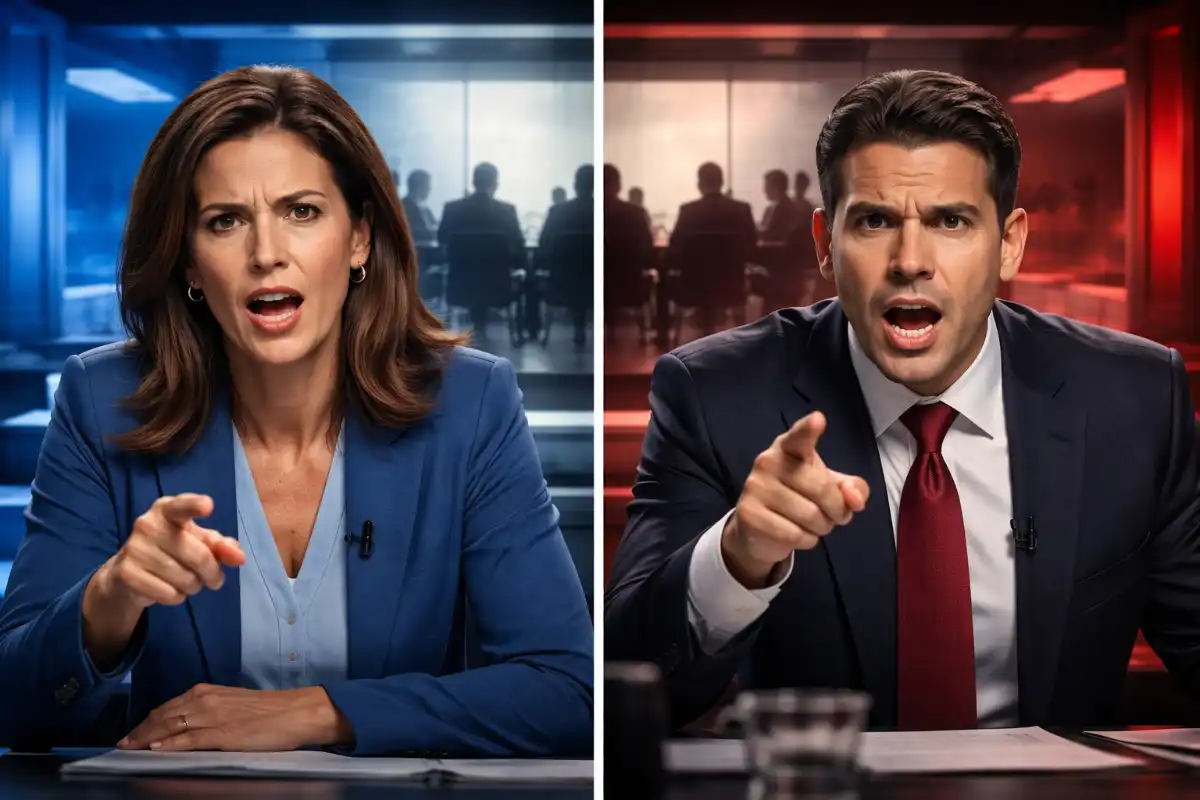
You think you're informed. You think you're choosing between perspectives when you flip from CNN to Fox, from the New York Times to the Wall Street Journal. Liberal versus conservative. Left versus right. A marketplace of ideas.
It's a lie.
The same corporations own everything. The same investment funds hold the shares. The same advertisers pay the bills. The same former officials fill the analyst chairs. And the same topics,the ones that might actually threaten power,never get discussed.
You're not informed. You're managed.
The Illusion of Choice
In 1983, fifty companies controlled 90% of American media,television, radio, newspapers, magazines, film.
By 1996, that number had fallen to ten.
By 2005, it was six.
Today, it remains a handful: Comcast (NBC, MSNBC, CNBC), Disney (ABC, ESPN, FX), Warner Bros. Discovery (CNN, HBO), Paramount, Fox Corporation, and a few others depending on how you count.
Six corporations decide what 330 million Americans see, hear, and read.
And here's the part they don't tell you: these six don't even compete. Not really.
Because the same three investment funds,BlackRock, Vanguard, and State Street,are among the top shareholders of all of them.
Together, BlackRock and Vanguard own approximately:
- 18% of Fox
- 16% of CBS/Paramount
- 13% of Comcast (NBC, MSNBC, CNBC)
- 12% of CNN (through Warner Bros. Discovery)
- 12% of Disney (ABC)
- 10-14% of Gannett (over 250 newspapers plus USA Today)
- 10% of Sinclair Broadcasting (193 local TV stations reaching 40% of American households)
The same funds. The same owners. The same masters.
When you watch Rachel Maddow attack Fox News, you're watching a product of BlackRock critique another product of BlackRock. When you read the Wall Street Journal debunk a New York Times story, you're watching Vanguard argue with itself.
The competition is theater. The debate is managed. The boundaries are set.
How We Got Here
This didn't happen by accident. It was legislated.
In 1996, President Bill Clinton signed the Telecommunications Act,the largest deregulation of media in American history. The stated goal was competition. More voices. Lower prices. Better service.
The actual result was a feeding frenzy.
Before the Act, companies couldn't own more than 40 radio stations nationwide. Immediately after, Clear Channel (now iHeartMedia) exploded from 40 stations to over 1,200,thirty times what Congress had previously allowed.
Local radio died. Local news gutted. Local programming replaced by syndicated content beamed from corporate headquarters. The DJ who knew your town was replaced by a voice from New York who couldn't find your city on a map.
Within five years, radio station ownership dropped from 5,100 owners to 3,800. Today, two companies control 42% of the listening audience. News staffs shrank by 44%. Part-time staff by 71%.
And television followed the same path.
The promise was diversity. The result was monopoly.
But here's what makes it sinister: the same lawmakers who passed the Act were funded by the same corporations who benefited from it. And the media companies that should have exposed this conflict of interest? They were too busy merging to notice. Or too compromised to care.
The Propaganda Model
In 1988, Edward Herman and Noam Chomsky published Manufacturing Consent, a book that described exactly how this would work. They called it the Propaganda Model.
It wasn't conspiracy theory. It was structural analysis.
The model identifies five "filters" that determine what becomes news:
1. Ownership. The corporations that own media are massive, profit-driven entities with interests that extend far beyond journalism. They own defense contractors, pharmaceutical companies, tech firms, banks. Why would NBC investigate General Electric when GE owned NBC? Why would ABC expose Disney's labor practices?
2. Advertising. Advertisers don't just buy ad space,they buy influence. A newspaper that runs stories critical of, say, the automotive industry will find its automotive ads disappearing. Media companies learn quickly what stories cost them money. The self-censorship becomes automatic.
3. Sourcing. Journalists rely on official sources,government spokespeople, corporate PR departments, think tank experts. These sources are cheap, readily available, and come with the appearance of authority. But they also come with agendas. When 76% of sources in Iraq War coverage were current or former government officials, is that journalism or stenography?
4. Flak. Criticize the wrong people, and you'll face organized pushback,letters, lawsuits, advertiser pressure, accusations of bias. It doesn't have to succeed. It just has to make the next journalist think twice.
5. Ideology. During the Cold War, it was anti-communism. Today it's "terrorism" or "national security" or "disinformation." Any label that can be applied to delegitimize dissent. Question foreign policy? You're naive. Question the war? You don't support the troops. Question the system? You're a conspiracy theorist.
These filters don't require a phone call from the CEO. They don't require a secret meeting. They're structural. Built into how the system operates. Journalists who internalize them succeed. Those who don't find themselves unemployed.
The Iraq War: Case Study in Managed Information
If you want proof of how the system works, look at Iraq.
In the months before the 2003 invasion, every major media outlet in America sold the same story: Saddam Hussein had weapons of mass destruction. He was connected to Al-Qaeda. He threatened American security. War was necessary.
The New York Times led the charge. Reporter Judith Miller published story after story about Iraq's nuclear program, chemical weapons, biological agents,all based on sources provided by the Iraqi National Congress, an exile group funded by the Pentagon that wanted regime change.
The Bush administration then cited her stories as evidence. Dick Cheney went on Meet the Press and said, "There's a story in the New York Times this morning..." The newspaper of record confirmed the government's claims. The government cited the newspaper. A closed loop of mutual validation.
According to a study by Fairness and Accuracy in Reporting (FAIR), in a two-week period before the invasion, the major networks aired 267 American guests discussing the war. Only one questioned it.
One out of 267.
Pro-war voices outnumbered skeptics by roughly 25 to 1.
After the invasion, when no weapons of mass destruction were found, when everything they'd reported turned out to be false, the Times published a half-hearted mea culpa:
"We have found a number of instances of coverage that was not as rigorous as it should have been. In some cases, information that was controversial then, and seems questionable now, was insufficiently qualified or allowed to stand unchallenged. Looking back, we wish we had been more aggressive in re-examining the claims as new evidence emerged,or failed to emerge."
That's the apology for helping start a war that killed hundreds of thousands of people, displaced millions, destabilized a region, and cost trillions of dollars.
Judith Miller eventually left the Times. She now works for Fox News and Newsmax. The editors who approved her stories? Most kept their jobs. The system that produced the failure? Unchanged.
Because it wasn't a failure. It worked exactly as designed.
The Defense Industry Pipeline
Turn on any cable news network during a conflict,any conflict,and watch who explains the war to you.
Retired generals. Former CIA directors. Ex-Pentagon officials. National security consultants.
What they don't tell you: most of them work for defense contractors.
In 2008, the New York Times revealed that the Pentagon had been running a years-long program using 75 military analysts as "message force multipliers." The military invited them to secret briefings, gave them classified information, and encouraged them to speak favorably about the war on TV. Many of these analysts had financial ties to defense contractors who stood to profit from the wars they were promoting.
But you wouldn't know it from watching. Networks rarely disclose these conflicts. When Jeremy Bash appears on MSNBC to discuss Middle East policy, they introduce him as a former CIA chief of staff. They don't mention that his consulting firm has worked with Raytheon, which manufactures missiles for Israel's Iron Dome. When Leon Panetta advocates for military action, they call him a former Secretary of Defense. They don't mention his ties to the defense industry.
- ABC/Disney interlocked with Boeing
- Raytheon interlocked with the New York Times
- Lockheed Martin interlocked with the Washington Post and Gannett
- Caterpillar (maker of military bulldozers) interlocked with the Tribune Company
This is why, when Trump bombs Iran, the coverage debates tactics,not whether bombing is justified. It's why "experts" discuss which weapons are most effective,not whether we should be dropping them. The question of whether war is answered before the cameras roll. Only how is up for debate.
The range of acceptable opinion runs from "bomb them more" to "bomb them smarter."
Local News: The Trojan Horse
National news is obviously political. That's expected. But local news? That's supposed to be different. Your neighbors. Your weather. Your community.
Except it isn't yours anymore.
Sinclair Broadcast Group owns 193 television stations reaching 40% of American households. They appear on your screen as your local ABC, CBS, NBC, or Fox affiliate. Your anchors. Your newsroom. Your trusted source.
But Sinclair mandates "must-run" segments,content produced at corporate headquarters that every station must air, sometimes up to nine times a week. These segments include commentary from former Trump advisors, warnings about "fake news" from other outlets, and talking points that blur the line between news and opinion.
In 2018, Sinclair forced nearly 200 local anchors to read the same script, word for word:
"Unfortunately, some members of the national media are using their platforms to push their own personal bias and agenda to control exactly what people think. And this is extremely dangerous to our democracy."
When video compilations showed dozens of anchors reciting the identical words, it went viral. The Orwellian nature was impossible to miss.
But here's what makes it insidious: local news is trusted. Seventy-six percent of Americans trust their local news,more than family or friends, according to some surveys. Sinclair exploits that trust. They let local stations build rapport with their communities, then inject corporate messaging through the back door.
As former New York Times public editor Margaret Sullivan said: "What Sinclair is cynically doing is trading on the trust that develops among local news people and their local audience."
The local face. The corporate message. The manufactured consent.
What They Agree On
Watch CNN and Fox scream at each other all day. They'll fight about pronouns, about immigration, about Trump, about Biden. Culture war. Personality clashes. Red team versus blue team.
But notice what they never debate:
The defense budget. Both parties vote for it. Both networks support it. When was the last time you saw a serious discussion on whether we need to spend more on weapons than the next ten countries combined?
Bank bailouts. In 2008, Congress handed $700 billion to Wall Street in days. Both parties. Both networks covered it as necessary, inevitable, the only option. Where was the debate about letting them fail?
Healthcare for profit. Single-payer is "radical." Medicare for All is "socialism." But somehow, every other developed nation has universal healthcare. The debate is always whether we can afford it,never why we can afford endless war but not medicine.
Corporate power. You'll see stories about individual companies,a scandal here, a recall there. But the systemic critique? The question of whether corporations have too much power? Off the table.
Billionaire influence. Jeff Bezos owns the Washington Post. Marc Benioff owns Time. Patrick Soon-Shiong owns the LA Times. Laurene Powell Jobs owns the Atlantic. But these outlets cover billionaires as celebrities, philanthropists, innovators,not as threats to democracy.
The disagreements are real. But they're contained. They happen within boundaries that never threaten the structures of power. You're allowed to debate abortion. You're not allowed to debate capitalism. You're allowed to argue about the border. You're not allowed to ask why American intervention in Central America created the refugees in the first place.
The system gives you two teams so you don't notice there's only one game.
See the Pattern?
The Kade Frequency documents what corporate media won't. No sponsors. No filters. No propaganda. If this investigation matters to you, share it. Come back. Read more.
The Boundaries of Debate
There's a term for this: the Overton Window,the range of ideas considered acceptable in public discourse. Anything inside the window is "reasonable." Anything outside is "extreme," "fringe," "conspiracy theory."
The media doesn't tell you what to think. It tells you what to think about. It defines what's serious and what's crazy. What's news and what's noise.
Challenge the existence of weapons of mass destruction before the Iraq War? Conspiracy theorist. Question the official story of Russiagate? Putin apologist. Suggest that maybe the same corporations that fund both parties control both outcomes? Radical.
But here's the tell: the things dismissed as fringe today often become accepted truth years later.
Iraq had no WMDs. The NSA was spying on everyone. The pharmaceutical industry lied about opioids. Big tobacco lied about cancer. The banks were gambling with your money.
The "conspiracy theories" of the past are the documented facts of the present. But by the time they're admitted, the consequences have been paid. The war was fought. The economy crashed. The people died. The acknowledgment comes with a shrug: "Mistakes were made."
And the same people who got it wrong? They're still on TV. Still writing columns. Still explaining the world to you.
The Alternative
So what does real independent journalism look like?
It looks like Knight-Ridder, the one major news organization that questioned the Iraq War before the invasion. While the Times and Post were printing Pentagon talking points, Knight-Ridder ran headlines like "Lack of Hard Evidence of Iraqi Weapons Worries Top U.S. Officials" and "CIA Report Reveals Analysts' Split Over Extent of Iraqi Nuclear Threat."
Knight-Ridder didn't have papers in New York or Washington. Their reporters weren't invited to the best cocktail parties. They weren't "connected." They were just doing journalism.
And they were right when everyone else was wrong.
Real journalism costs money and makes enemies. It gets you fired. It gets you sued. It gets you called crazy right up until the moment it becomes obvious you were right.
That's why it's rare. And that's why it matters.
The Way Out
You can't opt out of the system entirely. Media is everywhere. Information is everywhere.
But you can see the game for what it is.
When you watch news, ask: Who owns this outlet? Who advertises here? Who benefits from this story? What isn't being covered? What questions aren't being asked?
When experts appear, ask: Who pays them? What are their institutional affiliations? Do they profit from the policies they advocate?
When both parties agree, ask: Why? What interest is served by bipartisan consensus? Who loses when the debate is closed?
When something is called "extreme," ask: Who decides what's extreme? What makes it extreme,its content, or its threat to power?
The media isn't a mirror reflecting reality. It's a filter shaping perception. The question isn't whether you're influenced. You are. Everyone is. The question is whether you see it happening.
Because once you see the machine, you can't unsee it.
The anchors reading scripts. The generals selling wars. The debates that never question power. The "choices" between products of the same owner. The managed opposition. The manufactured consent.
You're not being informed. You're being told what to think about, by people who profit from your conclusions.
The news isn't free.
It's owned.
And the owners have interests that are never, ever questioned on air.
The Kade Frequency
Independent journalism that names names and follows the money. No corporate sponsors. No establishment access. No reason to lie to you.
Subscribe free , or don't. But don't say you weren't told.
Frequently Asked Questions
How many corporations control American media?
Six major corporations control approximately 90% of American media: Comcast (NBC, MSNBC, CNBC), Disney (ABC, ESPN, FX), Warner Bros. Discovery (CNN, HBO), Paramount, Fox Corporation, and Sony. In 1983, fifty companies controlled the same share. The Telecommunications Act of 1996 accelerated consolidation by removing ownership caps, allowing rapid mergers and acquisitions that concentrated media power in fewer hands.
Who are the largest shareholders of major media companies?
The same institutional investment funds—BlackRock, Vanguard, and State Street, rank among the top shareholders of nearly all major media corporations. Together, BlackRock and Vanguard own approximately 18% of Fox, 16% of CBS/Paramount, 13% of Comcast, 12% of CNN (through Warner Bros. Discovery), 12% of Disney, and 10-14% of Gannett newspapers. This means nominally competing networks share the same major owners.
What is the propaganda model from Manufacturing Consent?
The propaganda model, developed by Edward Herman and Noam Chomsky in their 1988 book Manufacturing Consent, explains how media systems function without direct government censorship. It identifies five "filters": concentrated corporate ownership, advertising as primary revenue source, reliance on official sources, organized "flak" against dissent, and dominant ideologies that marginalize alternatives. These structural factors shape what becomes news without requiring explicit orders, creating a system where journalists self-censor to succeed.
How did media coverage of the Iraq War demonstrate propaganda?
In the weeks before the 2003 Iraq invasion, major networks aired 267 American guests, only one questioned the war. Studies found pro-war sources outnumbered skeptics approximately 25 to 1. The New York Times published stories about Iraq's weapons programs based on sources provided by Pentagon, funded exile groups, which the Bush administration then cited as independent confirmation. After no WMDs were found, the Times acknowledged its coverage "was not as rigorous as it should have been," but the journalists involved faced minimal consequences while the systemic problems remained unchanged.
What is Sinclair Broadcast Group and why is it controversial?
Sinclair Broadcast Group owns 193 local television stations reaching approximately 40% of American households. The company mandates "must-run" segments, content produced at corporate headquarters that local stations must air, often including conservative commentary and warnings about "fake news" from other outlets. In 2018, Sinclair required nearly 200 local anchors to read identical scripts criticizing national media, demonstrating how corporate ownership can inject uniform messaging into trusted local news sources that audiences assume are independent.