When We Stopped Scaring Them
We march on Saturday, post on Sunday, work on Monday. The numbers keep growing. The results keep shrinking. What changed? They learned to absorb us. The day we scare them again is the day we stop asking and start stopping.

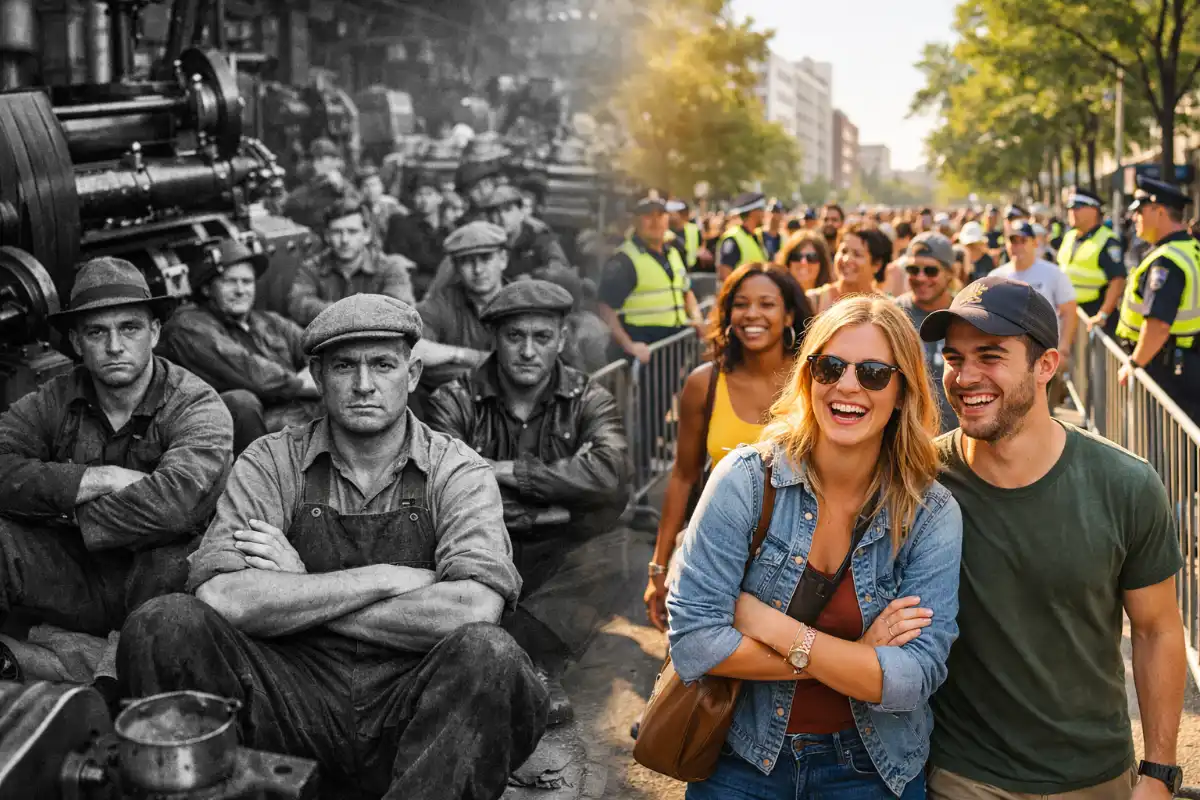
There was a time when workers could shut down a city. When a strike meant the factories went silent, the trains stopped running, the economy bled until the bosses listened. When the powerful looked at the people in the streets and felt something they don't feel anymore: fear. That time is over. They won. And most of us don't even know when we lost.
When the Machine Stopped
The 1930s were not polite.
In Flint, Michigan, in 1936, autoworkers didn't march outside the General Motors plant with clever signs. They occupied it. The Flint Sit-Down Strike lasted 44 days. Workers lived inside the factory. They controlled the means of production, literally. GM lost $50 million. The National Guard was called. Violence was threatened.
The workers won. GM recognized the United Auto Workers. The 40-hour work week, weekends, benefits, union rights, these weren't gifts. They were concessions extracted through economic pain.
In 1934, the Minneapolis Teamsters Strike turned the city into a war zone. Workers fought police in the streets. Two strikers were killed. Dozens wounded. The governor declared martial law. And when it was over, the workers won. The bosses signed.
In 1937, the Steel Workers Organizing Committee launched a wave of strikes that spread across the industrial Midwest. At Republic Steel in Chicago, police opened fire on a Memorial Day crowd, killing ten workers. It became known as the Memorial Day Massacre. The workers kept striking. Eventually, they won.
This is what power looked like. Not signs. Not chants. Not awareness. Shut down the machine and don't restart it until they meet your demands.
The machine stopped. That's why they listened.
France Remembers
May 1968. France.
What started as student protests became a general strike. Ten million workers, two-thirds of the French workforce, walked out. The country stopped. Factories occupied. Universities occupied. The economy paralyzed.
President Charles de Gaulle secretly fled to Germany. The man who had led Free France, who had defied Hitler, ran from his own people. He returned only after securing military support and called snap elections.
The workers got wage increases of 35%. The minimum wage jumped 25%. New rights. New protections. Not because de Gaulle was generous. Because ten million people stopped the machine and wouldn't restart it.
France still remembers how to do this. In 2023, when Macron tried to raise the retirement age, millions struck. Garbage piled in Paris streets. Refineries shut down. The government used a constitutional maneuver to bypass parliament because they couldn't win a vote.
France still fights. France still bleeds. That's why France still has something to fight over.
America marches on Saturday and goes back to work on Monday. That's why America has nothing left.
The Miners Who Brought Down a Government
Britain, 1974.
The National Union of Mineworkers demanded a 35% pay raise. The government said no. The miners struck. Coal supplies dwindled. Power stations couldn't run. Prime Minister Edward Heath declared a state of emergency and put Britain on a three-day work week to conserve electricity.
Three days. The most powerful economy in Europe, reduced to working three days a week because miners stopped digging coal.
Heath called an election, framing it as "Who governs Britain?" The people answered: not you. Labour won. The miners got their raise.
A strike brought down a government. That's power.
The ruling class never forgot. Ten years later, Margaret Thatcher came back for revenge.
How They Broke Us
The counterattack was systematic. Deliberate. And devastatingly effective.
In America, it started with Taft-Hartley in 1947. The law banned solidarity strikes, workers couldn't walk out to support other workers. It banned secondary boycotts. It allowed the President to invoke "national emergency" to break any strike. It required union leaders to sign affidavits swearing they weren't communists.
The weapon that built the American middle class was disarmed in one law. Everything that came after, the slow decline of unions, the stagnation of wages, the explosion of inequality, traces back to that moment.
In Britain, Thatcher finished what Heath couldn't. The 1984 miners' strike lasted a year. Thatcher had prepared, stockpiled coal, mobilized police, waited for winter to pass. She didn't need to negotiate. She needed to crush. And she did. The miners lost. The union broke. British labor never recovered.
"There is no such thing as society.", Margaret Thatcher
She meant it. The atomization was the point. Workers as individuals, not as a class. Employees, not labor. Human resources, a thing to be managed, not a force to be feared.
Then came globalization. "Strike and we move the factory to Mexico. To China. To Vietnam." The threat didn't need to be spoken. Everyone understood. Your leverage disappeared the moment capital became mobile and labor stayed rooted.
Then came the gig economy. No employees, just independent contractors. No union, just an app. No collective bargaining, just accept the terms or starve. Uber drivers aren't workers, they're entrepreneurs. Amazon warehouse workers aren't employees, they're associates. The language changed. The power didn't.
By the time they were done, the strike was defanged. Legal restrictions, economic threats, structural atomization. The weapon that built the middle class was taken apart piece by piece until nothing was left but the memory of what it used to do.
The Weekend They Sold Us
Here's the deal nobody talks about:
They gave us the weekend. We gave them our leverage.
Saturday and Sunday. Two days off. It feels like a victory. It feels like a right. But it's also a container. A boundary. A permission structure.
Protest happens on Saturday. You march, you chant, you hold your sign. Sunday you recover. Monday you go back to work. The machine never stops. Your boss doesn't notice. The economy doesn't flinch.
A protest that fits inside a weekend is a protest that fits inside the system. It's allocated time. Permitted dissent. A pressure valve that releases steam without ever threatening the boiler.
The workers who won didn't protest on Saturday. They struck on Monday. And Tuesday. And Wednesday. Until the silence in the factories was louder than any chant.
We traded that for a parade permit and two days off.
The truth doesn't trend. It survives because a few still care enough to keep it alive.
Keep The Kade Frequency transmitting.
The Absorption Machine
The system learned.
In the 1960s, fire hoses and police dogs turned public opinion against the segregationists. The violence was visible. The brutality was broadcast. It backfired.
So they stopped. Not the oppression, the visibility.
Now they don't beat protestors on camera. They contain them. Permit them. Route them down approved streets at approved times. They assign police to "protect" the march, which also means control it. They cover it on the news with a kind of ritual familiarity: here's the annual march, here are the signs, here are the crowd estimates, here's what the organizers say, here's the dismissive quote from the other side. Weather at eleven.
The protest becomes content. It fills airtime. It generates engagement. It performs opposition without creating threat.
And then it ends. Everyone goes home. The algorithm moves on. The machine keeps running.
This is absorption. The system takes the energy of dissent and converts it into something harmless. A march becomes a parade. A movement becomes a brand. A revolution becomes a hashtag.
They don't need to crush you if they can contain you. They don't need to silence you if they can make your voice part of the background noise.
The Numbers That Don't Matter
Eight million people marched yesterday.
The Women's March in 2017 put four million in the streets, the largest single-day protest in American history at the time. Trump served his full term. Won again in 2024.
Black Lives Matter in 2020 brought out 15 to 26 million people over the summer, the largest protest movement in American history. Police budgets in most major cities went up, not down. The legislation failed. The momentum dissipated.
Occupy Wall Street spread to every major city. Banks got bigger. Inequality got worse. Nobody went to jail for 2008.
The Iraq War protests in 2003 were the largest global protests in human history, 10 to 15 million people worldwide on a single day. The war happened anyway. A million dead.
March for Our Lives after Parkland. Climate strikes with millions of students. The numbers keep getting bigger. The results keep not coming.
At what point do we admit the numbers don't matter?
A million people marching past a building is a parade. A hundred people blockading a building is a disruption. One matters to the people inside. The other is a photo op.
The system isn't counting your bodies. It's counting whether the machine still runs.
What Actually Scares Them
The general strike. When everyone stops working. Not a march, a shutdown. The French know. The Poles knew when Solidarity brought down Soviet control. The Indians knew when Gandhi's salt march became a nationwide non-cooperation movement.
That's illegal in most countries now. Funny how that works.
The tax revolt. When people stop paying. Not protests about taxes, actual refusal. The American Revolution started this way. The government runs on your money. Stop providing it and watch how fast they listen.
The bank run. When people pull their money out. Banks operate on fractional reserve, they don't have your money. If enough people withdraw, the system collapses. This is why they work so hard to maintain "confidence."
Mass non-compliance. When people simply stop obeying. Not violently, just stop. Refuse to cooperate. Refuse to participate. The system requires your participation. It can't function without your consent. Withdraw consent and the machine has no fuel.
These things are illegal. Inconvenient. Scary. They have consequences. You might lose your job. Your house. Your freedom.
That's how you know they would work.
The things that are easy are the things that don't threaten. The things that threaten are the things they made illegal. The law isn't neutral, it's a map of what they fear.
Why We Don't
We don't strike because we can't afford to. Paycheck to paycheck. No savings. No safety net. One missed week and you're behind on rent. Two missed weeks and you're choosing between food and electricity. A month and you're homeless.
This isn't an accident. The precarity is the point.
A worker with six months of savings is a worker who can strike. A worker with nothing is a worker who shows up no matter what. The economy has been engineered to keep you desperate enough to comply.
We don't strike because we're alone. No union. No community. No collective identity. You're not a worker, you're a freelancer, a contractor, a gig economy entrepreneur. You're not part of a class, you're an individual. Your struggles are personal failures, not systemic problems.
The atomization is the point.
We don't strike because we're scared. The examples have been made. Air traffic controllers fired. Miners crushed. Union organizers blacklisted. Amazon workers surveilled. The message is clear: step out of line and you're destroyed.
The fear is the point.
So we march on Saturday instead. It's something. It feels like something. It's what we can afford to give. And maybe, maybe, if enough people show up, something will change.
But it doesn't. It hasn't. And deep down, we know it won't.
The Hard Truth
Here's the thing nobody wants to hear:
The marches aren't working. They haven't worked in decades. The numbers keep growing and the results keep shrinking because the system has adapted. It learned how to absorb dissent without being threatened by it.
This doesn't mean the people marching are stupid. They're not. They're doing what they know how to do, what they've been taught is the way to make change. Show up. Be counted. Raise awareness.
But awareness isn't power. Numbers aren't leverage. Visibility isn't threat.
Power is the ability to impose costs. The workers in Flint had power because GM lost $50 million. The French in 1968 had power because the country couldn't function. The miners in 1974 had power because the lights went out.
A march imposes no costs. It asks politely. It hopes. It performs.
The question isn't whether to give up. It's whether to keep doing something that doesn't work, or to find what does.
What Would It Take
A general strike in America would require something that doesn't exist: solidarity across industries, races, regions, and political tribes. It would require workers who compete with each other to see themselves as a class. It would require people with nothing in common to discover they have everything in common.
It would require a culture that values collective action over individual hustle. That sees "we" before "me." That understands your coworker's struggle is your struggle, whether you like them or not.
It would require breaking the fear. The fear of losing the job. The fear of being alone. The fear of consequences. The fear that has been deliberately cultivated to keep you in line.
It would require organization. Real organization. Not a Facebook group, a structure. Leadership. Resources. Strategy. The labor movement took decades to build the infrastructure that won the 1930s. That infrastructure was dismantled. It would have to be rebuilt.
It would require sacrifice. Real sacrifice. Not Saturday afternoon, Monday morning. Not a sign, a risk. Not awareness, commitment.
Is America capable of this?
I don't know. I really don't.
But I know what's not capable of changing anything: another march, another hashtag, another record turnout that produces nothing.
The Frequency That Remains
I'm not telling you not to march. March if it connects you to others. March if it reminds you that you're not alone. March if it's the only thing you can do.
But don't call it revolution. Don't call it resistance. Don't confuse the ritual with the result.
The people who won, the workers in Flint, the French in '68, the miners who brought down a government, they didn't win because they showed up. They won because they stopped showing up. To work. To compliance. To the machine that needed them more than they needed it.
That's the frequency that's been lost. The understanding that your labor is your leverage. That the system runs on your participation. That the most powerful word isn't "yes we can", it's "no."
No, I won't work today.
No, I won't pay this.
No, I won't comply.
No, I won't pretend this is normal.
When enough people say no at the same time, the world changes. It's happened before. It can happen again.
But not on Saturday. Not with a permit. Not while the machine keeps running.
The day we scare them again is the day we stop asking and start stopping.
Until then, the march is a parade.
And they're not afraid of parades.
Independent investigations. No sponsors. No filters.
Get investigations delivered.
A. Kade
The Kade Frequency, No sponsors, no filters, no propaganda.
Frequently Asked Questions
Why did strikes work in the past but not today?
Historical strikes imposed economic costs on the powerful. Workers in Flint occupied factories for 44 days, costing GM $50 million. French workers in 1968 paralyzed the entire economy with a general strike of 10 million. British miners caused nationwide blackouts and brought down a government. These actions threatened the system's ability to function. Modern protests march on Saturday and return to work Monday, imposing no costs and creating no disruption the system can't easily absorb.
What is the Taft-Hartley Act and why does it matter?
The Taft-Hartley Act of 1947 was the law that broke American labor. It banned solidarity strikes — workers couldn't walk out to support other workers. It banned secondary boycotts. It allowed the President to invoke "national emergency" to break any strike. It required union leaders to sign anti-communist affidavits. This single law dismantled the most effective tools of the American labor movement, and everything that followed — declining unions, stagnant wages, exploding inequality — traces back to that moment.
Why are general strikes illegal in most countries?
General strikes are illegal or heavily restricted precisely because they work. In the US, Taft-Hartley banned solidarity strikes. In the UK, the Trade Union Act requires 50% turnout and 40% approval for strikes in essential services — thresholds designed to be nearly impossible to meet. In Germany, political strikes are ruled unconstitutional; only wage disputes qualify. The law isn't neutral — it's a map of what the powerful fear. The things that are illegal are the things that would threaten them.
Why don't Americans strike anymore?
Three engineered conditions: precarity (paycheck-to-paycheck living means workers can't afford to miss a single week of work), atomization (gig economy, no unions, no collective identity — you're an "entrepreneur," not a worker), and fear (examples made of fired air traffic controllers, crushed miners, surveilled Amazon organizers). These conditions weren't accidents. The economy was deliberately restructured to make collective action nearly impossible.
What would actually scare the powerful today?
General strikes that shut down the economy. Tax revolts that starve the government. Bank runs that threaten financial stability. Mass non-compliance that withdraws consent from the system. These actions impose real costs and threaten the machine's ability to function. That's precisely why they're illegal, heavily penalized, or culturally unthinkable. The things that are easy and permitted are the things that don't threaten. The things that would work are the things they made impossible.