Tone It Down!
"How dare you tell me this?" That's what EU chief prosecutor Laura Kövesi said when a senior Commission official asked her to soften her public messaging on corruption. In six years, her office has opened 3,600 cases and frozen over a billion euros.
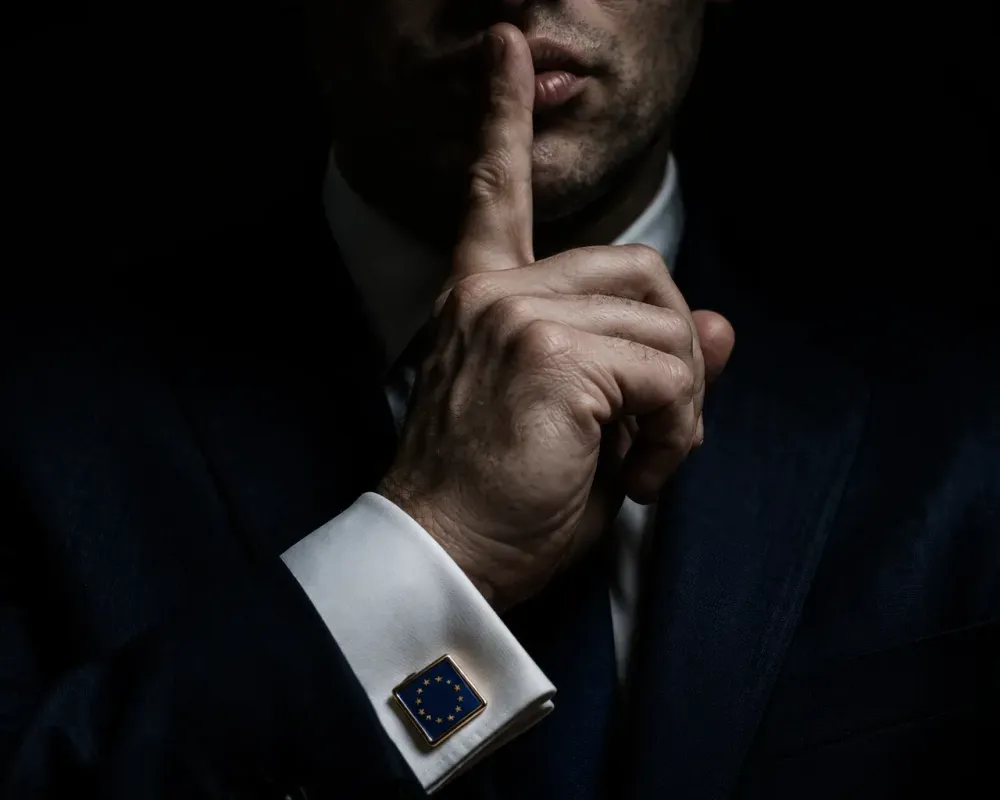
"Tone it down." That's what a senior European Commission official told Laura Kövesi, the EU's chief prosecutor. Tone down the public messaging about corruption. Tone down the exposure of fraud. Tone down the inconvenient truth that the institution lecturing the world about rule of law is rotting from the inside. The cop was told to stop catching criminals. And the criminals were her bosses.
The Quote That Says Everything
Laura Codruța Kövesi runs the European Public Prosecutor's Office. EPPO. The first-ever EU-level body with the power to investigate and prosecute crimes against the Union's financial interests. Fraud. Corruption. Money laundering. The stuff Brussels pretends doesn't happen while it's happening in every corridor.
In six years, her office has opened more than 3,600 cases. Frozen over a billion euros. Gone after people at the highest levels of the European Union, people who thought they were untouchable.
And for this, she was told to shut up.
"How dare you tell me this? We are independent. And if there is a case, it is our mandate to investigate it.", Laura Kövesi
That's what she told them. But think about the fact that she had to say it at all.
A senior Commission official, she hasn't named who, walked into her office and suggested, politely no doubt, in that particular Brussels way, that perhaps the public messaging could be... softer. Less alarming. Less specific. Less damaging to the institution's reputation.
Translation: Stop telling people how corrupt we are.
What She Found
Let's be clear about what the European Public Prosecutor's Office has been investigating.
This isn't about low-level fraud. This isn't about some regional official padding expense reports. This is systemic. Institutional. At the top.
The biggest case? The largest vaccine procurement contract in EU history. The one where European Commission President Ursula von der Leyen personally negotiated with Pfizer's CEO via text messages. The one where those text messages mysteriously disappeared. The one where the Commission bought 1.8 billion vaccine doses, ten times what the EU needed, at prices that have never been disclosed.
That investigation is ongoing. And Kövesi says member states are dragging their feet, delaying cooperation, making her job harder at every turn.
Why would they do that?
Because von der Leyen is one of them. Because the system protects itself. Because when the rot reaches the top, the whole structure has an interest in keeping it quiet.
The Commission as Evaluator and Arbiter
Here's how corruption works in Brussels.
The European Commission awards contracts. Billions of euros flow from EU funds to companies, NGOs, member states, development programs. Someone has to decide who gets the money. Someone has to evaluate the bids. Someone has to make sure the process is fair.
That someone is the Commission itself.
No meaningful external oversight. No independent audit with teeth. The institution that hands out the money is the same institution that checks whether the money was handed out properly. They evaluate and arbitrate their own decisions.
And when the EU's own prosecutor opens 3,600 cases, the institution's response isn't "thank you for exposing this." It's "tone it down."
The Commission operated for decades with almost no internal controls. Tender procedures where the same people setting the rules were also picking the winners. Favoritism baked into the architecture. And when someone finally started looking, really looking, they told her to stop talking about what she saw.
The Mogherini Case
The Commission official who told Kövesi to tone it down might have had specific concerns.
Like, for example, the investigation into Federica Mogherini, former EU High Representative for Foreign Affairs. One of the most powerful positions in Brussels. The EU's top diplomat during the Juncker Commission.
The EPPO opened an investigation into a tender that the European External Action Service awarded to the College of Europe in Bruges. A nine-month training program for young diplomatic professionals. Sounds innocent enough. But there are "serious suspicions" of favoritism. Rigged bids. A contract that went where it was always going to go, with the process as theater.
And Mogherini's name is attached.
Also under investigation: Stefano Sannino, former Secretary-General of the External Action Service. The number two.
These aren't fringe figures. These are the people who ran European foreign policy. The people who lectured Eastern Europe about corruption. The people who withheld funds from Hungary and Poland over "rule of law concerns."
And now their own prosecutor is investigating them for fraud.
No wonder someone wanted her to tone it down.
Qatargate Never Ended
Remember Qatargate?
December 2022. Belgian police raiding the homes of European Parliament officials. Finding bags of cash, €1.5 million in total. Arresting a sitting Vice President of the European Parliament, Eva Kaili, who was literally caught trying to hide the evidence.
The charges: corruption, money laundering, organized crime. Qatar and Morocco allegedly paying European officials to kill resolutions criticizing their human rights records. Buying favorable treatment on visa deals. Purchasing the conscience of the institution that claims to represent 450 million Europeans.
That scandal was supposed to be a wake-up call. The Parliament promised reforms. Ethics bodies. Transparency rules. Accountability.
Three years later, the ethics body is "stalled in committee procedure." The reforms never happened. And corruption cases keep multiplying.
In 2025, two more MEPs, Elisabetta Gualmini and Alessandra Moretti, had their immunity lifted for the Belgian investigation. In 2023, investigators found €280,000 in cash in the apartment of MEP Marie Arena's son. The son whose apartment happens to be right next to hers.
The investigating judge was recused because his son is in a cannabis business with Arena's son. You can't make this shit up.
And through it all, the Parliament President Roberta Metsola, who presided over the most corrupt Parliament in EU history, never resigned. Never apologized. Instead, she demanded that Azerbaijan's parliament "take measures" against deputies who pointed out the corruption in her institution.
The audacity. The fucking audacity.
The truth doesn't trend. It survives because a few still care enough to keep it alive.
Keep The Kade Frequency transmitting.
The Lecturers and the Lectured
The European Union loves to lecture.
It lectures Hungary about rule of law. It lectures Poland about judicial independence. It lectures candidate countries about meeting "Copenhagen criteria" for governance and anti-corruption. It withholds funds. It threatens sanctions. It conditions membership on reforms.
The EU is very concerned about corruption, in other places.
When Romanian prosecutor Laura Kövesi was fighting corruption in her own country, the EU championed her. She was a hero. She prosecuted over 1,200 people for corruption, including a sitting prime minister. The European institutions celebrated her work, used her as an example, held her up as proof that the Eastern European countries could clean themselves up if they just followed the rules.
Then they gave her the job of cleaning up Brussels.
And now they're telling her to tone it down.
The irony is perfect. The woman the EU used as a symbol of anti-corruption in the periphery is now exposing corruption at the center. And the center doesn't like it.
The Von der Leyen Problem
Ursula von der Leyen is the President of the European Commission. The most powerful unelected official in Europe. The face of the EU's response to COVID, to Russia, to climate change, to everything.
She is also, potentially, a subject of criminal investigation.
The vaccine texts. The Pfizer deal. The contracts that have never been fully disclosed. The prices that remain secret. The doses that were never needed. The billions that flowed somewhere.
The European Ombudsman called the Commission's handling of the texts "maladministration." The New York Times sued for access. The European Parliament demanded answers. Von der Leyen's response has been silence, obstruction, and lawyerly non-denial denials.
And she was just reappointed to another five-year term.
The EU Parliament that should have demanded accountability instead confirmed her for another mandate. The same Parliament with members under investigation for corruption. The same Parliament that can't pass its own ethics reforms. The same Parliament where cash was literally found in bags.
They confirmed her anyway. Because the system protects itself. Because at the top, there is no accountability. There is only the game.
Why Member States Don't Help
Kövesi isn't just fighting the Commission. She's fighting the member states.
The EPPO needs cooperation from national authorities to do its job. It needs documents. It needs access. It needs governments to actually enforce the rulings and support the investigations.
They don't.
Some countries refuse to cooperate at all. Hungary isn't even a member of EPPO. Neither is Poland, though Poland is joining now. Sweden, Denmark, and Ireland opted out entirely. They get EU money but refuse EU-level prosecution of fraud involving that money.
Even the countries that are members drag their feet. Requests go unanswered. Documents arrive late or redacted. Bureaucratic obstacles multiply. Everyone has an excuse. Everyone has a reason why this particular investigation can't move forward right now.
And Kövesi keeps going anyway. 3,600 cases. A billion euros frozen. The woman is either fearless or stupid, and given her track record in Romania, it's not stupid.
But there's only so much one prosecutor can do when the entire system is designed to protect itself.
The Real Message
"Tone it down" wasn't a suggestion. It was a warning.
It was the institution telling its own watchdog: you've gone far enough. You've made your point. Now dial it back before you become a problem.
Because exposure is a threat. Not to any individual corrupt official, they can be sacrificed if necessary. But to the legitimacy of the whole project. To the idea that the EU is different. Better. Cleaner than the nation-states it lectures. More principled than the Eastern Europeans it disciplines. More trustworthy than the populists it condemns.
If the public understood how deep the rot goes, they might start asking uncomfortable questions.
Questions like: Why is the institution that withheld funds from Hungary over corruption now under investigation for corruption itself?
Questions like: Why did the Commission President's text messages disappear right when investigators wanted them?
Questions like: Why are MEPs being caught with bags of cash while the Parliament can't pass basic ethics reforms?
Questions like: If this is what they found, what haven't they found?
The Billion-Euro Question
A billion euros frozen.
Think about that number. That's just the cases where EPPO moved fast enough, found enough evidence, and had enough cooperation to actually freeze assets. That's not convictions. That's not recoveries. That's just what they've managed to hold onto while investigations proceed.
How much more is out there? How much has already disappeared? How much was never caught because the prosecutor was told to tone it down, and her predecessors didn't have teeth at all?
The EU budget is around €170 billion per year. The European Court of Auditors has refused to sign off on the accounts for decades, noting "material error" year after year. Nobody knows exactly how much is stolen, wasted, or redirected to friends of the people in charge.
But a billion frozen in six years gives you a hint.
And the institution's response to learning this was: please be quieter about it.
What Kövesi Understands
Laura Kövesi knows how this works. She's been here before.
In Romania, when she was head of the National Anticorruption Directorate, she went after the powerful. Prime ministers. Mayors. Business tycoons. The political class that had looted the country since communism fell.
They tried to fire her. They changed the laws to limit her power. They accused her of abuse of office. They did everything possible to make her stop.
She didn't stop. She kept prosecuting. Eventually they removed her, but by then she'd convicted over a thousand people and become the most respected prosecutor in the country.
The EU made her their prosecutor precisely because she couldn't be intimidated.
Now they're learning what that means.
She won't tone it down. She said so publicly. She's telling the world that Commission officials tried to silence her, and she refused. That's not an accident. That's a woman who knows the game, knows the stakes, and is making sure there's a record.
If they fire her, everyone will know why.
The System's Last Defense
The final defense of a corrupt system isn't denial. It's normalization.
Everyone does it. It's how things work. You can't change human nature. These are complex situations. The rules are unclear. There are always two sides.
That's the voice you hear when someone says "tone it down." Not "you're wrong", that can be fought. But "you're making too big a deal of this." That's how corruption survives. Not by winning arguments, but by making the arguments seem pointless.
Yes, there's fraud. Yes, there's favoritism. Yes, the vaccine contracts were opaque. Yes, the MEPs had cash in their bags. But what can you do? This is how institutions work. Be realistic. Be pragmatic. Don't be naive.
Tone it down.
That's the request of every corrupt system to every honest investigator. Don't be so loud. Don't make us look bad. Don't force us to actually change.
And to her credit, Kövesi's answer was: How dare you.
What Happens Next
Nothing will happen next. That's the point.
Kövesi will continue her investigations. Some cases will succeed. Most will be slow-walked into irrelevance. The Commission will continue operating without meaningful oversight. Von der Leyen will serve another term. The vaccine texts will stay disappeared. The ethics body will stay stalled. The MEPs will keep their immunity until Belgian prosecutors go through years of procedural motions.
And the EU will continue lecturing Hungary about rule of law.
That's the tell. That's how you know the system isn't serious about reform. They'll punish the periphery for sins the center commits daily. They'll withhold funds from countries that don't meet "standards" that Brussels itself can't meet. They'll talk about values while their own officials stuff cash in bags.
The European Union isn't a corruption-free zone surrounded by problematic member states. It's a corruption system with better PR. The rot is at the center. The periphery just gets caught more often because nobody's telling their prosecutors to tone it down.
The Question Nobody Asks
Here's the question nobody in Brussels wants to hear:
If this is what we know, what don't we know?
If a prosecutor with limited resources and constant obstruction has opened 3,600 cases and frozen a billion euros, what would a fully-supported investigation find? What would happen if member states actually cooperated? What if the ethics body existed and had power? What if the Commission couldn't investigate itself?
Nobody wants to know the answer. Because the answer might be that the European Union, the institution that claims moral authority over a continent, is as corrupt as any government it criticizes. Maybe more. Because at least the corrupt governments don't pretend otherwise.
At least Viktor Orbán doesn't lecture about transparency while hiding vaccine contracts.
At least the Poles don't demand ethics reforms while their Parliament President presides over Qatargate.
At least the Hungarians don't tell their prosecutor to tone it down.
The EU does all of this. And then wonders why populism rises. Why trust falls. Why the project that was supposed to unite Europe keeps fracturing along every possible line.
Maybe it's because people can sense the lie. Maybe it's because "tone it down" is the motto of every institution that has something to hide. Maybe it's because the European Union has become exactly what it was supposed to prevent: an unaccountable elite extracting wealth from a continent while lecturing everyone else about values.
Laura Kövesi won't tone it down.
Neither will we.
Independent investigations. No sponsors. No filters.
Get investigations delivered.
A. Kade
The Kade Frequency, No sponsors, no filters, no propaganda.
Frequently Asked Questions
Who is Laura Kövesi and why is she significant?
Laura Kövesi is the head of the European Public Prosecutor's Office (EPPO), the first EU-level body with power to investigate and prosecute crimes against EU financial interests, fraud, corruption, money laundering. In six years, her office has opened over 3,600 cases and frozen more than a billion euros. Previously, she was Romania's chief anti-corruption prosecutor, where she convicted over 1,200 people including a sitting prime minister. A senior Commission official asked her to "tone down" public messaging about corruption. She refused.
What is the von der Leyen vaccine investigation about?
The EPPO is investigating the largest vaccine procurement contract in EU history. European Commission President Ursula von der Leyen personally negotiated with Pfizer's CEO via text messages. Those texts later disappeared. The EU purchased 1.8 billion vaccine doses, roughly ten times what was needed, at prices that remain undisclosed. The European Ombudsman called the Commission's handling "maladministration." Member states are allegedly delaying cooperation with the investigation.
What was Qatargate?
Qatargate was a 2022 corruption scandal where Belgian police raided homes of European Parliament officials and found €1.5 million in cash. Vice President Eva Kaili was arrested while allegedly trying to hide evidence. Officials were charged with taking bribes from Qatar and Morocco to influence EU resolutions on human rights and visa deals. Despite promises of reform, the Parliament's ethics body remains "stalled in committee procedure" three years later. Additional MEPs have since been implicated.
Why don't EU member states cooperate with EPPO?
Several countries — Hungary, Sweden, Denmark, and Ireland, opted out of EPPO entirely. They receive EU funds but refuse EU-level prosecution of fraud involving those funds. Even participating countries drag their feet: document requests go unanswered, responses arrive late or redacted, bureaucratic obstacles multiply. The system protects itself because investigations touch senior officials in both member state governments and EU institutions.
How does EU corruption relate to EU criticism of Hungary and Poland?
The EU withholds funds from Hungary and Poland over "rule of law concerns" while its own institutions face corruption investigations. The Commission that lectures Eastern Europe about governance has officials under investigation for fraud. Parliament President Roberta Metsola presided over Qatargate without resigning. Former High Representative Federica Mogherini is under investigation for favoritism in contracts. The institution demands standards from the periphery that the center cannot meet.