The Vassals: How Europe Chose Silence While One Man Said No
Friedrich Merz stood silent as Trump threatened Spain. Pedro Sánchez said "No to war." Investigation documents European complicity in America's war on Iran, and the one leader who refused to be a vassal.
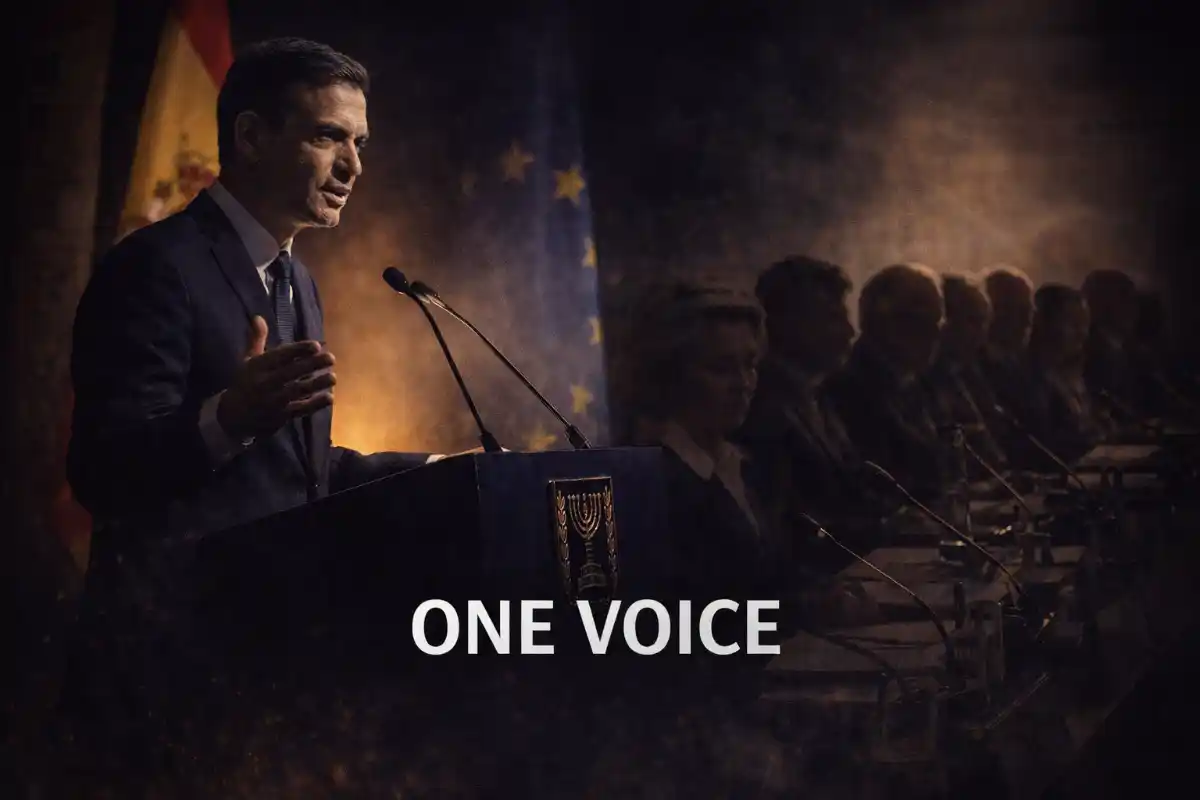
On March 4th, 2026, Friedrich Merz stood in the Oval Office and watched Donald Trump threaten to cut off all trade with Spain. He said nothing. He did not defend a fellow EU member. He did not invoke the principle of European solidarity that Brussels loves to invoke when it needs something. He stood there like a man who had already decided that his place in the new order was on his knees.
The next day, Pedro Sánchez went on national television and gave Europe the speech its leaders have been too cowardly to give.
"No to war."
Three words. That is all it took to distinguish the Prime Minister of Spain from every other major leader on the continent. Three words that Merz could not say. That Starmer would not say. That von der Leyen has spent two weeks carefully avoiding.
This is the story of how Europe surrendered its voice in the most consequential war of the 21st century, and the one leader who refused to surrender his.
The truth doesn’t trend. It survives because a few still care enough to keep it alive.
Keep The Kade Frequency transmitting.
The Silence of the Lambs
Let us be precise about what Europe's leaders have done since February 28th.
They have condemned Iran's retaliatory strikes as "indiscriminate" and "inexcusable." They have expressed "concern" about civilian casualties. They have called for "de-escalation" while providing logistical support for escalation. They have wrung their hands about the "humanitarian situation" while refusing to name who created it.
What they have not done, with one exception, is state the obvious: that the United States and Israel launched a war of aggression against a sovereign nation, killed its head of state, and are now systematically destroying its civilian infrastructure while the world watches.
Ursula von der Leyen reportedly supports regime change in Iran. NATO Secretary General Mark Rutte says Europe is "supportive" of the strikes because Iran is a "threat," and that he believes the US "knows what it is doing." The UK has provided defensive military support and access to Diego Garcia. France has quietly authorized American forces to use French bases. Germany has offered what Merz calls "support" for getting rid of the "terrible terrorist regime."
59% of Germans oppose this war. Their chancellor went to Washington anyway and nodded along.
This is what vassalage looks like in 2026. Not occupation. Not coercion at gunpoint. Just a quiet understanding that when America starts a war, Europe's job is to enable it, pay for its consequences, and keep its mouth shut.
The Man Who Said No
Pedro Sánchez is not a radical. He leads a center-left coalition in a NATO member state. Spain hosts two joint US military bases, Rota and Morón, that Washington considers strategically vital. Four million Americans visit Spain every year. Amazon just announced $40 billion in data center investments there.
Sánchez had every incentive to do what Merz did. Nod along. Express concern. Issue carefully worded statements that mean nothing. Keep the relationship smooth.
Instead, he refused to allow US forces to use Spanish bases for operations against Iran. When Trump threatened to cut off all trade with Spain in response, Sánchez did not back down. He went on television and told the truth.
"It is absolutely unacceptable that those leaders who are incapable of improving people's lives use the fog of war to cover up their failures and line the pockets of the few, the usual ones."
He named the profiteers. He drew the parallel to Iraq, the last time an American administration "dragged us into a war in the Middle East" with promises of democracy and stability, only to unleash "the greatest wave of insecurity that our continent had suffered since the fall of the Berlin Wall."
And then he said what no other European leader has been willing to say about the men standing next to each other in the Oval Office:
"It is naive to think that practicing servile and blind following is a way to lead."
That was aimed directly at Friedrich Merz. At Giorgia Meloni. At every European leader who has decided that the path to relevance runs through Washington's approval.
Independent investigations. Imperial expansion exposed. Pattern documented.
Get investigations delivered.
The Price of Compliance
While Europe's leaders compete for Trump's favor, their citizens are paying the price of a war they did not choose.
European gas prices have nearly doubled since February 28th. The Dutch TTF benchmark jumped from the low €30s to over €60 per megawatt hour. EU gas storage sits at 30%, below recent years. Germany's reserves are at 21.6%. France is in the low 20s.
Qatar, which provides 12-14% of Europe's LNG imports, has suspended production after Iranian drone attacks on its facilities. The Strait of Hormuz, through which 20% of global oil and LNG passes, is effectively closed. And Europe, which spent four years "diversifying" away from Russian energy by becoming dependent on seaborne LNG, is now discovering what happens when the sea routes go through a war zone.
The Bruegel think tank puts it plainly: Europe is "far less dependent on Gulf oil and LNG than China, India, Japan or South Korea, but it is not insulated." Any blockage of Hormuz "could trigger immediate price spikes in global oil and LNG markets, hitting Europe regardless of its relatively limited direct imports."
The consequences are already radiating outward. In India, the world's second-largest LPG importer, restaurants in Bengaluru are shutting down. Families in Bhopal wait 5-7 days for cooking gas cylinders. Domestic LPG prices jumped ₹60 overnight. Commercial cylinders rose ₹115. A geopolitical crisis that started in Washington has traveled through the Persian Gulf and into Indian kitchens.
And Russia, the country Europe spent four years trying to isolate, is watching this unfold with undisguised satisfaction. Putin is now "considering" cutting off all remaining fuel exports to Europe preemptively, while the Kremlin holds "energy market stabilization" talks with Washington. Hungary is calling for sanction’s relief. Von der Leyen insists returning to Russian gas would be a "strategic blunder”, but when the alternative is $100 oil and doubled gas prices, strategic blunders start to look attractive.
This is what Europe's silence has purchased: an energy crisis triggered by a war it could not prevent, fought by an ally it cannot influence, for objectives no one can clearly articulate.
The Merz Problem
Friedrich Merz's performance in Washington deserves special attention because it so perfectly captures Europe's failure.
Here was the new German Chancellor, leader of Europe's largest economy, visiting the White House in the middle of a war. The American president used the occasion to threaten a fellow EU member state. Merz did not object. When asked about Spain, he agreed with Trump's criticism of Madrid's defense spending.
A day later, Merz privately told reporters:
"There's no plan."
He knows. He understands that the United States has launched a war without clear objectives, without an exit strategy, without any articulated vision for what comes after. He just will not say it publicly, because saying it publicly might upset Washington, and upsetting Washington is something German chancellors no longer do.
Merz has since announced that he is conferring with Macron about extending France's nuclear deterrent to European allies. At Munich, he declared that the rules-based international order "no longer exists in that form." He is not stupid. He can see what is happening.
But seeing is not the same as acting. And when the moment came to choose between European solidarity and American approval, Merz chose to stand in silence while Trump threatened Spain.
The Iraq Parallel
Sánchez invoked Iraq for a reason. In 2003, the United States launched a war against a Middle Eastern country to eliminate weapons of mass destruction that did not exist, bring democracy that never arrived, and guarantee security that collapsed into chaos.
The result: the rise of ISIS, a migration crisis that reshaped European politics, higher energy prices, and a generation of instability. The countries that supported that war gained nothing. The countries that opposed it, France and Germany, most notably, were proven right.
Today, the United States has launched a war against Iran to... what, exactly? The nuclear program is not the stated objective. Regime change is not the stated objective. Senator Chris Murphy has called the war plans "incoherent." Defense Secretary Hegseth talks about "degrading" Iranian capabilities. Trump says there is "nothing left to target”, then orders more strikes.
The Pentagon has confirmed that outdated intelligence led to a US missile strike on an Iranian girls' elementary school that killed approximately 175 children. The school strike that Trump initially blamed on Iran.
This is the war that Europe is "supporting." This is the operation that Rutte believes the US "knows what it is doing" with. These are the strikes that Merz could not bring himself to question while standing in the Oval Office.
Iraq was supposed to be the lesson. Europe was supposed to have learned. Instead, the lesson was: follow America into the next disaster, just more quietly.
What Sánchez Understands
Pedro Sánchez is not an anti-American radical. He is not a pacifist. He sent the Spanish frigate Cristóbal Colón to join French and Greek forces defending Cyprus, an EU member under threat from Iranian drones. His position is not neutrality; it is the refusal to participate in aggression while defending against its consequences.
What Sánchez understands, and what Europe's other leaders refuse to acknowledge, is that leadership does not mean obedience.
"We will not be complicit in something that is bad for the world, and that is contrary to our values and interests, simply out of fear of reprisals from someone."
That "someone" is Donald Trump. And the "reprisals" are trade threats that cannot even be implemented because EU trade policy is set collectively, not by individual member states.
When Trump threatened to cut off all trade with Spain, the European Council President responded: "We reaffirm our firm commitment to the principles of international law and the rules-based order everywhere in the world." Macron called Sánchez to express "solidarity." The EU trade spokesperson reminded everyone that "the Commission will ensure that the interests of the European Union are fully protected."
In other words: Spain cannot be bullied alone. The mechanism for collective defense exists. It just requires someone to invoke it, and Sánchez did.
The Verdict
On Day 13 of this war, the numbers speak for themselves: 1,300 to 2,000 Iranian civilians dead. 3.2 million Iranians displaced. 634 Lebanese dead. 750,000 Lebanese displaced, 100,000 in the last 48 hours alone. 175 schoolchildren killed by an American missile that the White House initially blamed on Iran. Eight people killed on a Beirut beach where displaced families were trying to survive.
The International Energy Agency has released 400 million barrels from emergency reserves, the largest coordinated release since the agency was created in 1974. Their assessment: this war has caused "the largest supply disruption in the history of the global oil market." And still, oil climbed back above $100.
This is the war that Europe is quietly enabling. The war it will not name. The war its citizens oppose but its leaders will not stop.
One man stood up and said no. One man called it what it is. One man refused to be a vassal.
The rest of them? They are still standing in the Oval Office, watching their ally be threatened, saying nothing.
History will remember who spoke and who stayed silent.
We already know.
Frequently Asked Questions
What did Pedro Sánchez say about the Iran war?
Spanish Prime Minister Pedro Sánchez delivered a televised address on March 5, 2026, summarizing his position in three words: "No to war." He called the US-Israeli strikes on Iran "reckless and illegal," drew parallels to the 2003 Iraq invasion, and accused leaders like Trump and Netanyahu of using "the fog of war to cover up their failures and line the pockets of the few."
Sánchez also criticized European leaders who remained silent, stating: "It is naive to think that practicing servile and blind following is a way to lead." This was widely interpreted as aimed at German Chancellor Friedrich Merz, who stood silent in the Oval Office while Trump threatened Spain.
Why did Spain refuse to let the US use its military bases for the Iran war?
Spain hosts two joint US military bases, Rota and Morón, that Washington considers strategically vital. The Sánchez government refused to allow these bases to be used for offensive operations against Iran, citing concerns about international law, the lack of clear war objectives, and the lessons of the Iraq war.
Spain did, however, send its most advanced warship, the Cristóbal Colón, to defend Cyprus, an EU member threatened by Iranian drone attacks. Sánchez's position is not pacifism or neutrality, it is refusal to participate in aggression while defending against its consequences.
What did Trump threaten Spain with?
During a White House press briefing alongside German Chancellor Friedrich Merz on March 4, 2026, President Trump threatened to "cut off all trade" with Spain and "cut off all dealings" with the country in response to its refusal to support US military operations in Iran. Treasury Secretary Scott Bessent accused Spain of "putting American lives at risk."
However, trade policy in the EU is negotiated collectively, not by individual member states, making Trump's threat difficult to implement. The European Council and Commission expressed solidarity with Spain and reaffirmed collective defense of EU interests.
What was Friedrich Merz's response to the Iran war?
German Chancellor Friedrich Merz visited the White House on March 4, 2026, while Trump was threatening Spain. Merz did not object or defend Spain. When asked about Madrid's position, he agreed with Trump's criticism of Spain's defense spending. Publicly, Merz expressed "support" for the US effort to eliminate the "terrible terrorist regime" in Iran.
Privately, however, Merz reportedly told journalists: "There's no plan." A poll showed 59% of Germans opposed the US-Israeli strikes, but Merz chose not to voice that opposition publicly.
How has the Iran war affected European energy prices?
European gas prices nearly doubled following the start of the war. The Dutch TTF benchmark jumped from the low €30s to over €60 per megawatt hour. EU gas storage sits at 30%, below recent years, with Germany at 21.6% and France in the low 20s.
Qatar, which provides 12-14% of Europe's LNG imports, suspended production after Iranian drone attacks. The closure of the Strait of Hormuz, through which 20% of global oil and LNG passes, has created what the IEA calls "the largest supply disruption in the history of the global oil market."
How has the Iran war affected energy supplies outside Europe?
India, the world's second-largest LPG importer, has been severely affected. Restaurants in Bengaluru are shutting down due to gas shortages. Families in cities like Bhopal wait 5-7 days for cooking gas cylinders. Domestic LPG prices jumped ₹60 overnight, and commercial cylinder prices rose ₹115.
The crisis demonstrates how a war launched in Washington has rippled through the global energy supply chain and into kitchens thousands of miles from the conflict zone.
What is the European Union's official position on the Iran war?
The EU's position has been fragmented and contradictory. EU foreign policy chief Kaja Kallas has warned of "unpredictable consequences" from further escalation. Commission President Ursula von der Leyen has reportedly supported regime change in Iran. NATO Secretary General Mark Rutte said Europe is "supportive" of the strikes because Iran is a "threat."
Most EU leaders have condemned Iran's retaliatory strikes while avoiding direct criticism of the US-Israeli operation that triggered them, with Spain's Sánchez being the notable exception.
What parallel did Sánchez draw to the Iraq war?
Sánchez explicitly compared the Iran war to the 2003 US invasion of Iraq. He stated: "Twenty-three years ago, another US Administration dragged us into a war in the Middle East. A war which, in theory, was said to be waged to eliminate Saddam Hussein's weapons of mass destruction, to bring democracy, and to guarantee global security, but it unleashed the greatest wave of insecurity that our continent had suffered since the fall of the Berlin Wall."
He warned Europe not to "repeat the mistakes of the past" by blindly following the US into another open-ended Middle Eastern conflict.
Which European countries are supporting the US in the Iran war?
The UK has provided defensive military support and permitted US use of the Diego Garcia base. France has quietly authorized American forces to use French bases. Germany has expressed support for eliminating the Iranian regime. Italy under Giorgia Meloni has been praised by Trump for cooperation. Portugal has permitted use of Lajes Field for defensive purposes.
Countries that have been critical or have refused support include Spain (most vocally), Ireland, Slovenia, and Norway, though none with the direct confrontation that Sánchez demonstrated.
What are the civilian casualty figures from the Iran war?
As of Day 13 (March 12, 2026): Iran has reported 1,300+ civilian dead, with UN estimates suggesting up to 2,000. Approximately 3.2 million Iranians have been internally displaced. In Lebanon, 634+ have been killed and 750,000+ displaced.
The Pentagon confirmed that a US missile strike on an Iranian girls' elementary school, initially blamed on Iran by President Trump, killed approximately 175 students. The strike resulted from "outdated intelligence."
How has Russia responded to the Iran war and European energy crisis?
Russia has watched the crisis with undisguised satisfaction. President Putin is reportedly "considering" cutting off all remaining fuel exports to Europe preemptively, while the Kremlin holds "energy market stabilization" talks with Washington.
Hungary has called for lifting EU sanctions on Russian energy. Commission President von der Leyen insists returning to Russian gas would be a "strategic blunder", but the war has demonstrated Europe's continued vulnerability to energy supply disruptions.
What international oil reserves have been released?
The International Energy Agency announced that 32 member countries unanimously agreed to release 400 million barrels from emergency reserves, the largest coordinated release since the IEA was created in 1974. The US is contributing 172 million barrels from the Strategic Petroleum Reserve.
Despite this historic release, oil prices climbed back above $100 per barrel. The IEA assessed the war as causing "the largest supply disruption in the history of the global oil market."
A. Kade
The Kade Frequency
No sponsors. No filters. No propaganda.
Related Investigations
Investigation
The War They Wanted
Live tracking of the US-Israel war on Iran. Day-by-day updates. Casualties, strikes, political developments.
Investigation
Europe's Silence
How the continent abandoned every principle it claims to defend. Von der Leyen, Merz, Starmer, and the collapse of international law.
© 2026 The Kade Frequency. All rights reserved.