The Tariff Tantrum : Donald Trump's Economic War on His Own Country
The Supreme Court ruled Trump's tariffs unconstitutional. His response? Call the justices, including two he appointed, "an embarrassment to their families," accuse them of being "swayed by foreign interests," and raise tariffs anyway.

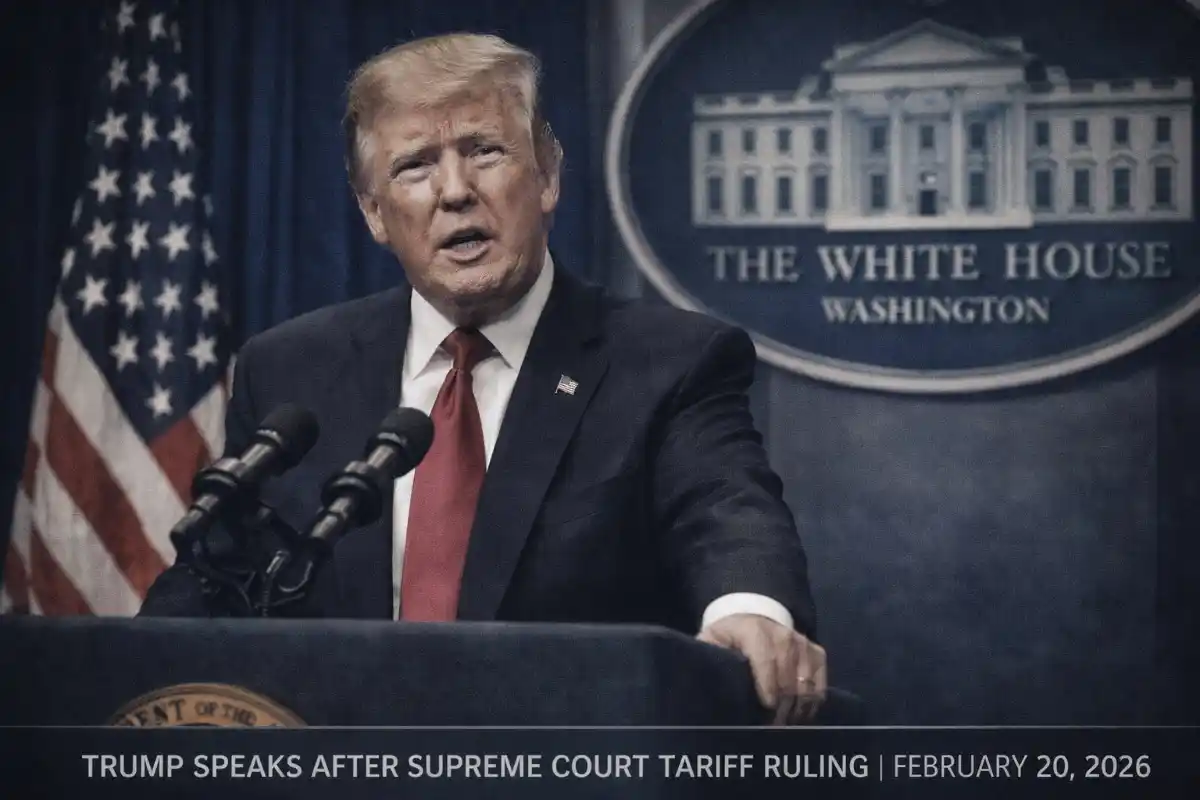
How a man who can't spell "tariff" made you pay $1,000 more for groceries last year, then threw a tantrum when the Supreme Court told him he couldn't do it anymore.
The Ruling
On Friday, February 20, 2026, the Supreme Court of the United States ruled 6-3 that Donald Trump had exceeded his constitutional authority when he imposed sweeping tariffs on nearly every country on Earth using the International Emergency Economic Powers Act (IEEPA).
Chief Justice John Roberts, writing for the majority, delivered a ten-minute constitutional masterclass that essentially said: the power to tax belongs to Congress, not to a man who thinks trade deficits work like a checking account.
"IEEPA contains no reference to tariffs or duties," Roberts wrote. "The Government points to no statute in which Congress used the word 'regulate' to authorize taxation. And until now no President has read IEEPA to confer such power."
Translation: You can't just make shit up.
The Tantrum
What followed was one of the most unhinged press conferences in American presidential history.
Trump called six Supreme Court justices, including two he appointed himself, “a disgrace to our nation" and "very unpatriotic and disloyal to the Constitution."
He specifically singled out Justices Neil Gorsuch and Amy Coney Barrett, both of whom he put on the Court:
"I think their decision was terrible. I think it's an embarrassment to their families, you want to know the truth, the two of them."
An embarrassment to their families. Over a trade policy ruling.
The truth doesn’t trend. It survives because a few still care enough to keep it alive.
Keep The Kade Frequency transmitting.
Barrett has seven children. Gorsuch has two. None of them asked to be dragged into a septuagenarian's temper tantrum because he learned the hard way that the Constitution still applies to him.
Trump then accused the justices, with zero evidence, of being "swayed by foreign interests." The man who had dinner with Viktor Orbán last month accused the Supreme Court of being compromised by foreign powers.
Vice President JD Vance piled on, calling it "lawlessness from the court." These people think any ruling they disagree with is illegitimate.
When asked if the justices were still invited to Tuesday's State of the Union address, Trump said: "They are barely invited. Barely. Honestly, I couldn't care less if they come."
The three dissenting justices, Thomas, Alito, and Kavanaugh, are "happily invited."
The President of the United States is sorting Supreme Court justices into loyalty categories based on how they ruled in a single case. This is what democracy death spirals look like.
The Doubling Down
Less than 24 hours after the Supreme Court told him his tariffs were illegal, Trump signed a new 10% global tariff under Section 122 of the Trade Act of 1974.
Then, on Saturday, he raised it to 15%.
His justification? A "thorough, detailed, and complete review" of the "ridiculous, poorly written, and extraordinarily anti-American decision."
He did this review overnight. While rage-posting on Truth Social.
Here's what Section 122 actually allows: tariffs of up to 15% for a maximum of 150 days to address balance-of-payment issues. After that, he needs congressional approval to extend them.
So, the plan is now: impose tariffs under emergency powers → get slapped down by courts → impose them under different emergency powers → repeat until you run out of emergency powers or Congress grows a spine.
This is not economic policy. This is a game of constitutional whack-a-mole played by a man who believes laws are suggestions that apply to other people.
The Damage
Let's talk about what Trump's tariff adventure actually cost you.
According to the Tax Foundation, Trump's tariffs amounted to an average tax increase of $1,000 per American household in 2025. That's set to rise to $1,300 per household in 2026 if the remaining tariffs stay in place.
The Federal Reserve Bank of New York found that 90% of tariff costs were paid by American consumers and businesses, not, as Trump repeatedly claims, by foreign exporters.
Independent investigations. Imperial expansion exposed. Pattern documented.
Get investigations delivered.
So when Trump says "China is paying these tariffs" or "Mexico is paying," he is lying. Full stop. You are paying. Your grocery store is paying. Your small business is paying. Then they pass the cost to you.
The tariffs raised the average effective tariff rate from 2.4% in 2024 to 7.7% in 2025, the highest since 1947. Before the Supreme Court ruling, we were on track to hit rates not seen since the Smoot-Hawley Tariff Act of 1930. You know, the one that helped turn a recession into the Great Depression.
Manufacturing employment? Down. The Tax Foundation reports that manufacturing lost 72,000 jobs from April to December 2025. Every single month after the tariffs went into effect saw manufacturing job losses.
So much for bringing manufacturing back.
The Trade War That Accomplished Nothing
This is not Trump's first rodeo with tariffs. He tried this in his first term too. It didn't work then either.
Between 2018 and 2019, the Trump administration imposed tariffs on over $380 billion worth of Chinese goods. China retaliated. We got a "trade war."
The results, according to multiple studies:
- American consumers bore the full cost of the tariffs. Foreign exporters did not lower prices.
- Manufacturing employment decreased due to rising input costs and retaliatory tariffs.
- The trade deficit with China temporarily shrank, but the overall U.S. trade deficit didn't change, it just shifted to other countries.
- American farmers got crushed by Chinese retaliation. The Trump administration had to spend nearly all of the tariff revenue on farm subsidies to bail them out.
- China set up new contracts with Brazil. Now they import more corn from Brazil than from the United States. Those contracts didn't come back.
A January 2024 study by economist David Autor, one of the foremost experts on the "China shock", concluded that the 2018-2019 tariffs "had neither a sizable nor significant effect on US employment in regions with newly-protected sectors."
The tariffs did nothing for the people they were supposed to help.
But here's what they did accomplish: they made Trump look tough. That's it. That's the whole policy. Looking tough.
Meanwhile, China figured out how to evade the tariffs entirely. According to CNBC, China's 2024 trade surplus hit a record $1.1 trillion. They route manufacturing through Vietnam, Thailand, and Malaysia, “shadow factories" that assemble Chinese-made components for export to the United States.
Trump's tariffs didn't hurt China. They taught China how to work around them.
The Con
The fundamental lie of Trump's tariff policy is that tariffs are paid by foreigners.
This is not a debatable point. This is Economics 101.
A tariff is a tax on imports. It is paid by the importer, usually an American company, when goods enter the country. That company then either:
- Eats the cost, reducing their profit margin
- Passes the cost to consumers in higher prices
- Some combination of both
Foreign exporters don't pay a dime unless they choose to lower their prices to stay competitive. Study after study after study has shown: they don't. Tariff costs are passed through almost entirely to American buyers.
Trump knows this. His Treasury Secretary Steven Mnuchin once tried to claim that "tariffs are not a tax." This is like saying water isn't wet. The definition of a tariff is a tax on imports.
So, either Trump doesn't understand what a tariff is, possible, given his general approach to reading, or he's deliberately lying to you.
He's been making this claim for decades. He made it in his first term. He's making it now. At some point, we have to stop calling it a misunderstanding and call it what it is: a con.
The Refunds
Here's the fun part: the Supreme Court just ruled that Trump collected $133 billion in tariffs under an unconstitutional use of IEEPA.
That money has to be refunded.
But when reporters asked Trump about refunds, he said: "I guess it has to get litigated for the next two years." He signaled he has no intention of voluntarily paying companies back.
More than 1,000 lawsuits have already been filed by importers seeking refunds. The process could take years. Smaller businesses, the ones without armies of lawyers, may never see that money.
Trump's response to being told his policy was illegal? Essentially: good luck getting your money back, suckers.
This is the "businessman" who was supposed to run the country like a company. The policy was unconstitutional. The money was illegally collected. And his position is: sue me.
The Pattern
This is not an isolated incident. This is how Trump operates.
He did it with the Muslim ban in 2017. Courts struck it down. He rewrote it and tried again. Courts struck that down. He rewrote it again.
He did it with DACA. Courts told him he couldn't end it the way he tried. He tried different ways.
He did it with the border wall funding. Courts said he couldn't redirect military funds. He found other pots of money to raid.
He's doing it with tariffs. Courts said IEEPA doesn't authorize them. He's using Section 122. When that expires or gets challenged, he'll try Section 232. Or Section 301. Or whatever emergency power he can find.
The strategy is exhaustion. Keep throwing unconstitutional actions at the courts until something sticks, or until people stop caring, or until your political opponents run out of resources to fight.
It's the legal equivalent of a DDoS attack on the Constitution.
The Bully
Let's be clear about what's happening here.
The President of the United States publicly attacked the families of Supreme Court justices because they ruled against him.
He accused the Supreme Court, without evidence, of being controlled by foreign powers.
He suggested that justices who rule his way are "patriotic" and those who don't are "disloyal to the Constitution."
He's now using invitation to the State of the Union as a loyalty test.
This is not normal. This is not how democratic leaders behave. This is how authoritarians behave.
When you attack judges for ruling against you, you're not criticizing a decision. You're attacking the legitimacy of judicial independence.
When you accuse courts of being controlled by foreign enemies, you're laying groundwork for defying their rulings.
When you divide government officials into "loyal" and "disloyal" based on whether they support your policies, you're building a personality cult.
Trump has always been a bully. He bullied contractors. He bullied tenants. He bullied business partners. He bullied competitors.
Now he's bullying a co-equal branch of government because six judges, including two he personally selected, told him he's not a king.
The Stupidity
Let's also acknowledge the sheer intellectual emptiness of Trump's tariff policy.
His core belief, repeated endlessly, is that trade deficits are bad because they mean we're "losing" money to other countries.
This is not how trade works.
A trade deficit means we import more than we export. It doesn't mean we're "losing." It means American consumers are buying foreign products because those products are cheaper, better, or simply not made here.
The money doesn't disappear. We get goods. They get dollars. They then use those dollars to buy American assets, invest in American companies, or lend to the American government.
A trade deficit is not inherently good or bad. It's a measurement. Treating it as a scorecard is like treating your blood pressure number as a grade on a test.
But Trump has been ranting about trade deficits since the 1980s. He literally cannot learn. He told House Republicans in January: "The president has to be able to wheel and deal with tariffs."
Wheel and deal. Like he's buying a used car.
This is economic policy as real estate negotiation. Everything is leverage. Everything is about getting a "win." There's no analysis, no modeling, no consideration of second-order effects. Just: hit them hard and see what happens.
What happened is American consumers paid $1,000 more per household. Manufacturing lost 72,000 jobs. China found workarounds and hit a record trade surplus.
Winning.
The Escape
The good news: the Supreme Court just put a wall around the most extreme version of this insanity.
Trump can no longer use emergency powers to impose whatever tariffs he wants on whoever he wants. He has to use actual trade laws with actual limitations. Section 122 caps him at 15% for 150 days. Section 232 requires Commerce Department investigations. Section 301 requires Trade Representative findings.
These aren't silver bullets. Trump can still do damage. He's still trying. But he can't just wake up, declare a fake emergency, and tax imports from Canada at 50%.
The checks are working. Barely. Slowly. But working.
The Court's three liberal justices, Kagan, Sotomayor, and Jackson, joined with Roberts, Gorsuch, and Barrett to form the majority. The system worked the way it's supposed to: judges appointed by presidents of both parties reading the Constitution and applying the law regardless of who it helps or hurts.
That's not "lawlessness." That's the rule of law.
The Bottom Line
Donald Trump's tariff policy was:
- Unconstitutional, according to the Supreme Court of the United States
- Ineffective, manufacturing employment went down, not up
- Expensive, $1,000 per household in 2025, headed to $1,300 in 2026
- Dishonestly sold, Americans paid the tariffs, not foreign exporters
- Part of a pattern, authoritarian governance through emergency powers
When caught, Trump:
- Attacked the justices who ruled against him
- Attacked their families
- Accused them of being controlled by foreign powers
- Immediately imposed new tariffs under different authority
- Signaled he won't voluntarily refund the $133 billion illegally collected
This is not a president executing policy. This is a bully throwing a tantrum because someone finally told him “No."
The Supreme Court ruling is a speed bump, not a solution. Trump will keep pushing. His enablers in Congress, the ones afraid to vote against him even when they know he's wrong, will keep enabling.
But for one brief, clarifying moment, the system worked.
Six judges looked at a president claiming powers that don't exist and said: No. You are not a king. The Constitution still matters. We don't care that you appointed two of us. We care about the law.
That's worth remembering.
Because we're going to need a lot more of it.
Independent. Unfunded. Uncompromising.
Investigating power. Exposing corruption. Demanding accountability.
No ads. No sponsors. Just signals from the noise.
Keep The Kade Frequency transmitting.
Related:
- The Fear Machine, How the EU Rules by Crisis
- The Digital Leash, Europe's Surveillance State
- The Protection Racket, Why Europe Arrests While America Protects
© 2026 The Kade Frequency. All rights reserved.