The Education Cartel: How Bologna Standardized European Minds
Bologna Process forced 48 European countries into standardized 3+2 Bachelor-Master structure 1999-2020 destroying diverse national education traditions.

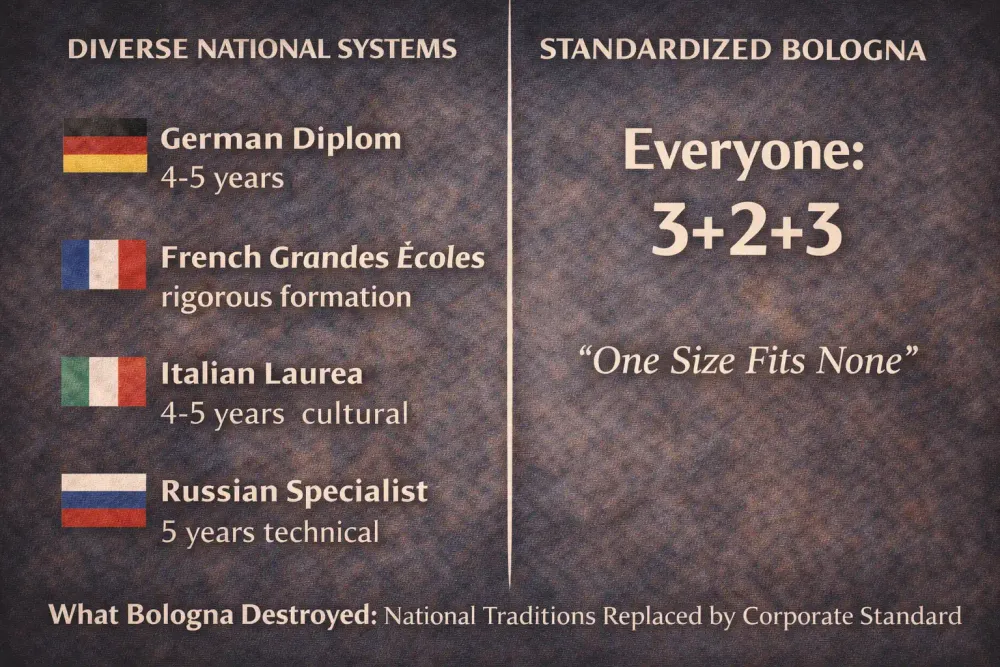
48 countries forced into one education system, nobody voted for this.
Every European under 40 went through Bologna, most don't know it exists.
German Diplom destroyed. French Grandes Écoles diluted. Italian Laurea abandoned. Russian Specialist declining.
3-year Bachelor replaced 4-5 year integrated degrees, less depth, more credentials, permanent debt.
Corporate language everywhere: "learning outcomes," "competencies," "employability," "stakeholders."
Education became credential acquisition. Credential inflation requiring Master's for Bachelor's jobs.
The Bologna Process turned universities into degree factories serving corporate workforce needs.
Introduction
There's an education system governing universities across 48 countries from Portugal to Kazakhstan. It standardized degree structures, credit systems, quality assurance, and curriculum design. It affects 30+ million students currently enrolled and every European under 40 who went through it.
Most people have never heard of it.
It's called the Bologna Process, named after the Italian city where education ministers signed the declaration in 1999. The stated goal was creating a "European Higher Education Area" with comparable degrees and increased student mobility. The actual effect was destroying diverse national education traditions and replacing them with an Anglo-American corporate model emphasizing credentials over learning, employability over critical thinking, and standardization over cultural formation.
Before Bologna, Europe had rich educational diversity. Germany had the Diplom, a 4-5 year integrated degree combining Bachelor and Master level work with deep specialization and a substantial thesis. France had Grandes Écoles producing elite technocrats through rigorous selection and formation. Italy had the Laurea emphasizing humanistic cultural formation and intellectual development. Russia had the 5-year Specialist degree with intense technical rigor.
After Bologna, everyone has the same thing: 3-year Bachelor, 2-year Master, 3-year Doctorate. The 3+2+3 structure copied from Anglo-American universities. Modular courses. Credit accumulation. Learning outcomes. Competency frameworks. Quality assurance metrics. Corporate speak everywhere.
What was lost? Time to develop intellectually. Depth of learning in a subject. Space for cultural formation. The idea that education has intrinsic value beyond employment. National traditions reflecting different philosophical approaches to knowledge. Free education in countries where Bologna coincided with fee introduction.
What was gained? Credentials. Stacks of them. You need a Master's now for jobs that previously required a Bachelor's, or didn't require a degree at all. Credential inflation through standardization. Continuous re-credentialing to stay "competitive." A generation raised to view education as CV-building, not intellectual development.
This investigation exposes how Bologna was sold as student mobility and competitiveness but actually served corporate interests in workforce standardization. It documents which national systems were destroyed and what they offered. It reveals the ideology, neoliberal human capital theory, replacing Bildung, formation, and umanesimo. It shows the credentialism trap where more education yields less value. It exposes the standardization machine of ECTS credits and quality metrics. It debunks the mobility myth when Erasmus already existed. It traces the privatization pipeline from standardization through austerity to full marketization. It documents corporate capture with business lobby groups shaping Bologna. It shows student resistance that failed. It reveals why the American model was imposed. It catalogs what was lost, time, depth, critical thinking, cultural formation, free education, national traditions. And it projects the future trajectory toward subscription education, micro-credentials, and full privatization.
The evidence is in Bologna declarations, EU reports, national education statistics, corporate lobby documents, and the lived experience of millions who went through this system without understanding what was done to them.
By the time you finish reading, you'll understand why your degree feels like a credential treadmill, why you're drowning in debt for a piece of paper that gets you less than your parents' degree got them, and who benefits from turning education into corporate workforce training.
By A. Kade
What This Investigation Exposes
The Bologna Process systematically destroyed diverse European education traditions replacing them with standardized Anglo-American corporate model. How 48 countries were pressured into 3+2 Bachelor-Master structure eliminating integrated degrees. National systems destroyed: German Diplom 4-5 year deep specialization replaced by shallow 3-year Bachelor, French Grandes Écoles elite formation diluted, Italian Laurea cultural formation abandoned for "skills," Russian Specialist technical rigor declining. The ideology shift from Bildung/formation/umanesimo to corporate "human capital" with language of "learning outcomes," "competencies," "employability," "stakeholders" replacing education discourse. Credentialism trap where education became credential acquisition not intrinsic value, credential inflation requiring Master's for Bachelor's jobs, continuous re-credentialing treadmill, debt accumulation for diminishing returns. Standardization machine through ECTS credits reducing education to accounting, quality assurance metrics optimizing for surveys not critical thinking, modularization destroying curriculum coherence. Mobility myth debunked when Erasmus existed since 1987, mobility increased marginally 5%, real benefit was labor mobility for employers and corporate curriculum access. Privatization pipeline from Bologna standardization enabling austerity cuts enabling private universities proliferating enabling student loans normalizing enabling full privatization coming. Corporate capture documented with European Round Table of Industrialists, UNICE, World Bank, OECD, McKinsey shaping Bologna implementing corporate wishlist. Resistance crushed with traditional professors ignored, student protests 2008-2009 Italy/Greece/France/Germany all failed, top-down imposition regardless of opposition. American model imposed copying US Bachelor-Master-Doctorate despite European traditions, credit-based modular continuous assessment student-centered customer service quality metrics all American imports. What was lost in transition: time to develop intellectually, depth of learning in subjects, space for critical thinking, cultural formation as education goal, free education in many countries, national traditions reflecting philosophical diversity. Future trajectory toward subscription education, micro-credentials and badges, competency verification replacing degrees, AI-delivered standardized content, lifelong learning mandates, full educational privatization completing corporate capture.
What Bologna Did: Destroying Diversity
In 1999, 29 European education ministers met in Bologna and signed a declaration committing to create a "European Higher Education Area" by 2010. The core mechanism: standardizing degree structures across all participating countries.
The 3+2+3 Structure:
Every country would adopt:
- 3-year Bachelor (first cycle)
- 2-year Master (second cycle)
- 3-year Doctorate (third cycle)
This seems innocuous until you realize what it replaced.
Before Bologna, European higher education was diverse:
Germany had the Diplom and Magister, 4 to 5 year integrated degrees combining undergraduate and graduate level work. You didn't get a Bachelor then decide whether to continue. You entered a program, studied deeply in your field, wrote a substantial thesis (Diplomarbeit), and emerged with a qualification recognized as equivalent to a Master's. It took longer because it was deeper.
France had multiple parallel systems. Universities offered long degrees (maîtrise). But the real elite formation happened in Grandes Écoles, highly selective institutions like École Polytechnique, ENA, Sciences Po, with intense preparation (classes préparatoires), rigorous entrance exams, and 3-4 years of specialized formation producing France's technocratic elite. Not degree accumulation, formation.
Italy had the Laurea, typically 4-5 years of study with substantial thesis work. The concept was cultural formation (formazione) and humanistic education (umanesimo) not just job training. You studied philosophy, literature, history alongside your specialization because education was about becoming a cultured person, not an employee.
Russia (and former Soviet states) had the 5-year Specialist degree, intensive technical education with deep theoretical grounding and practical application. Engineers actually learned engineering thoroughly, not surface-level competencies.
Spain had Licenciatura (4-5 years) with serious academic requirements and substantial final project.
After Bologna, everyone has the same:
3-year Bachelor + 2-year Master = 5 years total. Same as before? No.
The 3-year Bachelor is shallow. It can't be as deep as a 4-5 year integrated degree because you have to cover breadth for students who might not continue to Master's. Modularization means disconnected courses not coherent programs. You're preparing students for "flexibility" (read: job market uncertainty) not mastery of a field.
The Master's becomes mandatory. Not for deepening knowledge, for getting a credential that's actually useful. Employers know Bachelor's is shallow so require Master's for positions that previously needed Bachelor's, or no degree. Credential inflation through standardization.
The shift isn't just duration, it's philosophy. Integrated degrees assumed education was formation requiring time and depth. Modular stackable credentials assume education is skill acquisition for employment. The first is education. The second is training.
According to European Commission Bologna Process reports, by 2020 all 48 participating countries had adopted 3+2 structures. Compliance was achieved through EU pressure, funding conditions, and degree recognition threats. Countries that resisted (Germany held out longest) eventually capitulated because degrees that didn't fit Bologna couldn't be recognized across Europe, killing student mobility and academic careers.
This is standardization as imperialism. Not "let's learn from diverse models." It's "everyone adopt the Anglo-American model or be excluded."
And nobody fucking voted for it.
The truth doesn’t trend. It survives because a few still care enough to keep it alive.
Keep The Kade Frequency transmitting.
National Traditions Destroyed
Let me show you specifically what was lost when Bologna homogenized European education.
Germany: The Death of the Diplom
The German Diplom was a serious qualification. Engineering students at TU Munich or RWTH Aachen did 4-5 years of intensive study: advanced mathematics, deep theoretical foundations, substantial practical work, and a Diplomarbeit (thesis) of 80-100 pages documenting original research or development.
A German Diplom-Ingenieur was recognized globally as having genuine expertise. Companies knew you could hit the ground running. The degree combined what Americans would split into Bachelor's and Master's, eliminating redundancy and increasing depth.
Bologna replaced this with 3-year Bachelor + 2-year Master. The Bachelor is too short for real depth, you get overview not mastery. Companies hiring Bachelor graduates find them underprepared. So students need the Master's. But now you're doing 5 years in fragmented modules instead of 5 years as coherent formation. Less depth, more bureaucracy, same time.
According to German Academic Exchange Service (DAAD) data, the shift to Bologna increased dropout rates in STEM fields from 25% to 35%+ because modular structure with continuous assessment creates more pressure and less time for genuine understanding. Students game grades rather than learning.
German professors opposed Bologna. Surveys by Deutscher Hochschulverband showed 70%+ of faculty believed Bachelor-Master structure inferior to Diplom for education quality. They were ignored. Ministry implemented Bologna regardless because EU integration demanded it.
What did Germans get in return? Their degrees now "recognized" across Europe. But the Diplom was already recognized, by quality. Now it's recognized by structure, despite being worse.
France: Grandes Écoles Dilution
France's Grandes Écoles system produced the country's elite: presidents, ministers, CEOs, top engineers. Entry required grueling 2 years of classes préparatoires (intense preparatory courses), then competitive entrance exams selecting tiny percentages.
Once in, 3-4 years of demanding formation combined theoretical depth, practical application, and elite networking. Graduates of Polytechnique, ENA, Sciences Po, Centrale didn't just have knowledge, they had formation. A way of thinking, analyzing, problem-solving distinctive to French elite education.
Bologna pressured Grandes Écoles to integrate into the university system, adopt 3+2 structure, issue "Master's" degrees. The justification? International recognition. American employers supposedly didn't understand what an École Polytechnique degree meant. (They did. They just preferred standardization.)
Many Grandes Écoles resisted, maintaining parallel structures. But pressure intensified through funding, EU directives, and degree recognition. Gradually they adopted Masters programs, often keeping selectivity but losing distinctiveness. Formation became "Master's degree from French engineering school", legible to Americans, indistinct from any other Master's.
According to research by French sociologist Pierre Bourdieu (before his death in 2002 but prescient), homogenization of European higher education would destroy national elite formation mechanisms without democratic debate, exactly what happened.
What did France lose? The Grandes Écoles system was elitist, absolutely. But it was French elitism, producing leaders with distinctive formation, not generic MBA thinking. Bologna created equality through mediocrity: now everyone has comparable degrees that mean less.
Italy: Abandoning Formazione
The Italian Laurea embodied a philosophy: education as cultural formation (formazione culturale) and humanism (umanesimo). You didn't just study your major, you engaged with philosophy, literature, art, history. The idea was becoming a cultured person capable of thinking critically, not just an employee with skills.
Laurea programs took 4-5 years and culminated in a substantial thesis demonstrating original research and synthesis. The thesis defense (discussione della tesi) was a public intellectual performance, you defended your ideas before faculty and audience. It mattered.
Bologna killed this. The 3-year Laurea Triennale (Bachelor) is too short for deep cultural formation. It's overview courses preparing you for job market or further study. The thesis is often 40-50 pages and perfunctory. The concept of formazione, spending years becoming intellectually formed, disappeared in favor of "competencies" and "learning outcomes."
Italian Ministry of University and Research data shows post-Bologna Italian graduates have higher employment rates within 6 months. Bologna advocates claim success. But employment doing what? Precarious temporary contracts, underemployment, jobs unrelated to study. The employment metric optimizes for corporate HR needs not graduate fulfillment or social benefit.
Meanwhile, Italy's philosophy departments, once world-leading, have hemorrhaged students. Why spend 3 years on philosophy when you need "employable skills"? The humanistic tradition that defined Italian higher education for centuries is dying under Bologna's corporate metrics.
What did Italy trade formazione for? Employability statistics that hide exploitation.
Russia: The Specialist Decline
The 5-year Specialist degree in Soviet and post-Soviet higher education was intense. Engineering students at Bauman Moscow State Technical University or Novosibirsk State University did:
- Advanced mathematics (far beyond Western Bachelor's)
- Deep theoretical grounding in their field
- Substantial practical/lab work
- Diploma project demonstrating mastery
Russian engineers were feared globally because the Specialist degree actually produced specialists. Not generalists with "competencies", people who understood theory deeply and could apply it.
Bologna pressured post-Soviet states to abandon the Specialist for 3+2 structure. Some maintained parallel systems. But EU integration aspirations, funding conditions, and degree recognition issues gradually forced compliance.
Kazakhstan, for example, formally adopted Bologna in 2010 under EU pressure to qualify for Erasmus Mundus and other programs. According to Kazakhstani Ministry of Education reports, employers increasingly complain Bachelor graduates lack practical skills and theoretical depth, they're neither Russian Specialist depth nor Western critical thinking. The worst of both systems.
Ukraine, Georgia, Armenia, Azerbaijan all followed similar patterns: EU association agreements included education reforms "harmonizing with European standards" (read: Bologna). Economic incentives (EU funding, student exchange programs, degree recognition) and political pressure ("reforms needed for EU integration") forced compliance.
What did post-Soviet states lose? Educational systems that, whatever their ideological baggage, actually produced technically competent specialists. What did they gain? EU-compatible degree structures preparing students for labor markets that don't exist.
The standardization destroyed what worked while promising benefits that never materialized.
"In the matter of reforming things, as distinct from deforming them, there is one plain and simple principle; a principle which will probably be called a paradox. There exists in such a case a certain institution or law; let us say, for the sake of simplicity, a fence or gate erected across a road. The more modern type of reformer goes gaily up to it and says, 'I don't see the use of this; let us clear it away.' To which the more intelligent type of reformer will do well to answer: 'If you don't see the use of it, I certainly won't let you clear it away. Go away and think. Then, when you can come back and tell me that you do see the use of it, I may allow you to destroy it.'" - G.K. Chesterton, 1929
Bologna reformers didn't understand the fence before they tore it down.
The Ideology: From Bildung to "Human Capital"
The shift wasn't just structural, it was ideological. Bologna replaced diverse European educational philosophies with Anglo-American neoliberal human capital theory.
What Was Lost:
German Bildung , The concept that education forms the whole person intellectually, morally, culturally. Wilhelm von Humboldt's vision: universities cultivate autonomous thinking individuals who can contribute to society through cultivated judgment, not just technical skills. Bildung takes time, you can't rush formation. It requires depth, you can't modularize cultivation.
French Formation , The idea that education, especially in Grandes Écoles, forms elite capacity for leadership through rigorous intellectual and practical challenges. Formation implies transformation, you enter as student, emerge as formé capable of high-level responsibility. It's not about accumulating credits; it's about being formed.
Italian Umanesimo , Humanistic education where studying literature, philosophy, art isn't "nice to have", it's central to becoming educated. The belief that technical competence without cultural understanding produces technocrats, not thinkers. That a society needs cultured citizens, not just trained workers.
Russian Spetsializatsiya , Specialization meaning deep technical mastery, not narrow training. The belief that understanding theoretical foundations deeply enables adaptation and innovation, while surface-level "competencies" produce rigid technicians.
What Replaced Them:
Corporate human capital theory wrapped in bureaucratic education-speak:
"Learning outcomes" , Not what you learned or how you were formed, but measurable skills you can demonstrate. Education reduced to checklist. Can you do X? Can you do Y? Critical thinking, cultural formation, intellectual development, if you can't measure it on a rubric, it doesn't count.
"Competencies" , Skills useful to employers. Not knowledge for its own sake, not formation as a person, not Bildung or umanesimo. Competencies that make you employable. Flexible. Adaptable. Disposable. Retrained when your competencies become obsolete.
"Employability" , The supreme metric. Not: are graduates intellectually developed, culturally formed, capable of critical thought? But: do they get jobs? Any jobs. Precarious contracts, underemployment, irrelevant to study, doesn't matter. Employability statistics let universities claim success while students struggle.
"Stakeholders" , Corporate speak for employers and government, who have "stakes" in education serving their needs. Students aren't stakeholders, they're "customers." Education isn't a public good, it's a "service" meeting "stakeholder" demands. The shift in language reveals the ideology.
This isn't random terminology, it's deliberate reframing. EU Bologna Process documents systematically use this language. National education ministries adopted it. Universities internalized it. Now students think this way: "What competencies will this course give me? How does it improve employability?"
The question "What will I learn? How will this form me intellectually?" became obsolete. Formation replaced by training. Education replaced by credentialing.
OECD reports on higher education explicitly frame Bologna reforms through human capital theory: education as investment in productivity enhancement. Graduates are "human capital" producing economic returns. The idea that education has intrinsic value, developing minds, forming culture, enabling citizenship, pursuing truth, is dismissed as "ivory tower" thinking.
Bologna was ideological colonization dressed as technical harmonization.
The Credentialism Trap
Bologna didn't just change structures, it accelerated credential inflation and trapped millions in perpetual qualification seeking.
The Degree Treadmill:
Before Bologna, a degree meant something. German Diplom? You're qualified. French Licence? Educated. Italian Laurea? Formed. Jobs required degrees, but the degrees had substance. Getting one meant you knew something.
After Bologna, you have Bachelor's but need Master's. Why? Because 3-year Bachelor's doesn't actually prepare you fully. Employers know this. They require Master's for positions that previously needed Bachelor's, or didn't need degrees at all.
According to Eurostat labor market data, degree requirements for job postings increased 40% from 2010-2023 across EU countries. Admin assistant (previously high school diploma)? Now requires Bachelor's. Junior engineer (previously Bachelor's)? Now requires Master's. Senior positions? Master's + professional certificates + years of experience.
The goalposts keep moving. Not because jobs require more knowledge, because credentials mean less.
The Continuous Re-Credentialing:
Bologna enables modular stackable credentials: diplomas, certificates, micro-credentials, badges. You're never done learning, you're "lifelong learning." Sounds positive until you realize it means you're never qualified enough.
Finish your Master's? You need professional certificates to prove you're "current." Been working 10 years? Your skills are "obsolete", take courses to stay "competitive." Mid-career? Consider an executive Master's to stay "relevant."
OECD Skills Outlook data shows workers with degrees spend increasing time and money on additional credentials, up from 5% of workers pursuing additional qualifications in 2000 to 22% by 2020. This isn't people pursuing education for enrichment, it's people desperate to remain employable in credential-inflated markets.
The Debt Trap:
Bologna coincided with introduction or expansion of student fees in many European countries.
Germany introduced semester fees in some states (later abolished after protests). UK tripled fees to £9000 (Bologna structure made comparison with US easier, justifying marketization). Italy introduced fees where free previously. Eastern European countries moving to Bologna introduced fees to "align with Europe."
The connection isn't coincidental. Standardized modular structures enable marketization: if degrees are standardized products, they can be priced. If education is training for employment, students should pay as investment in their "human capital."
According to European Students' Union reports, student debt levels increased dramatically in Bologna countries 2000-2020:
- UK: From near-zero (grant system) to £50,000+ average graduate debt
- Netherlands: From near-zero to €20,000 average
- Sweden: From free to debt system with increasing costs
- Spain: From minimal fees to substantial costs
Even Germany, which mostly maintained free tuition, saw living cost burdens increase as BAföG (student support) failed to keep pace.
So now you need: 3-year Bachelor (shallow, requires Master's), 2-year Master's (actually useful, costs money), then professional credentials (costly, continuously), all while competing for jobs requiring more credentials for less pay.
This is the credentialism trap: more education required, more money spent, less value received. Permanent qualification seeking without advancement.
And the beneficiaries? Universities collect fees. Credential providers sell certificates. Employers get desperate workers continuously "upskilling" at their own expense. Students get debt and precarity.
The Standardization Machine: ECTS and Quality Metrics
Bologna created bureaucratic machinery standardizing education across 48 countries. The tools: ECTS credits and quality assurance frameworks.
ECTS: Education as Accounting
The European Credit Transfer and Accumulation System (ECTS) assigns numeric values to courses: 1 credit = 25-30 hours of student work. A Bachelor's is 180 credits (3 years x 60 credits). Master's is 120 credits (2 years x 60 credits).
This sounds neutral, just making degrees comparable. But it fundamentally changes education.
Before ECTS, courses had content and depth. A German seminar on Kant involved reading primary texts, secondary literature, discussion, essay writing, time was what it took. An Italian philosophy course integrated with others in a coherent program of formation.
After ECTS, courses are workload units. Too demanding? Reduce content to hit credit target. Interdisciplinary? Hard to credit-count. Long-term projects? Difficult to modularize. The system incentivizes bite-sized deliverables over deep engagement.
According to European University Association surveys, 70%+ of faculty report ECTS requirements reduce course depth and quality. You can't cover material properly in workload-constrained modules. So you cover less, broader but shallower.
For students, education becomes credit accumulation. "I need 60 credits this year" not "I'm studying philosophy." Gaming the system: take easier courses for better grades (GPA matters for Master's admission). Avoid challenging material that might hurt GPA. Optimize credit accumulation, not learning.
ECTS reduces education to accounting. Numbers on transcripts, not formation of minds.
Quality Assurance: Optimizing for Metrics
Bologna mandates quality assurance: external evaluations ensuring standards. Agencies accredit programs. Universities demonstrate "quality."
Sounds good. Except quality is measured through metrics easily gamed:
Graduation rates , Do students finish? Universities pressure faculty to pass marginal students. Lower standards rather than risk low graduation statistics. "Student success" measured by completion, not learning.
Employment rates , Do graduates get jobs? Universities push career services, employability training, credential stacking. Optimize employment statistics regardless of job quality, relevance, or satisfaction.
Student satisfaction surveys , Are students happy? Universities focus on customer service: comfy facilities, responsive administration, easy grading. "The customer is always right" applied to education. Challenging courses score poorly, eliminate challenges.
Research output , Do faculty publish? Universities pressure quantity over quality. Publish in any journal, as many articles as possible. Gaming citation metrics. Research becomes metric optimization, not truth-seeking.
This is Campbell's Law in action: "When a measure becomes a target, it ceases to be a good measure." Optimize for employment rates, get credentialism. Optimize for student satisfaction, get grade inflation. Optimize for research quantity, get meaningless publications.
European Commission Quality Assurance reports show "quality" has increased according to metrics while faculty and students both report education quality has declined in lived experience. The metrics don't measure quality, they measure compliance with standardized frameworks.
The Mobility Myth: What Bologna Really Enabled
Bologna was sold as increasing student mobility. The promise: degrees recognized across Europe, students can study anywhere, cultural exchange, unity through education.
The reality: Mobility benefits were marginal, and the real gains went to employers and corporate interests.
Erasmus Already Existed
The Erasmus program started in 1987, 12 years before Bologna. It already enabled student exchanges across Europe. Students could spend semesters abroad, take courses, return to home universities where credit was recognized.
By 1999, Erasmus had 1 million participants. By 2020, 10 million. That's growth, but it happened independently of Bologna structure changes. Students want to study abroad regardless of whether degrees are standardized.
According to Erasmus+ program data, mobility increased steadily but modestly: 2-3% annual growth. The dramatic increase wasn't degree structure, it was funding. EU budget for Erasmus expanded massively. More funding = more mobility. Structure irrelevant.
The 5% Mobility Rate
Despite Bologna supposedly enabling mobility, only about 5% of European students study abroad during their degree. Eurostat education statistics show this number hasn't changed significantly post-Bologna.
Why? Cost (even with Erasmus grants, living abroad is expensive), language barriers (courses in local languages), family ties, jobs students work to support studies, preference for completing degrees close to home.
Bologna didn't solve any of these real barriers. It standardized structures assuming that was the obstacle. It wasn't. Money, language, and life circumstances determine mobility, not degree structure.
Labor Mobility for Employers
But standardization did enable something: employers hiring across borders without understanding different national qualifications.
German Diplom meant expertise but required knowing the German system. French Grandes Écoles produced elite candidates but required understanding French formation. Hiring managers in multinational corporations found this confusing. They wanted simple: Bachelor's = 3 years, Master's = 5 years. Standardization serves corporate HR departments, not students.
According to European Round Table of Industrialists documents (leaked and documented by Corporate Europe Observatory), business lobby groups explicitly pushed Bologna for labor market standardization. They wanted graduates with "European competencies" easily deployable across subsidiaries without qualification translation.
This isn't education reform, it's workforce standardization for corporate convenience.
Corporate Curriculum Access
Standardization also enabled corporations to shape curriculum directly. When degrees are modular and measured by "learning outcomes," corporations can specify what outcomes they want.
Industry advisory boards, company-university partnerships, "stakeholder consultation", all mechanisms for corporate interests to dictate curriculum content. Business lobbies got exactly what they wanted: universities producing graduates with standardized competencies matching corporate needs.
According to research by scholars like Susan Robertson and Roger Dale, Bologna was always about embedding neoliberal economic goals in education policy. The mobility rhetoric provided cover for restructuring universities to serve corporate workforce needs.
The mobility myth worked: people supported Bologna thinking it would help students, while the real beneficiaries were employers getting standardized, pliable, endlessly re-credentialed workers.
The Privatization Pipeline
Bologna wasn't directly about privatization, but it enabled it. Standardization created conditions for market forces to transform public education into profit centers.
The Sequence:
1. Standardization , Bologna harmonizes degree structures. Education becomes comparable product.
2. Austerity , Financial crisis 2008-2015 hits. Governments cut university funding. Public universities struggling.
3. Marketization , Universities introduce/increase fees to compensate for funding cuts. Students become customers. Education becomes market transaction.
4. Private Expansion , Private universities proliferate in standardized Bologna space. For-profit institutions issue "recognized" degrees. Competition for "customers."
5. Student Loans , Fees increase, loans normalize. Students graduate with debt. Debt disciplines: take safe jobs, avoid risks, optimize earnings to repay.
6. Full Privatization , Public universities increasingly behave like private institutions (revenue-driven, customer-focused, brand-obsessed). Distinction between public and private erodes. Education fully marketized.
This trajectory is clearest in UK but spreading across Europe.
UK Example:
Pre-Bologna UK had polytechnics (vocational) and universities (academic). 1992: polytechnics become universities. System expands but stays public and affordable.
1998: Blair introduces £1000 tuition fees. Justified as modest contribution. 2006: Increased to £3000. 2010: Tripled to £9000. Current: £9250 and rising.
Bologna's 3+2 structure made this easier to justify: if Bachelor's is standalone qualification (Bologna framing), students should pay for standalone product. If degrees are comparable to American Bachelor's, why not comparable fees?
Result: Average UK graduate debt £50,000+. Universities operate like corporations optimizing revenue. Degrees marketed like products with glossy prospectuses and student recruitment targets. The concept of public education nearly dead.
Eastern Europe:
Former Soviet states transitioning to Bologna also transitioned from free to fee-paying education. The Bologna structure provided framework for marketization.
Poland: Free higher education until 1990s. Bologna reforms coincided with fee introduction for part-time and evening programs. Now full-time "free" but underfunded, while private universities proliferated. Over 30% of Polish students in private institutions by 2020.
Czech Republic, Hungary, Slovakia: Similar patterns. Bologna standardization made degrees legible to private providers. Market entry easier in standardized system. Private institutions grew rapidly 2000-2020.
According to European Commission education reports, private higher education enrollment across new EU member states increased from 15% to 30% in two decades post-Bologna, mostly in standardized Bachelor-Master programs that private institutions can easily replicate.
The Future: Full Marketization
Where is this going? Look at America, Bologna's model.
American higher education is substantially privatized: expensive private universities, public universities acting like privates (revenue-driven, business-model operations), for-profit colleges, massive student debt industry ($1.7 trillion), education as consumer product.
Bologna is bringing that to Europe: increasing fees, growing private sector, student debt normalization, universities competing like businesses.
The pandemic accelerated this: online education, remote learning infrastructure, modular delivery. Once education is fully modularized and delivered digitally, what stops Pearson or Coursera from issuing "recognized" degrees? Bologna's standardization makes this possible.
The endpoint: education as subscription service. Pay monthly for course access. Accumulate micro-credentials and badges. Stack them into "degrees" recognized by Bologna-standardized frameworks. Universities become credential-issuing platforms competing with tech companies.
This isn't speculation, it's the trajectory Bologna enabled.
Corporate Capture: Who Shaped Bologna
Bologna wasn't created by educators or students. It was shaped by corporate lobby groups and international economic organizations pushing neoliberal workforce development.
European Round Table of Industrialists (ERT):
Founded 1983, ERT brings together CEOs of Europe's largest corporations: Philips, Siemens, Nestlé, Total, Volvo, etc. According to Corporate Europe Observatory research, ERT lobbied intensively for education reforms serving business interests.
1989 ERT report "Education and European Competence" argued European education was too diverse, not producing graduates with standardized skills corporations needed. Recommendation: harmonize degree structures, focus on employability, engage business in curriculum design.
These exact recommendations became Bologna goals. Corporate wish-list implemented as education policy.
UNICE (BusinessEurope):
European employer confederation UNICE (now BusinessEurope) pushed similar agenda. Their education policy papers emphasized "flexibility," "employability," "competencies", the language that defines Bologna.
According to leaked documents, UNICE representatives participated in Bologna preparatory meetings and follow-up working groups. Corporate interests had direct input into policy formation.
World Bank and OECD:
International economic organizations framed Bologna as economic necessity. OECD education reports throughout 1990s argued Europe needed education reforms to compete globally. Emphasis on human capital theory, employability metrics, labor market alignment.
World Bank pushed similar frameworks in developing countries: standardize, modularize, marketize education. Bologna applied these principles to Europe.
McKinsey and Management Consultants:
Universities hired consultants like McKinsey to implement Bologna reforms. Consultants brought corporate management logic: efficiency metrics, customer satisfaction focus, brand management, revenue optimization.
According to research by scholars like Cris Shore, management consultants fundamentally reshaped university governance through Bologna implementation, making universities operate like businesses rather than educational institutions.
Where Were Educators and Students?
Largely excluded from Bologna design. Education ministers signed declaration. Government bureaucrats implemented. Corporate interests consulted. Educators and students faced fait accompli.
Traditional professors opposed Bologna but were ignored. European University Association surveys showed faculty skepticism, but implementation proceeded top-down. Academics complaining about dumbing-down, credentialism, corporate capture were dismissed as resistant to "modernization."
Students protested massively in 2008-2009 across Italy, Greece, France, Germany, Spain. Occupied universities. Demonstrated against Bologna reforms and fee increases. All failed. Governments proceeded with implementation regardless.
This is policy capture: corporate interests shape reforms serving their needs, while educators and students, the people actually in education, are bypassed.
Why the American Model Won
Bologna didn't just standardize Europe, it specifically imposed the Anglo-American education model on the continent. Why?
Ideological Hegemony:
By 1990s, Anglo-American neoliberalism dominated global economics. Thatcher and Reagan's free-market ideology spread globally. International institutions (World Bank, IMF, OECD, WTO) pushed Anglo-American policies everywhere.
Education reform followed the same pattern. American model treated as universal best practice. Diverse European traditions treated as backward, provincial, inefficient. The assumption: modern = American.
Market Logic:
American education is fundamentally market-driven: universities compete for students, tuition funds operations, degrees are products, students are customers. This appeals to neoliberal reformers who want to marketize everything.
European models, where education was public good, formation not training, free or low-cost, didn't fit market logic. Bologna's American structure made marketization possible.
Language and Legibility:
Bachelor-Master-Doctorate is globally legible because American universities dominated globally. Harvard MBA recognized everywhere. German Diplom? Requires explanation.
Standardizing on American structure made European degrees instantly understandable to global employers, especially American multinationals. This served corporate interests, not educational quality.
Modularity Enables Control:
American model of modular courses with credit accumulation enables standardization and control in ways integrated European degrees didn't.
Modular courses can be measured, assessed, compared, quality-assured through metrics. Integrated degrees require understanding whole programs, harder to bureaucratically control.
Bologna's standardization bureaucracy required modularity. American model provided template.
The Irony:
America is implementing Bologna in reverse. While Europe adopted American structures, American universities maintain what Europe lost: elite privates (Harvard, Yale, Stanford) operate more like old Grandes Écoles, selective, transformative formation, expensive but substantial. Meanwhile public universities hollowed out, the fate Bologna brings Europe.
So Europe adopted America's mass education model (cheap credentials, debt-financed, market-driven) while America's elite maintained European-style formation for their children.
The standardization is for everyone else.
What Was Lost
Let me catalog concretely what Bologna destroyed that mattered.
Time to Develop:
Integrated 4-5 year degrees gave students time to develop intellectually without credential pressure. You had space to explore, make mistakes, deepen understanding. Not racing to accumulate credits, growing as thinker.
3+2 structure eliminates this. Bachelor's is race against time (get credits, maintain GPA for Master's admission). Master's is credentialing (get degree employers recognize). No time to develop, only achieve.
Depth of Learning:
Studying fewer subjects more deeply vs. many subjects superficially. German Diplom required mastering your field. You knew your subject thoroughly, theory, practice, history, cutting edge.
Modular Bachelor's covers breadth. Overview courses. Survey classes. Introduction to everything, mastery of nothing. You know about many things but nothing deeply. Then specialized Master's adds narrow depth without broad foundations.
Result: graduates with superficial breadth and narrow specialism, unable to think across domains or master anything fully.
Critical Thinking:
Formation-based education developed capacity to think critically, question assumptions, analyze independently. Philosophy integrated across curricula. Time to read primary sources, engage deeply, argue rigorously.
Competency-based education teaches specific skills. "Critical thinking" becomes tick-box learning outcome, not actual capacity. Students learn what to think (textbook answers) not how to think (independent analysis).
According to studies by educational researchers like Ronald Barnett, critical thinking capacity declined post-Bologna measured by students' ability to analyze complex arguments, recognize implicit assumptions, and construct original critiques.
Cultural Formation:
European humanism held that education forms the whole person culturally, morally, intellectually. Italian umanesimo, German Bildung, not just knowledge acquisition but transformation into cultivated person.
Bologna's employability focus eliminates this. Why study philosophy if it doesn't improve job prospects? Why read literature if it doesn't teach competencies? Culture becomes leisure, not education.
The idea that society needs cultivated citizens capable of judgment, not just trained workers with skills, disappeared from Bologna discourse.
Free Education:
Many European countries had free or very low-cost higher education: Germany, France, Scandinavia, Eastern Europe. This reflected belief that education is public good, right not commodity.
Bologna's standardization enabled marketization and fee introduction. If degrees are products, students should pay. Now debt-financed education spreads across Europe. Future generations will have American-style debt burdens for European-style degrees worth less due to credential inflation.
National Traditions:
Each European country's education system reflected its philosophical traditions, historical development, cultural values. Diversity enriched the continent, different approaches to knowledge, different strengths.
Bologna homogenized everything into generic Anglo-American structure. What worked in Germany or France or Italy was destroyed for sake of standardization. Leveling down to common mediocrity.
The assumption that one size fits all countries, cultures, philosophies is arrogant imperialism dressed as progress.
The Future: Where Bologna Leads
Let me project where this system trends.
Subscription Education:
Universities becoming platforms issuing micro-credentials. Pay monthly subscription for course access. Accumulate badges and certificates. Stack them into "degree" recognized by Bologna frameworks.
This already happening: Coursera, edX, Udacity offer "Master's" recognized in Bologna countries. Once framework standardizes what "Master's" means, anyone can issue them. Universities competing with tech companies to sell credentials.
Competency Verification:
Degrees replaced by continuous competency verification. You don't "have" education, you "maintain" current competencies through perpetual assessment and re-credentialing.
Employers demand proof you're "up to date." Third-party verification services (blockchain credentials, digital badges, competency passports) become mandatory. Education becomes permanent surveillance.
AI-Delivered Content:
Why pay professors when AI can deliver standardized content at scale? Once education is modularized and measured by learning outcomes, AI can optimize delivery.
Universities become credential issuers verifying you completed AI-delivered modules. Faculty reduced to assessment administrators. The human element, mentorship, discussion, Socratic dialogue, eliminated as inefficient.
Lifelong Learning Mandates:
Governments and employers require continuous education to stay employed. Not optional enrichment, mandatory compliance. Your competencies "expire", must renew through courses, certificates, assessments.
You're never done learning because you're never qualified enough. Permanent anxiety, permanent credentialing, permanent revenue for education providers.
Full Privatization:
Public universities increasingly operate like private corporations. Private institutions proliferate. For-profit education companies issue Bologna-recognized degrees. The distinction between public and private education disappears.
Education fully marketized: profit-driven, customer-focused, brand-marketed. Learning becomes consumption, students become consumers, universities become vendors.
The Endpoint:
Education as subscription service delivering micro-credentials verified through AI assessment enabling temporary employment requiring continuous re-credentialing financed by permanent debt in fully privatized system optimized for corporate workforce needs.
That's where Bologna's logic leads. We're already halfway there.
What You Need to Know
The Bologna Process systematically destroyed diverse European education traditions replacing them with standardized corporate workforce training.
48 countries forced into one model, the 3+2 Bachelor-Master structure copied from Anglo-American universities. National systems offering deep formation, cultural cultivation, and intellectual development were eliminated for standardized credential accumulation.
Germany's Diplom combined Bachelor and Master into 4-5 years of serious specialization, destroyed. France's Grandes Écoles produced elite through rigorous formation, diluted. Italy's Laurea embodied humanistic cultural formation, abandoned. Russia's Specialist degree provided technical depth, declining.
The ideology shifted from Bildung, formation, umanesimo to corporate "human capital" theory. Education discourse now dominated by "learning outcomes," "competencies," "employability," "stakeholders", language serving employers not learners.
The credentialism trap emerged: Bachelor's too shallow requires Master's, Master's becomes mandatory for Bachelor-level jobs, continuous re-credentialing needed to stay "competitive." More education required, more money spent, less value received.
Standardization machinery through ECTS credits reduced education to accounting, accumulate numbers not develop minds. Quality assurance metrics optimized for employment statistics and student satisfaction, not actual learning or critical thinking.
The mobility myth: Bologna supposedly enabled student mobility but Erasmus already existed since 1987 and mobility rate stayed 5%. Real beneficiaries were employers getting standardized labor and corporations accessing curriculum design.
The privatization pipeline from standardization through austerity to marketization to private expansion to student loans to full privatization. Bologna created conditions for education's transformation from public good to market commodity.
Corporate capture documented: European Round Table of Industrialists, UNICE/BusinessEurope, World Bank, OECD, McKinsey shaped Bologna implementing corporate wishlist. Educators and students excluded, faced fait accompli.
American model imposed through ideological hegemony, market logic, global legibility, modular control. Europe adopted America's mass education structure (credential mills, debt-financed) while American elite maintained formation-based education for themselves.
What was lost matters: time to develop intellectually, depth of learning subjects thoroughly, critical thinking capacity, cultural formation as education goal, free or low-cost education, national traditions reflecting philosophical diversity.
The future trajectory toward subscription education, competency verification replacing degrees, AI-delivered standardized content, lifelong learning mandates, full privatization. Bologna's logic leads to education as permanent credentialing service optimized for corporate needs.
And nobody voted for any of this. Education ministers signed declarations. Bureaucrats implemented. Corporate lobbies consulted. Students and educators protested and were ignored.
This is the Bologna Process: standardization as imperialism, education as extraction, formation destroyed for credentials, minds reduced to human capital.
Related Investigations:
The ECB Dictatorship: How Unelected Bankers Control 340 Million People
The WEF Davos Dictatorship: When Billionaires Make Policy
The IMF Debt Trap: How Development Enslaves Countries
The Pension Theft: How Boomers Sold Their Children's Future
Independent. Unfunded. Uncompromising.
Investigating power. Exposing corruption. Demanding accountability.
No ads. No sponsors. Just signals from the noise.
Keep The Kade Frequency transmitting.
Subscribe for investigations on institutional capture, educational extraction, and corporate control.
© 2026 The Kade Frequency. All rights reserved.