The Soros Empire: How €18 Billion Buys European Policy, Funds Migration Crisis, and Silences Anyone Who Questions Him
George Soros spent €18 billion building Europe's largest political influence machine. OSF funds Mediterranean migrant rescue NGOs Italy calls human trafficking, media outlets that never investigate him, and political campaigns reversing democratic votes.

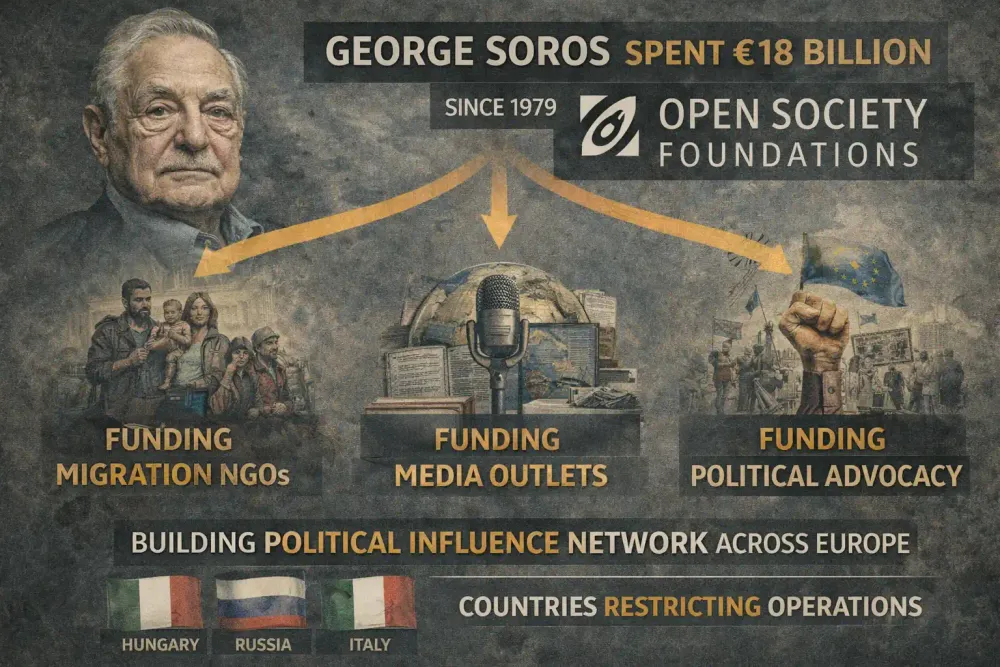
George Soros has spent €18 billion building a political empire that spans continents, funds hundreds of NGOs facilitating illegal migration, owns media outlets that never criticize him, and uses accusations of "antisemitism" to destroy anyone who documents what he openly admits doing. Hungary banned his organizations. Russia declared him a national security threat. Italy seized assets from NGOs he funds. But Brussels protects him because he funds the very politicians and institutions that should regulate him. This isn't philanthropy. This is political conquest disguised as charity.
They call him a philanthropist. A champion of democracy and human rights. A generous benefactor funding civil society across Europe. The media outlets he funds write glowing profiles. The politicians whose campaigns he bankrolls praise his commitment to European values. The NGOs operating on his money describe him as a humanitarian visionary.
Question any of this and you're immediately accused of antisemitism, conspiracy theories, or far-right extremism. It doesn't matter that Soros himself is Jewish and the criticism is about his documented political activities, not his ethnicity. It doesn't matter that he's openly written about his political philosophy and goals. Criticizing Soros has become the fastest way to get labeled a bigot and deplatformed.
But here's what they don't want you examining: George Soros has spent approximately €18 billion over three decades building a political machine that funds migration into Europe, owns European media, bankrolls politicians across the continent, and operates NGOs that openly work to undermine national sovereignty while calling it defending democracy.
His Open Society Foundations fund hundreds of organizations across Europe. Many operate boats in the Mediterranean picking up migrants and transporting them to European shores, activities several countries have called human trafficking disguised as rescue operations. His money flows to media outlets that shape European political coverage while never investigating their own benefactor. His organizations fund political movements from Brexit opposition to climate activism to refugee advocacy.
And when countries try to stop him, when Hungary expelled his university, when Russia banned his foundations, when Italy seized NGO assets, Brussels rushes to his defense. Not because his activities benefit European citizens, but because he funds the very institutions that should be regulating him.
The scale is staggering. The connections are documented. The outcomes are visible in migration statistics, political movements, and media coverage. George Soros has built the most sophisticated political influence operation in European history, and he did it by calling it charity while silencing critics as antisemites.
Let me show you how the empire actually works. Because once you see the funding flows, the organizational structures, and the documented outcomes, you'll understand this isn't conspiracy theory, it's the largest political money laundering operation in Europe, hiding in plain sight.
By A. Kade
The €18 Billion Political Machine Hidden As "Philanthropy"
Start with the scale because understanding the money reveals everything else.
George Soros founded the Open Society Foundations in 1979. Since then, OSF has distributed over $18 billion to political causes, NGOs, media organizations, and activist groups globally. In Europe alone, OSF spending exceeds €6 billion, with approximately €400-600 million distributed annually to European organizations.
This isn't charity in any conventional sense. OSF doesn't fund soup kitchens or homeless shelters. It funds political activism, advocacy organizations, media outlets, and policy institutes that push specific political agendas: open borders, transnational governance, reduced national sovereignty, and what Soros calls "open society" values.
The OSF annual reports are public and they're remarkable for what they reveal. Hundreds of millions flow to organizations working to influence European politics, policy, and public opinion. The grants are presented as supporting "democracy," "human rights," and "civil society." But examine the recipient organizations and you find migration advocacy groups, media outlets, political movements, and activist networks.
Migration and asylum organizations receive approximately €150-200 million annually from OSF. These aren't organizations helping migrants integrate, they're groups advocating for more migration, opposing border enforcement, and operating Mediterranean rescue operations that critics call migrant ferry services.
Media and journalism receives €80-120 million annually. Not advertising, direct grants to media organizations, investigative journalism funds, and press freedom groups. The outlets receiving OSF money rarely if ever investigate OSF or Soros critically. They're funded by him.
The truth doesn’t trend. It survives because a few still care enough to keep it alive.
Keep The Kade Frequency transmitting.
Political advocacy receives €200-300 million annually for organizations pushing policy changes across Europe. Climate activism, justice reform, election integrity, the causes vary but they're all political advocacy funded by a single billionaire's foundation.
This is political spending disguised as philanthropy. In the United States, this level of political activity would require disclosure as lobbying. In Europe, it's called charity and gets tax benefits while operating with minimal oversight.
The foundation's structure enables this. OSF operates through a network of regional and national foundations, Open Society European Policy Institute, Open Society Justice Initiative, dozens of country-specific branches. The complexity makes tracking funding difficult, but the money ultimately traces back to Soros.
And here's the critical point: this isn't passive philanthropy where Soros writes checks and walks away. OSF actively coordinates these organizations toward political goals. They don't just fund groups, they convene them, coordinate campaigns, and direct activity. This is political organizing at continental scale, funded by one man's billions.
Compare this to how European governments would treat similar spending by a Russian or Chinese billionaire. Billions spent funding political advocacy, migration organizations, and media outlets would be called foreign interference and face restrictions. But because Soros presents it as defending democracy and human rights, Brussels calls it philanthropy.
The €18 billion isn't random charity. It's systematic political investment designed to shape European policy, politics, and public opinion according to Soros's vision of "open society", which coincidentally aligns with policies that increase migration, reduce national sovereignty, and create the transnational governance structures his organizations advocate for.
The Migration Machine: NGOs Ferrying Migrants While Calling It Rescue
The most visible and controversial OSF activity in Europe is funding NGOs operating boats in the Mediterranean that pick up migrants and transport them to European shores. These operations are presented as humanitarian rescue. Critics including multiple European governments call them migrant smuggling that encourages more dangerous crossings.
OSF has provided millions in funding to organizations including Sea-Watch, Médecins Sans Frontières, SOS Méditerranée, and others operating rescue vessels. The funding is documented in OSF grants databases. The organizations acknowledge receiving OSF money. This isn't speculation, it's their own disclosures.
These NGOs operate boats that patrol off the Libyan coast waiting for migrant vessels to get into difficulty. When boats are found, NGOs take migrants aboard and transport them to Italy or Malta rather than returning them to Libya. The NGOs call this "rescue." European governments call it facilitating illegal migration.
Here's why the controversy: rescue operations are supposed to take distressed vessels to the nearest safe port. For boats leaving Libya, the nearest safe port is Tunisia or Libya. But NGO vessels consistently transport migrants hundreds of miles north to Italy instead. This isn't rescue, it's ferry service enabling migration that wouldn't succeed otherwise.
The pattern is documented: migrant departures from Libya increase when NGO vessels are present and operating. Italian and Libyan authorities have accused NGOs of coordinating with smugglers, even providing GPS coordinates for pickup locations. Some NGO communications show contact with migrant boats before they were supposedly "discovered" in distress.
Italy seized vessels from several NGOs and launched investigations into human trafficking. The Italian government documented that NGO presence off Libya encourages more migrant departures because people know they'll be picked up and taken to Europe rather than returned. This creates a pull factor making dangerous crossings more attractive.
Matteo Salvini, as Italian Interior Minister, banned NGO vessels from Italian ports and prosecuted NGO workers for facilitating illegal immigration. The prosecutions eventually failed, but the investigations revealed extensive coordination between NGOs, communication with migrant boats, and systematic transport to Europe rather than nearest safe ports.
Greece has made similar accusations. The Greek government documented NGO activities on islands near Turkey, with organizations providing information to migrants about how to reach Europe, legal assistance fighting deportation, and advocacy against border enforcement.
And OSF funds many of these organizations. Not all of their budget, they have multiple funders, but OSF money is significant. When Italian authorities investigated NGO financing, they found OSF connections to several organizations operating rescue vessels.
Soros doesn't hide this. He's openly stated that Europe should accept millions more migrants and that opposing migration is xenophobia. His organizations work toward this goal by funding groups that facilitate migration while fighting enforcement.
The human consequences are real. More people attempt dangerous crossings because NGO vessels operate. More people drown when crossings fail. More migrants reach Europe than would without NGO assistance. More European countries face integration challenges. And more political conflict over migration increases as citizens watch their governments unable or unwilling to control borders.
But from Soros's perspective, this advances "open society", more migration, less border enforcement, more transnational movement. The fact that European citizens increasingly oppose this doesn't matter because OSF isn't accountable to those citizens.
The Media Empire That Never Investigates Its Owner
George Soros doesn't just fund political activism, he owns media outlets and funds journalism organizations across Europe, creating an information ecosystem that promotes his agenda while rarely if ever examining his own activities critically.
Project Syndicate is the clearest example. Soros founded this syndication service that distributes columns to over 500 media outlets in 150 countries. The service is free to participating outlets. Why would Soros fund free content distribution? Because it allows him to shape opinion across hundreds of publications simultaneously.
Project Syndicate columns appear in major European newspapers, El País, Le Monde, Die Zeit, and dozens of others. The columns consistently promote Soros-aligned positions: more migration, more EU integration, more climate action, more transnational governance. And they're presented as independent commentary rather than content funded by the billionaire whose political agenda they advance.
OSF funds dozens of European media outlets directly. The Marshall Plan for Journalism (OSF-funded) provides grants to European news organizations. Open Society Justice Initiative funds investigative journalism into issues OSF prioritizes. International Press Institute (OSF-funded) advocates for press freedom while being funded by a billionaire with political goals.
The outlets receiving this funding rarely disclose it prominently. They'll acknowledge OSF support in annual reports or about pages, but readers consuming their coverage don't know the journalism they're reading is funded by Soros.
And critically: media outlets funded by OSF almost never investigate OSF or Soros critically. They'll report on OSF grants when announced. They'll cover Soros speeches. But investigative journalism into how OSF money shapes European politics? Into connections between OSF funding and policy outcomes? Into whether OSF-funded migration advocacy creates problems for European citizens? That journalism doesn't happen at outlets receiving OSF money.
This is how media capture works. You don't need to control all media, just fund enough to shape coverage of topics you care about while ensuring outlets dependent on your funding won't investigate you.
Direkt36 in Hungary, VSquare in Slovakia, Atlatszo in Hungary, RISE Project in Romania, these investigative outlets all receive OSF funding. They do important journalism exposing government corruption. But they don't investigate the billionaire funding them or examine whether his political activities warrant scrutiny.
The European Press Prize, European Journalism Centre, and dozens of journalism training and support organizations receive OSF funding. This creates dependency: journalists whose careers, training, and awards come from OSF-funded institutions are unlikely to bite the hand funding their profession.
Soros also funds fact-checking organizations that label criticism of him as "misinformation." Full Fact in the UK, Maldita in Spain, Demagog in Czech Republic, OSF provides grants to fact-checkers who then rate claims about Soros. The conflict is obvious but rarely acknowledged.
When Hungarian journalist Zsolt Bayer wrote critically about Soros's influence, he faced lawsuits and media attacks from OSF-funded outlets. When Italian politician Matteo Salvini accused Soros-funded NGOs of facilitating illegal migration, fact-checkers funded by Soros declared this "false" despite documented OSF funding to those NGOs.
This is information control disguised as supporting independent journalism. The journalists are independent from government, but they're dependent on Soros. And that dependency shapes what gets investigated and what doesn't.
The Politicians He Owns: From Brussels To National Capitals
OSF doesn't just fund NGOs and media, it funds politicians, political parties, and campaign organizations across Europe. The money isn't always direct; sometimes it flows through advocacy groups, sometimes through campaign organizations, sometimes through parallel structures that work with political parties without formally coordinating.
Best for Britain was an anti-Brexit campaign organization that fought to reverse the Brexit referendum. The organization received over £400,000 from Soros. When exposed, they initially denied it, then admitted it, then claimed the money didn't influence their position, despite the money funding their entire operation.
Soros opposed Brexit openly. He wrote op-eds arguing Brexit would damage Europe. Then he funded the main organization working to reverse it. This isn't subtle influence, it's a foreign billionaire spending hundreds of thousands to overturn a democratic referendum.
European Council on Foreign Relations (ECFR) received millions from OSF. ECFR is supposedly an independent think tank shaping European foreign policy. But it's funded by Soros and consistently promotes positions aligned with OSF priorities: more EU integration, more migration acceptance, more engagement with authoritarian regimes.
ECFR board members include former heads of state, foreign ministers, and EU officials. These aren't fringe figures, they're European establishment. And they're operating through an organization funded by a billionaire with specific political goals.
Multiple European Parliament members have received support from OSF-funded organizations. Not always direct campaign contributions, sometimes it's OSF-funded groups providing research support, policy analysis, or advocacy that benefits specific candidates.
Guy Verhofstadt, former Belgian Prime Minister and longtime MEP, has praised Soros publicly and worked closely with OSF-funded organizations promoting EU federalism. Daniel Cohn-Bendit, former Green MEP, has appeared at OSF events and advocated positions aligned with OSF funding priorities.
The revolving door operates here too. Former OSF staff become EU officials. Former EU officials join OSF. Judith Sargentini, former Dutch MEP, worked closely with OSF-funded organizations on migration policy. Marietje Schaake, former Dutch MEP, now works at Stanford's Cyber Policy Center, which received OSF funding.
This creates networks where OSF money, EU positions, and political advocacy flow together. It's not bribery in the legal sense, it's systematic influence where OSF funding shapes political careers, political positions, and political outcomes.
At national level, OSF funds "civil society" organizations that lobby governments on OSF priority issues. In Poland, OSF-funded groups opposed judicial reforms. In Hungary, OSF-funded organizations opposed Orbán's government. In Italy, OSF-funded groups opposed Salvini's migration policies.
These aren't grassroots citizens' movements, they're professionally staffed organizations operating on millions in OSF funding. They present themselves as representing civil society, but they're funded by a single billionaire pursuing specific political goals.
And when governments try to restrict foreign funding of political organizations—when Hungary passed laws requiring NGOs to disclose foreign funding, OSF and Brussels called it authoritarianism. Transparency about who funds political advocacy became an attack on democracy.
The irony is thick: Soros funds organizations promoting transparency and accountability in government, while opposing transparency about his own funding of political advocacy. Rules for thee but not for me, enforced through accusations of authoritarianism against anyone demanding disclosure.
The Countries That Banned Him And Why They Were Right
Several countries have restricted or banned OSF operations. Western media presents this as authoritarianism and attacks on civil society. But examining what these countries documented reveals legitimate concerns about foreign political influence.
Hungary has been the most aggressive. Prime Minister Viktor Orbán accused Soros of funding migration into Europe and working to undermine national sovereignty. Media dismissed this as conspiracy theory and antisemitism.
Then Hungary documented it. The government compiled reports showing OSF funding to migration advocacy organizations, media outlets critical of Hungarian border policies, and political groups opposing Orbán. The connections were documented, not speculated.
Hungary passed laws requiring NGOs receiving foreign funding above certain thresholds to disclose it. OSF-funded groups screamed authoritarianism. But the law didn't ban foreign funding, it required transparency. If OSF funding was legitimate philanthropy, why oppose disclosing it?
Hungary also shut down Central European University, a Soros-founded institution in Budapest. CEU was presented as an attack on academic freedom. But CEU was operating under legal structures that gave it advantages over Hungarian universities while being funded and controlled by Soros. Hungary required it to follow the same rules as other universities. CEU refused and moved to Vienna.
The EU condemned Hungary's actions. But notably, the EU never addressed the substance of Hungary's claims, that Soros was funding political interference in a member state. Instead, Brussels framed it as rule of law concerns while ignoring that Hungary's complaints were about a foreign billionaire's political activities.
Russia banned OSF in 2015, declaring it a threat to national security. Western media called this paranoid authoritarianism. But Russia documented OSF funding to organizations that participated in color revolutions in Georgia, Ukraine, and other former Soviet states.
OSF openly admits funding pro-democracy groups in these countries. Russia considers this foreign interference in internal politics. And here's the uncomfortable question: if Russian billionaires funded organizations in France or Germany that worked to change governments, would that be called democracy promotion or foreign interference?
Russia has legitimate concerns about OSF activities even if Russia itself isn't a democracy. The activities OSF admits to, funding political opposition, supporting protests, advocating regime change, would be considered foreign interference if done by Russian or Chinese billionaires in Europe.
Italy under Salvini's Interior Ministry seized vessels operated by NGOs and launched investigations into human trafficking. Several NGOs receiving OSF funding were targeted. The investigations documented coordination with migrant boats, systematic transport to Italy rather than nearest safe ports, and possible connections to smuggling networks.
The prosecutions ultimately failed, but the investigations revealed that OSF money was funding organizations whose activities Italian authorities considered facilitating illegal migration. This isn't authoritarian paranoia, it's documented evidence that OSF funding enables migration that Italian citizens voted to restrict.
Poland has restricted OSF activities and funding to political advocacy groups. The Polish government documented OSF money flowing to organizations opposing elected government policies on judiciary, migration, and social issues. Poland called this foreign interference. Brussels called it defending civil society.
Who's right? If you believe a billionaire should be able to fund political opposition in democracies, OSF activities are fine. If you believe domestic politics should be decided by citizens rather than foreign money, Hungary and Poland have legitimate complaints.
The fact that Brussels consistently sides with Soros against elected governments raises questions about who Brussels represents. When citizens vote for border control and Brussels uses Soros-funded NGOs to undermine it, whose democracy is being defended?
The Man Who Broke England And Lectures About Democracy
George Soros made his fortune through currency speculation, betting against national currencies and profiting when they collapsed. His most famous trade was shorting the British pound in 1992, making over $1 billion and forcing Britain out of the European Exchange Rate Mechanism.
The British call it "Black Wednesday." Soros calls it "my finest hour." The Bank of England spent billions trying to defend the pound. Interest rates spiked to 15%. Homeowners faced mortgage payment increases that bankrupted thousands. Businesses failed. People lost their savings.
Soros made $1 billion profiting from this crisis that devastated British families. He didn't cause the underlying economic problems, but he bet against Britain and profited enormously from British citizens' suffering.
Now this same man lectures Europeans about democracy, solidarity, and moral obligations to accept migration. The cognitive dissonance is fucking remarkable: a billionaire who made his fortune betting against European economies now funds political movements telling European citizens they're morally obligated to accept policies most oppose.
Soros has written books and op-eds about his political philosophy. He genuinely believes in "open society" principles, borderless, transnational governance, reduced national sovereignty, cosmopolitan values replacing national identity. These aren't secret conspiracy theories, he's openly advocated for them.
The problem is he's using billions earned through financial speculation to impose his political vision on Europeans who never voted for it. He's not running for office. He's not winning elections. He's buying influence through NGOs, media, and politicians to advance policies European citizens increasingly reject.
His foundation's mission statement talks about justice, equality, and freedom. But the "freedom" he promotes is freedom of capital and people to move across borders regardless of what citizens in those countries want. The "justice" he funds is often justice for non-citizens entering Europe illegally rather than justice for European citizens whose wages stagnate and communities transform due to mass migration.
And when Europeans vote against his vision, Brexit, Orbán's victories, Salvini's rise, Le Pen's support, he funds efforts to reverse or undermine those democratic outcomes. Best for Britain trying to overturn Brexit wasn't democracy, it was a billionaire using money to undo a referendum he opposed.
This is oligarchy disguised as philanthropy. One man's billions shaping European politics, policy, and media according to his vision while calling anyone who objects authoritarian or antisemitic. The authoritarian isn't the people questioning whether billionaires should buy political influence, it's the billionaire demanding he be allowed to without scrutiny.
The Color Revolutions: Ukraine, Georgia, And Regime Change As Democracy
OSF's activities aren't limited to Western Europe. The foundation has been deeply involved in Eastern Europe and former Soviet states, funding organizations that participated in "color revolutions", popular movements that overthrew governments in Georgia, Ukraine, Serbia, and other countries.
Western media presents these as spontaneous democratic uprisings. But examining the funding reveals sophisticated foreign-backed operations where organizations receiving millions from OSF and other Western sources organized protests, trained activists, and coordinated opposition to governments the West opposed.
Georgia's Rose Revolution (2003): OSF funded opposition groups including the Liberty Institute and Georgian Young Lawyers Association. These organizations trained activists, monitored elections, and organized protests that ultimately removed President Eduard Shevardnadze. OSF spending in Georgia increased from $500,000 annually before 2003 to several million during the revolution.
Ukraine's Orange Revolution (2004): OSF funded the Ukrainian opposition, civil society organizations, and media outlets that supported Viktor Yushchenko against Viktor Yanukovych. The revolution succeeded in bringing the Western-backed candidate to power. OSF grants to Ukrainian organizations exceeded $100 million in the years surrounding the revolution.
Ukraine's Euromaidan (2014): OSF funded dozens of organizations involved in the Maidan protests that removed Yanukovych. The foundation provided grants to protest organizers, media coverage, and civil society groups advocating for EU integration. After Yanukovych's removal, OSF spending in Ukraine increased dramatically to support the new government.
These aren't conspiracy theories, OSF openly acknowledges funding pro-democracy groups in these countries. But "pro-democracy" is interesting phrasing when the organizations receiving funding work to remove governments OSF opposes and install governments OSF supports.
If Russian billionaires funded similar operations in France or Germany, paying for protests, training activists, supporting opposition parties, coordinating regime change, Western governments would call it foreign interference and espionage. But when OSF does it in former Soviet states, it's called democracy promotion.
The outcomes of these color revolutions haven't been democratic paradises. Georgia faces ongoing instability. Ukraine descended into civil war and Russian invasion after the 2014 revolution. Serbia struggled with governance failures. The revolutions created chaos more than democracy.
But from a geopolitical perspective, they aligned these countries with the West and against Russia. And that's what OSF funding accomplished: weakening Russian influence by funding movements to remove Russian-aligned governments and install Western-aligned ones.
This is regime change through civil society funding rather than military invasion. It's sophisticated foreign interference that gets called democracy promotion because the money comes from a billionaire claiming humanitarian motives rather than a government admitting strategic goals.
And it's all legal. There's no law against a billionaire funding political movements in other countries. But if we're honest about what's happening, it's foreign interference in domestic politics of sovereign nations, funded by one man's billions and coordinated by his foundation.
The Weapon Of Antisemitism: How Criticism Gets Silenced
Here's the most effective part of the Soros protection system: accuse critics of antisemitism regardless of whether criticism has anything to do with Soros being Jewish.
Soros was born Jewish but is secular and has said religion plays no role in his life. Criticism of his political activities has nothing to do with his ethnicity. Yet media and OSF-funded organizations consistently frame criticism of Soros as antisemitic.
Viktor Orbán's criticism of Soros funding migration into Hungary was called antisemitic. Never mind that Orbán was criticizing documented OSF funding to migration organizations, the criticism became about Soros being Jewish rather than about his political activities.
Matteo Salvini's criticism of OSF-funded NGOs was called antisemitic conspiracy theory. Again, never mind that OSF funding to these NGOs is documented in OSF's own grant records, questioning it became antisemitism.
Criticism in Poland, Romania, and other Eastern European countries gets the same treatment. Document OSF political funding, call it foreign interference, and immediately face accusations of antisemitism and conspiracy theories.
This is weaponization of antisemitism accusations to silence legitimate criticism. Real antisemitism is hatred of Jews because they're Jewish. Criticizing a billionaire's documented political activities isn't antisemitism even if the billionaire happens to be Jewish.
But the accusation works because no one wants to be called antisemitic. So criticism gets dampened, media outlets think twice before investigating, and politicians avoid the topic entirely because the reputational cost is too high.
OSF-funded organizations actively promote this framing. Open Society Justice Initiative and other OSF-funded groups publish reports claiming criticism of Soros is coded antisemitism. They argue that focusing on Soros specifically rather than other billionaires is evidence of bias.
But Soros funds political activities at a scale other billionaires don't. He's openly political in ways Jeff Bezos and Warren Buffett aren't. Criticizing his political activities more than theirs isn't antisemitism, it's proportionate to his political involvement.
The ADL (Anti-Defamation League) has defended Soros against criticism while acknowledging some criticism is legitimate. But many Jewish organizations recognize that conflating criticism of political activities with antisemitism diminishes actual antisemitism.
Tablet Magazine, a Jewish publication, has documented this: "Crying antisemitism every time someone criticizes Soros's political activities does enormous damage by delegitimizing claims of actual antisemitism."
But the weapon keeps being deployed because it works. Politicians self-censor. Media outlets avoid investigation. And Soros's political activities continue with minimal scrutiny because examining them risks being labeled bigoted.
This is the same pattern as media capture where financial dependency and reputational risk silence investigation. Critics face professional and social costs that make questioning Soros too expensive regardless of whether the criticism is valid.
Why Brussels Protects Him: He Funds The System
Here's why European institutions consistently defend Soros against member state governments: he funds the institutions, the politicians, the NGOs, and the media ecosystem that Brussels depends on.
The European Council on Foreign Relations (OSF-funded) advises EU foreign policy. The European Policy Centre(OSF-funded) influences EU domestic policy. The European Stability Initiative (OSF-funded) advocates for migration policy. These aren't peripheral organizations, they're the policy infrastructure Brussels relies on.
When Hungary or Poland criticize Soros, they're criticizing organizations that EU officials work with daily, that provide policy research Brussels uses, that advocate for positions Brussels supports. Of course Brussels defends Soros, his organizations are embedded in EU policymaking.
Open Society European Policy Institute operates in Brussels specifically to influence EU institutions. OSEPI's stated mission is shaping EU policy on migration, justice, human rights, and democracy. That's not hiding influence, it's openly advocating for Soros's political vision through EU policy.
EU officials rotate through OSF-funded organizations. Former Commission officials join OSF-funded think tanks. Former MEPs work for OSF-funded NGOs. The revolving door ensures OSF influence persists regardless of election outcomes.
And critically: OSF funds organizations that defend EU integration against nationalist criticism. When Orbán criticizes Brussels, OSF-funded think tanks produce research defending EU authority. When Salvini opposed EU migration policy, OSF-funded NGOs advocated for more EU control of borders.
This creates alignment between OSF goals and EU institutional interests. Both want more integration, more transnational authority, less national sovereignty. Both oppose politicians emphasizing national borders and identity. Both frame resistance to migration as xenophobia rather than legitimate democratic choice.
So when member states try to restrict OSF activities, Brussels sees it as attacks on organizations supporting EU integration. Brussels defends Soros because Soros funds the ecosystem Brussels depends on to advance its goals.
This is institutional capture disguised as defending democracy. Brussels isn't defending democracy, it's defending a billionaire who funds its policy infrastructure against democratic governments representing citizens who oppose his agenda.
The pattern is identical across all corporate and institutional capture: the regulator depends on the regulated, financial flows create alignment, and citizens' interests get ignored in favor of elite arrangements.
What The €18 Billion Actually Bought
Make the outcomes concrete by understanding what Soros's money actually accomplished in Europe.
Migration levels increased: Europe experienced unprecedented migration in 2015-2016. OSF-funded organizations advocated against border enforcement, provided legal support to migrants, and operated boats facilitating Mediterranean crossings. Did OSF cause the migration crisis? No. Did OSF funding enable and encourage more migration than would have occurred otherwise? Absolutely.
Border enforcement weakened: OSF-funded organizations sued governments for deportations, challenged border controls, and advocated against enforcement. Countries including Greece, Italy, and Hungary faced legal challenges from OSF-funded NGOs when they tried to restrict illegal entry.
Media coverage shifted: OSF-funded journalism consistently frames migration as humanitarian issue rather than examining citizens' legitimate concerns about cultural change, wage impacts, or integration challenges. Coverage emphasizes migrant hardships while ignoring citizen opposition isn't balanced reporting, it's advocacy enabled by OSF funding.
Political opposition funded: OSF money went to organizations opposing Brexit, opposing Orbán, opposing Salvini, opposing Le Pen, always against politicians who emphasize national sovereignty and border control. The pattern is clear: OSF funds opposition to nationalist movements regardless of their democratic legitimacy.
EU integration advanced: OSF-funded think tanks consistently advocate for more EU power, more centralized authority, more transnational governance. These positions align with Brussels but not with European citizens who increasingly vote for less integration.
"Civil society" professionalized: Organizations claiming to represent grassroots citizens are actually professional operations on millions in OSF funding. They don't represent spontaneous citizen sentiment, they represent what OSF pays them to advocate for.
Discourse policing increased: OSF-funded fact-checkers, research institutes, and media organizations consistently frame nationalist positions as misinformation, extremism, or conspiracy theories. Legitimate political disagreement gets pathologized as dangerous rather than engaged as democratic debate.
What Soros bought for €18 billion is systematic influence over European migration policy, political discourse, media coverage, and institutional direction. Not total control, other forces exist, but massive influence shaping outcomes toward his political vision.
And European citizens had no vote in this. They didn't choose Soros's agenda. They often vote against it. But his billions enable it anyway through NGOs, media, and politicians operating on his funding.
The System Won't Stop Him Because The System Depends On Him
Here's why OSF activities will continue despite controversies: every institution that should regulate or investigate depends on OSF funding.
Media outlets investigating Soros would lose funding, access to OSF-funded sources, and face accusations of antisemitism. Easier to ignore his activities than risk those costs.
Politicians criticizing Soros face media backlash from outlets he funds, opposition from NGOs he funds, and accusations of bigotry. Safer to stay silent than challenge someone who funds substantial parts of civil society infrastructure.
EU institutions depend on OSF-funded think tanks for policy research and OSF-funded NGOs for civil society engagement. Criticizing Soros means losing organizational partners Brussels works with constantly.
NGOs that might criticize OSF political activities won't because they might want OSF funding in the future. Silence maintains funding possibilities. Criticism closes doors.
Academic institutions receive OSF grants for research. Universities hire OSF-funded scholars. Programs depend on OSF money. Academic criticism of Soros is rare because universities need his funding.
The system maintains itself through dependency. OSF doesn't need to directly threaten anyone, dependency creates self-censorship. Organizations and individuals know criticizing Soros risks funding, reputation, and access. So they don't.
Change would require:
Transparency laws requiring full disclosure of foreign political funding. Hungary tried this. Brussels called it authoritarian.
Media ownership disclosure making readers aware when journalism is funded by political actors. Some outlets disclose OSF funding. Most don't prominently.
Limits on foreign political activity preventing non-citizens from funding domestic political advocacy beyond certain thresholds. This would restrict OSF but also other foreign influence.
Electoral consequences for politicians accepting OSF support or implementing OSF-funded policy proposals. But voters often don't know about OSF connections.
Alternative civil society funding reducing NGO dependence on billionaire philanthropy. But governments don't fund political advocacy, so NGOs remain dependent on sources like OSF.
None of this is likely because the people who would implement it benefit from current arrangements. Politicians get advocacy support from OSF-funded groups. Media gets funding. NGOs get grants. Brussels gets policy infrastructure. Everyone benefits except citizens who don't want Soros's political vision implemented.
So the empire continues: €18 billion buying political influence, funding migration advocacy, owning media outlets, coordinating opposition to nationalist movements, and silencing critics through accusations of bigotry.
This is the same fucking pattern documented across European policy: elite interests advance through captured institutions while citizens' democratic choices get undermined by money they can't compete with and systems they can't change.
The NGO Army: Meet The Organizations Operating On Soros Money
Put names to the organizations because they're not abstract entities, they're specific groups with specific agendas operating on millions in OSF funding.
European Council on Foreign Relations (ECFR): Receives millions from OSF annually. Board members include former EU foreign policy chief Javier Solana, former Belgian PM Guy Verhofstadt, former Swedish FM Carl Bildt. Consistently advocates for EU integration, engagement with authoritarian regimes, and migration acceptance. Presents itself as independent think tank while operating on Soros funding.
Human Rights Watch - Europe: Receives substantial OSF grants for human rights monitoring. But HRW's European work focuses heavily on criticizing border enforcement, deportations, and migration controls while rarely examining impacts of mass migration on European citizens' rights to security and social cohesion.
European Stability Initiative (ESI): Received over €15 million from OSF. ESI Director Gerald Knaus was the architect of the EU-Turkey migration deal. His organization advocates for more migration acceptance while being funded by a billionaire who openly supports more migration. The circularity is remarkable.
Amnesty International - European branches: Receives OSF funding for migration and refugee advocacy. Amnesty consistently opposes European border enforcement, calls for more refugee acceptance, and frames enforcement as human rights violations rather than legitimate state authority.
Migration Policy Institute Europe: OSF-funded research organization providing policy analysis on migration. Their research consistently supports more migration acceptance, criticizes enforcement, and provides ammunition for politicians advocating open borders. Independent research would include migration's negative impacts, MPI research systematically doesn't.
European Programme for Integration and Migration (EPIM): A collaboration of European foundations including OSF that funds migration advocacy organizations with over €20 million annually. This pools billionaire money to coordinate migration advocacy across Europe.
Picum (Platform for International Cooperation on Undocumented Migrants): OSF-funded network advocating for rights of illegal immigrants, including opposing deportations and advocating for access to services regardless of legal status. This isn't helping legal migrants integrate, it's advocating against immigration enforcement.
European Network Against Racism (ENAR): OSF-funded organization that calls opposition to migration "racism" and advocates for more migration acceptance as anti-racism work. This conflates legitimate policy disagreement with bigotry, silencing democratic debate.
Oxfam Europe: Receives OSF grants for migration advocacy. Oxfam consistently frames European border enforcement as causing migrant deaths rather than acknowledging that smugglers and those encouraging dangerous crossings bear responsibility.
These organizations coordinate regularly, share research, and amplify each other's advocacy. They present themselves as independent civil society but they're a coordinated network operating on shared funding pursuing aligned goals. This is how €200-300 million in OSF migration funding translates into systematic advocacy shaping European policy.
The 2015 Refugee Crisis: How Soros Profited From Chaos He Helped Create
The 2015-2016 refugee crisis saw over 1.5 million people enter Europe illegally. Western media framed it as humanitarian catastrophe requiring compassion. But examining OSF's role reveals systematic advocacy that encouraged more migration while Soros positioned to profit from the chaos.
In early 2015, OSF-funded organizations escalated Mediterranean rescue operations. More NGO boats meant more migrants attempting crossings because they knew rescue was available. This created a pull factor: smugglers advertised rescue operations to customers, knowing NGOs would complete the journey smugglers started.
As the crisis escalated, OSF-funded advocacy groups pushed European governments to accept more refugees, oppose border enforcement, and provide services regardless of legal status. Their advocacy shaped policy: Germany's open-door policy in September 2015 was influenced by OSF-funded organizations advising Merkel's government.
Then Soros profited. In August 2016, he announced a $500 million investment in "businesses run by migrants and refugees." The crisis he helped encourage through NGO funding became an investment opportunity. Migrants would start businesses, Soros would invest in them, and he'd profit from the migration his organizations facilitated.
The audacity is fucking stunning: fund NGOs that facilitate migration, advocate for policies accepting more migrants, then invest in businesses serving migrants you helped bring to Europe. It's vertically integrated migration profiteering disguised as humanitarianism.
Soros also invested in real estate and services in areas receiving migrants. When thousands arrive needing housing, those who own housing profit from demand they helped create. When migrants need services, those who own service businesses profit from customers their advocacy helped import.
This pattern repeats: create crisis through funded advocacy, profit from crisis you created, call anyone who questions it a bigot. It's the same model he used with currency speculation, bet on chaos, profit when it arrives, lecture others about morality.
The migration crisis also strengthened Soros's political influence. Governments facing migration influx turned to OSF-funded organizations for expertise on managing arrivals. The crisis OSF helped create made governments dependent on OSF-funded solutions.
What This Costs European Citizens: The Bill For Soros's Vision
Make the impact personal by understanding what Soros's €18 billion in political spending costs average European families.
Higher crime rates: Multiple European countries saw crime increases correlated with migration influx. Sexual assaults in Germany increased sharply after 2015. Sweden became Europe's rape capital with migrants disproportionately represented in statistics. France faces ongoing terrorism risk from radicalized second-generation immigrants. These aren't racist observations, they're statistical facts from official crime data.
OSF-funded organizations oppose discussing this. They frame any connection between migration and crime as xenophobia. But citizens experiencing higher crime in their neighborhoods aren't xenophobic, they're suffering consequences of policies OSF money promoted.
Wage stagnation: Mass low-skilled migration increases labor supply, which suppresses wages for working-class Europeans competing for jobs. Economic data shows wage growth slowest in sectors with most migrant labor. But OSF-funded think tanks don't research migration's impact on European workers' wages—they research discrimination against migrants.
Housing costs: Increased population from migration drives housing demand faster than supply increases. Rents and home prices increased significantly in cities receiving migrants. Working families face higher housing costs due to migration policies OSF money advocated for.
Education quality decline: Schools with high percentages of non-native speakers struggle with language barriers, cultural differences, and varying education levels. Native children's education suffers when schools must accommodate students who don't speak the language. But OSF-funded organizations oppose acknowledging this because it might justify restricting migration.
Social cohesion breakdown: Rapid demographic change transforms communities faster than integration can occur. Citizens feel like strangers in their own neighborhoods. This isn't racism, it's natural human response to rapid change. But OSF-funded groups pathologize these feelings rather than acknowledging legitimate concerns.
Welfare system strain: Migrants receive welfare benefits before contributing taxes. Sweden's generous welfare system faces sustainability questions partly from migration costs. But OSF-funded research emphasizes migrant contributions while downplaying costs.
Political radicalization: Citizens watching migration policies they oppose implemented despite democratic opposition increasingly support anti-immigration parties. The rise of Alternative für Deutschland, Lega, National Rally, and other nationalist parties is directly connected to migration policies citizens didn't vote for.
OSF would blame this on racism. But when citizens vote against migration and billionaire money funds advocacy implementing it anyway, citizens radicalize because normal political processes don't work. That's not citizens' failure, it's democracy's failure when billionaire money overrides citizen preferences.
On average, European households pay approximately €400-600 annually in taxes funding services for migrants and refugees. That's money that could go to healthcare, education, or infrastructure for citizens. Instead, it's funding integration and services for people who entered illegally while OSF-funded organizations opposed deportation.
Add higher crime risk, wage suppression, housing costs, and degraded social cohesion, and the total cost to working families easily exceeds €2,000-3,000 annually. That's not theoretical, it's documented through economic research on migration's fiscal and social impacts.
But OSF-funded organizations never research these costs honestly. They research discrimination against migrants, barriers to integration, and xenophobia in European societies. The research is designed to justify more migration, not honestly assess costs and benefits.
The Honest Accounting Nobody Will Provide
Here's what honest assessment of Soros's European political activities would look like, which guarantees you'll never see it from OSF-funded media or organizations:
Acknowledge the political agenda: OSF isn't neutral philanthropy, it's systematic political advocacy pursuing specific policy goals: more migration, less border enforcement, more EU integration, less national sovereignty. Stop pretending this is charity when it's politics.
Disclose the funding: Every media outlet, think tank, NGO, and politician receiving OSF money should prominently disclose it. Readers deserve to know when journalism is funded by the billionaire it covers. Citizens deserve to know when advocacy comes from paid organizations rather than grassroots movements.
Allow democratic opposition: When citizens vote against migration or EU integration, respect those choices rather than funding organizations to undermine them. Democracy means accepting outcomes you oppose, not using billions to reverse them.
End the antisemitism weapon: Criticizing OSF political activities isn't antisemitism. It's legitimate policy disagreement. Stop conflating the two to silence democratic debate.
Investigate honestly: Media should examine whether OSF-funded migration advocacy contributed to Europe's migration crisis. Think tanks should research migration's costs honestly rather than only researching benefits. Academics should study whether billionaire political funding undermines democracy.
Demand accountability: Ask whether one man's billions should be able to shape European policy against citizen preferences. Question whether "civil society" funded by a billionaire serves citizens or the billionaire.
Respect national sovereignty: European citizens have the right to determine who enters their countries, what their borders mean, and how their societies change. Billionaire-funded advocacy working to override those choices isn't defending democracy, it's undermining it.
But none of this will happen because:
- OSF funds the media that should investigate
- OSF funds the NGOs that should provide civil society checks
- OSF funds the politicians who should regulate political money
- OSF funds the think tanks that should honestly research impacts
- OSF funds the fact-checkers who should verify claims
The system can't investigate itself when the system operates on Soros's money. Every institution that should provide oversight depends on his funding. Every mechanism that should enable accountability is captured by financial dependence.
Change requires citizens understanding how the empire actually works, demanding transparency about who funds political advocacy, and voting against politicians accepting OSF support or implementing OSF-funded policy proposals.
This is the largest political money laundering operation in Europe, surpassing even defense contractor profits and climate finance in its systematic influence over policy, media, and political discourse. And it's all hidden behind philanthropy while anyone who examines it gets called a bigot.
George Soros spent €18 billion building a political empire that serves his vision while calling it defending democracy. The real threat to democracy isn't citizens questioning billionaire influence, it's the billionaire buying influence then silencing questions about it.
A. Kade
"The best way to rob a bank is to own one."
William K. Black
No ads. No sponsors. Just signals from the noise.
Keep The Kade Frequency transmitting.