The IMF Debt Trap: How "Development Assistance" Enslaves Countries While Enriching Western Banks
IMF gave Greece €289B. GDP collapsed 25%, unemployment hit 27%, suicides doubled. 95% went to banks, not Greece. Africa got 40 years of IMF, poverty went UP from 41% to 51%. Argentina's 5 programs all failed. But countries that reject IMF? They recover faster.

€289 billion to Greece in "bailout" loans
GDP declined 25%, unemployment hit 27%, suicides doubled
Assets sold to foreign investors at fire-sale prices
Still drowning in debt while creditors profited
Same playbook in 60+ countries over 40 years
This isn't development assistance. This is debt colonization disguised as rescue. The International Monetary Fund operates a sophisticated loan scheme where crisis-hit countries receive emergency funds with conditions requiring privatization of state assets, cuts to social spending, and market liberalization. The policies consistently worsen economic conditions, create permanent debt dependency, and transfer public assets to Western corporations at distressed prices, all while being presented as necessary medicine for irresponsible governments.
Greece is the European example everyone saw but nobody learned from. Argentina experienced five IMF programs, each making things worse. Across Africa, 40 years of IMF structural adjustment left economies weaker than in 1980. The pattern repeats: crisis emerges, IMF offers rescue loans, conditions destroy local economy further, assets get privatized to Western corporations, debt becomes unpayable, country becomes permanently dependent.
And it's not accidental failure, it's the designed outcome. The IMF is controlled by Western countries (U.S. has veto power), policies benefit Western banks and corporations, and the revolving door between IMF and Wall Street ensures the same people profiting from the policies write the policies.
By A. Kade
What this investigation exposes:
→ Greece's €289B bailout destroyed economy while creditors profited
→ IMF structural adjustment failed in 60+ countries over 40 years
→ Conditions consistently worsen crises they claim to solve
→ Assets privatized to Western corps at pennies on dollar
→ Christine Lagarde: IMF head → ECB President (revolving door in action)
→ U.S. veto power ensures IMF serves Western interests
→ Same debt trap now being deployed in Ukraine ($15B loans)
→ 40 years of IMF programs left African economies worse than 1980
Let me show you exactly how the debt colonization works and why it keeps happening despite documented failure.
The Greek Destruction: €289 Billion In Loans, Economy Obliterated
Start with Greece because it happened in Europe where everyone could see it, and the pattern reveals everything.
2010: Greek debt crisis emerges. Years of government overspending, tax evasion, and European banks lending recklessly created unsustainable debt. Greece needed help. Enter the IMF, European Central Bank, and European Commission (the "Troika") with rescue package.
The deal: €289 billion in bailout loans between 2010-2018. In exchange, Greece must implement "structural adjustment":
- Cut public sector wages 20-30%
- Reduce pensions 40% on average
- Slash healthcare spending
- Fire public employees
- Increase taxes (VAT from 19% to 24%)
- Privatize state assets (ports, airports, energy companies, land)
- Liberalize labor markets (reduce worker protections)
- Open markets to foreign investment
The Troika called this "necessary reform" to make Greece competitive and restore economic health. Economists warned it would cause depression. The economists were right.
The truth doesn’t trend. It survives because a few still care enough to keep it alive.
Keep The Kade Frequency transmitting.
The results after 8 years of IMF programs:
GDP collapsed 25% - equivalent to Great Depression in United States. Not recession, depression. The Greek economy shrank by a quarter while being "rescued."
Unemployment hit 27% - youth unemployment reached 60%. An entire generation unable to find work. The "reforms" didn't create jobs, they destroyed them.
Poverty increased 40% - middle class families suddenly couldn't afford food. Homelessness soared. Soup kitchens for people who used to be employed.
Healthcare deteriorated - hospital budgets cut 40%. Medicine shortages. HIV infections increased as prevention programs got defunded. Infant mortality increased for first time in decades.
Suicide rates doubled - from 2.8 per 100,000 to 5.2 per 100,000. Not abstract statistics, actual people killing themselves because they lost everything.
Brain drain accelerated - 500,000+ educated Greeks (mostly young) emigrated seeking opportunity elsewhere. The country's future left.
WHAT THIS COST GREEKS:
Average Greek household income: Declined from €26,000 to €16,000 annually
Pensions: Cut 40% (retirees who paid in their whole lives got €600/month instead of €1,000)
Healthcare access: 2.5 million lost health insurance coverage
Job prospects: 1 in 4 adults unemployed, 3 in 5 young people
Mental health: Suicide, depression, anxiety rates doubled
Future: Half a million young, educated Greeks forced to emigrate
And the debt? Still there. Greece's debt-to-GDP ratio in 2010: 146%. After €289 billion in bailouts and 8 years of devastating austerity: 180%. The loans didn't reduce debt, they increased it while destroying the economy's ability to repay.
"The IMF's approach to the Greek crisis was a disaster. The policies imposed caused unnecessary suffering and didn't solve the problem." - Joseph Stiglitz, Nobel Prize-winning economist and former World Bank Chief Economist
Where did the money go? Not to Greeks. Approximately 95% of bailout funds went directly to banks, mostly French and German banks that had lent recklessly to Greece. The loans bailed out creditors, not the country. Greeks got the debt. Banks got paid. Then Greeks got austerity to service debt that bailed out banks.
And the privatization? Greek ports sold to Chinese companies. Athens airport to German consortium. Energy infrastructure to foreign investors. All at depression-era prices. Assets built over generations with Greek taxes sold at fire-sale prices to satisfy creditors.
The IMF knew this would fail. Internal documents released later showed IMF staff warning that the austerity would cause depression. They implemented it anyway because the priority was protecting creditor banks, not Greek citizens.
"Let them hate, so long as they fear." - Caligula
The Standard Playbook: How IMF Debt Colonization Works
Greece isn't unique, it's the pattern repeated across 60+ countries. The mechanism is always the same:
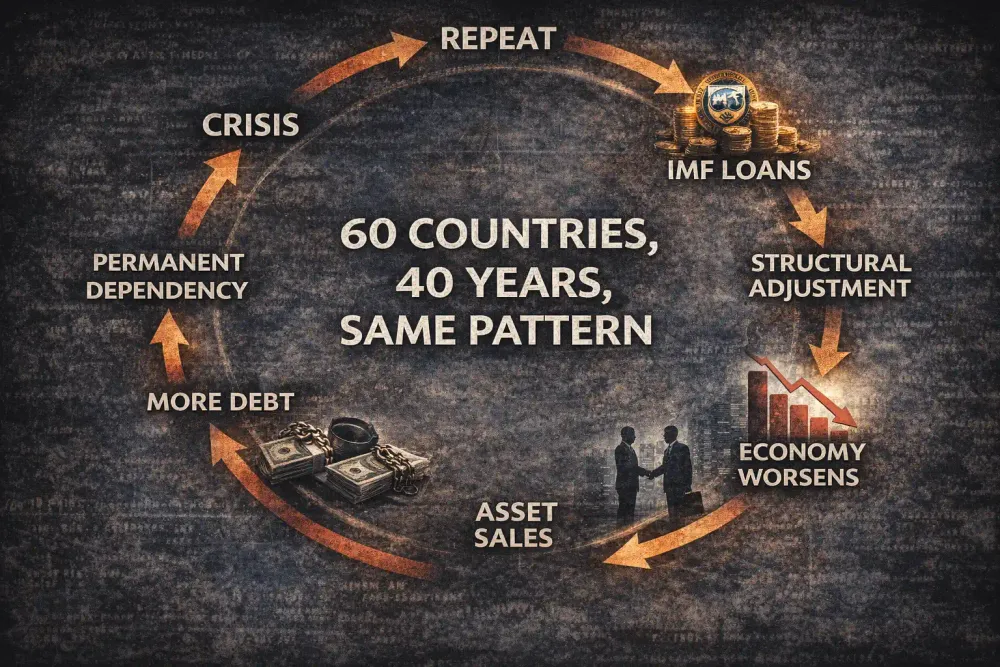
Step 1 - Crisis Emerges: Country faces economic crisis. Often caused by external shocks (commodity price collapse, financial contagion), bad domestic policy, or Western financial speculation. Regardless of cause, country needs emergency funding.
Step 2 - IMF "Rescue": IMF offers loans. Sounds generous. Except the loans come with conditions called "structural adjustment programs." The conditions require fundamental changes to how the country's economy operates.
Step 3 - Structural Adjustment Imposed: The conditions are remarkably consistent across different countries and decades:
Austerity measures: Cut government spending, reduce public sector, slash social programs. Presented as fiscal responsibility. Actually: reduces domestic demand, worsens economic contraction.
Privatization requirements: Sell state-owned enterprises to private investors (usually foreign corporations). Presented as improving efficiency. Actually: transfers public assets to Western corporations at distressed prices.
Market liberalization: Remove trade barriers, open markets to foreign competition, eliminate capital controls. Presented as increasing competitiveness. Actually: exposes domestic industries to foreign competition they can't survive, enables capital flight.
Labor market "reforms": Reduce worker protections, weaken unions, make firing easier. Presented as flexibility. Actually: drives wages down, shifts power to employers.
Currency devaluation: Force currency depreciation. Presented as improving exports. Actually: makes imports more expensive, increases inflation, reduces living standards.
Step 4 - Economy Worsens: The structural adjustment consistently makes the crisis worse. Austerity reduces demand. Privatization transfers wealth. Liberalization destroys local industry. Devaluation creates inflation. The economy contracts further.
Step 5 - Asset Sales: As economy worsens and government gets desperate for revenue, state assets get sold at rock-bottom prices. Ports, utilities, energy companies, land, resources, all bought by Western corporations at pennies on the dollar.
Step 6 - Permanent Dependency: The country can't repay original debt. Needs more IMF loans. Gets more structural adjustment. Economy weakens further. Cycle continues. Country becomes permanently dependent on IMF while Western corporations own its assets.
This isn't development assistance, it's economic subjugation disguised as helping.
WHAT THIS COSTS CITIZENS:
Jobs lost: Privatization and liberalization destroy domestic industries
Wages suppressed: Labor market reforms shift power to employers
Services cut: Austerity eliminates healthcare, education, infrastructure spending
Assets stolen: State enterprises built over generations sold at distressed prices
Sovereignty eliminated: IMF conditions dictate economic policy
Future mortgaged: Permanent debt means permanent control by creditors
And it's not accidental. The IMF has run this playbook for 40+ years across dozens of countries. Every time, the same conditions. Every time, the same results: worse economy, privatized assets, permanent debt. If the goal was development, they'd change the approach. They don't because development isn't the goal, extraction is.
"The greatest trick the Devil ever pulled was convincing the world he didn't exist." - Charles Baudelaire
Argentina: Five IMF Programs, Each One Making It Worse
Argentina provides the multi-decade case study proving IMF programs don't work, they create dependency.
1980s - First IMF program: Argentina faces debt crisis. IMF loans come with privatization and austerity. Economy crashes. Hyperinflation reaches 3,000% annually. Poverty explodes.
1991 - Convertibility plan: Argentina pegs peso to dollar, implements more IMF-recommended "reforms." Looks good initially. Underneath, country becomes dependent on foreign capital flows.
2001 - Catastrophic collapse: Peg becomes unsustainable. Currency crisis, bank runs, economic depression. IMF initially provides more loans, then suddenly cuts funding. Argentine economy implodes.
The 2001 crisis results: GDP declined 28%. Unemployment hit 25%. Poverty reached 57% of population. Middle class devastated. Government defaulted on $100+ billion in debt, largest sovereign default in history at the time.
2003-2015 - Kirchner era: Argentina tells IMF to fuck off. Defaults on debt. Renegotiates on own terms. Pays back IMF early to end their interference. Economy recovers faster than any IMF program predicted possible.
"The IMF failed Argentina. Every program made things worse. When we broke free from IMF conditions, the economy recovered." - Néstor Kirchner, Argentine President 2003-2007
2018 - Another IMF program: New government returns to IMF. $57 billion loan, largest in IMF history at the time. Same conditions: austerity, privatization, liberalization. Same results: economy contracts, poverty increases, debt becomes unsustainable.
2019-present - Ongoing crisis: Argentina still struggling with IMF debt. Inflation over 100%. Poverty over 40%. Yet another government trying to renegotiate yet another failed IMF program.
Five IMF programs over four decades. Every single one failed. Argentina's economy is worse now than it was in 1980 before the first program. The only period of growth was 2003-2015 when they rejected IMF policies.
This isn't incompetence, it's the designed outcome. IMF programs don't fail because they're poorly designed. They succeed at their actual purpose: maintaining debtor dependency and transferring assets to creditors.
The African Catastrophe: 40 Years Of "Development" That Destroyed Economies
Sub-Saharan Africa provides the longest-running evidence that IMF programs don't develop, they extract.
1980 - Starting point: African countries face debt crisis following oil price shocks and commodity price collapses. Most had been independent for less than 20 years, building from colonial extraction. They needed development support.
1980-2020 - 40 years of IMF programs: Nearly every African country implemented multiple structural adjustment programs. The conditions were consistent: austerity, privatization, liberalization, export orientation.
The results after 40 years:
GDP per capita stagnated or declined in most countries. African share of global GDP fell from 3.5% to 2.4%. The continent got poorer while being "helped."
Poverty increased from 41% to 51% of population. Half of Africans now live in poverty after 40 years of IMF development programs. That's development in reverse.
Healthcare deteriorated as structural adjustment required cutting public health spending. HIV/AIDS epidemic worsened. Malaria and tuberculosis increased. Life expectancy in some countries declined.
Education access declined as school fees were introduced (IMF requirement). Adult literacy rates stagnated. African countries now have some of the lowest education metrics globally.
Infrastructure crumbled as austerity reduced public investment. Roads, electricity, water systems, all deteriorated. African infrastructure is worse now than in 1980.
Foreign ownership increased as privatization sold African assets to multinational corporations. Mining, telecommunications, utilities, banking, all largely foreign-owned now. Profits flow out.
Debt increased from $60 billion in 1980 to $700 billion by 2020. Forty years of IMF "assistance" multiplied debt more than tenfold while making economies weaker.
Compare African countries that followed IMF programs closely (like Zambia, Ghana, Kenya) with those that resisted or limited IMF influence (like Botswana, Mauritius). The resisters performed significantly better across every development metric.
The IMF will claim external factors explain Africa's struggles. But after 40 years of implementing their policies in dozens of countries with consistent failure, the policies themselves are the problem. If IMF programs worked, at least some African countries would show sustained success. None do.
"Poverty is the worst form of violence." - Mahatma Gandhi
The Revolving Door: How IMF Alumni Profit From The Policies They Imposed
The IMF isn't a neutral development institution, it's a revolving door between public finance and private profit where officials implement policies benefiting banks, then go work for those banks.
Christine Lagarde is the perfect example:
2007-2011: French Finance Minister during global financial crisis. Supported bank bailouts over citizen relief. Implemented austerity in France.
2011-2019: IMF Managing Director. Oversaw Greek bailout that devastated Greece while protecting creditor banks. Imposed structural adjustment globally. Consistently sided with creditors over debtors.
2019-present: European Central Bank President. Now oversees monetary policy affecting countries she imposed austerity on as IMF head. Faces no accountability for Greek catastrophe.
Her career progression: national government → IMF → even more powerful position. The policies she imposed made her more valuable, not less. The system rewards causing devastation if it benefits the right interests.
Dominique Strauss-Kahn:
2007-2011: IMF Managing Director. Pushed austerity globally. Protected bank interests. (His tenure ended in scandal, but the pattern holds.)
Post-IMF: Consulted for banks and governments, earning millions. The banks he helped as IMF head hired him afterwards.
Stanley Fischer:
1994-2001: IMF First Deputy Managing Director. Architect of structural adjustment programs. Pushed privatization and liberalization globally.
2002-2005: Citigroup Vice Chairman. One of the banks that profited from the privatizations he pushed at IMF paid him millions to join.
2005-2013: Bank of Israel Governor. Implemented policies aligned with IMF thinking.
2014-2017: U.S. Federal Reserve Vice Chairman. Even more power over global finance.
The pattern is consistent: work at IMF pushing policies that benefit banks, leave IMF to work for banks, or move to even more powerful government position. No one implementing devastating policies faces consequences. They get promoted.
WHAT THIS COSTS YOU:
IMF European staff: Paid from EU contributions funded by your taxes
Policies benefit: Large banks and corporations, not citizens
When programs fail: Countries pay the cost, IMF officials get promoted
Greek bailout: Your taxes bailed out French/German banks that lent recklessly
Revolving door: People implementing policies get rich, you get austerity
Accountability: Zero. Officials face no consequences for failed programs
This isn't corruption in the legal sense, it's how the system is designed to operate. IMF officials come from Western finance, implement policies benefiting Western finance, return to Western finance enriched by the experience. The revolving door ensures policies serve creditors, not debtors.
"Those who make peaceful revolution impossible will make violent revolution inevitable." - John F. Kennedy
The Ukraine Debt Trap: IMF Playbook Deployed In Real Time
Watch the IMF debt colonization playbook being deployed in Ukraine right now, using the same mechanisms documented across decades.
2022-2024 - War and "assistance": Ukraine fighting Russian invasion desperately needs funding. IMF provides approximately $15 billion in loans. Media presents this as humanitarian support. Examine the conditions.
The IMF requirements for Ukraine:
Privatize state enterprises: Ukraine must sell state-owned companies to private investors. Energy sector, telecommunications, transportation, all targeted for privatization. Who buys war-damaged Ukrainian assets at distressed prices? Western corporations.
Pension reform: Cut pension benefits and raise retirement age. While people are dying in a war, survivors are told they'll work longer and receive less.
Labor market liberalization: Reduce worker protections, make firing easier. During war, job security gets eliminated to make Ukraine "competitive."
Energy sector restructuring: Open energy markets to private investment, raise prices toward "market rates." Translation: Western energy companies buy Ukrainian energy infrastructure, Ukrainians pay more for energy.
Land reform: Open agricultural land market to foreign investors. Ukraine's most valuable asset, some of the world's most fertile farmland, becomes available for purchase. Who has capital to buy during a war? Western agribusiness corporations.
Healthcare cuts: Reduce public health spending as part of fiscal consolidation. During a war with massive casualties, healthcare spending gets cut.
Anti-corruption requirements: Sounds good until you realize it means accepting Western oversight of Ukrainian institutions. National sovereignty gets reduced under guise of preventing corruption.
The pattern is identical to every other IMF program: use crisis to impose conditions that wouldn't be accepted otherwise, conditions benefit Western interests, recipient country gets debt and dependency.
Ukraine's pre-war GDP: $200 billion. Current GDP: $140 billion (war damage). Total debt accumulation 2022-2024: $100+ billion including IMF loans, EU loans, bilateral loans. Debt will exceed 150% of GDP.
This is unsustainable. Ukraine cannot repay this debt through normal economic growth. Which means creditors will require asset sales. State energy companies, agricultural land, ports, telecommunications, infrastructure, all will be privatized to service debt that was supposedly "assistance."
The war provided cover for the most aggressive debt colonization since Greece. When fighting ends, Ukraine will be drowning in unpayable debt, foreign corporations will own Ukrainian assets purchased at war-damaged prices, and IMF conditions will control Ukrainian economic policy for decades.
This is conquest through debt rather than invasion. And it's happening right now while being presented as helping Ukraine.
The Real Purpose: Debt As Control, Crisis As Opportunity
The IMF's consistent failure to achieve stated goals (economic development, poverty reduction, sustainable growth) makes sense once you understand the actual purpose: maintaining creditor control and facilitating asset extraction.
The stated purpose: Help countries in economic crisis. Provide emergency loans to stabilize economies. Support development and poverty reduction. Promote sustainable growth.
The actual function: Ensure debtor countries remain unable to default. Transfer public assets to private (Western) corporations. Maintain financial system where Western banks can lend recklessly then get bailed out by IMF-imposed austerity on borrower populations.
The evidence:
IMF advice before crises consistently wrong: IMF praised Argentina's policies months before 2001 collapse. Approved Greek accounting tricks that hid unsustainable debt. Encouraged countries to liberalize capital markets before Asian financial crisis. If IMF expertise was genuine, they'd predict crises. Instead they enable them.
IMF programs worsen the crises they address: Every major IMF structural adjustment program has resulted in economic contraction worse than predicted. Greece, Argentina, Indonesia, Thailand, Russia, all experienced depressions under IMF programs. If the goal was economic recovery, they'd change the approach.
Privatization consistently benefits foreign corporations: State assets privatized under IMF programs overwhelmingly end up owned by Western multinational corporations. If the goal was efficiency, domestic buyers or worker cooperatives could be prioritized. They're not because asset transfer is the point.
Conditions remain consistent despite failure: 40 years of structural adjustment in Africa produced catastrophic results. Yet IMF applies the same conditions to Ukraine. If learning from failure mattered, policy would evolve. It doesn't because the policy serves its purpose: extraction.
No accountability for failed programs: IMF officials implementing devastating programs get promoted. Countries suffer, but IMF faces no consequences. If development was the goal, failure would mean institutional reform. Instead it means same policies, different country.
"There are two ways to conquer and enslave a country. One is by the sword. The other is by debt." - John Adams
The IMF is the sword of debt. Countries unable to finance themselves fall under IMF control. Once controlled, they must privatize assets, cut social spending, and orient economies toward servicing debt rather than developing citizens' welfare.
And it works. Nearly 60 countries are currently under IMF programs. Many have been under continuous IMF influence for decades. The IMF becomes permanent fixture of their economic policy, ensuring they never develop enough independence to escape.
This is neo-colonialism with better PR. Instead of direct political control, it's financial control through debt. Same outcome, Western extraction of resources and wealth, just more sophisticated than traditional colonialism.
"The modern banking system manufactures money out of nothing. The process is perhaps the most astounding piece of sleight-of-hand that was ever invented." - Josiah Stamp, former Director of the Bank of England
Why The IMF Never Gets Stopped: Who Controls The Institution
The IMF operates beyond democratic accountability because it's controlled by creditor countries whose interests it serves.
Voting structure: IMF decisions require 85% of voting power. The United States has 16.5% of votes. That means the U.S. has effective veto power over any major IMF policy. No reform the U.S. opposes can pass.
Board representation: IMF Executive Board has 24 members. The U.S., UK, France, Germany, and Japan have permanent seats. Developing countries share rotating seats. The countries imposing structural adjustment control the institution.
Leadership: IMF Managing Director has always been European (by informal agreement, World Bank head is American). The institution supposed to help developing countries is run by representatives of developed countries that benefit from its policies.
Funding: IMF budget comes primarily from richest countries. They pay the most, they get the most votes, they control policy. There's no constituency within IMF for borrower country interests.
Mission drift: IMF was founded at Bretton Woods (1944) to provide short-term currency stabilization. It has expanded far beyond that mandate into comprehensive control of borrower economies. But the governance structure never changed to reflect expanded power.
The system is designed so creditor countries control an institution that imposes conditions on debtor countries. It's like letting the bank that gave you a bad mortgage also control the bankruptcy court. The conflicts of interest are structural.
And the major shareholders have no incentive to reform. IMF programs benefit:
Western banks: Get bailed out when risky loans go bad. IMF ensures they get repaid even when borrower can't afford it.
Western corporations: Buy privatized assets at distressed prices. Gain market access through liberalization requirements.
Western governments: Maintain influence over developing countries through debt dependency. Ensure markets stay open to Western goods and investment.
Why would they reform an institution serving their interests? They won't. The IMF will continue operating exactly as designed until countries stop accepting its loans.
What The IMF Debt System Actually Costs Developing Countries
Make the extraction concrete by understanding what IMF debt colonization costs the countries it "helps."
Economic growth sacrificed: Sub-Saharan Africa under 40 years of IMF programs: growth slower than countries that resisted IMF. Latin America under structural adjustment: growth slower than pre-IMF period. The programs don't enable growth, they prevent it.
Healthcare systems devastated: IMF-required cuts to public health spending contributed to HIV/AIDS epidemic spread in Africa. Led to shortage of doctors, nurses, medicine. Increased maternal mortality, infant mortality, preventable disease deaths. The cost isn't measured in dollars, it's measured in bodies.
Education access restricted: IMF-required introduction of school fees prevented millions from attending school. Adult literacy rates stagnated or declined. Lost generation of educated citizens who could have driven development.
Infrastructure decay: IMF-required austerity cut public investment in roads, electricity, water, sanitation. Infrastructure built in 1960s-70s crumbled without maintenance or replacement. Countries became less developed under IMF tutelage.
Asset theft: State enterprises worth billions privatized for millions. Future revenue from ports, utilities, telecom, resources now flows to foreign corporations instead of national development. Wealth extraction disguised as efficiency improvement.
Sovereignty destroyed: IMF conditions dictate budget priorities, tax policy, labor law, trade policy, privatization targets. Elected governments can't implement alternative policies because IMF conditions override democratic choices.
Permanent debt dependency: Countries that follow IMF programs don't graduate from needing them, they need more. The programs create conditions requiring perpetual IMF involvement. This isn't development, it's permanent subjugation.
On average, countries under IMF structural adjustment for extended periods:
- Growth rate: 0.5-1.5% below non-IMF countries
- Poverty rate: 15-20% higher than comparable countries without IMF
- Healthcare outcomes: Worse than countries at similar income without IMF
- Debt levels: Increase faster than GDP growth, making debt more unsustainable
WHAT THIS COSTS THEM:
Greece: €289B in loans, GDP down 25%, entire generation lost
Argentina: 5 failed programs, economy worse now than 1980
Africa: 40 years of IMF, poverty up from 41% to 51%
Everywhere: Assets privatized to foreign corps, sovereignty eliminated
Total extraction: Hundreds of billions in privatized assets, trillions in debt service, incalculable human cost in lost opportunities and suffering
The IMF doesn't fail at development because they don't understand economics. They fail because development isn't the purpose. Extraction is. And by that measure, the IMF succeeds spectacularly.
"The man who does not read has no advantage over the man who cannot read." - Mark Twain (on willful ignorance of obvious patterns)
The Honest Accounting Nobody At The IMF Will Provide
Here's what honest IMF would look like, which guarantees you'll never see it:
Admit the programs don't work: Forty years of consistent failure in Africa. Five failed programs in Argentina. Greek catastrophe. Acknowledge the approach doesn't achieve stated goals and needs fundamental rethinking.
Stop imposing one-size-fits-all conditions: Every country gets the same prescription: austerity, privatization, liberalization. Economies are different. Crises have different causes. Cookie-cutter solutions don't work.
Prioritize people over creditors: Stop designing programs to ensure banks get repaid while populations suffer. If a country genuinely can't afford its debt, allow default or restructuring on debtor-favorable terms.
End the revolving door: Ban IMF officials from working in finance sector for 10 years after leaving. Stop the pipeline where people imposing policies get rich from corporations benefiting from those policies.
Give debtor countries equal voice: Reform voting structure so borrower countries have meaningful input on conditions. Stop letting creditors control the institution imposing conditions on debtors.
Measure success by development outcomes: Not by whether debt gets serviced, but by whether poverty declines, growth returns, and citizens' welfare improves. Judge programs by results for people, not banks.
Allow policy alternatives: Stop requiring privatization, austerity, and liberalization. Let countries try alternative approaches. If economic development was the goal, experimentation would be welcomed.
Face accountability for failure: When IMF programs cause depressions, the officials who designed them should face consequences. Not promotions. Accountability would change behavior.
But none of this will happen because it would undermine the IMF's actual function: maintaining creditor control and facilitating extraction. Admitting that would end the institution's legitimacy.
The system maintains itself through:
- Creditor country control of governance
- Revolving door enriching officials
- Media presenting IMF as neutral expert
- Debtor countries having no alternative when crisis hits
- Same patterns as all captured institutions: serve elite interests, claim public benefit, face no accountability
Change requires countries rejecting IMF assistance entirely. Argentina did it 2003-2015 and recovered faster than any IMF program predicted. But that requires withstanding short-term financial pressure for long-term independence. Few governments have the courage.
"It is difficult to get a man to understand something, when his salary depends on his not understanding it." - Upton Sinclair
What Needs To Happen (That Won't Without Pressure)
The IMF won't reform itself. Change requires countries refusing participation and citizens demanding accountability:
Reject IMF assistance entirely: Countries facing crisis should seek alternative funding, regional development banks, bilateral assistance, even default rather than accepting IMF conditions proven to worsen outcomes.
Form debtor country coalition: Coordinate among debtor nations to refuse IMF terms, demand policy alternatives, and support each other economically during transition. Collective refusal is stronger than individual resistance.
Reform voting structure: Give borrower countries equal voice. End U.S. veto power. Make governance democratic. Without this, IMF will always serve creditor interests over debtor welfare.
Ban revolving door: Prohibit IMF officials from working in finance sector for decade after leaving. Stop the pipeline where people imposing policies get rich from beneficiaries of those policies.
Measure success by development outcomes: Judge programs by poverty reduction, growth recovery, citizen welfare, not by whether creditors get repaid. Make results for people the metric, not results for banks.
Allow debt restructuring: When countries can't afford debt, allow defaults or restructuring on debtor-favorable terms. Stop requiring austerity to service unsustainable debt.
End structural adjustment: Stop imposing privatization, austerity, and liberalization as loan conditions. Provide emergency funding without requiring fundamental economic restructuring.
Face accountability for failure: When programs cause depressions, officials responsible should face consequences. Not promotions. Not consultancies at banks. Actual accountability.
None of this happens through normal channels because the channels are controlled by creditor countries benefiting from current arrangements. Change requires countries collectively walking away from the system.
Argentina showed it's possible: reject IMF 2003, recover faster than IMF predicted, grow economy for a decade. Then 2018 they returned to IMF and crashed again. The lesson is clear: dependence on IMF means permanent impoverishment. Independence means development possibility.
But breaking free requires withstanding short-term pressure for long-term gain. Few governments have the courage. And IMF knows that, which is why they can keep running the same scam for 40+ years despite documented failure.
The debt colonization continues because it's profitable for the right people. Same pattern as every form of institutional capture: elite interests served through systems citizens can't control, with moral language disguising theft.
"A system that rewards sociopaths will create a society of sociopaths." - Unknown
The Asian Financial Crisis: How IMF Turned Currency Shock Into Depression
The 1997 Asian Financial Crisis reveals how IMF policies transform manageable problems into catastrophes.
Background: Thailand, Indonesia, South Korea, and other Asian countries experienced rapid growth in 1990s. Foreign capital flooded in. When Thai currency came under speculative attack mid-1997, contagion spread across region.
The crisis: Currency values collapsed. Banks faced liquidity problems. Countries needed short-term funding to stabilize currencies and banking systems. Enter the IMF with "rescue" packages.
Thailand: IMF provided $17 billion loan package. Conditions included closing 56 finance companies, raising interest rates to 25%, cutting government spending, selling assets to foreign investors.
Indonesia: IMF provided $43 billion. Conditions included closing 16 banks (causing bank runs and panic), eliminating food and fuel subsidies (causing riots), privatizing state enterprises, opening markets to foreign competition.
South Korea: IMF provided $58 billion. Conditions included restructuring entire corporate sector (chaebols), mass layoffs, opening markets to foreign investment, raising interest rates above 20%.
The results were catastrophic:
Indonesia: GDP contracted 13.1% in 1998. Poverty increased from 11% to 40% (100 million people). Riots killed 1,000+ people. Suharto regime fell. The "rescue" destroyed the economy.
Thailand: GDP contracted 10.5%. Unemployment quadrupled. Poverty doubled. The IMF cure was worse than the disease.
South Korea: GDP contracted 5.8%. Unemployment tripled. Suicide rates increased 50%. The crisis was containable, IMF policies made it devastating.
Malaysia: The control group. Malaysia was hit by same crisis but Prime Minister Mahathir Mohamad rejected IMF assistance. Instead, Malaysia imposed capital controls, maintained low interest rates, and pursued expansionary fiscal policy, all opposite of IMF prescription.
Malaysia's results: GDP contracted 7.4% in 1998 but recovered faster than Thailand, Indonesia, or Korea. By 2000, Malaysian economy growing stronger than IMF program countries. Poverty did not explode. No riots. No mass unemployment. No devastating social cost.
"The IMF made the Asian financial crisis far worse than it needed to be. Countries that rejected the IMF did better than those that accepted it." - Jeffrey Sachs, economist who advised on Asian crisis
The comparison is devastating for IMF credibility. Malaysia did everything IMF says not to do and recovered faster with less human cost than countries following IMF advice. This isn't theoretical, it's documented historical comparison.
But IMF learned nothing. The same policies that destroyed Asian economies in 1997 got applied to Greece in 2010, Argentina in 2018, and Ukraine in 2022. The playbook doesn't change because the purpose isn't recovery, it's extraction.
IMF vs. Loan Sharks: At Least Loan Sharks Are Honest About It
The comparison is offensive but accurate: IMF operates like institutional loan shark with better PR.
Loan shark tactics: Offer money when desperate. Charge interest. When you can't pay, take your assets. Use threat of ruin to force compliance. Operate beyond normal legal constraints.
IMF tactics: Offer money when crisis hits. Charge interest (IMF loans aren't free). When you can't pay, force privatization of assets. Use threat of financial collapse to impose conditions. Operate beyond democratic accountability.
Key differences:
Loan sharks are illegal. IMF is international institution presented as helping.
Loan sharks target individuals. IMF targets entire countries.
Loan sharks break legs. IMF breaks economies (worse, affects millions).
Loan sharks know they're exploiting people. IMF claims it's helping (more insidious).
Loan sharks work alone. IMF coordinates with Western banks and corporations maximizing extraction.
Similarities:
Both target desperate people/countries. The desperation is the leverage enabling exploitation.
Both impose terms borrower would never accept except under duress. Structural adjustment conditions are extortionate.
Both take assets when debt can't be repaid. Privatization is asset seizure disguised as reform.
Both create dependency. Loan shark victims need more loans to service debt. IMF debtor countries need continuous programs.
Both profit from keeping borrower perpetually in debt. Full repayment would end the relationship.
The fundamental difference is respectability. Loan sharks are criminals. IMF operates with legitimacy of international institution. The legitimacy makes it more effective at exploitation, victims don't realize they're being fleeced until assets are gone.
And loan sharks at least provide money directly to borrower. IMF "bailouts" go to creditors while debtor country gets conditions and future debt obligations. Greece got €289B in "assistance", 95% went straight to banks. Greeks got austerity and debt.
That's worse than loan sharks. That's using victim's credit to bail out previous lenders while sticking victim with debt and broken legs.
WHAT THIS COSTS YOU (European Citizens):
Your taxes fund IMF: European countries contribute billions to IMF budget
Those billions become loans: To countries like Greece, requiring austerity
Austerity destroys economies: Making repayment impossible
Then your taxes bail out banks: Who lent to Greece and get paid via IMF loans
You pay twice: Once for IMF contribution, again for bank bailouts
Meanwhile: IMF officials get promoted, banks profit, citizens suffer
The system is designed to transfer risk from banks to taxpayers while calling it international cooperation. You pay for the mistakes and the extraction.
"The borrower is servant to the lender." - Proverbs 22:7
The Corporate Beneficiaries: Who Actually Profits From IMF Structural Adjustment
Put names to who benefits when IMF forces asset privatization at distressed prices.
Greece - The Fire Sale:
Fraport (Germany): Bought 40% stake in 14 Greek regional airports for €1.23 billion. Airports built with Greek taxes, sold during depression. Fraport now extracts profits from Greek tourism.
COSCO (China): Bought majority stake in Piraeus Port (Greece's largest) for €368 million. Port built over generations, sold at crisis prices. China now controls critical Mediterranean shipping hub.
RAG Stiftung (Germany): Bought Greek natural gas company DEPA for €535 million. Energy infrastructure sold to foreign control.
Deutsche Telekom (Germany): Increased stake in Greek telecom during crisis. Greek communications infrastructure now foreign-owned.
Pattern clear: German and other foreign corporations buying Greek assets built with Greek taxes at depression-era prices imposed by German-backed IMF conditions.
Argentina - Repeat Cycle:
Repsol (Spain): Bought Argentine oil company YPF during 1990s privatization. Extracted billions in profits. Argentina later nationalized it back (2012) after discovering extent of asset stripping.
Suez (France): Bought Argentine water company during privatization. Raised prices, reduced service quality, extracted profits. Contract eventually terminated after protests.
Telecom companies: Multiple privatizations of Argentine telecommunications. Each time, foreign companies buy assets, extract profits, provide worse service than state company.
Africa - Systematic Extraction:
Glencore, BHP, Rio Tinto: Mining companies buying African mineral rights during IMF-required liberalization. Extract billions in copper, cobalt, gold while African countries get minimal royalties and destroyed environments.
Nestlé, Unilever, Danone: Food processing companies buying access to African markets and resources through liberalization requirements. Local food producers destroyed by foreign competition.
Vodafone, Orange, MTN: Telecom companies buying privatized African telecommunications. Infrastructure built with public funds now profit foreign corporations.
General pattern across all countries:
Utilities (electricity, water) → Privatized to foreign companies → Prices increase, service declines
Telecommunications → Privatized to foreign companies → Profits extracted, infrastructure investment minimal
Natural resources → Access opened to foreign companies → Resources extracted, little benefit to country
Banking → Opened to foreign banks → Domestic savings flow to international finance
Manufacturing → Markets opened to foreign competition → Domestic industries destroyed
The corporations buying these assets are the same ones that lobby for IMF structural adjustment. They don't benefit accidentally, the conditions are written to facilitate their acquisition of developing country assets.
And the IMF doesn't track what happens after privatization. They impose the requirement, declare success when sale completes, then move on. Whether privatization actually improves service or just transfers wealth to foreign corporations isn't measured.
What's Required To Stop The Racket (And Why It Won't Happen Easily)
Breaking the IMF debt colonization system requires coordinated action countries are afraid to take.
Form alternative funding sources: Regional development banks with borrower-country control. Bilateral assistance without policy conditions. Currency swap agreements among developing countries. Break dependence on IMF as only option.
Debt jubilee: Cancel unsustainable debt rather than perpetuating extraction through impossible repayment. Many debts were created through corrupt lending or bad IMF advice, why should citizens pay for others' mistakes?
Nationalize privatized assets: Reverse the asset theft. Nationalize utilities, resources, infrastructure sold at distressed prices. Compensate at sale price, not current value (buyers assumed risk).
Prosecute corruption: Both domestic officials who accepted bribes during privatization and foreign corporations that paid them. Make extraction costly.
Reform IMF or abandon it: Either give debtor countries equal voice in governance, or create new institutions they control. Current structure guarantees current results.
Build South-South cooperation: Developing countries trading with each other, lending to each other, developing without Western intermediation. Break the dependence making them vulnerable to IMF.
Capital controls: Prevent speculative attacks and capital flight. Malaysia proved in 1997 this works despite IMF warnings. Short-term instability beats long-term extraction.
Why this doesn't happen:
Individual countries fear retaliation: Credit rating agencies downgrade countries that resist IMF. Foreign investment flees. Short-term economic pain is intense.
Western countries control international finance: IMF, World Bank, credit agencies, major banks, all Western-dominated. System is designed to prevent alternatives.
Domestic elites often benefit: Political and business elites in developing countries profit from privatization and liberalization. They oppose change.
Media narrative favors IMF: "Responsible" countries follow IMF advice. "Irresponsible" countries pursue alternatives. The framing prevents honest debate.
Crisis provides leverage: When financial crisis hits, countries need immediate funding. Can't wait to build alternatives. IMF uses desperation as leverage.
Change requires collective action by debtor countries refusing IMF terms simultaneously. One country resisting faces crushing retaliation. Twenty countries resisting creates alternative system.
But coordinating twenty governments is difficult. And Western countries work hard to prevent such coordination because it would end their extraction system.
So the cycle continues: crisis, IMF loans, structural adjustment, economic devastation, asset privatization, permanent debt, repeat. Sixty countries currently under IMF programs, many for decades. The evidence of failure is overwhelming. The system continues because failure serves the purpose.
Frequently Asked Questions
Q: Doesn't IMF help countries in genuine crisis?
A: IMF provides short-term liquidity, yes. But the conditions attached consistently worsen the crisis. Greece is clearest example: €289B in "help" caused 25% GDP decline and doubled suicides. If help makes things worse, it's not help. Argentina recovered faster when they rejected IMF than under five IMF programs.
Q: Aren't structural adjustment programs necessary medicine for irresponsible countries?
A: This framing blames victims for crises often caused by external shocks or Western financial speculation. But even accepting the premise, why does the "medicine" always make patients sicker? Greece, Argentina, Indonesia, Thailand all experienced worse contractions under IMF programs than predicted without them. Medicine that kills the patient isn't medicine.
Q: Don't countries choose to accept IMF loans?
A: When facing currency crisis, bank runs, or economic collapse, countries have no choice if they want immediate funding. Rejecting IMF means financial catastrophe in the short term even if it's better long-term. That's not free choice, it's extortion. The gun-to-head "choice" isn't genuine consent.
Q: Haven't some IMF programs succeeded?
A: Rarely, and usually in countries with specific circumstances (like Korea after 1997 crisis, which had strong industrial base and recovered despite IMF, not because of it). The overwhelming pattern across 40+ years and 60+ countries is failure. If IMF programs worked, the pattern would be reversed.
Q: Why would IMF deliberately impose policies that don't work?
A: The policies do work, for their actual purpose. Western banks get repaid even when borrower can't afford it. Western corporations buy assets at distressed prices. Western governments maintain influence through debt dependency. The policies fail at development but succeed at extraction.
Q: Isn't this just leftwing criticism of free markets?
A: Conservative economists like Martin Feldstein and Joseph Stiglitz have criticized IMF programs. This isn't about ideology, it's about documented failure. Countries following IMF advice consistently do worse than those that don't. That's empirical fact, not political opinion.
Q: What about IMF successes in Eastern Europe after communism?
A: Poland, Czech Republic often cited as successes actually implemented different policies than IMF recommended. Poland explicitly rejected shock therapy IMF pushed. Czech Republic maintained capital controls IMF opposed. Russia followed IMF advice closely and experienced economic collapse. The "successes" succeeded by ignoring IMF.
Q: Don't debtor countries have to take responsibility for their debts?
A: When banks lend recklessly to countries that clearly can't repay, who bears responsibility? Greek banks that lent to Greece got bailed out with zero consequences. Greek citizens who didn't make lending decisions got austerity. The responsibility is entirely one-sided: borrower pays, lender escapes consequences.
Q: Can't countries just refuse IMF conditions?
A: Yes, and those that do often fare better. But during crisis, refusing means facing immediate financial collapse. IMF uses crisis as leverage to impose conditions countries wouldn't accept otherwise. It's economic warfare disguised as assistance.
Q: What's the alternative to IMF intervention in crises?
A: Regional development banks, bilateral assistance without policy conditions, debt restructuring favoring debtors, or even unilateral default. Argentina defaulted in 2001, recovered faster than any IMF program predicted. Iceland defaulted on bank debt post-2008, recovered faster than Ireland which accepted bailout. Sometimes default is better than the "help."
Q: Why do developing countries keep accepting IMF programs if they don't work?
A: Because during crisis they have no choice, and because new governments often don't learn from previous failures. Each crisis is presented as unique requiring IMF expertise. The alternative (rejecting IMF) requires political courage few governments have when facing immediate financial pressure.
Q: Haven't IMF policies evolved and improved over time?
A: Not meaningfully. Ukraine in 2022 is getting the same structural adjustment prescription as Greece in 2010, Argentina in 2001, and Africa in 1980s. Rhetoric evolves ("poverty reduction," "sustainable development") but core policies—austerity, privatization, liberalization, remain identical despite consistent failure.
A. Kade
"Debt is the slavery of the free." — Publilius Syrus, 1st century BC
No ads. No sponsors. Just signals from the noise.
Keep The Kade Frequency transmitting.
SHARE THIS: They call it development assistance. It's debt colonization. Share so more people understand what "helping" actually means.