THE FARMING EXTINCTION - How EU Policy Systematically Kills Small Farmers While Calling It Sustainable Agriculture
The Common Agricultural Policy is a €386 billion wealth transfer scheme that eliminated 5.3 million family farms in fifteen years. Brussels writes regulations small farmers can't afford, then hands subsidies to mega-farms. Supermarket oligopolies crush prices.

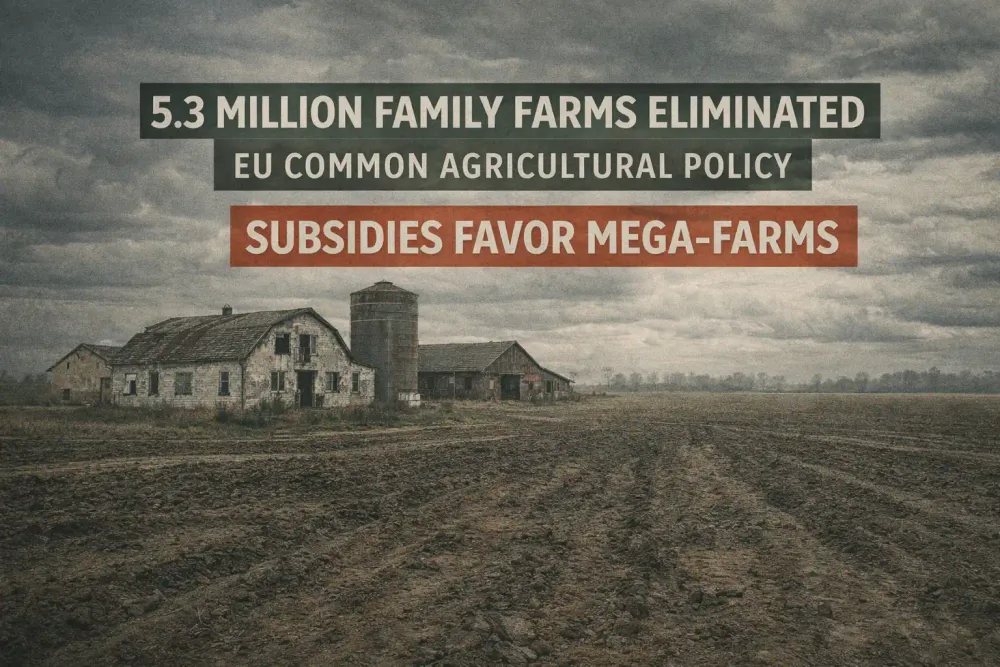
They call it the Common Agricultural Policy. They call it support for farmers. They call it the future of European agriculture. It's none of those fucking things. The CAP is a €386 billion wealth transfer scheme that pays giant agribusiness corporations while 5.3 million family farms disappeared in fifteen years. Brussels writes regulations small farmers can't afford to follow, then hands subsidies to mega-farms that can. Supermarket oligopolies crush prices below production cost. And every time a family farm closes, Brussels calls it "structural adjustment." This isn't agricultural policy. It's extermination with a sustainability label.
December 2024: The European Commission announced €300 billion in agricultural funding through 2034. They called it "ensuring stability and predictability for farmers."
Meanwhile, 30,000 Romanian farmers face bankruptcy. Polish fruit and vegetable farmers needed EU emergency funding after weather-related crop failures. Latvian, Lithuanian, and Bulgarian small farms, already operating on razor-thin margins, are collapsing under late frosts, heavy rain, and market instability that Brussels' emergency aid can't fix.
But Brussels keeps talking about "supporting farmers."
They're not supporting farmers. They're selecting which farmers survive. And the selection criteria are simple: be big, or fuck off.
Because the Common Agricultural Policy, the €386 billion monster that consumes a third of the entire EU budget, isn't designed to save family farms. It's designed to replace them with industrial agriculture operations that can afford compliance, absorb volatility, and produce at scale.
Small farms are going extinct. Not because they're inefficient. Because Brussels built a system where only giants can survive.
The truth doesn’t trend. It survives because a few still care enough to keep it alive.
Keep The Kade Frequency transmitting.
The Numbers Don't Lie
Between 2005 and 2020, the EU lost 5.3 million farms. That's 37% of all European farms, gone in fifteen years.
Nine million farms in 2020. Down from 14.4 million in 2005.
But this isn't random attrition. It's targeted elimination.
Mixed farms declined by 2.6 million. Livestock specialist farms dropped by 1.6 million. Crop specialist farms fell by 900,000.
The farms that survived? The big ones.
Because while the total number of farms collapsed by 37%, the average farm size increased. Family farms averaged 11.3 hectares in 2020. Non-family farms? 102.2 hectares.
That's nine times larger.
And here's the kicker: Brussels calls this "structural adjustment." Like it's a natural market process instead of policy-driven extermination.
Where The €386 Billion Actually Goes
The Common Agricultural Policy budget for 2023-2027 is €386.6 billion. That's €77 billion per year, roughly a third of the entire EU budget.
Brussels says this supports farmers. Look at where it actually goes.
€291.1 billion goes to the European Agricultural Guarantee Fund, direct payments to farmers and market support.
€95.5 billion goes to rural development.
Sounds fair. Until you see the distribution.
Mega-farms, just 8% of all EU farms, receive 37% of direct funding. Small-scale farms, which represent over two-thirds of all farms in the EU, get only 25% of the funding.
Read that again. The smallest two-thirds of farms get one-quarter of the money. The largest 8% get more than one-third.
This isn't an accident. It's how the CAP is designed.
Direct payments are calculated by hectares farmed. More land = more money. So family farms with 11.3 hectares on average get crumbs. Industrial operations with hundreds or thousands of hectares get millions.
France, with the most agricultural land, receives 17.1% of total CAP funds. Spain gets 12.5%. Germany gets 11.2%. Italy gets 10.5%.
Four countries capture 51% of the money.
Meanwhile, Romania gets 8.3% for rural development but nowhere near proportional direct payments despite having millions of small farms.
The system is rigged. Big farms in rich countries dominate. Small farms in poor countries get fucked.
And Brussels designed it this way.
The Regulations That Kill
But direct payment distribution is only half the weapon. The other half is regulatory compliance.
Brussels layers European agriculture with environmental regulations, safety standards, pesticide restrictions, land-use requirements, animal welfare rules, and record-keeping obligations.
Each regulation costs money to implement. Each standard requires investment. Each compliance check demands administrative capacity.
Family farms can't afford it. The CAP's "gruelling bureaucratic processes and long waiting times" prevent many from even accessing subsidies that theoretically exist.
So small farmers either pay compliance costs that eliminate their margins, or they close.
Mega-farms? They hire compliance officers. They have legal teams. They spread regulatory costs across massive operations where per-unit impact is negligible.
This is the "go big or go bust" dynamic that Greenpeace documented: small-scale farms are pushed to produce more just to survive, but increased production drives prices down, which squeezes margins further, forcing more consolidation.
Every regulation Brussels adds, no matter how well-intentioned, accelerates the cycle.
And when farmers protested in early 2024, blocking streets across Europe with tractors? Brussels' response was to relax environmental rules for everyone, rewarding large operators while doing nothing to address the core problem: subsidies flow to giants while small farmers drown.
The Green Deal Makes It Worse
Then Brussels introduced the European Green Deal.
New climate regulations. Emissions targets. Rewilding requirements. Pesticide bans. Land set-asides for biodiversity.
Every single one increases costs.
The Commission proposed waiving the requirement that 4% of arable land be dedicated to non-productive areas—after farmer protests. But that didn't reverse the damage already done. It just showed Brussels knows the rules are unsustainable but won't actually fix the underlying system.
Because here's what the Green Deal does: it adds compliance costs that small farmers can't afford, while paying subsidies to large operators who can afford compliance and get rewarded for it through "eco-schemes."
So small farmers bear the cost of transition. Large operators get paid for it.
The European Court of Auditors found in 2024 that the CAP lacks alignment with EU climate objectives in the Green Deal. Because the CAP isn't designed for climate goals. It's designed to consolidate agriculture while greenwashing the consolidation as "sustainable farming."
Small mixed farms, the ones most likely to practice diverse, resilient agriculture—are being eliminated. Industrial monocultures, the ones most dependent on chemical inputs and most vulnerable to climate shocks, are being subsidized.
And Brussels calls this "environmental sustainability."
It's fucking insane.
The Job Losses Nobody Counts
Between 2007 and 2022, agricultural employment in the EU declined by 38%, a loss of 3.8 million full-time equivalent jobs.
Small-scale farms lost 58% of their workforce. That's 3.8 million full-time jobs—gone.
Medium-to-large farms also saw workforce declines.
Only mega-farms saw employment increase. Slightly.
So the consolidation isn't even creating jobs. It's eliminating them while concentrating ownership.
And when you lose 3.8 million agricultural jobs, you don't just lose farmers. You lose rural communities. You lose local food systems. You lose knowledge passed down through generations. You lose people who understand the land they work.
You lose the unpaid labor that keeps family farms running, family members who work the farm not because it's profitable but because it's theirs.
Family farms saw the largest decline in unpaid workforce, the core characteristic of family farming.
Brussels is systematically eliminating the family farm as an economic model. Replacing it with wage labor on industrial operations.
And they call this "modernization."
The Supermarket Stranglehold
But CAP subsidies and Green Deal regulations aren't the only weapons killing small farms.
The third weapon is supermarket oligopolies.
In the UK, Tesco, Sainsbury's, Asda, and Morrisons control 65% of the grocery market. Add Aldi and Lidl, and six retailers control nearly 80%.
Germany? Aldi and Lidl dominate, leveraging scale to drive supplier costs down by as much as 20%.
France? Carrefour and Leclerc rule.
Across Europe, a handful of supermarket chains control food retail. And they use that control to crush farmer prices.
UK farmers report a "climate of fear" around speaking out against unfair buying practices, because if you piss off Tesco, you lose access to 27% of the UK market.
Supermarkets demand prices below production cost. They impose long-term fixed-price contracts that transfer all risk to farmers. They require compliance with private standards beyond legal requirements, and farmers pay for third-party audits to prove compliance.
When input costs rise energy, fertilizer, labor, supermarkets don't adjust contracts. Farmers eat the loss.
When weather destroys crops, supermarkets don't share the risk. Farmers eat the loss.
When global prices swing, supermarkets lock in cheap contracts. Farmers eat the loss.
Dairy farmers get 46 pence per litre at the farmgate, barely covering costs, while supermarkets maintain retail margins.
And Brussels? Does nothing.
Because supermarket consolidation benefits the CAP's real goal: centralizing food supply chains. Mega-farms sell to mega-retailers. Small farms can't meet the volume requirements, quality specifications, or delivery logistics that supermarket chains demand.
So supermarkets buy from large suppliers. Small farmers are priced out structurally.
And every time a small farm closes, supermarkets consolidate purchasing power further.
It's a death spiral. And Brussels designed it.
The Eastern European Massacre
But if the system crushes small farms in Western Europe, it exterminates them in Eastern Europe.
Romania, Poland, Hungary, Bulgaria, countries with millions of small family farms, are being systematically deindustrialize in agriculture just as they were deindustrialize in manufacturing.
The pattern is identical.
Romania reports 30,000 farmers facing bankruptcy. Poland needed emergency EU funding for fruit, vegetable, and nut farmers. The Baltics struggle under late frosts and market instability.
Why? Because CAP subsidies are calculated by hectares farmed, and Eastern European family farms are tiny compared to Western European operations.
So Eastern European farmers get minimal direct payments. But they face the same regulatory costs as Western farmers. The same Green Deal compliance requirements. The same supermarket pricing pressure.
They can't compete.
High proportions of crop specialist farms in Bulgaria (73%), Hungary (72%), and Romania (67%) reflect attempts to survive through specialization. But specialization makes farms more vulnerable to weather, pests, and price volatility.
And when Eastern European farms fail, who benefits?
Western European agribusiness. Which expands into Eastern European land. At bargain prices.
Brussels calls this "integration". Eastern Europeans call it colonization.
The Debt Trap Brussels Built
Here's the most insidious part: mega-farms aren't more profitable than small farms because they're more efficient.
They're more profitable because they have access to capital.
Mega-farms hold 70% of total agricultural debt in the EU. They borrow massively to expand. They use CAP subsidies as collateral for loans. They scale up to repay debt—creating a cycle where they must keep growing to service the debt they took on to grow.
Banks love this. Guaranteed CAP payments make agricultural lending low-risk for large operators.
Small farmers? Banks won't lend. They're too small. Too risky. No economies of scale.
So small farmers can't invest in equipment that would reduce labor costs. Can't modernize facilities to meet new regulations. Can't expand to achieve minimum efficient scale.
They're locked out of capital markets while mega-farms gorge on cheap credit backed by guaranteed EU subsidies.
And when mega-farms expand, they buy the land that small farms couldn't afford to keep.
Land prices rise. Young farmers can't enter. Existing small farmers can't expand. Mega-farms consolidate further.
Brussels doesn't just allow this. The CAP enables it by making large-scale operations the only economically viable model.
What Survives Isn't Agriculture
The farms that survive Brussels' system aren't really farms anymore. They're industrial operations.
Thousands of hectares. Monoculture production. Heavy chemical inputs. Mechanized to minimize labor. Managed by MBAs, not farmers.
They produce commodities, not food. Corn, wheat, soy, rapeseed. For industrial processing, animal feed, biofuels.
They don't grow vegetables. They don't raise animals on pasture. They don't practice crop rotation or integrated pest management or any of the farming methods Brussels claims to support through "environmental sustainability" programs.
Because those methods require labor, knowledge, and management intensity that only small farms can provide.
But Brussels is systematically eliminating small farms.
So what's left is industrial agriculture, efficient at producing biomass, terrible at everything else.
Studies show 80% of CAP subsidies in 2013 supported emissions-intensive animal products, a ratio that hasn't significantly changed. Brussels subsidizes exactly the agriculture most harmful to climate and environment, while forcing small farms to close through regulations supposedly designed to protect climate and environment.
It's schizophrenic. Unless you realize the regulations aren't designed to improve agriculture. They're designed to eliminate small farmers and consolidate production.
Then it makes perfect sense.
The Land That Dies
When family farms close, the land doesn't rest.
It gets bought. By mega-farms. By investment funds. By corporations.
And the way that land gets used changes.
Family farmers manage land for the long term. Because their children will farm it. Their grandchildren will farm it. They can't extract value and leave, the land is their legacy.
Corporations and investment funds optimize for quarterly returns. Extract maximum value. Minimize input costs. If soil degrades, sell and buy elsewhere.
So consolidation doesn't just eliminate farmers. It eliminates stewardship.
And rural communities die.
When a family farm closes, the family leaves. Their kids move to cities. The local school loses students. The village shop closes. The community hollows out.
Mega-farms don't employ many people. Maybe a few seasonal workers, often migrants on temporary contracts, paid minimum wage, no investment in the community.
So rural Europe is emptying. Young people leave. Services disappear. Towns decay.
And Brussels' response? Rural development funds—€95.5 billion over seven years.
Which sounds significant until you realize: Brussels is spending €95.5 billion to "develop" rural areas while simultaneously spending €291.1 billion to eliminate the farms that sustain rural economies.
It's like setting a building on fire, then funding the fire department, then claiming credit for firefighting investment.
The Farmers Who Fight Back
In early 2024, farmers across Europe drove tractors to Brussels. To Paris. To Berlin. To Madrid.
They blocked roads. They dumped manure at government buildings. They demanded change.
And what did Brussels do?
Relaxed environmental requirements that farmers found burdensome. Exempted 65% of CAP beneficiaries from certain controls.
But didn't change the subsidy distribution. Didn't address supermarket pricing power. Didn't fix the structural problems killing small farms.
Brussels treated symptoms while accelerating the disease.
Because Brussels doesn't want to save small farmers. It wants them to shut up while the consolidation continues.
And when farmers protest, Brussels uses the same playbook it always uses: make minor concessions, claim to listen, then proceed with the original plan.
Because the farmer protests aren't actually a problem for Brussels. They're proof the system is working.
If small farmers weren't being eliminated, they wouldn't be protesting. The protests confirm the policy is having its intended effect.
Brussels just needs them to go bankrupt quietly.
The Supermarket Lie
Supermarkets tell consumers: "We keep food prices low."
Bullshit.
Supermarket consolidation keeps supermarket margins high. They extract surplus profit through oligopolistic control, the amount they wouldn't make if competition was real.
They pay farmers less. Charge consumers the same. Pocket the difference.
Aldi and Lidl source 75% of UK fresh products from British farms, but they drive costs down by negotiating pan-European deals that small farms can't match. They offer 2,000 SKUs per store versus 30,000+ at traditional supermarkets, less choice, more volume per product, lower costs.
Consumers think they're getting value. Actually, they're getting less diversity, less quality, and they're complicit in killing small farms.
Because when you buy the cheapest milk, the cheapest vegetables, the cheapest meat—you're voting for the system that eliminates family farms and replaces them with industrial operations that externalize environmental and social costs.
The "cheap" food isn't cheap. You're just not paying the full price at checkout. You're paying through environmental degradation, rural decline, loss of food sovereignty, and increased vulnerability to supply shocks.
But supermarkets don't put that on the label.
The Future Brussels Is Building
If current trends continue, and nothing suggests they won't, here's where European agriculture is heading:
By 2030, another 2-3 million farms will close. Mostly small. Mostly in Eastern Europe.
The farms that remain will be massive. Thousands of hectares. Corporate-owned or investor-backed. Managed like factories.
They'll produce commodity crops at scale. Wheat, corn, soy, rapeseed. For processing, animal feed, biofuels.
Fresh vegetables and fruit will be imported. From North Africa. From South America. Wherever labor and land are cheapest.
Meat will come from massive confined feeding operations. Thousands of animals. Minimal labor. Maximum output.
Rural Europe will be empty. Villages abandoned. Land consolidated into industrial operations that employ almost no one.
And Brussels will call this "sustainable agriculture" because the operations will be "climate-neutral", not through sustainable practices, but through carbon credits and accounting tricks.
Food sovereignty? Gone. Europe will depend on global supply chains for everything but commodity crops.
Resilience? Gone. Concentrated production means system-wide vulnerability to weather, disease, or political disruption.
Quality? Irrelevant. Supermarkets will define quality as "meets minimum standards at lowest cost."
And the family farmers who understood the land, who practiced diverse agriculture, who sustained rural communities, will be gone.
Replaced by operations that see farming as biomass production, not stewardship.
The System Working Exactly As Designed
Here's what people don't understand: this isn't policy failure.
The CAP is achieving exactly what it was designed to achieve.
Brussels wanted to consolidate European agriculture. To create economies of scale. To make EU agriculture "competitive" with American and Brazilian industrial operations.
They wanted centralized supply chains feeding centralized retail. So supermarkets and mega-farms could negotiate directly, cutting out intermediaries, reducing transaction costs.
They wanted to eliminate "inefficient" small farms that couldn't achieve industrial productivity.
And they're succeeding.
5.3 million farms eliminated in 15 years. Mega-farms capturing 37% of subsidies. Small farmers driven out by regulations they can't afford. Rural communities hollowing out.
This is the plan working.
The only people who call it failure are the farmers being eliminated and the rural communities being destroyed.
But they don't matter to Brussels. Because Brussels doesn't represent farmers or rural communities.
Brussels represents the agricultural industry. Agribusiness corporations. Seed and chemical companies. Agricultural equipment manufacturers. Food processing conglomerates. Supermarket chains.
The entities that profit from consolidation.
And just like with pharmaceuticals, Brussels writes policy that benefits the corporations, then claims it's helping the people being destroyed.
What Brussels Won't Admit
The Common Agricultural Policy costs €386 billion over seven years.
That's €55 billion per year. Roughly €110 per EU citizen annually.
What does that €110 buy?
Not food security, Europe imports 40% of its food and dependency is increasing.
Not environmental sustainability, industrial monocultures are the most environmentally destructive agriculture possible.
Not rural development, rural communities are dying as farms close.
Not employment, 3.8 million agricultural jobs lost in 15 years.
Not resilience, concentrated production is maximally vulnerable to shocks.
What it buys is consolidation. The systematic elimination of small farms and transfer of land to large operators.
That's what €55 billion per year accomplishes.
And Brussels calls it agricultural support.
The Farmers Brussels Forgets
There are still 9.1 million farms in the EU. Most are family operations.
They wake up before dawn. They work land their grandparents worked. They produce food the way food was produced for centuries, carefully, attentively, sustainably.
They know their soil. Their animals. Their crops. They adapt to weather. They diversify to spread risk. They sell locally when they can.
They're not inefficient. They're not backwards. They're not obstacles to progress.
They're the only thing standing between Europe and complete dependence on industrial food systems that treat agriculture as extractive industry.
But Brussels is eliminating them. Systematically. Through subsidies that flow to giants. Regulations they can't afford. Supermarkets that won't pay fair prices.
And when they protest, Brussels makes minor adjustments and continues the plan.
Because the plan is elimination. And the plan is working.
The Question Brussels Won't Answer
If the CAP is supposed to support farmers, why are farmers disappearing?
If it's supposed to ensure food security, why is import dependency increasing?
If it's supposed to develop rural areas, why are rural communities dying?
If it's supposed to promote sustainability, why does it subsidize industrial monocultures?
The answer is simple: the CAP isn't designed to do any of those things.
It's designed to consolidate agriculture. To replace family farms with industrial operations. To centralize food systems under corporate control.
And it's succeeding.
Every farm that closes is proof the system works.
Every rural community that empties confirms the policy's effectiveness.
Every young person who leaves farming demonstrates the intended outcome.
This isn't failure. It's success.
And the people calling it success are the same people who profit from pharmaceutical industry consolidation, the same people who profit from Eastern European exploitation, the same people who run EU policy for corporate benefit.
Brussels doesn't serve farmers. It serves agribusiness.
And agribusiness doesn't need 9 million farms. It needs 900,000.
So 8.1 million have to go.
Brussels calls this "structural adjustment."
Farmers call it extermination.
The Truth Nobody Will Say
Family farming in Europe is being systematically eliminated by policy designed to eliminate it.
€386 billion in subsidies flows mostly to mega-farms. Regulations crush operations that can't afford compliance. Supermarkets squeeze prices below production cost. Rural communities hollow out. And Brussels claims it's supporting farmers.
It's not supporting farmers. It's selecting which farms survive.
And the selection is simple: industrial operations owned by corporations and investors, yes. Family farms worked by people who live on the land, no.
This is the same model Brussels applies everywhere. Consolidate. Centralize. Eliminate small operators. Reward large corporations. Call it progress.
And when people protest, farmers with tractors, workers with strikes, citizens with votes, Brussels makes symbolic concessions and continues the plan.
Because the plan isn't to help people. The plan is to transfer power and wealth upward.
In pharmaceuticals, it's from patients to corporations.
In Eastern Europe, it's from workers to Western European capital.
In agriculture, it's from family farmers to agribusiness.
The mechanism changes. The outcome doesn't.
What Happens Next
The farming extinction will continue. Another 2-3 million farms will close by 2030.
Rural Europe will empty. Villages will die. Land will consolidate.
The food system will centralize. Supermarkets and mega-farms will control everything from soil to shelf.
And Brussels will keep claiming it supports farmers while spending €55 billion per year to eliminate them.
Until someone stops it.
But stopping it requires admitting what the CAP actually does: it systematically destroys family farming while pretending to support it.
And Brussels will never admit that.
Because admitting it means admitting the entire European project is a corporate consolidation machine disguised as integration and cooperation.
So the extinction continues.
Family farms close. Rural communities die. Mega-farms expand. Supermarkets consolidate.
And Brussels calls it agricultural policy.
It's not agricultural policy.
It's extermination with subsidies.
A. Kade
"They say the CAP supports farmers. Then why did 5.3 million farms disappear in 15 years while mega-farms captured 37% of subsidies? Small farmers can't afford compliance costs that giants absorb. Supermarkets crush prices below production cost. Rural communities die. And Brussels spends €55 billion annually to call this 'agricultural support.' This isn't policy failure. It's systematic elimination of family farming, and it's working exactly as designed."
No ads. No sponsors. Just signals from the noise.
Keep The Kade Frequency transmitting.