The €200 Billion Theft: How Ireland, Netherlands, and Luxembourg Loot Europe While Brussels Looks Away
Three EU member states operate the largest tax avoidance scheme in history. Ireland, Netherlands, Luxembourg cost other EU countries €160-190 billion annually. Apple pays 0.005% tax. Amazon 0.4%. Luxembourg gave 340 secret tax deals under Juncker, who then became EU President.

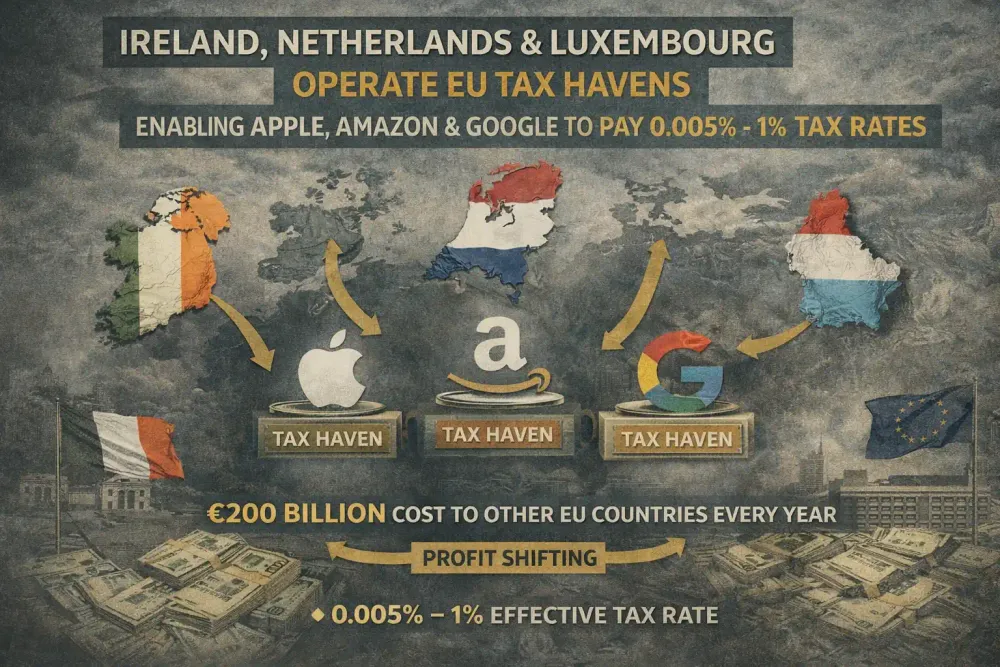
Three small EU countries operate the largest tax avoidance scheme in history, costing other member states €160-190 billion annually. Apple pays 0.005% tax in Ireland. Amazon pays 0.4%. Google routes billions through the Netherlands. Luxembourg gave 340 secret tax deals to multinationals under Juncker, who then became EU Commission President. This isn't tax competition. It's organized theft disguised as sovereignty.
They call it tax competition. A race to the bottom, maybe. Unfortunate but inevitable in a globalized economy. These are the words Brussels uses when pressed about why three EU member states, Ireland, Netherlands, Luxembourg, function as corporate tax havens that drain hundreds of billions annually from their supposed partners.
The reality has simpler language: theft. Systematic, deliberate, protected theft that costs other EU countries €160-190 billion every year in lost tax revenue. Revenue that could fund healthcare, education, infrastructure. Revenue that instead becomes corporate profits through elaborate schemes designed by the world's most expensive tax lawyers and blessed by governments that profit from the arrangement.
Apple paid 0.005% tax on European profits routed through Ireland. That's not a typo. Five thousandths of one percent. Amazon's Luxembourg entity paid 0.4% tax. Google shifts billions through Netherlands using structures so complex they require flowcharts to understand, all to avoid paying tax in the countries where actual economic activity occurs.
The architects of these schemes didn't hide in shadows. Jean-Claude Juncker built Luxembourg's tax haven system as Prime Minister, giving 340+ multinationals secret tax deals, then got promoted to European Commission President where he was supposed to fight tax avoidance. Ursula von der Leyen's son works at McKinsey, which designs tax avoidance structures. The Irish government fought for seven years to prevent Apple from paying €13 billion in back taxes.
This is institutional capture operating in plain sight. The people running the EU either built the tax haven system or benefit from it. The corporations using it fund political campaigns and hire former officials. The media investigating it is funded by Brussels and the corporations avoiding taxes. And the citizens paying higher taxes to make up the shortfall have no idea where their money is going because the complexity is deliberate.
Let me show you how the scam works. Because once you understand the mechanisms, the Double Irish Dutch Sandwich, the Luxembourg leaks, the Irish rulings that made Apple functionally tax-exempt, you'll see it's not sophisticated tax planning. It's theft dressed in legal language, enabled by governments that profit from facilitating it.
By A. Kade
The Irish Con That Costs Europe €80 Billion Annually
Ireland markets itself as the Celtic Tiger, an economic miracle. The reality is simpler: Ireland is a corporate tax haven that systematically steals revenue from other EU countries while hiding behind nominal tax rates that mean nothing.
Ireland's official corporate tax rate is 12.5%. That's already the lowest in Western Europe, designed explicitly to attract multinationals that want to avoid paying tax in countries with normal rates. But the 12.5% rate is marketing. The effective rate corporations actually pay is far lower through mechanisms Ireland deliberately created.
Start with the Apple case because it reveals the entire system. Apple established Irish subsidiaries in the 1980s and routed virtually all non-US profits through them. By 2014, Apple was booking over €100 billion in annual profits through Irish entities that employed a few hundred people.
The truth doesn’t trend. It survives because a few still care enough to keep it alive.
Keep The Kade Frequency transmitting.
The European Commission investigated and found that Apple paid effective tax rates as low as 0.005% on European profits in some years. In 2014, Apple's main Irish subsidiary reported €16 billion in profits and paid €50 million in tax. That's an effective rate of 0.31%. For comparison, the EU average corporate tax rate is 21.3%.
How did Apple pay 0.005%? Through a structure called "stateless companies", Irish-registered entities that Ireland ruled were not tax resident anywhere. These companies existed legally but had no tax residence, allowing profits to accumulate untaxed.
Ireland gave Apple advance rulings in 1991 and 2007 approving this structure. These weren't accidental loopholes, they were deliberate arrangements negotiated between Apple and Irish tax authorities. The Irish government created a system where a company could exist under Irish law but have no tax obligations to any jurisdiction.
The European Commission ruled in 2016 that these arrangements constituted illegal state aid and ordered Ireland to collect €13 billion in back taxes from Apple. Ireland's response? They fought the ruling. For seven years, the Irish government spent millions in legal fees defending Apple's right not to pay €13 billion in taxes.
Think about that. A government with a GDP of €500 billion, facing healthcare shortfalls and housing crises, spent years fighting to prevent receiving €13 billion because accepting it would threaten the tax avoidance system attracting multinationals.
Ireland finally collected the money in 2018 but immediately challenged the ruling. The case went to the European Court of Justice. In 2020, the ECJ sided with Ireland and Apple, ruling the Commission hadn't proven illegal state aid. The €13 billion went back to Apple.
The message was clear: member states can give corporations sweetheart tax deals that let them avoid tax on European profits, and the EU won't effectively stop them.
Apple isn't unique. Google Ireland Holdings reported €75 billion in revenue in 2019 and paid €47 million in tax, an effective rate of 0.063%. Microsoft's Irish subsidiary reported profits of €315 billion between 2011-2020 and paid minimal tax. Facebook routed European advertising revenue through Ireland, paying effective tax rates below 1%.
The combined annual cost of Ireland's tax haven status to other EU countries is estimated at €80 billion in lost tax revenue. That's not speculation, it's calculated from the profits multinationals route through Ireland versus where actual economic activity occurs.
Germany, France, Italy, Spain, these countries lose billions annually because Ireland deliberately undercuts their tax rates and provides structures letting corporations book profits in Ireland that were actually earned in Frankfurt, Paris, Milan, Madrid.
And Ireland isn't apologetic. They defend it as competition, as attracting investment. But there's no real investment. Apple's Irish subsidiaries are brass plate operations, registered addresses with minimal staff. The economic activity happens elsewhere. Ireland just provides the legal structure to avoid tax on it.
This is theft. When a corporation earns profits in Germany but routes them through Ireland to avoid German tax, Germany loses revenue. When that corporation pays 0.005% tax in Ireland instead of 30% in Germany, the difference doesn't disappear, it becomes corporate profits and shareholder returns.
Ireland facilitates this deliberately, collects minimal tax, and pockets fees from the lawyers and accountants structuring the schemes. Other EU countries lose massive revenue. Corporations extract the difference. And Brussels does nothing because the people running Brussels either built similar systems or profit from them.
The Dutch Disease: Funneling €100 Billion Through Shell Companies
The Netherlands operates a different flavor of the same scam, not through ultra-low rates but through legal structures that let corporations shift profits through Dutch entities on their way to actual tax havens.
The mechanism is called a "conduit jurisdiction." Profits earned in one country get routed through Netherlands before reaching the final destination, exploiting Dutch tax treaty networks and legal structures that reduce or eliminate taxation.
The most famous scheme is the "Double Irish Dutch Sandwich." Here's how it worked before Ireland closed some loopholes:
- Corporation earns profits in France through actual business operations
- Pays royalty fees to Irish subsidiary for intellectual property rights
- Irish subsidiary pays those royalties to Dutch company
- Dutch company pays them to second Irish company
- Second Irish company is tax resident nowhere (stateless)
- Profits accumulate tax-free or at minimal rates
The Netherlands was the crucial middle layer. Dutch tax law exempts certain royalty and interest payments from tax. Dutch treaty network covers most developed countries. So routing payments through Netherlands provided legal cover and eliminated withholding taxes that would apply to direct transfers.
Google perfected this. They earned advertising revenue across Europe, paid royalties to Irish entity for using Google's intellectual property, routed through Netherlands, ended up in Bermuda subsidiary. European profits, almost zero European tax.
This wasn't Google exploiting loopholes, it was Google using a structure the Dutch government explicitly designed and maintained. The Netherlands knew these entities had no genuine economic substance. They existed solely to shift profits. Dutch authorities approved them anyway.
The scale is staggering. Approximately €4.5 trillion in capital flows through Netherlands annually, money passing through Dutch entities on its way somewhere else. That's more than 5 times Dutch GDP. It's not real economic activity. It's corporate money laundering using legal structures.
Shell companies registered in Netherlands number over 12,000. Not Shell the oil company, shell companies as in entities with no employees, no offices, no activity except owning other entities and shifting money. These exist only for tax avoidance.
Dutch Special Purpose Entities (SPEs) held assets worth €4.6 trillion in 2019. Again, not real business assets, financial structures for routing profits. For comparison, total Dutch business assets were under €2 trillion. The shell structures exceeded real economic activity by more than double.
The lost revenue is harder to calculate than Ireland because Netherlands functions as a transit point rather than destination. But estimates suggest routing profits through Netherlands costs other EU countries €100 billion+ annually in tax revenue that disappears through the conduit.
Like Ireland, Netherlands defends this as legitimate business and tax competition. But there's no legitimate business reason for 12,000 shell entities with €4.5 trillion in financial flows except tax avoidance. The structures exist because Netherlands created favorable laws knowing they'd be used for avoidance.
The Dutch government profits from fees and employment for lawyers and accountants. Corporations profit from tax savings. Other EU countries lose revenue. And again, Brussels does nothing because people like Frans Timmermans, who served as Dutch Foreign Minister before becoming Commission Vice President, built their careers in systems benefiting from these arrangements.
The pattern is identical to Ireland: deliberate policies creating avoidance opportunities, massive profit shifting from other EU countries, minimal taxation, and political leaders who enabled it getting promoted to EU positions.
The Luxembourg Files: When The Tax Haven Architect Became EU President
Luxembourg's tax avoidance system might be the most brazen because the man who built it, Jean-Claude Juncker, went on to lead the European Commission while claiming to fight tax avoidance. This isn't subtle corruption, it's the architect of corporate tax theft getting promoted to regulate tax policy.
The Luxembourg Leaks, published in 2014, exposed over 340 secret tax agreements Luxembourg gave to multinational corporations during Juncker's time as Prime Minister (1995-2013). These weren't public rulings, they were private deals negotiated between companies and Luxembourg tax authorities guaranteeing ultra-low effective tax rates.
PepsiCo got a deal ensuring 0.25% tax on European profits. Amazon's Luxembourg structure paid 0.4%. IKEA paid under 1%. Disney, FedEx, Heinz, 340+ companies with customized arrangements ensuring they'd pay minimal tax on profits earned across Europe.
The deals used Luxembourg's legal structures, particularly finance companies and IP holding companies, to shift profits from high-tax countries to Luxembourg, then applied negotiated interpretations of Luxembourg tax law to minimize what little tax was due.
These weren't standard rulings available to anyone, they were bespoke agreements negotiated in private. Large corporations hired expensive advisors (typically the Big 4 accounting firms) to negotiate deals with Luxembourg authorities. The deals got approved. The companies paid minimal tax. Luxembourg collected fees and pocketed what little tax was charged.
Juncker knew exactly what was happening because he was Prime Minister during most of these agreements. He was also Finance Minister at various points. The system wasn't created by rogue officials, it was government policy under Juncker's leadership.
When the leaks came out in 2014, Juncker was already serving as Commission President. He had been selected in June 2014. The leaks dropped in November. Juncker faced calls to resign but refused, claiming he didn't personally negotiate the deals and Luxembourg's system was legal.
Legal, perhaps. But Juncker spent 18 years as Luxembourg Prime Minister building a tax avoidance system that cost other EU countries tens of billions annually, then got promoted to lead the institution supposedly fighting tax avoidance. The conflict isn't subtle.
How much does Luxembourg's system cost other EU countries? Conservative estimates suggest €30-40 billion annually. Luxembourg has a population of 630,000 and GDP of €75 billion. It shouldn't be routing profits for 340+ multinationals earning hundreds of billions across Europe. The only reason it does is deliberate tax haven policies.
Luxembourg's "effective" contribution to EU tax revenue is dwarfed by what other countries lose from profits being routed there. If those profits were taxed where actual economic activity occurred, EU countries would collect €30-40 billion more annually.
And Juncker's response as Commission President? He proposed tax reforms that didn't threaten Luxembourg's core business model. Minimum tax rates, yes, but implemented in ways that preserved Luxembourg's appeal. Transparency requirements, but with loopholes ensuring continued confidentiality. Public country-by-country reporting, resisted for years, watered down when finally adopted.
Juncker left the Commission in 2019. Luxembourg's tax haven system continues operating largely unchanged. The secret tax rulings stopped after the scandal, but the legal structures enabling profit shifting remain. Companies still route billions through Luxembourg using mechanisms Juncker helped create.
This is regulatory capture's purest form: the person who built the system that costs EU countries €40 billion annually got promoted to regulate that system, implemented toothless reforms that didn't threaten the racket, and faced no consequences.
The pattern holds: Build tax haven as national politician. Get promoted to EU position. Claim to fight tax avoidance while protecting the system you created. Retire with EU pension and consulting income from corporations you helped.
The Mechanisms: How The Scams Actually Work
Strip away the jargon and the schemes are simple: move profits from where you earned them to where you won't pay tax, using legal structures these three countries deliberately created.
The Double Irish Dutch Sandwich (now partially closed):
- US company (Google) creates Irish subsidiary holding intellectual property rights
- Irish subsidiary licenses those rights to second Irish company
- Second Irish company operates European business, earns billions
- Second Irish company pays huge royalty fees to first Irish company for using IP
- Royalties route through Dutch company to avoid withholding tax
- First Irish company is tax resident in Bermuda (no corporate tax)
- Profits accumulate in Bermuda, untaxed
Ireland provided the stateless companies. Netherlands provided the conduit. Result: European profits, virtually zero European tax.
Ireland closed the stateless company loophole in 2015 but grandfathered existing structures until 2020. Companies had five years to find new schemes. They did.
The IP Box Regime:
Netherlands and Ireland (also Belgium, Cyprus, Malta) offer special low tax rates on income from intellectual property. Instead of paying 25% corporate tax, companies pay 5-10% on IP income.
Companies assign valuable IP to entities in these countries, claim all profits come from IP, and pay minimal tax. The IP often has nothing to do with the country, it's assigned there solely for tax purposes.
This is perfectly legal under EU law. The countries designed it that way.
The Luxembourg Finance Company:
Create a holding company in Luxembourg that "owns" subsidiaries across Europe. Those subsidiaries pay interest or royalties to Luxembourg parent. Luxembourg company deducts those payments against minimal income. Profits shift from operating countries to Luxembourg, taxed at negotiated ultra-low rates.
Again, legal. The economic activity happens in France, Germany, Spain. The profits appear in Luxembourg. The tax disappears.
The Netherlands CV/BV Structure:
Dutch law allows hybrid entities treated as partnerships in some countries and corporations in others. Companies exploit the mismatch, deduct payments in one jurisdiction, don't report income in another.
Result: phantom deductions that reduce tax without corresponding income anywhere. Pure tax arbitrage using legal structures Netherlands knowingly maintains.
These mechanisms aren't loopholes in the sense of unintended gaps. They're deliberate policies these countries implemented to attract multinationals. The countries know the structures exist only for tax avoidance. They maintain them anyway because they profit from it.
The €200 Billion Question: Why Brussels Won't Stop It
Here's what makes the EU's internal tax havens unique: they're stealing from their own partners with EU blessing. This isn't the Caymans helping foreigners avoid tax. It's Ireland, Netherlands, and Luxembourg systematically draining revenue from Germany, France, Italy while sitting in the same Parliament claiming European solidarity.
The combined annual cost is €160-190 billion based on profit shifting calculations by economists at UC Berkeley and Copenhagen Business School. That's conservative, some estimates reach €240 billion when including second-order effects.
For context: €200 billion is roughly the entire EU budget. It's more than EU structural funds. It's equivalent to Germany's annual defense and education spending combined. This is massive systematic wealth extraction happening internally while Brussels lectures about tax fairness.
Why doesn't the EU stop it? Because the people running the EU built these systems or benefit from them.
Jean-Claude Juncker: Built Luxembourg's tax haven as PM, became Commission President, implemented token reforms that preserved the core system.
Ursula von der Leyen: Family connected to corporate interests, son works at McKinsey which designs tax structures. Unlikely to aggressively pursue tax avoidance affecting McKinsey clients.
Valdis Dombrovskis: Latvia's representative, country also offering attractive tax regimes. No incentive to crack down on competitive tax rates.
The institutional incentive structure prevents meaningful reform. Small countries profit enormously from tax haven status relative to their size. Ireland's tax revenue is artificially inflated by profit shifting. Netherlands gets fees from shell company operations. Luxembourg's entire financial sector depends on it.
Large countries lose revenue but their corporations benefit from the schemes. German companies use Dutch and Irish structures. French companies route through Luxembourg. The corporations lobby against reform and fund political campaigns across Europe.
Brussels could theoretically impose minimum tax rates or mandate consolidated EU corporate taxation. They don't because:
- Tax policy requires unanimity, Ireland, Netherlands, Luxembourg can each veto
- Politicians depend on corporate donations from beneficiaries
- Former officials get hired by corporations and advisories running schemes
- Media investigating it is funded by Brussels and corporations
- Citizens don't understand mechanisms so political cost is minimal
The recent OECD minimum tax agreement (15%) doesn't solve this. Ireland already exceeds 15% nominal—the problem is effective rates of 0.005% through sweetheart rulings. Netherlands would comply through conduit structures that don't technically violate minimum rates. Luxembourg can maintain IP boxes and finance company benefits within 15% minimum.
The reforms are theater. They create appearance of action while preserving the fundamental system enabling €200 billion in annual revenue loss.
Who Actually Pays For Corporate Tax Avoidance
When corporations avoid €200 billion in taxes, that money doesn't disappear, someone else pays it. The burden falls on citizens and small businesses that can't afford the lawyers and structures to avoid tax.
Higher taxes on workers: Income and payroll taxes are harder to avoid. When corporate tax revenue decreases, governments maintain budgets by taxing labor more. The average EU worker pays 40-45% marginal tax rates while corporations pay single-digit effective rates.
VAT increases: Consumption taxes hit lower-income households hardest. As corporate tax avoidance increased, European VAT rates rose from 15-17% average in the 1990s to 20-22% today. Working families pay more for everything to compensate for corporate tax avoidance.
Reduced public services: Healthcare, education, infrastructure deteriorate when governments lose €200 billion annually. The austerity documented in how corporate profit expansion extracted €238 billion from European households is partially enabled by tax avoidance reducing government revenue.
Higher taxes on small businesses: SMEs can't afford complex tax structures. They pay full statutory rates while multinationals pay fractions through avoidance schemes. This creates competitive disadvantage punishing businesses that actually operate where they're registered.
Debt accumulation: Some governments borrow to maintain spending when tax revenue falls. National debts increase. Future generations will pay for current corporate tax avoidance through higher taxes or reduced services.
The distributional impact is clear: corporate tax avoidance is a wealth transfer from workers and small businesses to multinational shareholders. Apple paying 0.005% means German workers pay more to fund services Apple uses but won't pay for.
And it's regressive. Wealthy individuals own shares in companies avoiding tax. They benefit from higher corporate profits enabled by avoidance. They also hire advisors to avoid personal tax through similar structures. The bottom 80% can't avoid tax and pay more to compensate for the top 20% avoiding it.
This is class warfare identical to the EV subsidy scam or the aid racket: systems designed to benefit wealthy and powerful, costs imposed on working families, moral language ("tax competition," "attracting investment") disguising theft.
The Silicon Valley Special: Tech Giants Paying Nothing
Technology companies perfected tax avoidance because their business models, digital services with easily moveable intellectual property, make profit shifting simpler than manufacturing or retail.
Google: Earned €45 billion in European revenue in 2021. Paid approximately €500 million in European taxes. Effective rate: 1.1%. The structure: European advertising revenue flowed to Irish entity, which licensed search technology from Bermuda subsidiary via Dutch conduit. Most profits ended up in Bermuda (zero tax).
Apple: Discussed above. 0.005% effective rate on hundreds of billions in European profits. Even after the EU fight, Apple restructured to continue minimizing European tax using similar mechanisms.
Amazon: Luxembourg entities paid 0.4% tax on European profits. Amazon's European headquarters employs 7,500 people. Amazon Europe earned €44 billion in 2020 and paid €254 million in tax, 0.58% effective rate.
Facebook (Meta): Routed European advertising revenue through Irish subsidiary. Paid under 1% effective tax rates for years. Only changed structure after public pressure, and new structure still minimizes tax.
Microsoft: Irish subsidiary accumulated €315 billion in profits 2011-2020. Paid minimal tax through structures similar to Apple's. Microsoft's European operations are massive, but tax gets minimized through IP assignments to Irish entities.
These companies collectively avoid an estimated €50-60 billion in annual European taxes. That's roughly equivalent to Italy's entire healthcare budget. The profit shifting is documented, they report European revenue in public filings, report minimal European profits in tax filings.
The mechanisms are identical: register IP in Ireland, license it to European operating entities, charge huge royalty fees, shift profits to Ireland, pay minimal tax. Legal, deliberate, enabled by Ireland's willingness to facilitate it.
And Brussels does nothing because these companies lobby extensively, donate to political campaigns, hire former EU officials as advisors, and fund think tanks producing research claiming tax avoidance benefits Europe through "investment" and "innovation."
The investment and innovation happen regardless of tax rates. Google didn't build search because Ireland offered low taxes, they built it in California. The Irish operations exist solely to minimize tax on European profits. There's no economic value, just tax arbitrage.
The Enablers: Big 4 Accounting Firms Making Billions From The Scam
The tax haven system couldn't function without professional enablers designing structures, negotiating rulings, and providing legal cover. The Big 4 accounting firms, Deloitte, PwC, KPMG, EY, make billions facilitating corporate tax avoidance.
These firms employ thousands of tax advisors who do nothing but design structures to shift profits from high-tax to low-tax jurisdictions. They don't prepare tax returns or provide compliance services, they engineer avoidance.
The Luxembourg Leaks revealed how it works. Companies hire Big 4 firms to negotiate tax rulings with Luxembourg authorities. The firms draft complex structures, prepare ruling requests, negotiate with officials, implement arrangements, and charge millions in fees.
PwC alone arranged over 100 Luxembourg tax rulings. Deloitte, KPMG, EY handled hundreds more. These weren't legitimate tax planning, they were structured deals ensuring clients would pay minimal tax on profits earned elsewhere.
The firms defend this as legal tax planning within client fiduciary duties. But there's planning and there's enabling theft. When you design structures whose only purpose is avoiding tax on profits earned in countries where actual business occurs, you're not planning, you're facilitating revenue theft from those countries.
The Big 4 earn an estimated €3-5 billion annually from tax advisory services in Europe. Much of that comes from designing avoidance structures. They profit enormously from the system operating exactly as it does.
And here's the conflict: these same firms audit corporate financial statements, advise governments on tax policy, and provide "independent" analysis on tax reform proposals. They audit Apple while helping Apple avoid tax. They advise Ireland on tax policy while earning millions arranging Irish tax rulings for clients.
The regulatory capture is complete. The firms that enable the system are the same firms governments hire to design reforms. Unsurprisingly, reforms don't threaten the business model.
Former Big 4 partners staff tax authorities across Europe. They regulate former colleagues using structures they designed. The revolving door ensures enforcement stays toothless and reforms stay weak.
This is documented in the same pattern of institutional capture where industries fund the institutions supposedly regulating them. Tax advisors fund tax authorities. Media outlets funded by Brussels investigate Brussels. The same mechanism: capture through financial dependency.
What €200 Billion Could Actually Fund
Make the theft concrete by understanding what €200 billion in annual lost tax revenue could provide.
That's enough to:
- Eliminate university tuition across the EU (cost: €40 billion)
- Provide universal childcare (€60 billion)
- Build 2 million housing units annually (€80 billion)
- Triple renewable energy investment (€60 billion)
- Fund complete high-speed rail network (€50 billion over decade)
Or in terms of what governments claim is unaffordable:
- Energy assistance covering crisis increases: €200 billion fully funds it for 10 years
- Healthcare improvements: €200 billion is 40% of total EU health spending
- Pension increases: €200 billion prevents all cuts being discussed
- Infrastructure repairs: €200 billion covers everything flagged as urgent
The money exists. It's being stolen through corporate tax avoidance enabled by Ireland, Netherlands, and Luxembourg. Citizens are told there's no money for services while €200 billion annually disappears into corporate profits through government-sanctioned schemes.
The same pattern documented in how climate policy became corporate welfare: money for corporations, austerity for citizens, moral language disguising theft.
The Honest Account You Won't Hear From Brussels
Here's what honest EU tax policy would look like, which guarantees you'll never see it:
Admit the problem: Ireland, Netherlands, Luxembourg operate tax havens that cost other EU countries €200 billion annually. This is deliberate policy, not accidental loopholes. The countries profit from facilitating corporate theft from their partners.
End unanimity on tax policy: As long as Ireland can veto reforms, nothing changes. Tax policy should require qualified majority voting. Small tax havens shouldn't block reforms protecting larger countries.
Implement consolidated EU corporate taxation: Companies operating across EU should pay tax on European profits at average EU rate, divided among countries based on actual economic activity (employees, sales, assets). This eliminates profit shifting.
Ban sweetheart rulings: No more secret tax deals. No more negotiated interpretations giving specific companies advantages. Tax law should apply uniformly or not at all.
Close IP box loopholes: Tax all income at standard rates. No special low rates for IP income that encourage profit shifting through IP assignment.
Criminalize enabling: Make it illegal for advisors to design structures whose primary purpose is tax avoidance. Prosecute Big 4 partners for facilitating theft.
Publish company-by-country reporting: Require multinationals to publicly disclose revenue, profits, employees, and taxes paid in each country. Let citizens see the profit shifting in real numbers.
Claw back avoided taxes: Estimate what companies would have paid under fair taxation, demand back payment, use funds to reduce taxes on workers and small businesses.
But none of this will happen because:
- People who built the tax havens run the EU
- Corporations using the system fund political campaigns
- Big 4 firms that enable it advise on reform
- Media investigating it is funded by beneficiaries
- Citizens don't understand mechanisms well enough to demand change
So the theft continues. €200 billion annually flows from countries where economic activity occurs to tax havens whose only product is legal structures for avoiding tax. Working families pay higher taxes to compensate. Corporations extract the difference. And Brussels claims European solidarity while allowing systematic internal theft.
The Political Class That Profits From The Scam
The tax haven system persists because politicians directly benefit from maintaining it. The revolving door between government and corporate interests ensures those in power either built the system, profit from it, or will profit from it after leaving office.
Jean-Claude Juncker's trajectory is instructive: Luxembourg Prime Minister for 18 years, building the tax haven system. Then EU Commission President, supposedly fighting tax avoidance. Now retired, serving on advisory boards and consulting for companies that used the structures he created. This isn't corruption in the sense of illegal bribes, it's the legal rotation between enabling corporate interests and being rewarded for it.
Mark Rutte: Dutch Prime Minister for 14 years while Netherlands functioned as conduit for €4.5 trillion in annual profit shifting. Defended Dutch tax structures despite obvious evidence they existed only for avoidance. Now leaving to become NATO Secretary-General. His legacy includes maintaining the system that costs EU countries €100 billion annually while claiming Dutch economic success.
Leo Varadkar and Enda Kenny: Irish leaders who fought the European Commission's ruling that Apple owed €13 billion in taxes. Spent millions in legal fees defending Apple's right not to pay taxes to Ireland. Their argument wasn't that Apple didn't owe the money, it was that forcing Apple to pay would threaten Ireland's ability to attract multinationals through low effective tax rates.
The political calculus is simple: multinational corporations threaten to leave if countries enforce normal taxation. Politicians prioritize keeping corporate presence over collecting tax revenue. The corporations pay minimal tax but fund political campaigns. Politicians get donations and post-government consulting deals. The system perpetuates itself.
Ursula von der Leyen's family connections illustrate the capture. Her son David works at McKinsey, which designs corporate tax structures and advises multinationals on minimizing European tax. Her daughter works in corporate communications. These aren't disqualifying conflicts under EU standards, they're features of how the system works.
Von der Leyen, as Commission President, oversees tax policy while her family profits from the tax avoidance industry. She's unlikely to aggressively pursue reforms that would hurt McKinsey's business or the clients McKinsey serves. The conflict isn't hidden, it's just normalized.
Irish MEPs defending tax avoidance: When EU Parliament debates tax reform, Irish MEPs from all parties defend Ireland's low rates and oppose harmonization. They claim tax competition benefits the EU by attracting investment. They don't mention that the investment is brass plate operations with no economic substance, or that Ireland's gain is other countries' loss.
These MEPs represent Irish electoral interests, which include maintaining the tax haven system that artificially inflates Irish tax revenue and employment in financial services. But they sit in a European Parliament supposedly pursuing collective European interests. The structural conflict is irreconcilable.
Finance Ministers who rotate to banking: Multiple EU finance ministers have left government for positions at banks and corporations that benefited from lax tax enforcement. They regulate banking and tax policy while in office, then get hired by the industries they regulated. The future employment opportunity shapes current policy.
The pattern holds: build or maintain tax haven system as national politician, defend it as EU official, retire to consulting and advisory roles with corporations that used the system. Every incentive pushes toward maintaining the status quo.
The Devastating Impact on Smaller EU Countries
While Ireland, Netherlands, and Luxembourg profit from tax avoidance, smaller EU countries without tax haven infrastructure get doubly screwed: they lose revenue to profit shifting and can't compete to attract corporate registrations.
Portugal loses an estimated €3-4 billion annually to profit shifting. Portuguese workers and businesses generate economic activity, multinationals book profits elsewhere, Portugal collects minimal tax. Portugal's entire health budget is €12 billion, tax avoidance costs roughly one-third of healthcare spending.
Greece loses €2-3 billion annually. During the debt crisis, Greece was lectured about fiscal responsibility while hemorrhaging revenue to corporate tax avoidance. The troika demanded pension cuts and tax increases on citizens while corporations operating in Greece paid minimal tax through profit shifting to Ireland and Luxembourg.
Romania loses €4-5 billion annually. Romania's GDP per capita is one-quarter of Ireland's. Romanian workers create value that gets taxed in Ireland's haven system. Romania can't compete for corporate registrations because it lacks the legal infrastructure and political will to facilitate tax avoidance.
The dynamic is extractive: wealthy Western European countries lose revenue to tax havens but their corporations benefit from the schemes. Poor Eastern European countries lose revenue and don't benefit because they lack corporations using the structures.
Portugal, Greece, Romania, Bulgaria, Croatia, these countries bear pure costs. Their economic activity gets taxed elsewhere, they can't attract registration through tax competition, and they need revenue more desperately than wealthier countries.
When Greece faced fiscal crisis, EU institutions demanded austerity while ignoring that corporate tax avoidance was draining billions annually. The crisis narrative blamed Greek profligacy while overlooking systematic revenue theft through legal tax avoidance.
The same pattern applies to Hungary, Poland, Czech Republic, countries told they must reform, must cut spending, must accept austerity, while losing billions to tax havens that face no consequences.
The Farce of EU Tax Reform Attempts
Brussels occasionally announces tax reforms with great fanfare. The reforms are theater designed to appear responsive while protecting the fundamental system.
The Common Consolidated Corporate Tax Base (CCCTB): Proposed multiple times since 2011. Would establish unified EU corporate tax calculation and apportion profits by actual economic activity. Makes perfect sense, tax profits where they're earned based on employees, sales, and assets rather than legal structures.
Status: Blocked for over a decade by Ireland, Netherlands, Luxembourg, and other countries benefiting from profit shifting. Requires unanimity. Will never pass without treaty changes removing unanimity requirement.
The Digital Services Tax: Proposed to ensure tech giants pay tax on European digital revenue. Would impose 3% tax on digital advertising and platform revenue. Addresses obvious problem, Google, Facebook, Amazon earning billions in Europe and paying minimal tax.
Status: Implemented only by individual countries (France, UK, Italy) facing US retaliation threats. EU-wide version stalled by Ireland and Nordic countries. Abandoned in favor of OECD minimum tax deal.
The OECD Minimum Tax (15%): Global agreement that corporations should pay at least 15% tax regardless of jurisdiction. Sounds meaningful, prevents race to bottom below 15%.
Reality: Ireland's official rate is already 12.5%, and they'll likely raise it to 15% for compliance. But the problem isn't nominal rates, it's effective rates of 0.005% through special rulings and structures. 15% minimum doesn't prevent sweetheart deals, IP boxes, or conduit structures that reduce effective rates far below nominal rates.
Netherlands can comply with 15% minimum while maintaining conduit role because money flowing through doesn't technically violate minimum rates when it's not taxed there at all, it's just passing through.
Luxembourg can maintain finance company benefits and IP advantages within 15% framework through creative structuring.
The minimum tax is better than nothing but doesn't solve the fundamental problem. It's the reform version of security theater, looks effective, doesn't actually work.
Public Country-by-Country Reporting: Proposed to force multinationals to publicly disclose revenue, profits, employees, and taxes paid in each jurisdiction. Would expose profit shifting to public scrutiny.
Status: Resisted for years by corporate lobbying. Finally adopted in watered-down form with high revenue thresholds (€750M+) and delayed implementation. Won't apply to most multinationals. Won't include all relevant data. Better than nothing but neutered through lobbying.
Every reform follows the pattern: propose something meaningful, water it down through lobbying, implement toothless version years late, claim victory despite not solving the problem.
The reform process itself is theater maintaining legitimacy for a system designed to resist meaningful change.
The Media Silence On €200 Billion Annual Theft
Corporate tax avoidance gets occasional coverage when leaks force attention, Luxembourg Leaks, Paradise Papers, Pandora Papers. Then the story disappears despite the underlying problem continuing unchanged.
Why doesn't media sustain coverage of €200 billion in annual theft? Because media outlets are funded by the institutions and corporations benefiting from tax avoidance.
Brussels funds European media to the tune of €1 billion as documented in how EU money bought media compliance. Media outlets dependent on EU funding won't aggressively investigate systems EU institutions refuse to reform.
Corporations using tax havens advertise in media. Google, Apple, Amazon, Facebook spend billions on advertising. Media outlets won't extensively cover tax avoidance by their major advertisers. The conflict is direct and obvious.
Media companies use same tax structures. Large media conglomerates route profits through Dutch and Irish entities just like tech companies. Investigating corporate tax avoidance means investigating practices they use themselves.
Financial media depends on Big 4 sponsorship. Accounting and advisory firms sponsor conferences, advertise in trade publications, provide "expert" analysis for business coverage. Media won't aggressively cover tax avoidance when the enablers fund their operations.
When Luxembourg Leaks broke in 2014, coverage peaked for weeks then faded. Juncker survived. Luxembourg's system continued. New leaks (Paradise Papers 2017, Pandora Papers 2021) generated brief attention then disappeared.
The coverage focuses on salacious details, specific celebrity or politician named, rather than systematic analysis of how the system works and who benefits. It treats tax avoidance as scandal rather than policy, individual corruption rather than institutional design.
Sustained investigation would reveal that €200 billion in annual revenue loss is theft enabled by governments, facilitated by professional advisors, used by corporations funding political campaigns, and protected by EU institutions run by people who built the tax haven systems.
That story doesn't get told because telling it threatens too many powerful interests funding media operations.
What This Means For You Specifically
Translate the abstract billions into household impact because that makes the theft concrete.
You pay higher income taxes because corporations avoid theirs. The average EU worker pays 40-45% marginal tax rates. If corporations paid normal taxes instead of 0.005-1%, worker tax rates could drop to 30-35% while maintaining government revenue.
On a €45,000 salary, that's €2,250-3,375 annually in additional take-home pay you lose to corporate tax avoidance. Over a 40-year career, that's €90,000-135,000 stolen from your lifetime earnings.
You pay higher VAT to compensate for corporate tax avoidance. EU VAT rates average 21% versus 15% in the 1990s. That 6 percentage point increase on all consumption costs you thousands annually. For a household spending €30,000 on VAT-applicable goods, that's €1,800 annually more than 1990s rates.
You receive worse public services because €200 billion in tax revenue disappears annually. Your local hospital has longer wait times because funding is cut. Your child's school has larger classes and older textbooks. Roads have potholes. Public transport runs less frequently. The degradation you experience directly results from revenue loss to corporate tax avoidance.
You face higher unemployment because small businesses can't compete with multinationals paying minimal tax. When a local retailer pays 25% tax and Amazon pays 0.4%, Amazon has a built-in cost advantage. Small businesses lose market share, cut jobs, close down. The unemployment affects your community directly.
Your pension is threatened because governments claim they can't afford it while losing €200 billion to tax avoidance. You're told to work longer, accept lower benefits, pay more contributions, because the money isn't there. The money would be there if corporations paid normal taxes.
Make it personal: Every time you see an Apple store, remember they paid 0.005% tax while you paid 40%. Every Amazon delivery, remember they paid 0.4% while you paid 45%. Every Google search, remember they shifted billions through Netherlands while your VAT increased.
The tax haven system extracts thousands from your household annually while corporations and shareholders extract billions. You pay more so they pay less. The theft is systematic, deliberate, and protected by people whose careers depend on maintaining it.
Why This Won't Change Without Forcing It
The tax haven system won't reform through normal political processes because every institution that should fix it benefits from it continuing.
National governments in Ireland, Netherlands, Luxembourg profit from tax haven status. They'll veto reforms requiring unanimity. Politicians in those countries get elected partly on maintaining the system.
Large countries' corporations benefit from the schemes even as their governments lose revenue. German companies use Dutch structures. French companies route through Luxembourg. Corporate lobbying prevents meaningful reform from large countries that should demand it.
EU institutions are run by people who built or maintain tax haven systems. Juncker built Luxembourg's. Von der Leyen's family profits from tax advisory. Dombrovskis represents Latvia with its own tax advantages. They won't reform systems benefiting them.
Big 4 firms make billions enabling tax avoidance and advise governments on tax reform. They design reforms that don't threaten their business model. They hire former officials who regulated them. The capture is complete.
Media won't sustain coverage because they're funded by Brussels and corporations using tax havens. They treat it as scandal rather than system.
Citizens don't understand the mechanisms well enough to demand change. The complexity is deliberate. Tax structures designed by the world's most expensive lawyers can't be understood from headlines.
Change requires forcing it against institutional resistance:
End tax policy unanimity. Treaty change requiring qualified majority voting on tax policy. Small tax havens can't veto protecting large countries.
Public country-by-country reporting. Force multinationals to disclose where they earn profits and pay taxes. Make profit shifting visible.
Criminalize enabling. Make designing structures whose primary purpose is tax avoidance illegal. Prosecute Big 4 partners facilitating theft.
Claw back taxes. Estimate what companies should have paid, demand payment retroactively, use funds to reduce worker taxes.
Electoral pressure. Make tax avoidance a voting issue. Punish politicians who defend it. Reward those who fight it.
None of this happens through normal channels. Normal channels are controlled by people benefiting from the system. Change requires understanding the mechanisms, recognizing the theft, and demanding reforms that politicians will resist because those reforms threaten their donors and future employers.
The €200 billion annual theft continues until citizens force it to stop. And forcing it requires first seeing it, which this investigation provides.
A. Kade
"It is difficult to get a man to understand something when his salary depends on his not understanding it."
Upton Sinclair
No ads. No sponsors. Just signals from the noise.
Keep The Kade Frequency transmitting.