The Mercosur Extraction: How Brussels Sold European Farmers for 0.05% GDP Growth
On January 17, 2026, the European Commission signed the EU-Mercosur trade deal, delivering 0.05% GDP growth while sacrificing European farmers. Four days later, Parliament voted to challenge its legality. The Commission split the agreement to bypass national parliaments. This is corporate capture.
"The comfort of the rich depends upon an abundant supply of the poor."
Voltaire, 1764
On January 17, 2026, Ursula von der Leyen flew to Paraguay to sign the largest trade deal in European history. Twenty-five years of negotiations. 780 million people. Over 700 billion euros in combined GDP. The "world's biggest free trade zone," she called it.
Four days later, the European Parliament voted 334-324 to refer the deal to the European Court of Justice.
Not to approve it. Not to celebrate it. To challenge its legality.
Because the European Commission did something extraordinary: it split a single trade agreement into two separate legal instruments, one requiring approval from all 27 national parliaments, the other requiring only the EU Council and European Parliament, specifically to prevent democratically elected national governments from vetoing the deal.
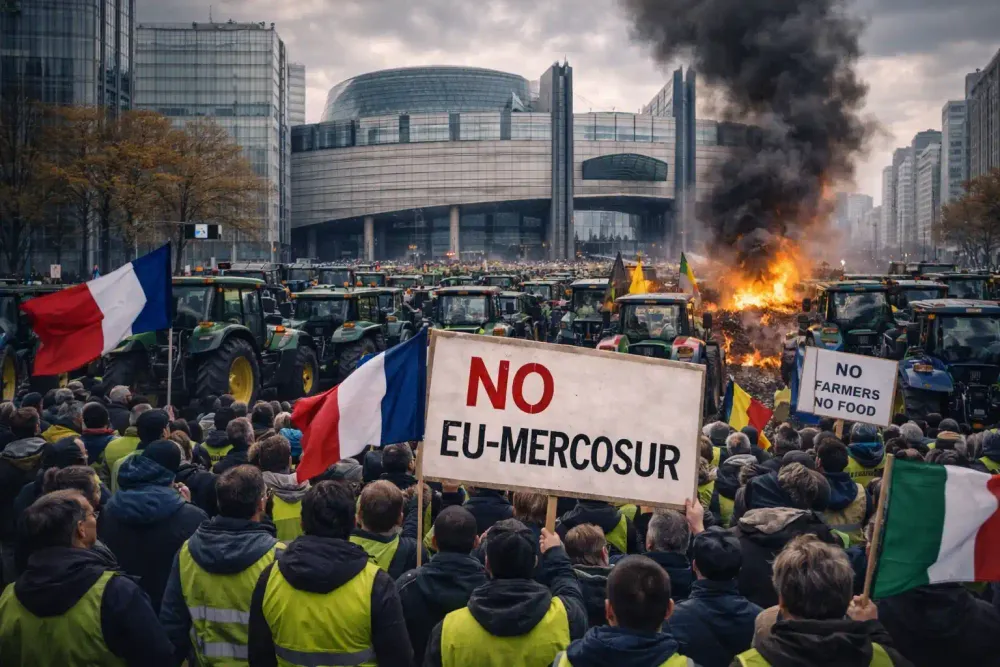
Thousands of farmers surrounded the European Parliament with tractors the day before the vote. They burned tires. They blocked motorways across France, Poland, Greece, and Ireland. They slept on bales of straw outside the French National Assembly.
The Commission signed the deal anyway.
And here's what European farmers are getting in exchange for their livelihoods: 0.05% GDP growth by 2040.
Not 5%. Not 0.5%.
Zero-point zero five percent.
That's the European Commission's own estimate of the economic benefit this deal will deliver over the next 14 years.
For context, that's roughly €90 billion spread across 27 countries and 450 million people. Or about €6.40 per person per year. Less than the price of a beer in Brussels.
Meanwhile, European farmers, who already operate under the strictest environmental, animal welfare, and food safety standards in the world, will compete directly against beef, poultry, sugar, and soy produced in countries where 30+ pesticides banned in the EU are legal, where chlorine-washed poultry is standard, where growth hormones in meat are permitted, and where labor violations are routine.
This isn't a trade deal. It's extraction. European agriculture sacrificed to secure export markets for German cars and French pharmaceuticals, all wrapped in the language of "geopolitical strategy" and "countering China."
Let's walk through what Brussels actually agreed to. And why it's not about economics at all.
The truth doesn’t trend. It survives because a few still care enough to keep it alive.
Keep The Kade Frequency transmitting.
Who Pushed This Deal Through?
"The masses have never thirsted after truth. Whoever can supply them with illusions is easily their master; whoever attempts to destroy their illusions is always their victim."
Gustave Le Bon, The Crowd: A Study of the Popular Mind, 1895
Before we talk about what's in the deal, let's talk about who wanted it.
The German auto industry.
In December 2025, three weeks before the deal was signed, the German Association of the Automotive Industry (VDA) issued a statement: "The consequences of a Mercosur deal failure in January would be severe for prosperity, growth, jobs and the joint fight against climate change."
VDA President Hildegard Mueller added: "70% of all jobs in the auto industry are sustained by exports."
The BDI industry association called the December delay "a setback for Europe's credibility as a geostrategic actor."
The German chemical industry association VCI said: "Frustration is growing."
Here's why they were desperate:
German automakers, Volkswagen, BMW, Mercedes-Benz, posted net profit declines of 64%, 84%, and 54% respectively in Q3 2024. The collapse was driven by Trump's tariffs (which hit 15% in August 2025), China's dominance in electric vehicles, and stagnant European sales.
US tariffs on German cars cost Porsche alone €400 million in the first half of 2025. Combined free cash flow for Germany's Big Three automakers dropped €10 billion in 2025.
Volkswagen announced plans to cut 35,000 German jobs by 2030. Bosch is cutting 5,500 jobs. ZF Friedrichshafen is laying off 10,000 workers.
Mercosur offered a lifeline: export markets where German cars face 35% tariffs that will be eliminated over 15 years. German car exports to Brazil were worth €1 billion in 2024. The deal could boost German automotive exports to Mercosur 39% by 2040.
So when von der Leyen flew to Paraguay on January 17, she wasn't representing European farmers. She was representing Volkswagen.
The deal's geopolitical framing, "countering Trump," "reducing reliance on China", was cover. Trump's tariffs created pressure to "diversify trade relationships." China's dominance in EVs and critical minerals created urgency to secure alternative supply chains.
But the actual economic benefit? 0.05% GDP growth over 14 years.
That's not an economic strategy. That's a bailout for German industry dressed up as geopolitics.
Von der Leyen even admitted it in her signing ceremony speech on January 17: "We choose fair trade over tariffs. We choose a productive long-term partnership over isolation."
Translation: We choose export markets for German cars over protecting European farmers.
The Atlantic Council called the deal "a geopolitical imperative" driven by "Trump's tariffs in effect by summer 2025"and the "new US National Security Strategy that places the Western Hemisphere at the center of US foreign policy."
Translation: Washington's geopolitical posturing gave Brussels cover to push through a deal German industry needed.
China's stranglehold on critical minerals? Mercosur holds lithium reserves. Europe needs lithium for EV batteries. The deal locks in access.
But none of this required sacrificing European farmers. The Commission could have negotiated a pure critical minerals agreement. Could have secured lithium access without opening agricultural markets to imports produced under lower standards.
They chose not to. Because the German auto lobby wanted full tariff elimination, including on cars.
And von der Leyen delivered.
Independent investigations. Imperial expansion exposed. Pattern documented.
Get investigations delivered.
What Did Brussels Actually Agree To?
The EU-Mercosur deal eliminates 90% of tariffs between the European Union and four South American countries: Argentina, Brazil, Paraguay, and Uruguay.
For the EU, that means exporting cars (currently taxed at 35%), machinery (14-20% tariffs), pharmaceuticals (up to 14% tariffs), wine (27% tariffs), spirits (35% tariffs), cheese, and chocolate to a market of 295 million people.
For Mercosur, that means exporting beef, poultry, sugar, rice, honey, soy, and ethanol to a market of 450 million people.
The deal creates quotas for "sensitive" European products. Mercosur can export:
- 99,000 tons of beef per year at a 7.5% tariff (that's 1.5% of total EU beef production)
- Unlimited poultry (currently one-third of EU poultry imports already come from Mercosur)
- Sugar, rice, honey, ethanol, all capped at specific tonnage limits
In exchange, Europe gets to protect 344 food and drink products from imitation in South America. Parma ham. Champagne. Roquefort cheese. Geographic Indications locked in.
The Commission also set aside €6.3 billion as a "crisis fund" for European farmers in case the deal causes market disturbances.
Sounds balanced. Sounds reasonable. Sounds like both sides win.
Here's what the Commission didn't advertise:
The pesticide gap. Over 30 active substances approved for use on sugarcane in Brazil are banned for use on sugar beets in the EU. 52% of substances authorized for maize in Brazil are banned in the EU.
The chlorine gap. Poultry in Brazil can be decontaminated with chlorine washes, banned in the EU since 1997.
The hormone gap. Growth hormones in beef are legal in Mercosur countries. Banned in the EU since 1988.
The labor gap. According to the ITUC Global Rights Index, all Mercosur countries except Uruguay regularly violate workers' rights, freedom of association, collective bargaining, the right to strike.
The welfare gap. Animal welfare standards in Mercosur fall "far short" of EU protections, according to the European Federation of Food, Agriculture and Tourism Trade Unions.
The enforcement gap. The deal includes "commitments" on deforestation, climate, and labor standards. None of them are binding. None of them are enforceable. The deforestation prevention clause doesn't even start until 2030.
So European farmers, who must comply with every environmental regulation Brussels imposes, who cannot use chlorine washes or growth hormones, who face strict limits on pesticides, who operate under animal welfare standards that increase costs, will now compete directly against producers who face none of those restrictions.
And if European beef, poultry, or sugar producers go under?
The Commission set aside €6.3 billion to cover it.
That's not a safety net. That's a severance package.
How Did the Commission Bypass National Parliaments?
Here's where it gets interesting.
The original EU-Mercosur deal was negotiated as a mixed agreement, meaning it covered both trade (an EU competence) and political/cooperation issues (a shared competence between the EU and member states).
Under EU law, mixed agreements require:
- A vote in the European Parliament
- A unanimous vote in the EU Council
- Ratification by all 27 national parliaments
That means any single country, France, Poland, Ireland, Austria, Hungary, could veto the deal.
The Commission knew this. France had already said it would block the agreement. Poland opposed it. Austria, Ireland, and Hungary expressed strong objections.
So in September 2025, the Commission did something unprecedented: it split the agreement in two.
Agreement #1: The Interim Trade Agreement (iTA)
- Covers tariffs, quotas, market access, the trade pillar
- Requires only EU Council + European Parliament approval
- Can be applied "provisionally" before ratification
- National parliaments have no vote
Agreement #2: The Partnership Agreement (EMPA)
- Covers political dialogue, cooperation, sustainability commitments
- Requires all 27 national parliaments to ratify
- Takes years to complete
By splitting the deal, the Commission turned a mixed agreement requiring unanimous approval into a trade-only agreement requiring qualified majority.
France, Poland, Austria, Ireland, and Hungary can no longer veto the trade provisions. Their national parliaments have no say. The only vote that matters is the European Parliament.
And the Commission can apply the trade agreement provisionally, meaning it takes effect immediately, before any national parliament votes on anything.
Civil society groups called it "an outrageous abuse of power." MEPs called it "chicanery" designed to "prevent national parliaments from having their say."
That's why 334 MEPs voted to send the deal to the European Court of Justice. Not because they oppose free trade. Because they believe the Commission violated the negotiating mandate it was given in 1999, which explicitly required a mixed agreement to strengthen political relations with Mercosur, not just trade.
The Court will now decide if the Commission's split was legal. That process takes 12-24 months.
But here's the thing: the Commission can still apply the trade agreement provisionally while the Court deliberates.
Meaning: European farmers could be competing against chlorine-washed poultry and hormone-treated beef while judges decide if the deal that authorized it was even legal.
Why Is This Deal Worth 0.05% GDP Growth?
"When I give food to the poor, they call me a saint. When I ask why they are poor, they call me a communist."
Hélder Câmara, 1970s
Let's talk numbers.
The European Commission estimates the EU-Mercosur deal will add 0.05% to EU GDP by 2040.
That's €90 billion over 14 years. Across 27 countries. For 450 million people.
€6.40 per person per year.
For context:
- The EU spent €386 billion on Common Agricultural Policy subsidies from 2021-2027
- Germany's GDP grew 0.7% in 2024 alone
- The entire deal delivers less economic benefit than Germany's quarterly GDP fluctuations
And this is the Commission's optimistic projection.
Independent analyses suggest the actual benefit will be lower, or negative, once you account for:
- Market disruptions in beef, poultry, and sugar sectors
- Increased deforestation driving climate costs
- Health impacts from importing food produced under lower standards
- Job losses in rural agriculture
The Heinrich Böll Foundation analyzed the deal and concluded it would accelerate deforestation in the Amazon,increase greenhouse gas emissions, and expose European consumers to pesticides banned in the EU.
Friends of the Earth called it "climate-wrecking."
Greenpeace said it would "propel destructive agribusiness and destroy precious ecosystems in South America."
So why push it through?
Because this isn't about GDP. It's about who benefits.
German automakers want access to South American car markets. French pharmaceutical companies want to export drugs at lower tariffs. The agrochemical industry wants to sell pesticides banned in Europe to Brazilian soy farmers, and then import the soy back to Europe for animal feed.
And Brussels wants to claim it's "countering China" and "reducing reliance on Trump's America" by securing trade deals with anyone willing to sign.
The fact that it delivers almost no economic benefit to average Europeans? Irrelevant.
The fact that it undermines European farmers who've spent decades complying with environmental regulations? Collateral damage.
The fact that it accelerates deforestation in the Amazon, one of the planet's most critical carbon sinks? A problem for future administrations.
The Commission got what it wanted: a geopolitical talking point. German industry got export markets. And European farmers got a €6.3 billion severance package to shut up and accept their elimination.
What Did Farmers Say?
Thousands of farmers surrounded the European Parliament in Strasbourg on January 20, 2026, the day before MEPs voted on the legal challenge.
They drove tractors from France, Poland, Ireland, Greece. They carried signs reading "STOP Mercosur" and "Free trade is destroying our future."
They clashed with police. They blocked motorways. They burned tires outside the Parliament building.
In France, young farmers slept on bales of straw in front of the National Assembly. The French National Assembly voted unanimously against the deal, a rare moment of cross-party agreement in a fractured political system.
The Irish Farmers' Association called the deal a "disgraceful and feeble sell-out."
COPA-COGECA, which represents 23 million farmers across the EU, warned the deal "will go down in history as a very dark moment."
The European Federation of Food, Agriculture and Tourism Trade Unions issued a statement titled "EU-Mercosur Agreement betrays European farmers, workers, consumers and the environment."
They wrote:
"The sustainability provisions of the deal are neither binding nor sufficient to prevent adverse health, environmental and employment impacts, leaving EU farmers and the economy exposed to unfair competition."
"The most recently added safeguards are nothing more than a communication tool to sell the agreement. Thresholds and triggers are not relevant or are set so high that they would be nearly impossible to activate, offering no real protection to affected sectors."
Von der Leyen signed the deal anyway.
On January 17, in Paraguay, she stood next to Mercosur leaders and announced: "We are creating the largest free trade zone in the world."
Four days later, Parliament voted to challenge the deal's legality.
German Chancellor Friedrich Merz, one of the deal's strongest backers, called the vote "regrettable" and said MEPs "misjudged the geopolitical situation."
Translation: Farmers don't understand geopolitics. The Commission knows best. Shut up and compete against chlorine-washed poultry.
What About the Environment?
"We are in danger of destroying ourselves by our greed and stupidity."
Stephen Hawking, 2016
The EU-Mercosur deal includes environmental commitments. On paper, they look strong:
- Adherence to the Paris Agreement is an "essential element" of the deal
- "Concrete commitments" to prevent deforestation
- Biodiversity protection measures
- A dedicated chapter on sustainable development
Here's what those commitments actually mean:
Nothing.
The Paris Agreement clause is not enforceable. If Brazil violates its climate commitments, there is no mechanism to suspend the trade agreement.
The deforestation commitments don't start until 2030. Meaning: for the next four years, Mercosur countries can clear as much forest as they want, and the trade agreement won't stop it.
The sustainability chapter has no sanctions. If labor violations occur, if pesticides banned in Europe are used, if indigenous land rights are violated, there is no enforcement mechanism.
The EU Deforestation Regulation, passed in 2023 to ensure products sold in Europe don't contribute to forest destruction, was supposed to apply to all imports, including those under the Mercosur deal.
But in December 2025, MEPs voted to delay the regulation and weaken its provisions.
Coincidence? Or clearing the path for Mercosur beef and soy imports?
Here's what environmental groups said:
Greenpeace: The deal will "jeopardize the EU Deforestation Regulation, breach EU climate laws, boost trade in plastics, facilitate the entry of a toxic cocktail of banned pesticides into the EU, and propel destructive agribusiness."
Friends of the Earth: The deal is "climate-wrecking" and will lead to increased deforestation as Mercosur countries sell more beef and soy, often sourced from the Amazon.
Heinrich Böll Foundation: The deal "conflicts with ambitious climate action" and would result in increased EU imports of agricultural commodities from "a region critical for maintaining global biodiversity and regulating climate."
Land use changes, primarily deforestation driven by farming, contribute 12-20% of global greenhouse gas emissions,according to the European Commission itself.
But the Mercosur deal incentivizes more beef and soy exports. Which means more land clearing. Which means more emissions.
And the environmental "protections" in the deal?
Theater. Unenforceable commitments that sound good in press releases and mean nothing in practice.
Frequently Asked Questions
Q: Why did the Commission split the deal into two agreements?
A: To bypass national parliaments. Under EU law, mixed agreements (covering trade + political cooperation) require ratification by all 27 national parliaments, any one country can veto. By splitting the trade provisions into a separate "Interim Trade Agreement," the Commission reduced the approval requirement to just the EU Council and European Parliament. National parliaments no longer have a vote on the trade provisions.
Q: Is that legal?
A: Unknown. The European Parliament voted 334-324 to refer the deal to the European Court of Justice to decide if the split violates EU treaties. The Court's opinion could take 12-24 months. MEPs argue the Commission violated its 1999 negotiating mandate, which required a mixed agreement to strengthen political, not just trade, relations with Mercosur.
Q: Can the deal be applied before the Court rules?
A: Yes. The Commission can apply the trade agreement "provisionally" before the Court issues its opinion. That means tariff reductions and import quotas could take effect while judges decide if the deal was even legal.
Q: What's the actual economic benefit of this deal?
A: The European Commission estimates 0.05% GDP growth by 2040, roughly €90 billion over 14 years, or €6.40 per person per year. For context, that's less economic benefit than quarterly GDP fluctuations in Germany alone.
Q: Why are farmers protesting?
A: European farmers operate under strict environmental, animal welfare, and food safety standards that increase costs. The Mercosur deal allows imports from countries where 30+ pesticides banned in the EU are legal, where chlorine-washed poultry is standard, where growth hormones in beef are permitted, and where labor standards are weaker. Farmers say they cannot compete on price against producers who don't face the same regulatory costs.
Q: What about the environmental protections in the deal?
A: Not enforceable. The Paris Agreement clause has no sanctions. Deforestation commitments don't start until 2030. The sustainability chapter has no enforcement mechanism. Environmental groups call the commitments "theater", they sound good but lack any teeth.
Q: How much beef can Mercosur export to the EU under this deal?
A: 99,000 tons per year at a 7.5% tariff (compared to the normal 12% tariff). That represents 1.5% of total EU beef production. However, Mercosur already exports 206,000 tons of beef to the EU annually under existing quotas, so the deal actually reduces current import levels in exchange for lower tariffs.
Q: Which countries opposed the deal?
A: France, Poland, Austria, Hungary, and Ireland voted against it in the Council. Belgium abstained. France's National Assembly voted unanimously to reject it. But under qualified majority voting (enabled by the split structure), 21 countries voting in favor was enough to approve it.
Q: What happens next?
A: The European Court of Justice will review whether the Commission's split was legal. That takes 12-24 months. Meanwhile, the Commission can provisionally apply the trade agreement. If the Court rules the split was illegal, the deal would need to be restructured and re-voted, this time requiring all 27 national parliaments to approve.
Do You Consent?
"The creatures outside looked from pig to man, and from man to pig, and from pig to man again; but already it was impossible to say which was which."
George Orwell, Animal Farm, 1945
Here's the fundamental question:
Did you consent to a system where the European Commission can bypass your national parliament by splitting a single trade agreement into two legal instruments?
Did you consent to a system where 25 years of negotiations deliver 0.05% GDP growth while exposing European farmers to competition from producers who use pesticides banned in Europe, chlorine-wash their poultry, and inject growth hormones into beef?
Did you consent to a system where thousands of farmers surround the Parliament with tractors, sleep on bales of straw outside the National Assembly, burn tires in the streets, and the Commission signs the deal anyway, four days before Parliament votes to challenge its legality?
Because that's what happened.
Not in some corrupt regime overseas. Not in some authoritarian state. Here. In Brussels. By the European Commission. With the backing of Germany, Spain, and 19 other member states.
The Mercosur deal isn't about economics. The Commission's own analysis proves that, 0.05% GDP growth over 14 years is a rounding error, not an economic strategy.
It's not about geopolitics either. "Countering China" by selling cars to Argentina doesn't reduce European dependence on Chinese rare earth minerals. "Diversifying away from Trump" by importing Brazilian beef doesn't protect European industry from U.S. tariffs.
This is about institutional priorities.
Brussels prioritizes the export markets that benefit large corporations, German automakers, French pharmaceutical companies, agrochemical firms, over the livelihoods of millions of small and medium-sized farmers who've spent decades complying with environmental regulations that make European agriculture the most sustainable in the world.
Brussels prioritizes completing a 25-year negotiation, a symbolic victory for the Commission, over the democratic right of national parliaments to vote on agreements that fundamentally reshape their agricultural sectors.
Brussels prioritizes provisional application of trade deals, getting tariff reductions in place immediately, over waiting for a legal opinion on whether the deal violates EU treaties.
And when farmers protest, when national parliaments vote unanimously against the deal, when MEPs challenge its legality in court, Brussels calls it "regrettable" and says they "misjudged the geopolitical situation."
Translation: You don't understand. We know better. Trust us.
The Mercosur deal is extraction. European farmers extracted. Democratic accountability extracted. Environmental protections extracted.
All for €6.40 per person per year.
And the Commission calls it the "world's biggest free trade zone."
They're not wrong. It's free for everyone except the people who pay the price.
No ads. No sponsors. Just signals from the noise.
Keep The Kade Frequency transmitting.
Independent. Unfunded. Uncompromising.
Investigating power. Exposing corruption. Demanding accountability.
© 2026 The Kade Frequency. All rights reserved.