The ECB Dictatorship: How Unelected Bankers Control 340 Million People
European Central Bank created €5 trillion through quantitative easing 2015-2022 benefiting banks and corporations not citizens. Negative interest rates 2014-2019 destroyed €2.4 trillion in German savings punishing prudence forcing speculation.

340 million Europeans governed by monetary policy makers they never elected and cannot remove.
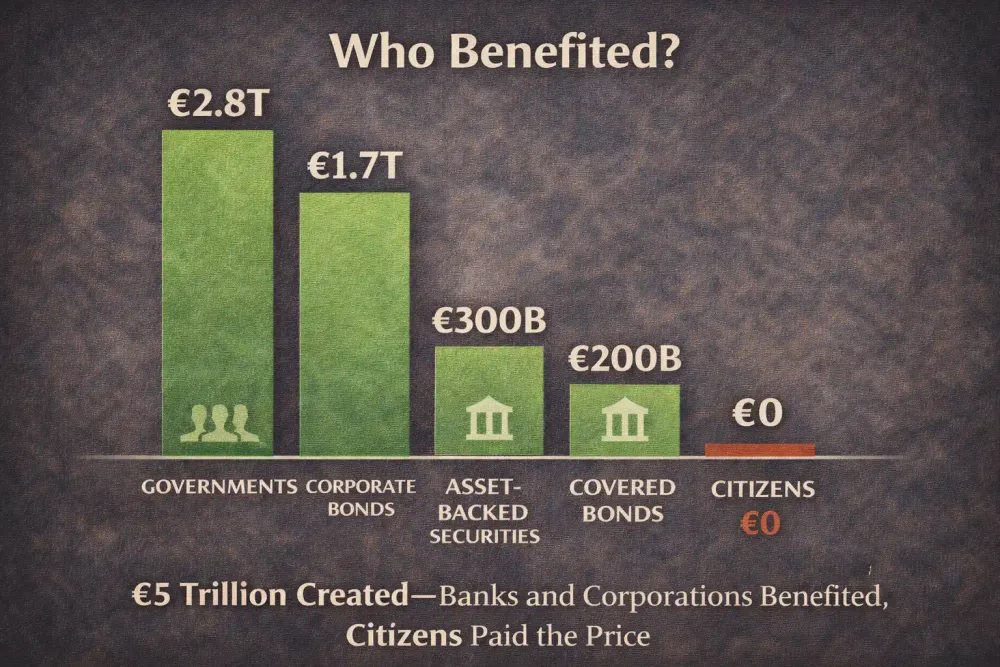
€5 trillion created through quantitative easing, went to banks and corporations, not citizens.
€2.4 trillion in German savings destroyed by negative interest rates, prudence punished, speculation forced.
€1.7 trillion in corporate bonds purchased, subsidizing Apple, BMW, Shell, Nestlé while small businesses got nothing.
Christine Lagarde: Never elected. Enforced Greek austerity at IMF. Now ECB President. Zero accountability.
Greece 2015: Citizens voted 61.3% against austerity. ECB cut off bank liquidity. Government capitulated in 8 days.
This isn't central bank independence. This is monetary dictatorship.
Introduction
There's a central bank governing the economic lives of 340 million people across 20 countries. It controls their interest rates, determines their inflation, decides whether their savings grow or shrink, influences whether they can afford a mortgage, and shapes whether they have jobs.
Who elected the people running this institution?
Nobody.
Who can vote them out if they perform poorly?
Nobody.
Who do they answer to?
Nobody.
This isn't hyperbole. The European Central Bank operates as an unelected monetary dictatorship with zero democratic accountability. Christine Lagarde is ECB President, she governs monetary policy for 340 million Europeans. You didn't vote for her. You can't remove her. She faces no accountability to any electorate despite controlling the most fundamental aspect of your economic life: money itself.
Before becoming ECB President in 2019, Lagarde was IMF Managing Director from 2011-2019 where she enforced catastrophic austerity on Greece that caused a 25% GDP collapse, 27% unemployment, 58% youth unemployment, and a 35% increase in elderly suicides as pensions were slashed. Greeks suffered immensely. Greek bonds got paid. Creditors were protected. Same person. Same policies. Same ideology. Zero consequences.
Now she controls European monetary policy. Same extraction, different title.
The ECB created €5 trillion through quantitative easing programs from 2015-2022. That money went to banks (free reserves to lend at profit), corporations (cheap debt through €1.7 trillion in bond purchases), and asset owners (stocks and property inflated). Workers? Wages stayed stagnant. Citizens needing help? Got nothing. Small businesses? No access to ECB programs, they don't issue bonds the ECB buys.
The ECB imposed negative interest rates from 2014-2019, destroying approximately €2.4 trillion in German saver wealth alone. Save €100, get back €99. This is wealth confiscation through monetary policy. Prudence was punished. Speculation was forced. Anyone trying to save for retirement or their children's education saw their wealth actively eroded by an institution they never elected and cannot remove.
Then came inflation. The ECB printed €5 trillion and acted surprised when inflation hit 10%+ in 2022-2023. Basic economics says more money without more goods equals higher prices. The ECB initially denied responsibility, "it's transitory," "supply chains," "Putin's fault." Then the ECB tacitly admitted causation by aggressively raising interest rates to fight the inflation its money printing caused. Real wages declined 5-10%. Living standards collapsed. And nobody at the ECB faced any consequences.
But the smoking gun proving this is dictatorship not independence came in 2015. Greek citizens voted in a referendum, 61.3% voted NO to austerity bailout terms. A clear democratic mandate. The ECB's response? Cut off Emergency Liquidity Assistance to Greek banks. Strangled the economy. Forced government capitulation within 8 days. Democracy was overridden by unelected central bankers using monetary policy as a weapon.
This investigation exposes how the ECB operates as the most undemocratic major central bank in the world, governing more people than any except China's (which doesn't pretend to be democratic). It documents the €5 trillion extraction benefiting financial sectors not citizens, the negative rates destroying savings, the corporate welfare through bond purchases, the personnel revolving door ensuring same people implement same policies across institutions, the inflation lie and tacit admission, the Southern European extraction where one-size-fits-all policy serves German interests, the Greek strangulation proving monetary control overrides democracy, and the structural impossibility of democratic reform.
The evidence is in the ECB's own data, official reports, documented historical events, and simple political analysis. The conclusion is unavoidable: 340 million Europeans live under monetary dictatorship. You can vote all you want. The ECB decides. And you cannot change that.
By A. Kade
What This Investigation Exposes
The €5 trillion quantitative easing scam where money went to banks, corporations, and asset owners while citizens got nothing. The €2.4 trillion savings destruction through negative rates punishing prudence and forcing speculation. The €1.7 trillion corporate welfare program subsidizing profitable multinationals like Apple and BMW while excluding small businesses. Christine Lagarde's revolving door from IMF Greek austerity enforcer to unelected ECB President. The inflation explosion to 10%+ that ECB denied causing then admitted through rate hikes destroying real wages. Southern Europe's permanent extraction where Germany gains €3+ trillion in surpluses while Italy, Spain, Greece, Portugal bleed wealth. Greece 2015 where ECB strangled economy until government overrode 61.3% referendum vote against austerity. The democratic impossibility where you cannot vote ECB out, cannot pressure through government, cannot override through parliament, cannot reform through treaties, and cannot exit euro without catastrophe. The comparison showing even the US Federal Reserve has more democratic legitimacy than the ECB. The structural requirement for monetary dictatorship because one currency for 20 different economies is economically irrational. And why reform is impossible, Germany benefits and will veto, ECB opposes accountability, financial sector loves current system, and crisis hasn't been severe enough yet to force change.
The truth doesn’t trend. It survives because a few still care enough to keep it alive.
Keep The Kade Frequency transmitting.
The €5 Trillion Scam: Who Got the Money
From March 2015 to July 2022, the ECB created €5 trillion from nothing through quantitative easing. Not a metaphor, literally created the money electronically with keystrokes. That's more than France's entire GDP. Created. From. Nothing.
Where did it go?
According to the ECB's own Statistical Data Warehouse, here's the breakdown:
Government Bonds: €2.8 trillion
The ECB purchased government debt from eurozone countries, keeping borrowing costs suppressed at zero or even negative rates. Governments could borrow unlimited amounts and pay nothing, or get paid to borrow. Fiscal discipline? Eliminated. Who benefits? Governments avoiding tough budget choices and bondholders getting guaranteed returns backstopped by ECB.
Corporate Bonds: €1.7 trillion
The ECB bought bonds from large multinationals. Not small businesses, they don't issue bonds. The beneficiaries were companies like Apple, BMW, Shell, Siemens, Nestlé. These are some of the most profitable corporations in the world. They don't need central bank subsidies. They got them anyway. Direct wealth transfer from the ECB to shareholders and executives of companies with easy market access.
Asset-Backed Securities: €300 billion
Bundles of loans packaged and sold, remember 2008? The ECB bought these to support lending, but analysis by the Bank for International Settlements shows most benefits accrued to financial institutions packaging the securities, not borrowers getting cheaper loans.
Covered Bonds: €200 billion
Bonds backed by pools of mortgages or public sector loans. Again, benefits went primarily to issuing banks, not homebuyers or citizens.
Who Benefited:
Banks received free reserves they could lend at profit. Commercial banks sell assets to the ECB, receive cash reserves, lend that money at interest. Free money for banks. According to ECB annual reports, eurozone banks used QE to rebuild balance sheets after 2008, meaning they repaired their own crisis-created damage with public money rather than facing consequences.
Corporations refinanced existing debt at near-zero or negative rates. Companies that would've paid 4-5% on bonds in normal markets paid 0.5% or less, or got paid to borrow. €1.7 trillion in subsidies for multinationals that don't need help. The ECB's Corporate Sector Purchase Programme data shows 70%+ of purchases went to investment-grade companies with strong credit ratings and easy market access.
Asset owners saw stocks and real estate values inflate from cheap money flooding into speculation. If you owned stocks before QE, you got richer. If you owned property before QE, you got richer. The wealth effect, except it only works if you already have wealth. Eurostat data shows wealth inequality increased in every eurozone country during the QE period.
Governments borrowed unlimited amounts at zero cost, avoiding fiscal reforms and maintaining unsustainable spending. Italy, Spain, Greece, all countries that should've faced market discipline for running up debt instead got backstopped by ECB purchases removing any pressure to reform. Moral hazard at sovereign scale.
Who Didn't Benefit:
Workers. Real wages across the eurozone remained flat or declined from 2015-2022 according to Eurostat. The "stimulus" didn't stimulate wages.
Savers. Bank deposit rates were zero or negative for a decade. Saving money meant losing money. Pension funds and insurance companies couldn't meet obligations because they couldn't earn returns on safe assets. Retirees living on interest income saw income collapse to nothing.
Small businesses. They don't issue bonds, so they couldn't access ECB's corporate bond purchases. They don't have investment-grade credit ratings, so they couldn't benefit from suppressed borrowing costs. Small and medium enterprises employ 70% of European workers but received 0% of ECB's €1.7 trillion corporate welfare program.
The real economy. Productivity growth remained anemic. Business investment stayed weak despite historically cheap borrowing costs. The European Commission's economic data shows eurozone productivity growth averaged below 1% annually throughout the QE period. Creating €5 trillion stimulated financial markets, not productive economic activity.
So €5 trillion created, and it went to those who least needed it while those who most needed it got nothing. That's not monetary policy. That's extraction.
And you never voted for any of it.
"The issue which has swept down the centuries and which will have to be fought sooner or later is the people versus the banks." - Lord Acton, 1875
Negative Rates: The €2.4 Trillion Theft From Savers
From June 2014 to September 2019, the ECB imposed negative interest rates on bank deposits. Banks holding reserves at the ECB had to pay 0.4-0.5% annually for the privilege of keeping money there.
This sounds technical until you realize what it means in practice: saving money cost you money.
If you saved €100 and earned zero interest for five years while inflation ran at 1-2%, you lost 5-10% purchasing power. But it was worse than that, many banks passed the negative rates onto large depositors, meaning saving €100 meant getting back €99. The fundamental principle that prudent deferred consumption should be rewarded was inverted. Saving was punished. Speculation was mandatory.
The scale of destruction is documented in Bundesbank data. German savers alone lost approximately €2.4 trillion in foregone interest during the negative rate period. Not a reduction in interest earned, €2.4 trillion that would've been earned in a normal interest rate environment was simply destroyed by ECB policy.
Who Paid:
Retirees living on savings interest. A German retiree with €100,000 in savings would've earned €2,000-3,000 annually at normal 2-3% rates. With negative rates they earned nothing, or paid to save. Five years of retirement income: gone. Multiply that across millions of German, Dutch, Austrian savers and you get the €2.4 trillion figure.
Anyone saving for a house down payment, children's education, or retirement. Millennials trying to accumulate €20,000 for a down payment saw that money earn nothing for a decade while house prices inflated 30-50% from cheap mortgage money. The path to homeownership became longer as saving was punished and asset prices inflated.
Pension funds couldn't meet obligations. They promise 3-5% returns to retirees. With negative rates on safe assets, they couldn't earn anything on bonds without taking massive risk. Result: either break promises to pensioners or gamble pension money on risky assets. Many did both, cutting benefits while speculating.
Insurance companies faced the same problem. Life insurance policies promise guaranteed returns. Negative rates made those guarantees impossible to meet. German insurance company Allianz warned in annual reports that sustained negative rates threatened the entire insurance sector's solvency.
Who Benefited:
Debtors got to borrow for free, or got paid to borrow. Governments issued bonds at negative yields, meaning they borrowed money and got paid to do it. Corporations did the same, Nestlé issued bonds at -0.05%, meaning they were paid €5 for every €10,000 borrowed.
The ECB's justification was forcing money out of savings into spending or investment. If saving costs money, people have to spend or invest. But that logic applies to people who have excess savings, wealthy people and corporations. Poor and middle-class people don't have extra savings to deploy. They have emergency funds they need for security. Forcing them into speculation to avoid wealth destruction is fucking cruel.
And it didn't even work. Eurostat consumption data shows consumer spending remained weak throughout the negative rate period. People didn't spend more, they saved harder to compensate for earning nothing on savings. Perverse effect: policy designed to boost spending reduced it.
€2.4 trillion stolen from savers. Given to debtors, speculators, and gamblers. And the person who implemented this policy, Christine Lagarde, was never elected and cannot be removed.
The €1.7 Trillion Corporate Welfare Scam
From June 2016 to December 2022, the ECB's Corporate Sector Purchase Programme bought €1.7 trillion in corporate bonds. This was sold as "supporting lending to the real economy." That's bullshit.
The ECB bought bonds from companies that don't need help. To qualify for ECB purchases, companies needed:
- Investment-grade credit rating (BBB- or higher)
- Bonds issued in euros
- Eurozone incorporation
- Minimum issue size
These requirements screened out every small or medium business in Europe. SMEs employ 70% of European workers and provide 60% of value added to the economy. They got exactly zero euros from the corporate bond purchase program because they don't issue bonds.
Who got the money? The ECB's own disclosure data shows top beneficiaries included:
Apple - issued €2.5 billion in euro bonds, ECB bought substantial portion. Apple has $150+ billion in cash. Doesn't need ECB help.
BMW - issued multiple euro bonds totaling €5+ billion. ECB purchased significant amounts. BMW is highly profitable automaker with investment-grade rating and easy market access.
Shell - oil giant issued €10+ billion in euro bonds during this period. ECB bought billions. Shell is one of most profitable corporations on earth.
Siemens - issued €8+ billion, ECB bought large chunks. Siemens is industrial giant with fortress balance sheet.
Nestlé - food multinational issued €5+ billion. ECB participated as major buyer.
These companies don't need subsidized borrowing. They have cash reserves, strong earnings, and easy access to credit markets at any time. When the ECB buys their bonds it pushes yields even lower than markets would set, direct subsidy to already profitable corporations.
The stated goal was supporting real economy lending. The actual effect was corporate welfare. Here's how it works:
Company issues €1 billion in bonds at 0.5% interest. Without ECB buying, market might demand 2% yield. ECB purchase pushes yield to 0.5%. Company saves €15 million annually in interest. That's €15 million that otherwise would've gone to bondholders. Who keeps it? Company shareholders and executives.
Multiply that across €1.7 trillion in purchases and you get tens of billions in annual wealth transfer from the ECB to corporate shareholders. The Bank for International Settlements documented that ECB corporate bond purchases reduced eurozone corporate borrowing costs by 40-60 basis points on average, massive subsidy to companies with market access.
Meanwhile, small businesses in Spain, Italy, and Greece couldn't access credit at any price. Banks wouldn't lend to them despite having excess reserves from ECB. Why? Small businesses are risky. Why take risk lending to Spanish bakery when you can buy guaranteed government bonds the ECB will purchase?
So the ECB created €1.7 trillion that went to companies that don't need it while companies that do need it got nothing. That's not stimulus. That's extraction disguised as monetary policy.
And nobody elected the people who decided this.
The Lagarde Revolving Door: Same People, Same Extraction
Christine Lagarde has never been elected to any position in her career. Yet she's had immense power over millions of people's lives across multiple institutions.
2007-2011: French Finance Minister
Appointed by President Sarkozy. Not elected. Oversaw French finances during financial crisis. Advocated austerity for other countries while protecting French interests.
2011-2019: IMF Managing Director
Selected through backroom negotiations among finance ministers. Not elected. During this period she enforced catastrophic austerity on Greece:
Greece's GDP collapsed 25% from 2011-2016, worse than the Great Depression's 27% U.S. GDP decline. Unemployment hit 27%, youth unemployment 58%. The elderly suicide rate increased 35% as pensions were slashed. Eurostat data and Greek statistical authority document the devastation.
Lagarde at IMF demanded:
- Pension cuts (hitting elderly living on fixed incomes)
- Wage reductions (for public sector workers already struggling)
- Privatization (selling Greek assets to foreign investors at fire-sale prices)
- Tax increases (while unemployment was 27%, taxing people who had no income)
The IMF's stated goal was making Greece's debt sustainable. Greek debt-to-GDP went from 120% in 2010 to 180% by 2018. The program objectively failed by its own metric. But Greek bonds got paid. European banks were protected. German and French banks holding Greek debt were bailed out indirectly through Greek "bailout" funds that went straight to creditors.
Lagarde faced no consequences for this failure. No IMF official was fired. No accountability mechanism existed.
During this period she was also convicted in French court for negligence in the Tapie affair, a €400 million corruption case where she approved irregular payments to businessman Bernard Tapie. She received no punishment, kept her position, and later ascended to the ECB.
2019-Present: ECB President
Selected through EU negotiations. Not elected. Now controls monetary policy for 340 million Europeans.
Same person. Same policies. Same ideology. Zero accountability.
The pattern repeats across ECB leadership:
Mario Draghi:
- Goldman Sachs Vice Chairman Europe (2002-2005)
- Bank of Italy Governor (2005-2011)
- ECB President (2011-2019), architect of €5 trillion QE with famous "whatever it takes" speech
- Italian Prime Minister (2021-2022)
Never elected to ECB. Rotated from investment bank to central bank to government.
Jean-Claude Trichet:
- French Treasury Director (1987-1993)
- Bank of France Governor (1993-2003)
- ECB President (2003-2011), raised interest rates during 2008 crisis worsening recession
- Various corporate boards post-retirement
Never elected. Implemented catastrophic rate hikes in 2008 and 2011 that deepened crises. Faced no consequences.
Benoît Cœuré:
- French Treasury official (various roles 1992-2009)
- ECB Executive Board (2012-2019)
- Bank for International Settlements (2019-present)
Never elected. Cycled through French government to ECB to international banking institution.
These people rotate through unelected positions of power. They implement the same neoliberal orthodoxy prioritizing creditor interests over citizen welfare. They serve the same masters throughout their careers: banks, large corporations, bondholders. They never face consequences for policy failures. And they answer to no electorate.
This is the revolving door. It ensures continuity of ideology regardless of elections, priorities, or democratic input. Citizens can vote for left-wing or right-wing governments. Doesn't matter. The same technocrats cycle through unelected institutions implementing the same policies.
And you have zero mechanism to change it.
"The modern banking system manufactures money out of nothing. The process is perhaps the most astounding piece of sleight of hand that was ever invented." - Josiah Stamp, Director of the Bank of England, 1927
The Inflation Lie and Tacit Admission
2015-2022: ECB creates €5 trillion from nothing.
2021: Inflation starts rising above the 2% target.
ECB: "It's transitory. Supply chain disruptions. Nothing to worry about."
2022: Inflation explodes to 10%+ across Europe.
ECB: "Still transitory. Supply chains. Putin's fault with the Ukraine invasion. Our monetary policy has nothing to do with this."
Also 2022: ECB raises interest rates aggressively from -0.5% to +4% in 18 months, one of the fastest tightening cycles in ECB history.
Wait a fucking minute.
If inflation had nothing to do with ECB monetary policy, if it was all supply chains and Putin, why did the ECB change its monetary policy to fight inflation? The rate hikes are the admission.
By raising rates to combat inflation, the ECB tacitly admits that monetary policy affects inflation, that their €5 trillion money printing contributed significantly, that tighter money will reduce inflation, and therefore that their loose money increased it. Basic economics: increase the money supply dramatically without a proportional increase in goods and services, and prices rise. This is literally Econ 101.
Eurostat inflation data shows eurozone inflation hit 10.6% in October 2022. Germany reached 11.6%, the Netherlands 14.5%, Estonia 24.1%. Food prices soared 15-20% in most countries. Energy costs doubled or tripled. Real wages across the eurozone declined 5-10% according to European Commission data, meaning even if your nominal pay increased, you got poorer because prices increased faster.
Who paid for the ECB's inflation:
Workers whose real wages declined 5-10%. Your paycheck might've increased 3%, but prices increased 10%, so you're 7% poorer. The OECD wage data documents this across every eurozone country from 2021-2023.
Savers whose wealth evaporated. That €10,000 in your savings account lost 10% purchasing power in one year. €1,000 gone. Not spent, destroyed by inflation the ECB created.
Pensioners on fixed incomes. Pension barely keeps pace with official inflation, definitely doesn't keep pace with actual cost increases for food, energy, healthcare. Elderly people choosing between heating and eating because the ECB printed €5 trillion.
Anyone renting saw costs soar. Eurostat housing data shows rents increased 15-25% in major cities from 2021-2023 as cheap ECB money inflated property values and landlords passed costs to tenants.
Who benefited:
Governments and corporations with debts. Inflation reduces debt burden in real terms. Borrow €1 billion, inflation hits 10%, now you effectively owe 10% less in real terms. Governments across Europe benefited enormously from inflating away debt while the ECB kept nominal borrowing costs at zero.
Asset owners saw nominal values increase. Your stock portfolio or property might've increased 15% nominally even if it was flat in real terms. But if you needed to sell and realized those gains, you paid tax on the nominal increase, not the real inflation-adjusted gain. Wealth transfer from real economy to asset holders.
Banks got higher interest rate spreads and profits. As ECB raised rates, banks could charge higher rates on loans while keeping deposit rates near zero. Net interest margin exploded, ECB financial stability data shows eurozone bank profits hit record highs in 2022-2023.
Who faced consequences at the ECB:
Nobody. Christine Lagarde is still ECB President. No officials were fired for the inflation disaster. No accountability mechanism exists. The ECB simply pivoted from "inflation is transitory" to aggressively raising rates, destroying purchasing power in both directions, first through inflation, then through the recession caused by rate hikes.
This is monetary dictatorship: create the crisis, deny responsibility, admit it tacitly through policy reversal, face zero consequences, continue governing 340 million people who never elected you and can't remove you.
Southern Europe Extraction: How Germany Wins, The South Loses
The euro is sold as a currency union benefiting all members equally. That's a lie. The euro functions as an undervalued Deutschmark for Germany and golden handcuffs for Southern Europe.
How Germany Benefits:
Germany cannot devalue against other euro members. If Germany still had the Deutschmark, the currency would strengthen against trading partners due to Germany's productivity and export surplus, making German goods more expensive and reducing competitiveness. The euro prevents this, Germany gets a weak currency relative to what the Deutschmark would be, making German manufactured goods cheaper globally.
ECB monetary policy prioritizes German preferences. Low inflation protects German savers. Tight money supports German export competitiveness. The "stability culture" reflects German ordoliberal ideology. One-size-fits-all policy happens to fit Germany perfectly.
Result: Germany runs massive chronic trade surpluses. According to Deutsche Bundesbank data, Germany's cumulative current account surplus since euro introduction in 1999 exceeds €3 trillion. That's €3 trillion more exported than imported over 25 years, €3 trillion in claims on foreign assets, €3 trillion in wealth accumulation.
How Southern Europe Loses:
Italy, Spain, Greece, and Portugal cannot devalue to restore competitiveness. When your economy becomes uncompetitive, the normal adjustment mechanism is currency devaluation making exports cheaper and imports more expensive, naturally rebalancing trade. The euro eliminates this option, you're stuck with the same currency as Germany despite having vastly different productivity and wage levels.
They cannot set their own interest rates to provide stimulus. National central banks in the eurozone don't control monetary policy, the ECB does. When Italy needs lower rates to boost growth, tough shit, the ECB sets rates for the entire eurozone based on German inflation concerns.
They cannot print money to finance programs. The ECB has a monopoly on euro creation. National governments can't finance spending through monetary expansion like countries with sovereign currencies can.
They receive no fiscal transfers to balance asymmetric shocks. The EU budget is tiny, around 1% of EU GDP according to European Commission budget data, and most goes to agriculture and regional development, not fiscal balancing between strong and weak economies.
Result: Southern Europe runs chronic trade deficits mirroring German surpluses. Wealth flows continuously from periphery to core. Eurostat current account data shows Italy, Spain, Greece, Portugal accumulated hundreds of billions in cumulative deficits during the same period Germany accumulated €3+ trillion in surpluses.
This isn't random. It's structural. The euro creates permanent winners (Germany, Netherlands, Austria) and permanent losers (Southern Europe) because one currency for economies with vastly different productivity, wage levels, and economic structures requires adjustment mechanisms that don't exist.
Within a normal country, this works through fiscal transfers. California runs trade deficits with other U.S. states, but federal taxation and spending redistribute resources, Social Security, Medicare, military spending, disaster relief. This happens automatically within a fiscal union.
The eurozone has monetary union without fiscal union. Shared currency, no shared budget. Germany gets surpluses, Southern Europe gets deficits, and there's no mechanism to balance except suffering in deficit countries until they become "competitive" through internal devaluation, meaning wage cuts, austerity, unemployment, and emigration.
And the ECB enforces this system. When Southern European countries want looser monetary policy, the ECB says no. When they want higher inflation to reduce debt burdens, the ECB says no. When they try democratic alternatives, the ECB strangles them.
Which brings us to Greece.
Greece 2015: When the ECB Strangled Democracy
July 5, 2015: Greek citizens voted in a referendum called by the Syriza government. The question was simple: accept the bailout terms being imposed by the Troika (European Commission, ECB, IMF)?
Result: 61.3% voted NO.
This was a clear democratic mandate. Greek citizens explicitly rejected austerity, pension cuts, wage reductions, and privatization being demanded in exchange for bailout funds. They voted for an alternative path.
The ECB's response came immediately.
June 28, 2015 (one week before referendum): ECB caps Emergency Liquidity Assistance to Greek banks. Banks can no longer access ECB funding to meet deposit withdrawals.
Effect: Bank runs accelerate. Greeks queue at ATMs trying to withdraw cash before banks run dry. Daily withdrawal limits imposed, €60 per day maximum. Financial system faces total collapse within days.
Greek Finance Minister Yanis Varoufakis described this as "financial asphyxiation" in his book Adults in the Room. The ECB was deliberately strangling the Greek financial system to force political capitulation.
July 5, 2015: Referendum held. 61.3% vote NO despite ECB pressure. Citizens stand firm.
July 6-12, 2015: ECB maintains stranglehold. No increase in ELA. Greek banks remain closed. Economy freezing. Government has days before complete collapse.
July 13, 2015: Greek Prime Minister Alexis Tsipras capitulates. Accepts bailout terms nearly identical to what Greek voters rejected eight days earlier.
What happened?
The ECB proved definitively that it's more powerful than national democracy. When Greek citizens voted and the ECB disagreed, the ECB won. Not through military intervention. Not through tanks in the streets. Just by controlling the money supply.
Turn off Emergency Liquidity Assistance → Banks collapse → Economy implodes → Government has no choice → Democratic vote is nullified.
This is monetary policy as a weapon against democracy. And it worked perfectly.
Varoufakis wrote: "We were given an ultimatum: sign on the dotted line or the ECB will close Greece's banks on Monday morning." They signed.
The European Parliament's own research service documented this sequence, calling it "unprecedented use of monetary policy for political ends." Even EU institutions acknowledged the ECB overrode democracy, they just didn't care.
The Lesson:
Every eurozone country learned: don't bother voting against ECB preferences. If you elect a government that opposes austerity or wants different monetary policy, the ECB can destroy that government through financial strangulation. Democracy is theater. The ECB decides.
When Italians want stimulus, the ECB says no. When Spanish want higher inflation, the ECB says no. When Greeks voted against austerity, the ECB strangled them until they complied.
You can vote all you want. It doesn't matter. The unelected bankers control the money, and money is power.
And you never elected any of them.
The Democratic Impossibility
Imagine you're Italian. You're unhappy with ECB monetary policy. It's causing unemployment, stagnant wages, and economic stagnation in your country while Germany accumulates surpluses. You want different policy.
What can you do?
Option 1: Vote for a different government
Your government cannot change ECB policy. The ECB is structurally independent from all national governments by treaty design. Italian Prime Minister can want different monetary policy all day, doesn't matter. The ECB doesn't answer to national governments.
Even if every Italian voted for a party promising to change ECB policy, that party would be powerless to deliver. Electoral politics are irrelevant to monetary policy.
Option 2: Protest at ECB headquarters in Frankfurt
The ECB doesn't care. It faces no accountability to public opinion. You can have a million people marching in Frankfurt, and the ECB will continue its policy unchanged. Public pressure doesn't work on institutions with zero democratic accountability.
Option 3: Use the European Parliament to override ECB decisions
The European Parliament can question ECB leadership. That's it. Parliament cannot override ECB decisions. Parliament cannot change ECB mandates. Parliament cannot remove ECB officials for poor performance.
The ECB testifies to Parliament quarterly under Article 284 of the Treaty on the Functioning of the European Union. The ECB President answers questions. Then the ECB does whatever it wants. This is accountability theater, not actual accountability.
Option 4: Change ECB's mandate or structure through treaty revision
Changing anything fundamental about the ECB requires revising EU treaties under Article 48 TEU. Treaty revision requires unanimous consent of all 27 EU member states plus ratification through national processes (referenda or parliamentary votes depending on country).
Germany benefits enormously from the current ECB structure, €3+ trillion in surpluses from euro design favoring German interests. Why would Germany vote to change this?
Germany will veto any treaty change threatening its advantages. One veto = reform impossible. This is permanent structural capture.
Option 5: Exit the euro
Legally unclear, no exit mechanism exists in treaties (unlike EU membership which has Article 50). Practically catastrophic:
All existing debts remain euro-denominated. Italy has €2.8 trillion in public debt, all in euros. If Italy exits and creates the New Lira, that currency immediately devalues 30-50% against the euro. Debt burden explodes in domestic currency terms, suddenly owing 30-50% more lira to pay the same euro debt.
Banks collapse. Italian banks hold assets (loans to Italian businesses and citizens) that would be denominated in devaluing New Lira, but liabilities (deposits from Italian citizens, bonds held by international investors) that remain in euros. Balance sheets implode.
Capital flight. Anyone with wealth in Italy moves it abroad immediately before the new currency launches and devalues. Bank runs, capital fleeing, financial crisis.
International isolation. The EU would treat euro exit as hostile act. Trade barriers, no financial market access, political ostracism.
Depression. The combination of debt explosion, bank collapses, capital flight, and international isolation causes economic depression making the 2010-2015 crisis look mild.
Only Germany could theoretically survive euro exit without catastrophe, because the new Deutschmark would appreciate not depreciate, strengthening not weakening. Germany's debt would get cheaper, not more expensive. But Germany benefits from the current system, so why would they leave?
Southern European countries are trapped. Cannot stay (permanent disadvantage). Cannot leave (economic suicide). This is by design.
Option 6: Suffer indefinitely
This is the only realistic option. Comply with ECB policy regardless of what your citizens want. Accept permanent structural disadvantage. Watch wealth flow north to Germany. Hope eventually crisis forces change.
But crisis forcing change requires catastrophe so severe the current system becomes politically unsustainable. We're not there yet. So extraction continues.
This is the democratic impossibility built into the euro. You cannot vote your way out. You cannot protest your way out. You cannot reform your way out. You're trapped in a system governed by unelected officials serving interests (German export sector, large banks, creditors) that aren't yours, and there's no democratic mechanism to change it.
That's not a currency union. That's a dictatorship.
Even the Fed Is More Democratic Than the ECB
The U.S. Federal Reserve is already a problematic institution with insufficient democratic accountability. Yet even the Fed has significantly more democratic legitimacy than the ECB.
Federal Reserve:
Appointment: Fed Chair is appointed by the elected President of the United States and must be confirmed by the elected U.S. Senate. This gives two elected bodies, executive and legislative, input into who controls monetary policy.
Oversight: The Fed Chair testifies to Congress twice yearly (Humphrey-Hawkins testimony) and Congress has power to change the Fed's mandate through ordinary legislation. Congress could vote tomorrow to abolish the Fed, change its goals, or restructure it completely.
Mandate: The Federal Reserve has a dual mandate, maximum employment AND price stability. The Fed must balance both goals, not just inflation. Employment matters statutorily.
Transparency: Federal Open Market Committee meeting minutes are published. Decisions are explained. Accountability exists through documentation and explanation.
Democratic pressure: The President who appoints the Fed Chair faces voters. Senators who confirm face voters. If Fed policy is terrible, voters can punish elected officials who appointed that Chair. Indirect but real accountability loop.
European Central Bank:
Appointment: ECB President is selected through negotiations among EU heads of government and finance ministers, all unelected to their EU roles. No elected body confirms the appointment. European Parliament can question but cannot reject. Zero electoral input.
Oversight: Parliament can question the ECB President quarterly. That's it. Parliament cannot override decisions, cannot change mandates, cannot remove officials. The ECB reports to nobody with power.
Mandate: Single mandate, price stability. The Treaty on the Functioning of the European Union Article 127 says price stability is the primary objective, and "without prejudice to the objective of price stability" the ECB can support general economic policies. Employment is explicitly secondary.
Treaty Change: Changing anything about the ECB requires unanimous treaty revision, politically impossible. Congress can change the Fed's mandate with a law. Changing the ECB requires 27 countries to agree unanimously.
Democratic pressure: Zero. The people who select the ECB President aren't directly elected to those EU roles. Citizens can vote for national governments all day, doesn't affect ECB. No accountability loop exists.
The Fed is imperfect. But at least Americans can theoretically influence it through elections. If the Fed Chair is destroying the economy, elect a President who will appoint someone different. Vote for Senators who will reject nominees. Pressure Congress to change the Fed's mandate.
Europeans have no equivalent mechanism. You cannot elect anyone who influences the ECB. You cannot pressure anyone who controls it. You cannot vote to change it.
The ECB is the most undemocratic major central bank in the developed world. It governs more people than any major central bank except China's, and China doesn't pretend to be a democracy.
Europe does. That's the fucking obscenity.
Why One Currency Requires Dictatorship
The euro requires monetary dictatorship because one currency for 20 different economies is economically irrational.
Optimal currency area theory, developed by economist Robert Mundell who won the Nobel Prize for this work, shows that a currency union works when regions have:
- Similar economic structures (not vastly different productivity, wages, industries)
- Labor mobility (workers can move to where jobs are)
- Fiscal transfers (rich regions subsidize poor regions through shared budget)
- Flexible wages and prices (markets can adjust to asymmetric shocks)
The eurozone fails on all counts:
Different structures: German manufacturing export powerhouse versus Greek tourism service economy. Vastly different productivity, wage levels, competitive positions.
Limited labor mobility: Language barriers, cultural differences, family ties mean workers don't easily move from unemployed Southern Europe to job-rich Germany. Some do, creating brain drain, but nowhere near the mobility within the United States between states.
No fiscal transfers: EU budget is 1% of GDP mostly spent on agriculture. Compare to U.S. federal budget at 20% of GDP with Social Security, Medicare, defense, infrastructure redistributing resources between states automatically.
Rigid wages: European labor markets are relatively inflexible with strong unions, employment protections, wage-setting institutions that prevent rapid wage adjustment to economic shocks.
Without these adjustment mechanisms, asymmetric shocks (something affecting one region but not others) create permanent imbalances. Germany gets more competitive, Southern Europe less competitive, and there's no mechanism to rebalance except internal devaluation, meaning unemployment and wage cuts until you're competitive again.
This is economically irrational for the losers. Why stay in a system guaranteeing permanent disadvantage?
The answer: because exit is impossible. The euro was deliberately designed without exit mechanism to prevent any country from leaving. Trapped. And the only way to make this work politically is to remove democratic input entirely.
If Italians could vote on whether ECB policy serves their interests, they'd vote no. If Greeks could vote on whether to accept ECB-imposed austerity, they'd vote no (they did, and were ignored). If Southern Europeans generally could vote on the euro design, many would reject it.
So the system eliminates democratic input. ECB is independent, not just from political manipulation, but from democratic accountability entirely. Treaty changes require unanimity, blocking all reform. Exit mechanisms don't exist, trapping everyone.
Rather than admit the euro was badly designed for disparate economies, European elites created monetary dictatorship and called it "central bank independence."
This wasn't accidental. This was the only way to make the euro work: eliminate democracy's ability to challenge it.
"It is well enough that people of the nation do not understand our banking and monetary system, for if they did, I believe there would be a revolution before tomorrow morning." - Henry Ford
Why Reform Is Impossible
The reforms needed are obvious:
- Democratic oversight: European Parliament can override major ECB decisions
- Appointment reform: ECB President nominated by Commission, confirmed by elected Parliament
- Mandate expansion: Add maximum employment to inflation targeting
- Transparency: Publish all asset purchases with beneficiaries
- Sunset clauses: ECB charter requires democratic renewal every 10 years
- National flexibility: Countries can opt out of policies causing disproportionate harm
- Citizen representation: Workers and consumers on ECB board, not just bankers and economists
Why will NONE of this happen?
Reason 1: Treaty change requires unanimity
Reforming the ECB requires changing EU treaties. Treaty changes require unanimous consent of all 27 member states under Article 48 TEU.
Germany benefits massively from current ECB structure. €3+ trillion accumulated surplus since 1999. Weak euro boosts exports. ECB policy serves German interests. Why would Germany vote to change this?
One German veto = reform impossible. Forever.
Reason 2: The ECB opposes accountability
Turkeys don't vote for Christmas. Unelected officials don't vote to become accountable to voters.
The ECB will deploy every argument to block democratic oversight: "Central bank independence is sacrosanct," "Political interference threatens monetary stability," "Market confidence requires insulation from politics," "Technical expertise cannot be subject to democratic whims."
Translation: "We like having power without accountability."
Reason 3: Financial sector benefits from current system
Banks, corporations, and asset owners benefit enormously from unaccountable ECB:
- QE = cheap money for speculation
- Negative rates = free borrowing
- Corporate bond purchases = direct subsidies
- Bailouts without meaningful conditions
Why would financial sector support reform introducing democratic accountability that might prioritize citizen welfare over bank profits?
They won't. They'll lobby against any democratic oversight.
Reason 4: Crisis hasn't been severe enough yet
Systems only reform when crisis forces change. Great Depression led to New Deal. World War II led to Bretton Woods. 2008 led to... QE and bailouts serving banks.
Current eurozone problems are bad for Southern Europe (permanent extraction), bad for youth (unemployment, stagnant wages), bad for workers (real wage decline). But not catastrophic enough to force fundamental restructuring.
System can limp along through muddling through, temporary crisis management, gradual deterioration, slow squeeze on ordinary people. Until crisis so severe that collapse forces choice: fiscal union or breakup.
Reason 5: Alternatives are worse (in the short term)
Meaningful reform requires choosing:
Fiscal union: Northern Europe transfers wealth to South permanently. Shared budget, shared taxes, shared welfare state. Political union, United States of Europe.
Politically impossible. German, Dutch, Finnish voters categorically refuse to fund permanent transfer union paying Southern European deficits indefinitely.
Euro breakup: Southern sovereign defaults. Banking crises. Financial contagion. Depression.
Economically catastrophic in short term, though possibly better long term than permanent extraction.
Both options worse than current system in the immediate term. So extraction continues. Pain distributed slowly enough to avoid revolution. Until forced choice.
The trajectory:
The ECB will remain monetary dictatorship until:
- Depression-level crisis forces reluctant fiscal union (requires political revolution)
- Catastrophic defaults force euro breakup (chaos, but possibly reset)
- Europeans accept dictatorship as normal (most likely, learned helplessness)
Gradual voluntary democratic reform through normal political processes? Structurally impossible under current architecture.
You can't vote your way out of this. That's not a bug. That's the feature.
What You Need to Know
340 million Europeans live under monetary policy they cannot influence, cannot change, and cannot escape.
The European Central Bank is not independent, it's unaccountable. There's a difference. Independence from short-term political manipulation is appropriate for operational decisions. Complete independence from democratic input on fundamental policy goals is dictatorship.
The ECB created €5 trillion that went to banks, corporations, and asset owners. Workers got stagnant wages. Citizens got nothing. Small businesses got excluded. This was wealth transfer disguised as stimulus.
The ECB destroyed €2.4 trillion in German savings through negative rates. Prudence was punished. Speculation was forced. Retirees lost income. Pension funds and insurance companies couldn't meet obligations. Saving for your future became impossible.
The ECB bought €1.7 trillion in corporate bonds from profitable multinationals that don't need help. Apple, BMW, Shell, Nestlé got subsidized borrowing. Small businesses employing 70% of workers got nothing because they don't issue bonds.
Christine Lagarde enforced catastrophic Greek austerity at the IMF, causing 25% GDP collapse and 35% increase in elderly suicides. Now she's ECB President controlling monetary policy for 340 million people. She was never elected to any position. You cannot remove her.
The ECB printed €5 trillion, caused 10% inflation, initially denied responsibility, then admitted it through rate hikes. Real wages declined 5-10%. Living standards collapsed. Nobody at the ECB faced consequences.
Germany accumulated €3+ trillion in surpluses while Southern Europe accumulated mirror-image deficits. This isn't random, it's structural. The euro serves German interests while extracting from the periphery. And Southern European countries cannot leave without economic catastrophe.
Greece voted 61.3% against austerity in 2015. The ECB cut off bank liquidity. Within 8 days the government capitulated. Democratic referendum nullified by unelected central bankers using financial strangulation. This proved the ECB is more powerful than national democracy.
You cannot vote the ECB out. You cannot pressure it through your government. You cannot override it through parliament. You cannot reform it through treaties. You cannot exit the euro without depression. You have zero democratic options.
Even the U.S. Federal Reserve has more democratic legitimacy through Presidential appointment, Senate confirmation, Congressional oversight, and dual mandate. The ECB has less democratic accountability than any major central bank outside authoritarian regimes.
The euro requires monetary dictatorship because one currency for 20 different economies is economically irrational. Rather than admit this design flaw, European elites eliminated democratic accountability and called it "independence."
Reform is structurally impossible. Germany benefits and will veto changes. The ECB opposes accountability. Financial sector likes current system. Crisis hasn't been severe enough yet. And alternatives (fiscal union or breakup) are politically or economically catastrophic.
The ECB dictatorship will continue until depression-level crisis forces fiscal union, catastrophic defaults force breakup, or Europeans accept permanent undemocratic governance as normal. Gradual reform through voting? Impossible.
This is the largest democratic deficit in the developed world outside China. And you never voted for any of it.
Related Investigations:
The WEF Davos Dictatorship: When Billionaires Make Policy
The IMF Debt Trap: How Development Enslaves Countries
The Pension Theft: How Boomers Sold Their Children's Future
The Eastern Conquest: How the EU Bought Half of Eastern Europe
Frequently Asked Questions
Isn't central bank independence necessary to prevent politicians from printing money to win elections?
Independence from short-term political manipulation yes, but independence from democratic accountability no. There's a crucial difference between operational independence (how to achieve goals) and goal-setting (what goals to pursue). The ECB has both, it sets its own priorities and faces zero oversight. Goals like inflation target level, employment priority weighting, and who benefits from policy should be democratically determined while technical implementation remains independent. The ECB's total independence from any democratic input creates dictatorship where unelected officials decide economic priorities for 340 million people with no accountability mechanism.
Didn't quantitative easing prevent economic collapse after 2008 and during COVID?
QE prevented financial sector collapse, banks and financial markets were bailed out. The real economy saw minimal benefit: wages stagnant, employment precarious, productivity flat. Who benefited? Banks (free reserves), corporations (cheap debt), asset owners (inflated wealth). Who paid? Savers (zero returns), workers (stagnant wages), future generations (inflation). Alternative existed: direct fiscal stimulus to citizens, debt forgiveness, public investment, helicopter money to households. ECB deliberately chose path benefiting creditors and asset owners not ordinary Europeans.
What's the alternative to the ECB's current undemocratic structure?
Democratic oversight where European Parliament can override major decisions and set broad policy priorities. Appointment reform with ECB leadership confirmed by elected Parliament. Mandate expansion adding employment and wage growth to inflation targeting. Transparency requirements publishing all purchases with beneficiaries. Sunset clauses requiring democratic renewal every 10 years. National flexibility allowing opt-outs from harmful policies. Citizen representation with workers and consumers on ECB board. None will happen: Germany will veto, ECB opposes accountability, financial sector benefits from current system.
Wouldn't democratic control lead to inflation like Weimar Germany?
Weimar hyperinflation myth justifies dictatorship but modern examples disprove it: UK, US, Japan have more democratic central banks than ECB, none have hyperinflation. Weimar's hyperinflation resulted from specific circumstances (war reparations, foreign currency debt, destroyed productive capacity) not democratic input. Hyperinflation happens when money creation massively exceeds productive capacity whether democratically decided or not. ECB created €5 trillion AND Europe got 10% inflation, so undemocratic control didn't prevent it. Democratic accountability means elected representatives set priorities with oversight, not unlimited money printing.
Doesn't ECB independence protect it from pressure from debtor governments wanting cheap money?
The ECB faces constant pressure, from banks wanting bailouts, corporations wanting cheap credit, financial markets threatening instability, Germany's ordoliberal preferences, internal ideological biases. "Independence" doesn't mean neutral; it means independent specifically from democratic accountability while susceptible to financial sector influence. Debtor governments wanting looser policy represent citizens' interests (employment, growth). Creditor governments wanting tighter policy represent wealthy savers and exporters. ECB consistently sides with creditors, punishing Southern Europe systematically. True independence would consider all perspectives equally, not privilege creditor interests through structure blocking electoral accountability.
Didn't the euro bring prosperity and stability to Europe?
Some benefited (German exports with weak euro, Northern European savers with low inflation, large corporations with cheap credit) while many suffered catastrophically (Southern Europe permanent trade deficits and debt, youth unemployment 40-50%, wages stagnant 20+ years). Greek GDP fell 25%. Italian living standards stagnant two decades. Spanish youth emigrating en masse. Stability? Sovereign debt crises 2010-2015, banking crises requiring bailouts, governments falling, separatist movements gaining. Euro created asymmetric benefits (North gains, South loses) without adjustment mechanisms. Prosperity claims ignore massive suffering in periphery and permanent extraction benefiting core at periphery's expense.
Can't the euro work properly with better fiscal integration?
Theoretically yes, if rich Northern regions permanently transferred substantial funds to poor Southern regions (like within nations), euro could function. But politically impossible: German, Dutch, Finnish voters refuse to fund permanent transfer union paying Southern deficits indefinitely. Euro deliberately designed without fiscal union because that requires political union (shared federal budget, taxation, welfare state, sovereignty). Europeans don't want United States of Europe. So they got monetary union without fiscal mechanisms to make it work. Result: permanent extraction benefiting some regions while harming others with no adjustment except suffering in deficit areas until system breaks.
What about ECB's COVID response with PEPP, wasn't that necessary?
Pandemic Emergency Purchase Programme created €1.85 trillion in 2020-2022. Necessary for whom? Financial markets were supported, bond yields stayed low, stock markets recovered quickly. Real economy? Businesses closed, millions lost jobs, incomes collapsed. PEPP supported governments (kept borrowing costs low) and financial system (prevented bond chaos). Workers got temporary wage support programs that governments paid for, not ECB. Pattern from 2008 repeated: financial system and bondholders protected as absolute priority, real economy and workers secondary. Alternative existed: direct transfers to citizens, broad debt forgiveness, support for businesses not bondholders.
Doesn't the ECB face real constraints from mandates and treaties?
The ECB has massive discretion despite official constraints because mandate language is deliberately vague and ECB interprets it. Inflation target "below, but close to, 2%", elastic enough for wide interpretation. 2015-2019 inflation stayed around 1% well below target, ECB claimed "transitory" and did unprecedented QE. 2021-2023 inflation hit 10%+ massively above target, ECB again claimed "transitory." Treaty says price stability primary but ECB defines this however convenient. If truly constrained, €5 trillion QE while inflation stayed low then surged high would've been impossible. Constraints are rhetorical not real, ECB does what it wants then interprets mandates to justify decisions already made.
Can individual countries leave the euro if unhappy?
Legally unclear as no exit mechanism exists in treaties. Practically catastrophic: all debts remain euro-denominated while new currency devalues 30-50%, debt burdens explode in domestic terms, banks collapse (assets in devalued currency, liabilities in euros), capital flight accelerates, financial crisis triggers depression. Only Germany could survive exit without catastrophe because new Deutschmark would appreciate not depreciate. Southern countries trapped: cannot stay (permanent disadvantage), cannot leave (economic suicide). This is feature not bug, euro designed as roach motel ensuring monetary dictatorship cannot be escaped democratically.
How does the euro benefit Germany at Southern Europe's expense?
Euro functions as undervalued Deutschmark boosting exports because Germany cannot devalue against trading partners using same currency, making goods cheaper globally. ECB policy prioritizes German preferences (low inflation protecting savers, tight money supporting exports) over Southern needs (higher inflation tolerance, loose money for growth). Result: Germany runs massive surpluses accumulating €3+ trillion since 1999. Southern Europe mirrors with chronic deficits because cannot devalue currency, cannot set own rates, cannot print money, receive no fiscal transfers. Wealth transfers continuously South to North through trade imbalances that shared currency without shared fiscal policy makes structurally impossible to correct.
Who is Christine Lagarde and why does her appointment matter?
Lagarde went from French Finance Minister (appointed not elected) to IMF Managing Director 2011-2019 (enforcing catastrophic Greek austerity causing 25% GDP collapse, 27% unemployment, 35% increase in elderly suicides) to ECB President 2019-present. Same person implementing same neoliberal extraction serving creditor interests across unelected positions, never facing consequences for destroying millions of lives. Never elected to any position, cannot be removed by voters, faces zero accountability despite governing 340 million Europeans' economic lives. Convicted of negligence in French corruption case yet faced no consequences and ascended to ECB presidency governing €15 trillion economy. Her trajectory exemplifies revolving door where same people rotate through IMF, central banks, governments implementing same policies serving same interests (banks, creditors, corporations) regardless of what citizens want.
What caused European inflation to reach 10% in 2022-2023?
ECB created €5 trillion through QE 2015-2022. Basic economics: increase money supply without increasing goods/services equals price inflation. ECB initially denied responsibility claiming "transitory" supply chain issues and blaming Putin, then tacitly admitted causation by aggressively raising rates to fight inflation. If external factors alone caused it, why change monetary policy? Rate hikes are admission that money printing contributed significantly. Real wages declined 5-10%, savings destroyed, living standards crashed, and ECB faced zero consequences for creating crisis then destroying purchasing power through policy reversal.
Independent. Unfunded. Uncompromising.
Investigating power. Exposing corruption. Demanding accountability.
No ads. No sponsors. Just signals from the noise.
Keep The Kade Frequency transmitting.
© 2026 The Kade Frequency. All rights reserved.