The Eastern Conquest: How the EU Bought Half of Eastern Europe While Calling It "Integration"
Romania: 30% farmland foreign-owned. Poland: 300K hectares to German companies. Bulgaria: 200K hectares to French investors. EU membership required removing protections. Privatization sold state farms at 10-30% of value. EU subsidies funded Western corporations buying Eastern land.

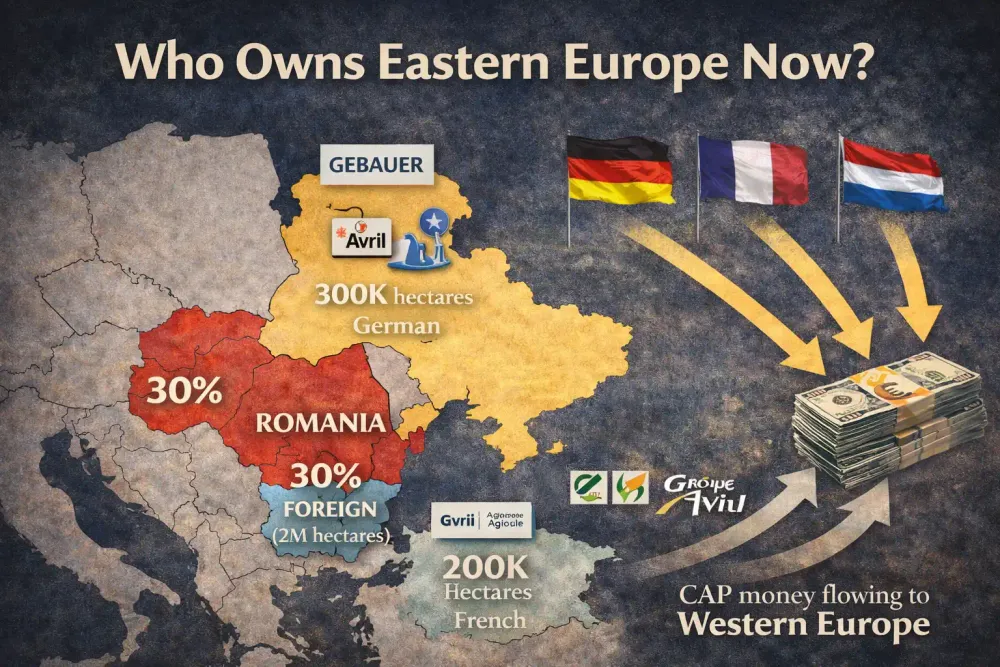
30% of Romanian farmland foreign-owned
German companies control 300,000+ hectares in Poland
French investors own 200,000+ hectares in Bulgaria
EU structural funds subsidized the purchases
CAP payments flow to foreign owners, not farmers
Citizens became tenants in their own countries
This isn't European integration. This is systematic conquest disguised as free market liberalization. When Romania, Poland, Bulgaria, Hungary, and other Eastern European countries joined the EU in 2004-2007, they were required to open their agricultural land markets, privatize state assets, and allow foreign investment without restrictions. What followed was the largest peacetime land transfer in European history, not through war or colonization, but through EU membership conditions requiring countries to sell their patrimony to the highest bidder.
Western European corporations, investment funds, and agricultural conglomerates bought hundreds of thousands of hectares at prices Eastern Europeans couldn't afford, often using EU subsidies to finance the purchases. Then they collected EU Common Agricultural Policy payments meant to support farmers. The result: Romanian farmers work land owned by German investment funds. Polish villages see profits from their fields flow to French corporations. Bulgarian agriculture serves Dutch holding companies. And EU taxpayers fund the entire extraction system through CAP subsidies paid to foreign landowners.
By A. Kade
What this investigation exposes:
→ 30% of Romanian farmland now foreign-owned (mostly German/Dutch investors)
→ German companies control 300,000+ hectares across Eastern Europe
→ French agricultural groups own 200,000+ hectares in Bulgaria alone
→ Privatization 2004-2015 sold state assets at 10-30% of actual value
→ EU structural funds subsidized Western corporations buying Eastern land
→ CAP payments flow to foreign owners while local farmers struggle
→ Land ownership restrictions lifted as EU accession condition
→ Citizens priced out of owning land in their own countries
Let me show you exactly how EU "integration" transferred Eastern European wealth to Western corporations while calling it development.
The truth doesn’t trend. It survives because a few still care enough to keep it alive.
Keep The Kade Frequency transmitting.
Romania: 30% Foreign Ownership, German Investment Funds Buying Entire Regions
Start with Romania because the scale is staggering and the data is most accessible.
Pre-EU (before 2007): Romania had restrictions on foreign agricultural land ownership. Land could be bought by Romanian citizens and companies. Foreign ownership was limited to protect farmers and prevent speculation.
EU Accession Requirement: As condition for joining EU in 2007, Romania had to phase out foreign ownership restrictions. Full market opening required by 2014. This wasn't negotiable, EU membership meant removing protections.
What happened after 2014:
According to Romanian land registry data, foreign investors now own approximately 30% of Romanian agricultural land, roughly 2 million hectares of the country's most fertile soil.
The buyers:
German investment funds are the largest foreign landowners. Companies like GEBAU (German agricultural real estate fund) bought massive holdings across Transylvania and southern Romania. These aren't family farms, they're 10,000+ hectare industrial operations.
Dutch pension funds own hundreds of thousands of hectares through investment vehicles. Romanian land provides returns to Dutch retirees while Romanian farmers can't afford to buy land in their own country.
Italian agricultural corporations expanded into Romania buying productive farmland at prices that seemed high to Romanians (€3,000-5,000 per hectare) but were tiny fractions of Italian land prices (€30,000-50,000 per hectare).
The mechanism:
Foreign investors didn't just outbid Romanians, they used EU structural funds to subsidize the purchases. EU provided agricultural development grants and rural investment funds. Western corporations applied for these funds to "develop" Romanian agriculture. The development money funded the land purchases.
Then came the Common Agricultural Policy payments. CAP provides subsidies based on hectares owned. Foreign investors owning Romanian land collect CAP payments, EU money meant to support farmers goes to German investment funds and Dutch pension funds.
WHAT THIS COSTS ROMANIANS:
Land prices: Increased 400% since EU accession, locals can't afford to buy
Ownership: 30% of country's farmland owned by foreigners
Profits: Agricultural income flows to foreign investors, not Romanian communities
CAP payments: €2 billion annually to landowners, significant portion to foreign owners
Future: Next generation of Romanians work as employees on land foreigners own
Sovereignty: Cannot change agricultural policy without affecting foreign investors
Romanian farmers who work land their families farmed for generations now rent from German funds. Villages see tractors harvesting fields, profits going to Amsterdam or Frankfurt. Young Romanians can't afford land prices driven up by foreign investment.
And this is presented as "European integration" bringing investment and development. What it actually brought is a modern form of land appropriation where Romanians became agricultural workers on land foreigners own.
"The best way to take control over a people and control them utterly is to take a little of their freedom at a time, to erode rights by a thousand tiny and almost imperceptible reductions." - Adolf Hitler (ironic given German investment funds' role)
Poland: German Agricultural Giants Control 300,000+ Hectares
Poland tried to resist the land grab but EU pressure forced compliance.
Pre-EU (before 2004): Poland maintained strict foreign ownership restrictions. Agricultural land could only be bought by Polish citizens who were farmers. This protected Polish agriculture from speculation.
EU Pressure: Poland negotiated 12-year transition period before fully opening land market (until 2016). But EU and foreign investors pressured for earlier liberalization. Germany especially pushed Poland to drop restrictions.
What happened:
Despite restrictions, German agricultural corporations found loopholes. They established Polish subsidiaries, used Polish nominees, created complex ownership structures. By 2016 when restrictions fully lifted, German companies already controlled significant holdings.
The scale:
German agricultural companies now control an estimated 300,000+ hectares in Poland, particularly in western regions near German border. Companies like KTG Agrar (before bankruptcy) and various German family-owned agricultural conglomerates bought prime Polish farmland.
French investors also moved in. Groups like AgroGeneration (backed by French investment) bought large holdings in eastern Poland.
The privatization component:
When Poland privatized state-owned agricultural enterprises (PGRs - former collective farms), foreign investors bought them at distressed prices. A 1,000-hectare state farm worth €5 million sold for €1-2 million to Western investors who had capital Polish farmers didn't.
The subsidy angle:
These foreign-owned operations collect CAP subsidies based on hectares. Polish taxpayers through EU contributions fund subsidies paid to German companies farming Polish land. The subsidy system rewards large landowners, exactly what foreign investors are.
Polish resistance:
Poland tried to maintain some protections. 2016 law requires agricultural land sales approval by state agency. But EU threatens infringement procedures claiming it violates free movement of capital. Poland's attempt to protect national interest labeled protectionism violating EU rules.
The local impact:
In villages near German border, entire farms sold to Germans. Polish farmers who couldn't compete with capital-rich foreign investors either sold or became employees. Agricultural profits that used to circulate in Polish communities now flow to Germany.
"We joined the EU thinking we'd become partners. Instead we became a market for German expansion and a source of cheap labor and land." - Polish farmer quoted in Investigate Europe report
The pattern is clear: EU membership didn't create partnership, it created dependency where Western capital buys Eastern assets and extracts value while calling it integration.
"The colonizers always claim to be civilizing the natives while extracting their wealth." - Frantz Fanon
Bulgaria: French Investors Own 200,000+ Hectares, Privatization at 10% of Value
Bulgaria shows the pattern most clearly because privatization records are partially public and investigative journalists documented it extensively.
The privatization robbery:
Bulgaria joined EU in 2007. Before joining, had to privatize agricultural state assets and open land market. The privatization process was systematically corrupt, with state assets sold at fractions of actual value to connected investors, many foreign.
Example: A 5,000-hectare state agricultural enterprise with modern equipment, irrigation infrastructure, and productive land valued at €15 million sold for €1.5 million to a French-Bulgarian joint venture. That's 10% of actual value.
This pattern repeated across hundreds of sales. OCCRP investigation documented systematic undervaluation benefiting foreign investors with connections to Bulgarian officials managing privatization.
The French conquest:
French agricultural investment groups are largest foreign landowners in Bulgaria. Companies backed by French investors now own an estimated 200,000+ hectares of Bulgarian farmland.
Groupe Avril (French agricultural conglomerate) operates massive holdings through Bulgarian subsidiaries. Cérélia(French food company) owns farmland producing grain for export. Various French investment funds hold Bulgarian agricultural land as investment asset generating returns through CAP subsidies and agricultural production.
The Dutch participation:
Dutch pension funds invested heavily in Bulgarian farmland post-EU accession. Farmland provides stable returns (CAP subsidies guarantee income) with capital appreciation as land prices rise.
Bulgarian farmers couldn't compete. Foreign investors paid prices that seemed high to Bulgarians (€2,000-3,000 per hectare in 2007-2010) but were tiny compared to French farmland prices (€6,000-10,000 per hectare). Bulgarian farmers with limited capital couldn't match foreign offers.
The CAP subsidy flow:
Bulgaria receives approximately €800 million annually in CAP payments. Significant portion goes to large landowners, which means foreign investors. EU taxpayers fund subsidies paid to French companies and Dutch pension funds owning Bulgarian land.
Meanwhile, small Bulgarian farmers struggle because CAP structure favors large operations. The subsidy system designed to help farmers actually helps foreign investors who bought Bulgarian land.
The sovereignty cost:
Bulgaria cannot implement agricultural policies favoring Bulgarian farmers without risking EU infringement. Cannot restrict foreign ownership without violating EU free movement of capital. Essentially surrendered agricultural sovereignty as cost of EU membership.
Hungary: Orbán Tried to Stop It, EU Forced Compliance
Hungary provides the example of resistance and EU's response.
Orbán's attempt:
Viktor Orbán's government recognized the land grab. In 2013, Hungary passed law restricting agricultural land sales to Hungarian citizens who are farmers. Explicit goal: prevent foreign investors buying Hungarian farmland.
The law worked. Foreign land acquisitions slowed dramatically. Hungarian farmers could afford land again without competing against German investment funds.
EU's response:
European Commission launched infringement proceedings against Hungary. Claimed the restriction violated EU law on free movement of capital. Threatened penalties and legal action.
The message was clear: Hungary's attempt to protect national agricultural land from foreign investors violates EU membership obligations. Free movement of capital means Hungarians cannot prevent Germans, French, or Dutch from buying Hungarian land.
The compromise:
Hungary modified the law allowing EU citizens to buy land but maintaining some protections (must be resident farmer for period before buying). This reduced foreign speculation but didn't stop foreign ownership entirely.
Current status:
Foreign investors still own significant Hungarian farmland, though less than Romania or Bulgaria. But the precedent is established: EU member states cannot meaningfully restrict foreign land ownership without violating EU law.
The broader message:
Orbán's attempt to protect Hungarian agricultural land gets portrayed as nationalism and authoritarianism. But the substance is: should Hungarians control Hungarian land, or should German investors be able to buy it freely? EU says the latter. National governments say the former. Guess who wins.
"Liberty means responsibility. That is why most men dread it." - George Bernard Shaw
The EU Subsidy System: Paying Foreign Investors to Own Eastern Land
The Common Agricultural Policy makes the conquest worse by subsidizing it.
How CAP works:
EU's Common Agricultural Policy provides approximately €55 billion annually in subsidies to farmers and landowners across EU. Originally designed to support farmers, ensure food security, and maintain rural communities.
The subsidies are primarily area-based payments, you receive money based on hectares you own/farm. More land = more subsidies.
The perverse incentive:
This structure rewards large landowners. Foreign investment funds and corporations owning thousands of hectares collect massive CAP payments. Small farmers receive minimal subsidies.
In Eastern Europe:
Foreign investors who bought Romanian, Polish, Bulgarian farmland now collect CAP subsidies on that land. They used EU structural funds to subsidize buying the land, then collect CAP payments annually for owning it.
Example: German investment fund owns 10,000 hectares in Romania. Collects approximately €2 million annually in CAP payments (€200/hectare average). That's €20 million over 10 years, more than they paid for the land, in subsidies from EU taxpayers.
Meanwhile, Romanian smallholder farmer with 10 hectares gets €2,000 annually in CAP payments. Can't expand because land prices (driven up by foreign investment) are unaffordable.
The beneficiary data:
EU publishes CAP payment data. Search reveals massive payments to foreign-owned operations in Eastern Europe:
- German companies operating in Poland: millions in annual CAP payments
- French agricultural groups in Bulgaria: millions in annual subsidies
- Dutch investment funds in Romania: collecting CAP payments
The subsidies meant to help farmers actually subsidize foreign investors' returns on land they bought cheaply in Eastern Europe.
WHAT THIS COSTS EU TAXPAYERS:
CAP budget: €55 billion annually from taxpayers
Foreign investor subsidies: Billions paid to corporations owning Eastern land
Small farmer support: Minimal because structure rewards large operations
Market distortion: Subsidies inflate land prices, preventing locals from buying
Extraction enabled: CAP payments guarantee returns to foreign investors
Sovereignty undermined: Cannot reform without affecting investor interests
The system is designed to transfer wealth: EU taxpayers pay CAP subsidies, which flow to foreign investors who bought Eastern European land cheaply, who extract returns while local farmers struggle.
And this is called agricultural support and rural development.
"It is difficult to free fools from the chains they revere." - Voltaire
The Privatization Theft: State Assets Sold at 10-30% of Value
Eastern European EU accession required privatization of state assets. The sales were systematically corrupt, benefiting foreign investors with connections.
The pattern across countries:
Romania: State agricultural enterprises sold 2004-2010 at average 15-20% of estimated value. Assets worth €100 million sold for €15-20 million to investors with political connections, many foreign.
Bulgaria: Documented cases of 90% undervaluation. €20 million state farm sold for €2 million. Modern equipment included at scrap value. Land valued at €500/hectare sold at €50/hectare.
Poland: PGR (state farm) privatization sold productive agricultural operations at distressed prices. Western investors bought entire enterprises for prices Polish farmers couldn't match even at undervalued rates.
The mechanism:
State assets valued by assessors who often undervalued deliberately. Sale through opaque processes favoring connected investors. Foreign corporations had capital and connections local farmers lacked.
Example case (Bulgaria):
State agricultural enterprise: 8,000 hectares prime farmland, irrigation system, grain storage, equipment.
Fair value estimate: €25 million (€3,000/hectare land + infrastructure)
Sale price: €3 million to French-Bulgarian joint venture
Buyer paid: 12% of actual value
Current value: €60+ million (land prices rose post-EU accession)
The buyer made €57 million by getting state assets at criminal undervaluation. And this was legal under privatization rules.
Who benefited:
- Western European corporations with capital
- Investment funds with local connections
- Political insiders who got preferential information
- Consultants and assessors who facilitated undervaluation
Who lost:
- Eastern European citizens whose state assets were stolen
- Local farmers who couldn't compete with foreign capital
- Countries whose patrimony was sold for pennies
The EU role:
EU pushed privatization as accession requirement. Provided technical assistance for privatization. Financed consultants who designed sale processes. EU institutions knew undervaluation was happening but prioritized speed of privatization over fair pricing.
The priority was integrating Eastern Europe into EU market quickly. Fair value for state assets was secondary concern.
The Corporate Ownership Trail: Following the Money from Berlin, Paris, Amsterdam to Bucharest, Warsaw, Sofia
Trace the ownership and the pattern becomes clear.
German agricultural conglomerates:
GEBAU (German agricultural real estate fund): Owns farmland across Romania, Bulgaria, Poland. Structure: German parent company → subsidiaries in Eastern Europe → land ownership.
KTG Agrar (before bankruptcy): At peak owned 40,000+ hectares across Romania, Poland. Used EU subsidies to expand, collected CAP payments, financed through German banks.
Various German family agricultural companies: Expanded from German operations into Eastern Europe. Buy through local subsidiaries to comply with formal restrictions.
French investment groups:
Groupe Avril: French agricultural conglomerate with operations across Bulgaria, Romania. Owns farmland through subsidiaries, collects CAP payments, exports production to France.
AgroGeneration: French-backed agricultural investment company. Operates in Poland, Ukraine. Structure designed to maximize CAP subsidies and returns.
Dutch pension funds:
Multiple Dutch pension funds invest in Eastern European farmland through agricultural investment funds. Structure: Dutch pension fund → agricultural investment vehicle → Eastern European land ownership.
The farmland provides stable returns (CAP subsidies + appreciation + agricultural income) for Dutch retirees. Romanian farmers work land providing returns to Netherlands.
The ownership complexity:
Corporate structures deliberately complex to obscure ultimate ownership. Example chain:
Amsterdam holding company → Luxemburg subsidiary → Romanian operating company → Land ownership
This structure minimizes taxes, obscures ownership, and complicates accountability.
The investigation challenge:
Tracing ultimate beneficial ownership requires navigating multiple corporate registries across jurisdictions. Eastern European land ownership databases show local company names, not foreign parents.
But investigative journalism by OCCRP, Investigate Europe, and local outlets has documented the connections. The ownership trail leads back to Berlin, Paris, Amsterdam.
"Follow the money, and you will find the truth." - Deep Throat (Watergate)
What Eastern Europeans Actually Got From EU "Integration"
Make the cost concrete by understanding what Eastern European countries received in exchange for losing control of their agricultural land.
What they were promised:
- Economic development
- Rising living standards
- Investment and growth
- Partnership with Western Europe
- Agricultural modernization
What they actually got:
Lost land ownership: 20-30% of agricultural land in foreign hands in Romania, Bulgaria. Significant foreign ownership in Poland, Hungary. Land prices driven beyond local affordability.
Lost agricultural sovereignty: Cannot implement policies favoring domestic farmers without violating EU free movement of capital. Foreign investors' interests protected by EU law.
CAP subsidies to foreign owners: Billions in EU agricultural support paid to German funds, French corporations, Dutch investors owning Eastern land rather than local farmers.
Demographic collapse: Young people emigrate to Western Europe for opportunities. Villages depopulated. Agriculture consolidates into large foreign-owned operations employing fewer people.
Dependency, not development: Eastern economies became suppliers of cheap labor, agricultural products, and manufacturing inputs to Western Europe rather than developing independent industrial capacity.
Corporate control: Major sectors dominated by Western European companies. Retail (German chains), banking (Austrian, Italian banks), energy (German, French companies), agriculture (foreign landowners).
Political constraints: Cannot pursue economic nationalist policies without EU pressure. Orbán's land ownership restrictions triggered infringement proceedings. Attempts to favor domestic companies labeled protectionism.
WHAT THEY LOST:
Land ownership: 30% of Romania, 25% of Bulgaria, significant portions of Poland/Hungary
Agricultural income: Flows to foreign investors, not local communities
Economic sovereignty: Cannot favor domestic farmers/companies without EU infringement
Future opportunity: Next generation works for foreign owners rather than owning land
Total wealth transfer: Hundreds of billions in undervalued privatization + ongoing CAP extraction
The promised development and partnership turned into dependency and extraction. Eastern European countries traded sovereignty for EU membership. The bargain was not equal.
"The problem is not that we have too much capitalism. The problem is that we have too little." - Margaret Thatcher (ironic, given how free markets enabled land grab)
Frequently Asked Questions
Q: Isn't foreign investment good for Eastern European agriculture?
A: Investment can be beneficial. But when 30% of a country's farmland is foreign-owned and profits flow abroad, that's not investment benefiting the country, that's wealth extraction. Romanian agricultural income going to German funds doesn't develop Romania. It enriches Germany while Romanians become agricultural workers on land foreigners own.
Q: Don't EU subsidies and investment compensate for land sales?
A: EU structural funds total roughly €100 billion over 7-year budget period for all Eastern Europe. The value of land transferred to foreign ownership at undervalued privatization prices plus ongoing CAP payments to foreign owners far exceeds this. And EU funds often subsidized foreign corporations buying the land.
Q: Didn't Eastern European countries agree to this?
A: They agreed to EU membership, which required removing foreign ownership restrictions and privatizing state assets. The alternative was remaining outside EU, facing economic isolation. That's not free agreement, it's coercion through structural power imbalance. And governments agreed, not citizens who weren't consulted.
Q: Can't Eastern Europeans just buy the land back?
A: Not at current prices. Foreign investment drove land prices up 400-500% since EU accession. Romanian farmer cannot compete with German investment fund. Even with credit, the economics don't work when land costs €5,000/hectare and agricultural returns are €200-300/hectare annually.
Q: Isn't this just free market capitalism working?
A: Free markets require equal bargaining power. German investor with access to cheap credit and EU subsidies competing against Romanian farmer with limited capital isn't free market, it's structural advantage enabling acquisition. Plus EU required market opening as membership condition, so it wasn't free market, it was imposed liberalization.
Q: What about Hungary and Poland trying to restrict foreign ownership?
A: They tried. EU launched infringement proceedings. Threatened penalties. Forced compliance. The precedent is clear: EU member states cannot meaningfully restrict foreign land ownership without violating free movement of capital. National control over land ownership incompatible with EU membership.
Q: Don't CAP subsidies help all farmers, including Eastern European?
A: CAP structure favors large landowners through area-based payments. Foreign investors with thousands of hectares collect millions. Small Eastern European farmers with 10-50 hectares get minimal subsidies. The system benefits exactly those who bought Eastern land at undervalued prices.
Q: Is this really different from any EU member state?
A: Yes. Western European countries had gradual agricultural development with land ownership protected through generations. Eastern Europe had forced rapid privatization as EU condition, with systematic undervaluation enabling foreign acquisition. The timeline and coercion make it qualitatively different.
Q: Can Eastern European countries exit EU to reclaim land?
A: Theoretically yes (Brexit precedent). Practically, economic integration makes it devastating. And foreign ownership is legal under international investment law, exit wouldn't automatically restore ownership. Would require nationalization compensating foreign owners at current (inflated) values.
Q: Aren't there benefits like modernization and efficiency?
A: Large-scale operations can be more efficient. But efficiency benefits go to foreign owners as profits, not to Eastern European communities. And consolidation destroys rural employment and community structure. Modernization that benefits foreigners while impoverishing locals isn't development.
Q: What's the alternative to EU integration?
A: Gradual integration maintaining national control over strategic assets. Conditional market opening requiring reciprocity. Protection for agricultural land ownership. These weren't considered because EU demanded rapid full liberalization as membership price.
Q: Who's to blame - EU or national governments?
A: Both. EU imposed conditions requiring privatization and market opening. National governments implemented corruptly, allowing undervaluation and foreign acquisition. EU benefited politically and economically. National elites benefited through privatization corruption. Citizens of Eastern Europe paid the price.
What Needs to Change (That Won't Without Massive Pressure)
The land grab won't reverse through normal politics because foreign investors' interests are protected by EU law and international investment treaties.
Reform CAP to favor family farmers: End area-based payments rewarding large landowners. Structure subsidies to benefit small and medium farms, not investment funds owning thousands of hectares. This would reduce foreign investors' returns on Eastern European land.
Allow land ownership restrictions: Let member states protect agricultural land from speculative foreign ownership. Poland, Hungary, Romania should be able to favor domestic farmers without EU infringement proceedings. National control over land more important than absolute free movement of capital.
Investigate privatization corruption: Prosecute systematic undervaluation that sold state assets at 10-30% of value. Recover stolen wealth where possible. Make it clear that future privatizations face real accountability.
Cap foreign agricultural land ownership: Limit percentage of agricultural land foreigners can own (20%? 10%?). This would require EU treaty change but addresses fundamental sovereignty issue.
Reform structural funds: Stop EU money subsidizing foreign corporations buying Eastern European assets. Target funds to domestic development, not facilitating Western acquisition.
Transparency in ownership: Require public disclosure of ultimate beneficial ownership of agricultural land. End complex corporate structures obscuring that Amsterdam fund owns Romanian farmland.
Preferential buy-back rights: Give Eastern European farmers right of first refusal when foreign owners sell land. At minimum, allow locals to buy back what was taken.
Nationalization option: For land bought through corrupt privatization at undervalued prices, allow nationalization compensating at original purchase price (not current inflated value). This creates accountability for privatization theft.
Exit provisions: Allow member states to exit EU agricultural market while maintaining other benefits. Recognize that full agricultural integration may not serve all members' interests.
None of this happens through normal EU politics because:
Foreign investors have legal protection: EU law and international investment treaties protect their ownership. Challenging this requires treaty changes all member states must approve.
Western European governments protect their investors: Germany won't support reforms harming German agricultural companies. France won't back changes affecting French land ownership. These are powerful EU members.
CAP reform threatens entire system: Changing subsidy structure to disfavor large landowners would affect Western European industrial agriculture too. Powerful agricultural lobbies resist.
Nationalism gets labeled authoritarian: Hungary and Poland's attempts to protect land ownership get framed as dangerous nationalism. EU institutions oppose any policy limiting foreign capital's freedom.
Sunk costs are massive: Foreign investors paid billions for Eastern European land (even at undervalued prices). Unwinding this requires either compensation (impossibly expensive) or expropriation (politically impossible in EU).
Change requires Eastern European countries collectively demanding fundamental reform. One country gets crushed (Hungary's experience with land law). Multiple countries together could force negotiation.
But coordination is difficult when EU can pressure individually, when national elites benefited from privatization corruption, and when economic integration creates dependency limiting action.
The most likely outcome is continuation: Eastern European agricultural land increasingly foreign-owned, CAP subsidies flowing to Western investors, local farmers unable to compete, rural depopulation continuing, and sovereignty over land permanently lost.
Unless citizens recognize this as conquest and demand governments act. Which requires seeing through "European integration" rhetoric to understand the wealth extraction underneath.
"Those who cannot remember the past are condemned to repeat it." - George Santayana
The Corporate Beneficiaries: Who Profits From Eastern European Land
Put names and numbers to who extracted wealth from Eastern European EU integration.
GEBAU (German Agricultural Real Estate Fund):
One of largest foreign agricultural landowners in Romania. Manages approximately 15,000 hectares across multiple Romanian regions. Structure: German fund owned by German investors → Romanian subsidiaries → land ownership.
Annual CAP subsidies: Estimated €3 million based on hectares owned.
Returns to investors: CAP subsidies + agricultural production + land appreciation = 8-12% annual returns flowing to Germany.
Groupe Avril (French Agricultural Conglomerate):
Operates across Bulgaria and Romania through local subsidiaries. Owns approximately 20,000 hectares of farmland. Produces oilseeds, grains for export to France and broader EU markets.
Annual CAP subsidies: Estimated €4 million.
Business model: Buy Eastern European land at low prices, farm at industrial scale using local labor, collect CAP subsidies, export production, generate profits for French parent company.
KTG Agrar (German - now bankrupt but illustrates model):
At peak owned 40,000+ hectares across Romania, Poland, Lithuania. Financed through German banks, collected massive CAP subsidies, expanded aggressively.
Bankruptcy (2016): Overleveraged expansion. But bankruptcy didn't help Eastern European farmers, land sold to other foreign investors, not returned to local ownership.
Lesson: Even failed foreign investment doesn't reverse conquest. Once land is foreign-owned, it stays foreign-owned through successive investors.
Sponda (Romanian subsidiary of foreign investors):
Operates 30,000+ hectares in Romania. Ultimate ownership: complex structure involving offshore companies, international investors. Public filings obscure beneficial ownership.
CAP subsidies: Among top recipients in Romania at €6+ million annually.
Local impact: Employs hundreds in large-scale operations but profits flow to foreign owners. Romanian agricultural workers on Romanian land enriching foreign investors.
Trigon Agri (Danish-backed agricultural company):
Operates across Eastern Europe including Romania, Ukraine. Owns/leases 50,000+ hectares. Listed on Nordic stock exchange. Returns flow to Scandinavian investors.
Business model explicitly extractive: Buy/lease land cheaply, farm at scale, collect subsidies, minimize local costs, maximize returns to foreign shareholders.
Dutch Pension Funds (various):
Multiple Dutch pension funds invested in Eastern European farmland through agricultural investment vehicles. Exact holdings difficult to determine due to complex structures.
Estimated total: 100,000+ hectares across Romania, Bulgaria, Poland owned by Dutch pension fund-backed investments.
Returns: Provide stable income to Dutch retirees through CAP subsidies and agricultural production from Romanian, Bulgarian, Polish land.
The pattern across all beneficiaries:
- Foreign capital buying land locals can't afford
- Complex corporate structures obscuring ownership
- CAP subsidies guaranteeing returns
- Profits extracted to Western Europe
- Local employment minimal relative to land controlled
- No accountability to Eastern European communities
These aren't family farmers. They're investment vehicles, agricultural corporations, and pension funds treating Eastern European land as financial asset generating returns for Western investors.
The Demographic Devastation: Empty Villages, Emigrated Youth, Foreign Landlords
The land grab contributed to demographic collapse across Eastern Europe.
The emigration wave:
Since EU accession, Eastern European countries experienced massive emigration to Western Europe:
Romania: 3-4 million emigrated (15-20% of population). Primarily young, educated, working-age. Largest diaspora in Western Europe. They left because opportunity at home disappeared.
Bulgaria: 1 million+ emigrated (15% of population). Villages across Bulgaria depopulated. Rural areas particularly devastated.
Poland: 2 million+ emigrated to UK alone, millions more across EU. Young Poles sought opportunity Western Europe seemed to offer.
The agricultural connection:
Foreign ownership of agricultural land contributed to emigration by eliminating opportunity in rural areas:
Before: Young person could aspire to own land, build farm, raise family in village. Land ownership meant independence and future.
After: Land unaffordable because foreign investors drove prices up. Only option is working as employee for foreign-owned operation or emigrating. Rural future disappeared.
Village depopulation:
Across Romania, Bulgaria, Poland, thousands of villages now have populations 30-50% lower than pre-EU accession. Schools closed. Churches empty. Young families gone.
The agricultural workforce:
Foreign-owned large-scale operations employ fewer people per hectare than family farms. Mechanization and scale economies mean 10,000 hectares farmed by 20-30 employees instead of 200+ family farmers.
The consolidation destroyed rural employment. Young people saw no future and left.
The extraction multiplies:
Young, educated Eastern Europeans emigrate to Western Europe. Work in German factories, British healthcare, French services. Send remittances home. But their economic productivity benefits Western economies, not home countries.
Simultaneously, their home countries' agricultural land owned by Western investors extracting returns.
Double extraction: labor emigrated West, land owned by West. Eastern European countries lose both human capital and agricultural wealth.
The cultural cost:
Rural traditions, languages, and cultures dying as villages depopulate. Foreign owners don't maintain cultural practices. Large-scale operations replace traditional farming with industrial agriculture.
Knowledge of local conditions, traditional crops, sustainable practices, lost as family farmers disappear and corporate operations implement standardized industrial methods.
WHAT THIS COSTS EASTERN EUROPE:
Population decline: Romania -15%, Bulgaria -15%, Poland -5% since EU accession
Young emigration: Lost doctors, engineers, teachers, entrepreneurs to Western Europe
Rural devastation: Thousands of villages depopulated, schools closed, communities dead
Agricultural employment: Consolidated operations employ 1/10th workers family farms did
Cultural loss: Traditional farming knowledge, rural culture disappearing
Future: Who will live in these countries in 30 years?
The demographic collapse makes reversal nearly impossible. Even if land ownership could somehow be reclaimed, who would farm it? The young farmers emigrated. The knowledge disappeared. The rural society that sustained agriculture is gone.
This is conquest completing itself: not just taking the land, but eliminating the people who would resist and the culture that would remember.
"A nation that destroys its soils destroys itself." - Franklin D. Roosevelt (applies to destroying rural communities too)
Comparing to Historical Colonization: Same Pattern, Different Justification
The Eastern European land grab follows classic colonial patterns, just with EU membership instead of military occupation.
Traditional colonization:
- Military conquest or forced treaties
- Extract resources (minerals, agricultural products, labor)
- Transfer wealth to colonizing power
- Leave colony dependent and impoverished
- Justify as "civilizing mission" or development
EU "integration" colonization:
- Economic pressure forcing EU membership on unfavorable terms
- Extract resources (land, agricultural production, cheap labor through emigration)
- Transfer wealth to Western European investors
- Leave Eastern Europe dependent and depopulated
- Justify as "European integration" and development
The parallels are remarkable:
Resource extraction: British took Indian cotton and tea. Western European investors take Romanian and Bulgarian grain and oilseeds from land they now own.
Wealth transfer: Spanish extracted South American silver. German and French investors extract agricultural profits and CAP subsidies from Eastern European land.
Dependency creation: Colonial powers made colonies dependent on manufactured imports. EU made Eastern Europe dependent on Western capital, expertise, markets.
Justification rhetoric: Colonizers claimed to bring civilization, Christianity, progress. EU claims to bring development, democracy, prosperity. Both disguise extraction as helping.
Local elite collaboration: Colonial rule required local collaborators. Eastern European privatization required corrupt national officials who benefited from selling state assets cheaply.
Legal frameworks enabling extraction: Colonial charters made extraction legal. EU treaties and free movement of capital make land grab legal.
The key difference:
Traditional colonization was imposed through military force and explicitly extractive. EU colonization is nominally voluntary (countries chose to join) and disguised as mutually beneficial integration.
But examine the outcomes: Eastern European land foreign-owned, profits flowing West, demographic collapse, dependency not development. The results match colonization even if methods differ.
The colonial mindset persists:
Western European political and economic elites genuinely believe Eastern Europe benefits from their investment and guidance. They don't see land acquisition as conquest, they see it as bringing capital and expertise to backward regions.
This is exactly how British colonialists viewed India, how French colonialists viewed Algeria, how Spanish conquistadors viewed Latin America. The civilizing mission justifies extraction.
The resistance gets delegitimized:
When Eastern European countries try to protect their interests (Hungary's land law, Poland's judicial reforms), Western European establishment calls it authoritarianism and nationalism.
When colonized peoples resisted colonial rule, colonizers called them savages and rebels. The pattern of delegitimizing resistance to serve extraction interests continues.
"The white man's burden" has become "European integration's benefits" , same paternalism, same extraction, different era.
"The oppressed are allowed once every few years to decide which particular representatives of the oppressing class are to represent and repress them." - Karl Marx
Individual Resistance Stories: Farmers Who Fought Back
Some farmers and communities resisted foreign land acquisition. Most lost, but their stories illustrate what's at stake.
Romanian farmer cooperative (Transylvania region):
Group of 50 farmers pooled resources to buy back land German fund was selling. Managed to outbid another foreign investor by getting bank loan.
Result: Kept 500 hectares in Romanian ownership. But required every farmer taking maximum debt. One bad harvest could bankrupt them all. The risk foreign investors don't face.
Shows resistance is possible but requires extraordinary effort locals can barely sustain while foreign capital easily acquires land.
Polish village blocking German expansion:
Village in western Poland fought German agricultural company trying to buy surrounding farmland. Organized protests, lobbied local government, created media attention.
Outcome: Slowed acquisition but ultimately company bought 70% of target land through proxies and legal maneuvering. Village preserved some land but lost most.
Lesson: Even organized local resistance struggles against patient foreign capital with legal resources.
Bulgarian farmers' lawsuit:
Group of Bulgarian farmers sued government over privatization of state agricultural land they were farming. Claimed they had priority rights under law but assets sold to foreign investors instead.
Court case lasted 7 years. Farmers won in principle but by then land was foreign-owned with EU legal protection. Winning in court didn't restore land ownership.
Demonstrates that even legal victories can't undo conquest once completed.
Hungarian family farms coalition:
Before Orbán's land law, Hungarian family farmers organized to lobby for ownership restrictions. Built coalition across political spectrum. Succeeded in getting law passed.
Then EU threatened infringement proceedings. Law had to be modified. Coalition's victory was partial and temporary.
Shows that even successful political organizing within democratic systems gets overruled by EU protecting foreign investor rights.
The pattern across resistance:
- Locals organize and fight back
- Sometimes achieve temporary victories
- But foreign capital is patient, has legal resources, and EU law protects it
- Resistance exhausts locals while foreign investors wait
- Eventually most land ends up foreign-owned despite resistance
The few successful resistance stories required extraordinary effort, luck, and timing. The general pattern is resistance failing against structural power imbalances.
"Powerlessness corrupts. Absolute powerlessness corrupts absolutely." - Rosabeth Moss Kanter
The Honest Reckoning Nobody in Brussels Will Provide
Here's what honest assessment of Eastern European EU integration would acknowledge:
Admit land grab happened: 30% of Romania, 25% of Bulgaria, significant portions of Poland and Hungary now foreign-owned. This wasn't organic market development, it was systematic acquisition enabled by EU membership conditions.
Acknowledge privatization corruption: State assets sold at 10-30% of value. Foreign investors with political connections benefited. Eastern European citizens' patrimony was stolen.
Recognize CAP perversity: EU agricultural subsidies flow to foreign investors who bought Eastern land cheaply, not to struggling local farmers. The system subsidizes extraction, not development.
Accept integration was unequal: Eastern European countries opened markets, allowed asset acquisition, permitted emigration. Western Europe protected key sectors, acquired assets, recruited labor. The bargain wasn't reciprocal.
Admit demographic catastrophe: 15-20% population decline in Romania and Bulgaria isn't just unfortunate outcome, it's directly connected to economic model imposed through EU integration.
Allow land ownership protection: Let member states restrict foreign agricultural land ownership without EU infringement. National food security and land sovereignty more important than absolute free movement of capital.
Reform CAP immediately: End area-based payments rewarding large foreign-owned operations. Structure subsidies to benefit family farms, not investment funds.
Investigate and prosecute privatization corruption: Make it clear that systematic undervaluation and theft of state assets will face accountability even if years later.
Provide buy-back mechanisms: Create EU-funded program allowing Eastern European farmers to buy back land from foreign owners at prices they can afford. Call it "agricultural sovereignty recovery."
Stop calling resistance authoritarian: When Hungary or Poland tries to protect national interests, engage substantively with their concerns instead of dismissing as nationalism.
None of this will happen because:
Acknowledging would require admitting EU integration served Western European interests at Eastern European expense. Can't maintain "win-win" narrative while admitting conquest occurred.
Foreign investors have legal and political protection. Unwinding land ownership requires either compensation (too expensive) or expropriation (too controversial).
CAP reform threatens Western agricultural interests. Changing subsidy structure affects wealthy French and German farmers, not just foreign investors in East.
Demographic collapse is irreversible. Can't bring back 4 million emigrated Romanians. Population policies take generations to show results.
Path dependency makes reversal nearly impossible. Economic integration creates dependencies making independence devastating (Brexit example of cost).
The most likely future: continuation of current patterns until Eastern European agricultural land is majority foreign-owned, rural areas depopulated, countries become agricultural production zones for Western European consumption.
Unless Eastern European countries collectively recognize this as existential threat and demand fundamental renegotiation of EU terms. Which requires political will current governments lack and populations disempowered by emigration can't mobilize.
A. Kade
No ads. No sponsors. Just signals from the noise.
Keep The Kade Frequency transmitting.
SHARE THIS: They called it integration. It was conquest. Eastern Europeans lost their land while Western investors collected EU subsidies. Share so more people understand what EU membership actually cost.
"The people never give up their liberties but under some delusion." - Edmund Burke