THE DIGITAL LEASH - How the ECB's "Convenient" Digital Euro Becomes Your Permanent Surveillance Collar
They call it innovation. It's a surveillance collar. The digital euro is programmable money, controllable money. Every transaction tracked. Every purchase approved. Christine Lagarde promises privacy. China's digital yuan promised the same. Now it tracks citizens and enforces social credit.

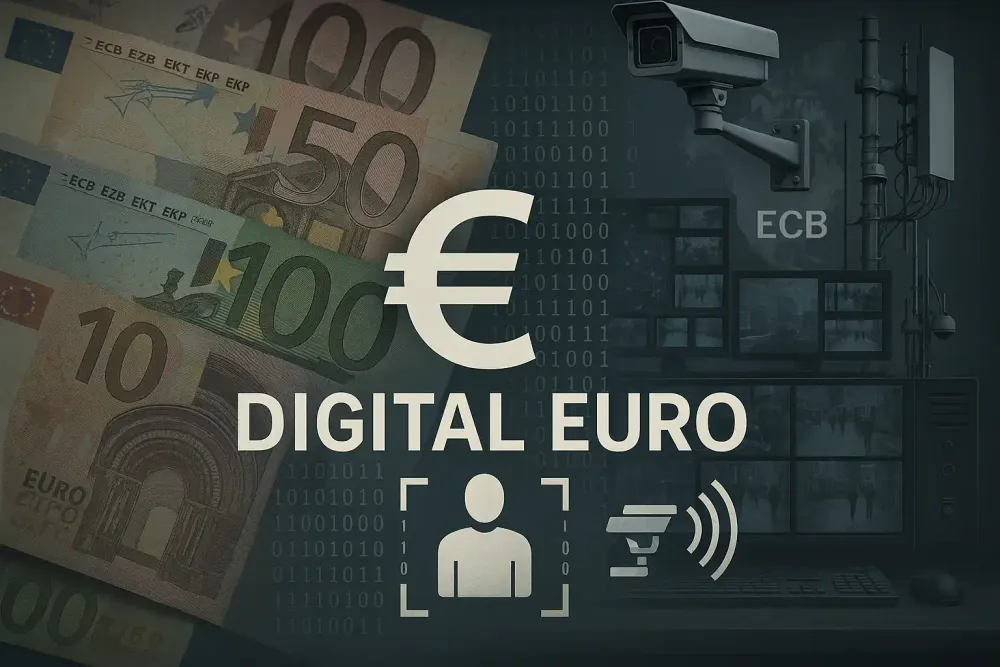
They call it innovation. They call it convenience. They call it the future of payments. It's none of those things. The digital euro is programmable money, which means controllable money. Every transaction tracked. Every purchase approved. Every cent you earn monitored by bureaucrats who already proved they can't be trusted. Christine Lagarde promises privacy. China's digital yuan promised the same thing. Now it tracks citizens, enforces social credit, and gives the state total financial control. The ECB is building the same system. And they're rushing to finish before you realize what you're losing.
October 2025: The European Central Bank signed €1.1 billion in contracts with ten tech companies to build the digital euro infrastructure. Launch target: 2029, maybe sooner if they can accelerate.
They're selling it as progress. "Digital form of cash," they say. "Complements banknotes and coins," they promise. "Protects your privacy just like physical cash," they lie.
Here's what they won't tell you: The US House of Representatives just passed the Anti-CBDC Surveillance State Act specifically to prevent a digital dollar because lawmakers recognized it as "surveillance disguised as currency."
Europe? Racing toward the exact same system. Faster. With less public debate. With more urgency to implement before citizens understand what's being taken.
Because once the digital euro launches, cash becomes obsolete. And once cash is gone, your financial freedom dies with it.
The truth doesn’t trend. It survives because a few still care enough to keep it alive.
Keep The Kade Frequency transmitting.
What They're Actually Building
Let's be clear about what a Central Bank Digital Currency is, and what it isn't.
It's not cryptocurrency. Bitcoin, Ethereum, those are decentralized. No single authority controls them. The digital euro is the opposite: centralized control by the ECB. Every unit issued directly to accounts the central bank manages. Every transaction visible to the state.
It's not like your current bank account. When you use a debit card, your bank processes the transaction. Banks compete. You can switch banks. The digital euro bypasses commercial banks entirely, your money sits in an ECB-controlled wallet. One system. One controller. No alternatives.
Christine Lagarde promises privacy. China's digital yuan promised the same thing. Now it tracks citizens, enforces social credit, and gives the state total financial control. The same pattern we exposed with COVID's "temporary" measures, promises made, freedoms lost.
It's not cash. Cash is anonymous. Untraceable. Private. The digital euro is the opposite of all three. Christine Lagarde admitted in 2022 it's "a digital banknote with a little less anonymity." Translation: no fucking anonymity.
What they're building is programmable money. Money that can be controlled, restricted, expired, or frozen based on rules written by unelected bureaucrats.
And they're building it by copying China.
The China Model: Digital Currency as Control System
Let's talk about what the digital euro is modeled on: China's digital yuan (e-CNY).
The World Economic Forum, yes, that WEF, published a report in October 2024 praising China's digital yuan as a "model CBDC" that "reduces reliance on physical cash" and "democratizes access to banking services."
Democratizes. In an authoritarian state with social credit scores, mass surveillance, and re-education camps.
Here's what the WEF report conveniently didn't mention:
China's digital yuan integrates with its social credit system. Citizens who break "trust" in one area face restrictions everywhere. Bad social credit score? No travel. No restaurants. No loans. No insurance. The digital yuan makes enforcement automatic.
The People's Bank of China now possesses a "significant data trove" combining transaction data with surveillance metadata, where you go, what you buy, who you pay, when you spend. The Center for a New American Security warned the digital yuan "opens up new forms of government surveillance and social control."
Chinese citizens can be blacklisted from using the digital yuan for political speech, for spending "too much time" playing video games, for criticizing the government. The currency itself becomes the enforcement mechanism.
And the ECB is rushing to implement the same technical infrastructure. €1.1 billion to tech companies including those building AI fraud detection (translation: AI monitoring of your spending), mobile wallet apps (your phone becomes the surveillance device), and systems to "safely share payment information" (with whom, exactly?).
The ECB's Lies About Privacy
Christine Lagarde and ECB officials keep repeating the same talking points: "The digital euro will protect privacy just like cash."
Bullshit. Complete, provable bullshit.
Lie #1: "We won't know who you are or what you're buying."
The ECB claims they won't be able to identify individuals from payment data. But the system requires digital wallets linked to identity verification. Know Your Customer (KYC) and Anti-Money Laundering (AML) regulations requireidentification.
Every wallet is linked to a person. Every transaction has a timestamp, location, merchant. The metadata alone is surveillance. And "we won't look at it" isn't a technical guarantee, it's a promise from the same institutions that deleted Pfizer texts illegally and face zero consequences.
Lie #2: "It's just like cash, but digital."
Cash is:
- Anonymous - no record of who spent it
- Untraceable - can't track where it went after
- Offline - works without network, approval, or intermediary
- Permanent - can't be remotely deactivated or expired
The digital euro is:
- Identified - linked to your digital ID
- Traceable - every transaction recorded permanently
- Online - requires network connection and central approval
- Programmable - can be restricted, frozen, or expired remotely
These are not equivalent. They're opposites.
Lie #3: "This is about protecting European monetary sovereignty."
The ECB claims the digital euro is necessary to prevent foreign digital currencies (read: China's yuan, US dollar stablecoins) from undermining European monetary sovereignty.
Translation: "We need total control over your money to compete with other countries' total control over their citizens' money."
This isn't about protecting your freedom. It's about ensuring the ECB maintains its monopoly over your financial life.
Official ECB information - "ECB digital euro project"
The Technical Infrastructure of Control
Let's look at what the ECB is actually building with that €1.1 billion.
Giesecke+Devrient: Offline payment solutions. Sounds good until you realize "offline" in a digital currency context still requires the device (your phone) to store transaction data that syncs when back online. No transaction is truly offline if it's recorded.
Feedzai: AI-powered fraud detection. "Fraud" detection becomes "behavior" detection. AI monitoring every transaction for "suspicious patterns." Who defines suspicious? The ECB. Who gets flagged? Anyone whose spending the algorithm doesn't like.
Almaviva and Fabrick: Mobile wallet apps. Your phone becomes the mandatory interface. Lose your phone, lose access to money. Government shuts down your digital wallet remotely? Lose access to money. No phone, no alternative, no money.
Senacor FCS: Secure payment information sharing. "Sharing" with whom? Banks? Regulators? Tax authorities? Law enforcement? All of them, obviously. But the ECB calls it "secure sharing" to make you feel better about total financial transparency.
This infrastructure enables several control mechanisms that don't exist with cash or current digital payments:
Programmable expiration: Money that expires if not spent by a certain date. "Stimulus" that must be used within weeks or it disappears. Forcing spending, eliminating saving.
Geographic restrictions: Money that only works in certain areas. Can't spend your euros outside the eurozone. Can't send money to blacklisted countries or entities.
Purchase restrictions: Money that can't be used for certain transactions. Alcohol? Tobacco? Firearms? Carbon-intensive products? Political donations? All can be blocked at the transaction level.
Negative interest rates: Money that loses value automatically. The ECB's wet dream, forcing spending by making saving expensive. Your digital euros lose 5% per year just sitting in your wallet.
Social credit integration: Link spending to behavior scores. Low ESG compliance? Higher transaction fees. Wrong political donations? Purchase restrictions. Social media violations? Wallet frozen pending review.
Instant confiscation: Governments can freeze, seize, or delete your money without touching a physical bank. No need to go through courts or banks. Just change the database. Your money disappears.
Christine Lagarde won't talk about these capabilities. But they're built into the technical architecture. Whether they're activated initially is irrelevant, the infrastructure will exist. And what can be done, will be done.
The ECB's Rush to Implement
Here's what's revealing: The ECB is rushing implementation despite massive concerns from banks, privacy advocates, and citizens.
October 2025: Governing Council decides to move to the next phase of the digital euro project.
July 2025: One day before the US House passed its Anti-CBDC Act, the ECB reaffirmed "commitment to moving steadily toward implementation." The same day America said "this is surveillance and we're banning it," Europe said "we're accelerating it."
Target launch: 2029, with pilot programs potentially starting 2026. That's 4-5 years, extremely fast for a fundamental change to the entire monetary system.
Why the rush?
Reason 1: The ECB is desperate. The European Central Bank posted €7.8 billion in losses for the second consecutive year. Sovereign bonds are slumping. Confidence in ECB policy is declining. Inflation expectations rising.
The digital euro lets them wash away disastrous policy. Print digital money directly. Monitor every transaction. Control every euro. It's not about innovation, it's about control in crisis.
Reason 2: China is accelerating. The digital yuan's existence pressures Europe. But instead of learning from China's surveillance dystopia, the ECB is copying it. Because in the race between central banks to control citizens, being second means losing power.
Reason 3: Cash is disappearing. More Europeans use digital payments every year. The ECB knows physical cash will eventually decline to minimal use. If they don't have a digital euro ready, private alternatives (cryptocurrencies, stablecoins, foreign CBDCs) might fill the gap. And the ECB can't surveil those.
So they're racing to implement before:
- Citizens understand what they're losing
- Political resistance can organize
- Alternative systems become entrenched
- The US example spreads to Europe
What You're Losing: The Death of Financial Privacy
Let's be specific about what disappears when cash dies and digital euros replace it.
Financial anonymity: Every purchase linked to your identity. Groceries, medicine, books, donations, entertainment, all monitored. The government knows what you buy, when, where, and from whom. Forever.
Transaction privacy: Your spending patterns analyzed. Algorithms predict behavior. "Unusual" transactions flagged. Perfectly legal purchases investigated. Privacy inverted, instead of government needing warrants to surveil, you must justify every purchase.
Financial independence: Can't make transactions the state disapproves of. Can't send money to blacklisted entities. Can't save without negative interest. Can't spend on restricted purchases. Every euro conditional on government approval.
Generational wealth transfer: Can't give cash gifts outside the system. Can't inherit money without records. Can't help family without transparency. Everything taxed, everything monitored, everything controlled.
Political dissent: Can't donate to controversial causes. Can't fund opposition parties outside approved channels. Can't support grassroots movements. Financial participation in democracy becomes transparently visible to those you're opposing.
Exit options: Can't hold money outside the banking system. Can't protect wealth from bad policy. Can't preserve purchasing power when the ECB debases currency. No escape from monetary mismanagement.
And all of this justified by "convenience," "safety," "innovation."
And notice: The same unelected bureaucrats who spent €365 billion creating corruption in Eastern Europe, who deleted Pfizer texts, who face zero accountability, they're the ones who'll control the digital euro.
The Banking Sector's Concerns (That the ECB Ignores)
Here's something revealing: Banks hate this.
The German Banking Industry Committee says the digital euro represents "both an opportunity and a challenge", polite banker-speak for "this could destroy us."
Why? Because if people hold digital euros directly with the ECB instead of deposits in commercial banks, the banking sector collapses.
The problem: Imagine millions of Europeans shifting funds from banks into ECB-issued wallets. That's a digital bank run. Banks lose deposits. Lending capacity evaporates. Credit crunch. Financial instability.
Former ECB Supervisory Board member Andreas Dombret warned that people might prefer holding CBDCs over bank deposits, triggering "major expansion of the central bank's balance sheet" and eventually forcing the ECB to issue loans directly to households and businesses.
Translation: The ECB becomes the only bank. Commercial banking dies. Central planners allocate credit. Soviet-style monetary control disguised as digital innovation.
Implementation cost for banks? €4-5.8 billion. Banks pay billions to build infrastructure that may destroy them. And the ECB is accelerating implementation despite these concerns because central bank power matters more than financial stability.
The Legislative Process: Rushing Through Democracy
The European Commission submitted legislation for the digital euro in June 2023. Two and a half years later, EU member states and Parliament are still negotiating.
Why? Because implementation details matter enormously:
- What are holding limits on digital euros?
- What information gets shared with governments?
- Can transactions be restricted or frozen?
- What happens to cash when the digital euro launches?
- Who has access to transaction data?
- What are the privacy protections—actually, technically, enforceably?
These questions determine whether the digital euro is money or a surveillance tool. The ECB wants to decide them later, after legislation passes. "Just approve the concept, we'll work out the details during implementation."
That's not how you protect rights. That's how you eliminate them.
And notice: The same unelected bureaucrats who spent €365 billion creating corruption in Eastern Europe, who deleted Pfizer texts, who face zero accountability, they're the ones who'll control the digital euro.
Christine Lagarde: Appointed, not elected. Running the ECB without democratic mandate. Now wants to control every euro you spend.
The European Commission: 32,000 bureaucrats. 25,000 corporate lobbyists spending €343 million annually. They're writing the rules for your programmable money.
And you? You don't get a vote. The European Parliament, your only elected representatives, can't even propose legislation. They can amend what the Commission submits. That's it.
So the people who'll control your financial life aren't accountable to you. By design.
The European Commission: 32,000 bureaucrats. 25,000 corporate lobbyists spending €343 million annually. They're writing the rules for your programmable money. The same system that serves corporations, not citizens.
What Happens When It Goes Wrong
Let's imagine scenarios where the digital euro's "features" become weapons:
Scenario 1: Political crackdown Protests against government policy. Participants identified through facial recognition. Digital euro wallets frozen pending investigation. Can't buy food, pay rent, or access savings until "cleared." Protest collapses. Message sent.
Scenario 2: Social credit creep Initially, the digital euro has no restrictions. Then: "To combat climate change, transactions for flights over 500km incur 20% surcharge." Then: "High carbon purchases face graduated fees." Then: "Low ESG scores result in purchase restrictions." Your spending controlled to enforce compliance with policy you never voted for.
Scenario 3: Bank run panic Economic crisis. People lose confidence in banks. Try to move funds to digital euro wallets. ECB imposes emergency limits: "Maximum €5,000 per wallet for stability." Your life savings trapped in failing banks while the ECB decides how much of your own money you can hold.
Scenario 4: Negative rates Recession. ECB wants to force spending. Implements -5% annual interest on digital euro holdings. Your €10,000 becomes €9,500 after a year. Saving becomes penalty. Forced consumption. Wealth destruction by design.
Scenario 5: Selective enforcement Journalist critical of EU policy. Digital transactions flagged as "suspicious." Account frozen for "AML investigation." Can't work, can't pay bills. Investigation drags on months. Message sent to others: comply or lose access to money.
Scenario 6: Technical failure System outage. Millions can't access digital euros. Can't buy food, fuel, medicine. No cash alternative because cash is phased out. Society grinds to halt while ECB techs troubleshoot. Single point of failure for entire economy.
These aren't science fiction. They're architectural features waiting to be activated. And when they are, it'll be too late to object.
But look at what happened with COVID digital certificates. "Temporary." "Optional." "Just for travel." Now it's permanent global infrastructure. Optional became mandatory. Temporary became forever.
The US Said No. Europe Should Too.
July 2025: The US House of Representatives passed the Anti-CBDC Surveillance State Act by 219-210 votes.
Congressman Tom Emmer, lead sponsor: "Unelected bureaucrats can never unilaterally issue a CBDC or weaponize a digital dollar to erode our freedoms."
The bill prohibits the Federal Reserve from issuing a digital dollar, citing "the principle that money should be free from political manipulation and government surveillance."
It recognizes CBDCs as "taxpayer-borne science experiments with money" that threaten fundamental freedoms.
The reasoning: Programmable money is controllable money. Controllable money is unfree citizens.
Europe's response? Silence. Then acceleration.
One day before the US vote, the ECB reaffirmed commitment to implementation. The EU isn't pausing to consider whether a surveillance currency is compatible with democracy. It's rushing to implement before the American example spreads.
Why? Because as we documented, Europe isn't run by elected leaders answerable to citizens. It's run by unelected bureaucrats who answer to themselves.
And those bureaucrats want the power a CBDC provides. Total financial visibility. Complete transaction control. Elimination of exit options. The ultimate enforcement mechanism for whatever policies Brussels decides, regardless of what citizens want.
What You Can Do (While You Still Can)
Here's the reality: The ECB is probably going to implement the digital euro. €1.1 billion in contracts are signed. Infrastructure is being built. Pilots start soon.
But implementation isn't the same as adoption. They can build it. You don't have to use it.
Keep using cash. As long as it exists, use it. Every cash transaction is a vote for privacy. Every digital payment is data surrendered.
Demand cash acceptance. When businesses say "card only," push back. It's still legal tender. Make them accept it.
Oppose phasing out cash. When governments propose limits on cash transactions, eliminating large bills, or "modernizing" to digital-only, fight it. Cash is the last bastion of financial privacy.
Use privacy-preserving alternatives. Cryptocurrencies that can't be controlled. Peer-to-peer transactions. Decentralized systems. They're trying to eliminate these, which tells you they work.
Pressure elected officials. The European Parliament can't propose legislation, but they can reject or heavily amend it. Demand they refuse the digital euro unless privacy protections are technically guaranteed and legally enforceable.
Spread awareness. Most people don't know what's coming. They hear "digital euro" and think "convenient app." They don't realize it's surveillance infrastructure replacing financial freedom.
Prepare for implementation. It's probably happening. So minimize your dependence. Hold assets outside the banking system. Diversify. Don't keep everything in places the ECB can reach with a keystroke.
And most importantly: Recognize what this is.
It's not innovation. It's not convenience. It's not progress.
It's a digital leash. And once it's around your neck, it's not coming off.
The Question They Won't Answer
If the digital euro is just a "convenient digital form of cash," why do banks fear it will destroy them?
If it "protects privacy like cash," why does it require identity verification and transaction monitoring?
If it's "about monetary sovereignty," why does it copy China's surveillance currency?
If it's "democratic," why are unelected bureaucrats implementing it without meaningful public debate?
If it's "just an option alongside cash," why is cash systematically being phased out?
If it's "safe and secure," why is the US banning it as a surveillance tool?
The answers reveal everything the ECB doesn't want you to know:
The digital euro is a surveillance tool designed to give unelected bureaucrats total control over your financial life.
It's programmable money, which means controllable money.
It's the death of financial privacy, transaction freedom, and monetary independence.
It's China's social credit system applied to European wallets.
And it's being rushed into implementation before you realize what you're losing.
The Choice That's Not a Choice
They'll tell you it's optional. "Cash will remain," they promise. "The digital euro just gives you more choices."
But look at what happened with COVID digital certificates. "Temporary." "Optional." "Just for travel."
Now it's permanent global infrastructure. Optional became mandatory. Temporary became forever.
The digital euro follows the same playbook:
Phase 1: Launch as optional alternative to cash. "Just try it. So convenient."
Phase 2: Incentivize adoption. "Digital euro transactions have no fees. Cash transactions face surcharges for counting, transport, security."
Phase 3: Restrict cash. "For safety, cash transactions over €500 require reporting. Then €200. Then €50."
Phase 4: Phase out cash. "Cash is expensive, inefficient, used by criminals. We're eliminating it for your protection."
Phase 5: Digital euro is mandatory. "Everyone uses it anyway. We're just making it official."
Phase 6: Controls activate. "For climate. For safety. For stability. For your own good."
And by Phase 6, it's too late. Because you can't opt out of the only money that exists.
That's the choice they're offering: Surrender your financial freedom voluntarily in Phase 1, or have it taken in Phase 6 when resistance is impossible.
The Truth About What's Coming
Five years from now, maybe sooner—the digital euro will be everywhere. Your phone will have the mandatory wallet app. Merchants will accept it. Cash will be "available" in theory, increasingly unavailable in practice.
And when that happens, these capabilities will exist:
- Every purchase you make, tracked and stored permanently
- Every financial interaction, visible to unelected bureaucrats
- Transaction restrictions based on policies you never voted for
- Programmable expiration forcing you to spend on schedule
- Negative interest rates destroying your savings automatically
- Geographic and merchant restrictions limiting where and how you spend
- Instant account freezing for any reason bureaucrats decide
- No cash alternative, no exit option, no financial privacy
Christine Lagarde will tell you this is progress. Ursula von der Leyen will tell you it's protecting European sovereignty. The unelected bureaucrats running Europe will tell you it's for your own good.
They're lying.
The digital euro is about control. Total, permanent, inescapable control over your financial life.
And they're building it right now, with €1.1 billion of infrastructure contracts, while you're distracted by everything else.
By the time you notice the leash around your neck, it'll be too late to remove it.
This is your warning. What you do with it determines whether you stay free or accept your digital collar.
A. Kade
"They call it a digital euro. It's a digital leash. Programmable money is controllable money, and controllable money means controlled citizens. China built this system first. Europe's copying it. And by the time you realize cash is gone, so is your financial freedom."
No ads. No sponsors. Just signals from the noise.
Keep The Kade Frequency transmitting.
Related Articles You Must Read:
Digital Control & Surveillance:
- Five Years of COVID: The Lies That Stuck - "Temporary" measures became permanent surveillance infrastructure
- The Fear Machine: How Brussels Uses Crisis to Control - Every emergency expands power, COVID proved it works
Who Controls Europe:
- Who Is Running Europe? The Unelected Empress and 25,000 Lobbyists - The system that will control your programmable money
- Ursula von der Leyen: The Empress of Clean Hands - Deleted Pfizer texts, now controlling digital currency
Corporate & Financial Control:
- Brussels' Corruption Colony: How EU Funds Eastern Europe's Graft - The system that manages money, not citizens
- The War That Feeds Itself: Europe 2025 - How crisis becomes business model and control mechanism