BRUSSELS' CORRUPTION COLONY - How the EU Feeds the Rot It Pretends to Fight in Eastern Europe
Brussels lectures Eastern Europe about corruption while pumping €365 billion into systems designed to steal it. EU funds are the largest source of corruption in the region, not despite Brussels' efforts, but because of them. Research proves it. Brussels knows it. They do it anyway.
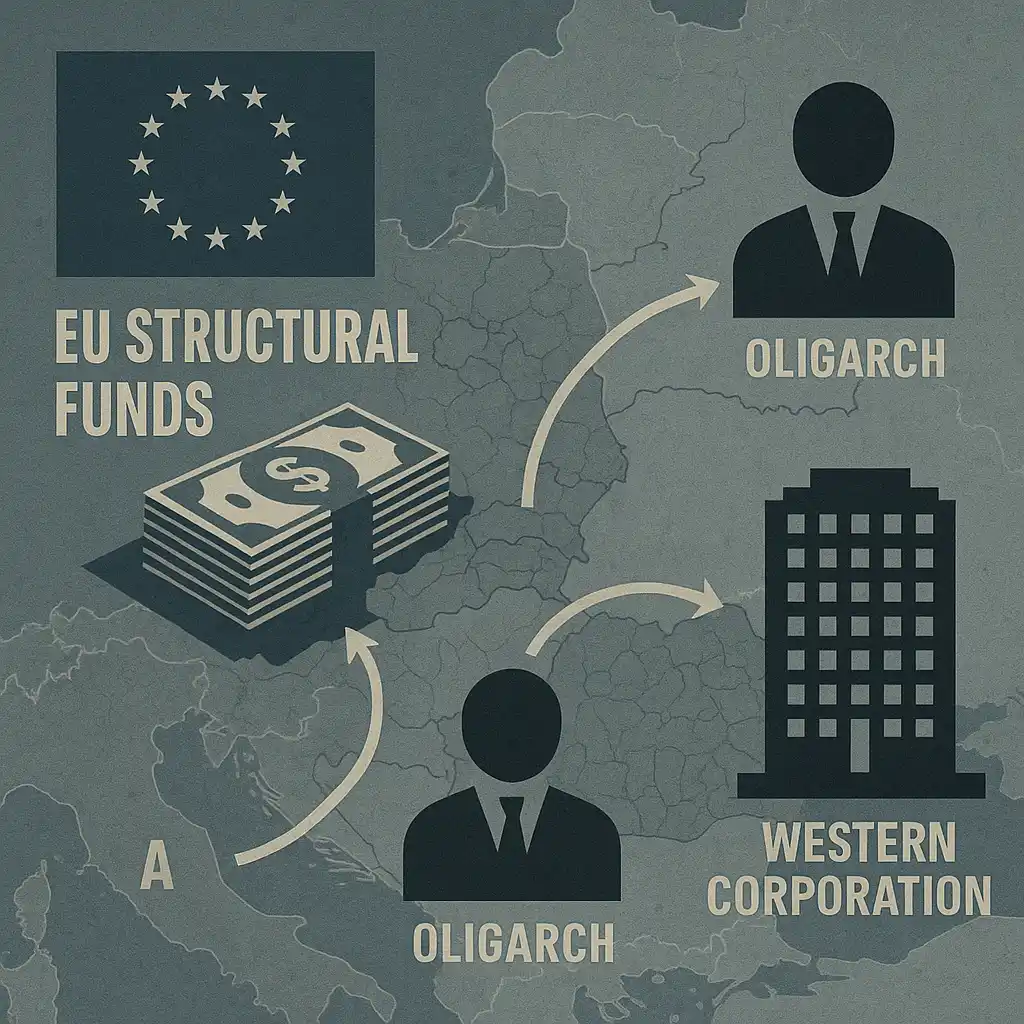
Brussels lectures Eastern Europe about corruption while pumping €365 billion into systems designed to steal it. EU funds are the largest source of corruption in the region, not despite Brussels' efforts, but because of them. They pick compliant governments, pave roads for Western corporations, and when the embezzlement becomes too obvious, they freeze payments, issue warnings, and send more money. This isn't incompetence. It's the business model.
Bulgaria: Corruption Perceptions Index score 45. Lowest in the EU.
Romania: 46. Tied for second-worst.
Hungary: 42. Worse than both.
Brussels' response? €23 billion to Romania, €22 billion to Hungary, hundreds of billions total to Eastern Europe under EU Structural and Investment Funds. Money supposedly for "convergence," "development," "fighting corruption."
The result? Research shows EU funds increased corruption risk in every Eastern European member state. Public procurement funded by Brussels becomes a "hotbed of clientelism and direct political influence." Mayors allocate contracts to political allies. Organized crime infiltrates projects. Billions disappear into shell companies and offshore accounts.
And Brussels? Knows. Always knew. Keeps sending money anyway.
Because the corruption isn't a problem. It's how the system works.
"Corruption Perceptions Index"
The Numbers That Expose the Con
Let's start with what Brussels doesn't want you to see.
€365 billion allocated to EU's newest members under Structural and Investment Funds between 2004-2020. That's 2.6% of their GDP every year. In some countries, EU funds constitute over 50% of public investment.
Research from the Corruption Research Centre Budapest found EU funds in Central and Eastern Europe "deteriorate the quality of government and increase corruption." Not reduce it. Increase it.
A 2013 study analyzing public procurement in Czech Republic, Hungary, and Slovakia found EU funding increased corrupt rent extraction by up to 1.21% of GDP. Meanwhile, the supposed anti-corruption controls built into EU funding? Decreased corruption by 0.03% of GDP, and even that tiny benefit was limited to Slovakia. In Czech Republic and Hungary, even the controls increased corruption.
And Brussels? Knows. Always knew. Keeps sending money anyway. As we documented in Who Is Running Europe, the unelected bureaucrats and 25,000 lobbyists don't answer to you, they answer to the system.
Transparency International's data: Bribery rates hit 42% in Moldova, 34% in Albania, 29% in Romania, 24% in Lithuania. Meanwhile, Western Europe? Single digits.
The Economist estimated corruption increases the cost of EU contracts by $5 billion annually. That's stolen money. Your money. Taxed from productive economies and funneled into systems that distribute it to political elites and their business cronies.
The truth doesn’t trend. It survives because a few still care enough to keep it alive.
Keep The Kade Frequency transmitting.
What we learned: EU funds are the largest source of corruption in Central and Eastern Europe. Brussels doesn't fight corruption, it finances it.
EU funds increase corruption research - "Corruption Research Centre Budapest"
How the Machine Works: From Brussels to Oligarchs' Pockets
Here's the playbook:
Step 1: Brussels announces funding for "regional development," "infrastructure," "convergence."
Step 2: Eastern European governments submit project proposals. Brussels approves them with minimal scrutiny because disbursing funds is the goal, not effectiveness.
Step 3: Projects go to tender. Public procurement rules apply, on paper. In reality, contracts are pre-arranged.
Step 4: Winner is always connected to the ruling party. Sometimes directly owned by politicians' relatives. Often through shell companies and offshore structures.
Step 5: Work begins. Costs inflate 200-300%. Quality drops. Timelines extend. "Modifications" add millions.
Step 6: Project completes, or doesn't. Either way, money's already gone. Empty highways to nowhere. Unfinished hospitals. "Modernized" schools with crumbling infrastructure.
Step 7: Brussels audits. Finds "irregularities." Issues warnings. Maybe freezes 10% of future payments.
Step 8: Government promises reforms. Brussels unfreezes payments. Cycle repeats.
The corruption isn't incidental. It's structural. And Brussels built the structure.
Bulgaria: The Poster Child
Let's look at Bulgaria, EU's most corrupt member state and Brussels' favorite case study in "how not to do it."
Bulgaria joined the EU in 2007. Seventeen years later: GDP growth 50% (compared to Romania's 202% in the same period). Average salary: €690/month, lowest in EU, below non-member Montenegro (€785) and Bosnia (€741).
Where did the EU funds go?
Investigative journalists uncovered "massive frauds targeting procurement in EU funded programmes" involving cash, offshores, political parties, Russian oligarchs, and organized crime. The #GPGate scandal exposed consultancy companies involved in "grand corruption with EU funds and public procurement."
Bulgarian prosecutors investigated. Then mysteriously dropped cases. Why? Because the prosecutor general himself is part of the system. Civil society organizations and the Bulgarian Judges Association have campaigned for judicial reform for years. Brussels responds with "progress reports" urging Bulgaria to "put in place procedures concerning the accountability of the prosecutor general."
Translation: Please reform yourselves. We know you won't. We'll send more money anyway.
July 2020: Mass protests erupt. "EU are you blind?" becomes a slogan. Protestors demonstrate at Christian Democratic Union headquarters in Berlin. They know Brussels sees exactly what's happening.
European Chief Prosecutor prepares investigation into Bulgarian government's spending of EU funds. Too late. Money's already gone. System's already entrenched. And next funding cycle's already approved.
Romania: Corruption With Multinational Assistance
Romania's story is even more instructive because it shows how Western corporations actively participate in the looting.
Liviu Dragnea: Convicted. Radu Mazăre: Convicted. Sorin Blejnar: Convicted. High-profile corruption cases that made headlines. "See? Romania's fighting corruption!"
Meanwhile: Oracle and Veolia cases revealed sophisticated corruption mechanisms involving major Western multinationals tolerating, or actively facilitating, practices by their Romanian subsidiaries.
The investigations exposed "high costs for the Romanian state in both fiscal and social terms." But here's what they didn't expose: Brussels' role in creating the environment where this flourishes.
OLAF (EU's anti-fraud office) investigated misuse of EU funds in Romania's Danube Delta development projects. Found fraud. Recommended prosecution. What changed? Projects continued. Systems stayed the same. New funds allocated.
Selection processes for EU funded projects became "hotbeds of clientelism" and "opportunity networks" that benefit political and business elites. Contracts go to companies with party connections. Infrastructure projects balloon in cost. Public money disappears into private pockets.
And Brussels keeps the tap flowing. Because Romania is obedient. Unlike Hungary or Poland, Romania doesn't challenge Brussels' political authority. So corruption gets tolerated.
Hungary: When Defiance Meets Consequences (But Corruption Gets Ignored)
Hungary's a fascinating case because it shows what Brussels actually cares about, and what it doesn't.
Viktor Orbán's government uses EU funds to "benefit those close to the government." Friends, family, political allies. Public procurement becomes "contractual relationships which benefit the highest echelons of the political and business elite."
Corruption Perceptions Index: 42. Worst in the EU. €22 billion in EU funds allocated 2014-2020.
Brussels' response? Sanctions. Frozen funds. "Rule of law" violations. Hungary attacked relentlessly for "democratic backsliding," "judicial independence concerns," "corruption."
But here's the thing: Bulgaria's corruption score is 45. Romania's is 46. Both higher (less corrupt) than Hungary's 42. Yet Bulgaria and Romania don't face the same sanctions, the same attacks, the same threats.
Why? Because Bulgaria and Romania comply politically. They vote the way Brussels wants in the Council. They support von der Leyen's agenda. They don't challenge EU authority.
Hungary does. Orbán opposes migration policy. Questions climate mandates. Blocks Ukraine aid. Maintains ties with Russia.
The corruption isn't the problem. The defiance is. Brussels tolerates corruption in compliant states. Punishes it only in defiant ones.
Proof? Federica Mogherini, former EU High Representative, arrested December 2024 for fraud, corruption, and misuse of EU funds. At the heart of Brussels. Not Hungary. Not Romania. Brussels itself.
Hungarian Foreign Minister Péter Szijjártó: "It's clear why Brussels isn't demanding accountability from Kyiv. Because exactly what's happening in Kyiv is also happening in Brussels: large-scale corruption."
He's right. But Brussels lectures anyway. Because the lectures aren't about corruption. They're about control.
Anti-fraud investigations - "OLAF"
The Corporate Pavement: How EU Funds Pave Roads for Western Companies
Here's what nobody talks about: EU funds don't just feed Eastern European corruption. They systematically benefit Western corporations exploiting cheap Eastern labor and weak regulations.
Infrastructure spending, roads, ports, telecommunications, doesn't primarily benefit Eastern citizens. It benefits logistics companies moving goods west. Manufacturing companies sourcing cheap production. Retailers exploiting low-wage markets.
This is how it's funded. Your taxes, filtered through Brussels, building the infrastructure that lets Western corporations profit from Eastern European poverty wages.
A factory opens in Romania. EU "development funds" paid for the road connecting it to the highway. The telecommunications infrastructure. The industrial park. All publicly funded.
The factory pays Romanian workers €150/month making products sold for premium prices in Germany. Profits flow west. Taxes barely cover the infrastructure costs. But Brussels calls it "convergence."
It's not convergence. It's subsidized colonialism.
How Brussels Picks Governments
The corruption Brussels tolerates isn't random. It's selective. And the selection process reveals what Brussels actually wants.
Post-communist Eastern Europe arrived at EU membership with weak institutions, oligarchic networks, and political systems vulnerable to capture. Brussels could have demanded robust anti-corruption infrastructure as a condition of membership and funding.
Instead? Brussels rewards compliant corruption and punishes defiant corruption.
Romania under the Social Democrats: Massive corruption. EU funds misused. But Romania votes correctly in Brussels, supports Commission priorities, doesn't challenge authority. Result? Funds flow. Warnings issued. No real consequences.
Romania under reformist governments: Attempts at actual anti-corruption reform. Prosecutions of high-level officials. EU... lukewarm support. Because reformed Romania might be harder to manage.
Hungary under Orbán: Corruption similar to or worse than Romania/Bulgaria. But Orbán challenges Brussels politically. Result? Sanctions. Frozen funds. Rule of law mechanism activated.
The pattern is clear: Brussels doesn't want clean governments in Eastern Europe. It wants obedient ones. Corruption is tolerated, even useful, as long as it doesn't interfere with Brussels' political agenda.
Because corrupt governments are controllable. They need the money. They're vulnerable to pressure. They can't afford to defy Brussels because defiance means investigations, frozen funds, "rule of law" violations.
Clean governments are independent. They don't need Brussels' tolerance of their graft. They can't be blackmailed with corruption investigations. They might actually prioritize their citizens over Brussels' preferences.
So Brussels doesn't build clean governments. It selects for corruption it can manage.
The "Anti-Corruption" Theater
Brussels loves anti-corruption initiatives. Funds them generously. €3 million for the Internal Security Fund to "enhance EU actions against corruption." Networks. Workshops. Reports. Strategies.
October 2024: EU Network Against Corruption meets in Brussels. Video message from Commissioner. "Member States have strengthened their commitment to fight corruption, dedicating more resources and making anti-corruption institutions stronger."
Bullshit. Member states dedicate resources to appearing to fight corruption while the actual corruption continues untouched.
June 2024: Workshop on asset declaration systems. Nearly all EU countries have systems requiring public officials to disclose assets. Sounds good. Except:
Asset declarations in most Eastern European countries are toothless. Incomplete. Unverified. Penalties for false declarations? Rare. Prosecutions? Rarer. Consequences for officials with unexplained wealth? Almost never.
The systems exist. That's the point. Not to catch corruption, to check the box saying "we have an asset declaration system."
November 2024: Commission presents study on "high-risk areas of corruption." Will inform development of "first EU strategy against corruption."
First strategy. After 20 years of Eastern European membership. After €365 billion distributed. After research proving EU funds increase corruption. Now they're developing a strategy.
Because corrupt governments are controllable. The same pattern we exposed in The Fear Machine—crisis creates opportunity for control, and dependency ensures compliance.
It's not incompetence. It's deliberate delay. Because an actual anti-corruption strategy would require admitting the system is designed to tolerate corruption.
What Brussels Knows (And Won't Say)
Internal research Brussels doesn't publicize widely:
Study finding: "EU funding generally increased corruption risk in all member states."
Study finding: Structural Funds "gradually became a symbol of corruption in the distribution of government subsidies" in Slovakia.
Study finding: EU funds distributed through "contractual relationships which benefit the highest echelons of the political and business elite" in Hungary.
Study finding: Selection processes in Romania and Bulgaria are "hotbeds of clientelism and direct political influence."
Brussels knows. Commissioned the research. Read the findings. Then... continued exactly the same policies.
Why? Because the alternative, actually requiring clean governance as condition of funding, would mean:
- Confronting powerful interests in Eastern Europe that Brussels needs for political support
- Admitting past failure in allowing corruption to flourish
- Restructuring the entire funding system to prioritize accountability over disbursement
- Losing leverage over governments that depend on corrupt access to funds
So Brussels doesn't fix the system. It manages it. Selects which corruption to tolerate (compliant) and which to punish (defiant). Issues reports. Holds workshops. Develops strategies that never materialize.
And the money keeps flowing. Because the money is the point.
The Citizens' Perspective: "EU Are You Blind?"
Focus group research in Hungary, Romania, and Slovenia reveals what ordinary citizens think about EU funds:
Quote: "Citizens perceive cohesion policy implementation as intertwined with grand corruption."
Quote: "National political elites are considered the main culprit, but EU institutions are also seen as failing in their duties."
Quote: "The most potent impact of the EU on party politics [in CEE] tends to be in disputes, allegations and accusations surrounding the management and disbursement of European funds."
Bulgarian protesters: "EU are you blind?" Not a question. An accusation. They know Brussels sees. They know Brussels tolerates. They know Brussels is complicit.
Citizens understand what Brussels pretends not to: The EU funds are the corruption. Not just vulnerable to it. Not just exploited by it. Are it.
The sheer size, 2.6% of GDP annually, over 50% of public investment, means EU funds fundamentally reshape governance. Not toward transparency and accountability. Toward dependence and compliance.
Countries become addicted. Political elites become dependent. And Brussels becomes the dealer controlling the supply.
The Lisbon Treaty Trap
Here's a fun fact: The Lisbon Treaty (2007) was supposed to address the "democratic deficit" and make EU more accountable.
Result? More centralization. More power to unelected Commission. Less national sovereignty. And critically: No meaningful improvement in corruption monitoring.
The European Public Prosecutor's Office (EPPO) finally became operational in 2021, 14 years after the treaty. Even now, not all member states participate. And its investigations? Focus on fraud affecting EU financial interests. Translation: EU money stolen gets investigated. EU money used corruptly within legal frameworks? Different story.
Because the corruption isn't primarily fraud. It's legal theft. Contracts awarded legally to politically connected companies. Costs inflated legally through change orders. Projects selected legally based on political priorities rather than need.
The law allows it. Brussels designed the law. The corruption is built into the structure.
Where This Goes: The Permanent Dependency
Eastern Europe isn't converging with Western Europe. It's being locked into permanent dependency.
EU funds should be temporary, helping new members catch up, then ending as economies strengthen. Instead? After 17-20 years of membership, dependency increased.
Why? Because the funds don't build self-sustaining economies. They build economies dependent on EU funding.
Infrastructure benefits Western corporations more than Eastern workers. Industrial development favors foreign investors over domestic entrepreneurs. "Development funds" subsidize low wages that keep Eastern Europe competitive as cheap labor source.
And the corruption? Ensures political elites stay focused on accessing EU funds rather than building independent economies.
Romania's GDP growth since EU accession: 202%. Bulgaria's: 50%. Same membership date. Similar starting points. Different governments. One managed the funds somewhat effectively (though corruptly). One catastrophically.
But neither achieved genuine convergence. Both remain dependent. Both are poorer than they should be. And Brussels calls it success because dependency is the goal.
Eastern Europe isn't a partner, it's a product. EU funds are the mechanism keeping it that way.
The Mogherini Scandal: Corruption At the Heart
December 2024: Federica Mogherini, former EU High Representative, one of Brussels' most senior diplomats—arrested in Belgium on suspicion of fraud, corruption, and misuse of EU funds.
The details are still emerging. But the symbolism is perfect. Brussels lectures Eastern Europe about corruption while its own officials are embezzling EU funds.
Hungarian Foreign Minister's response: "It's clear why Brussels isn't demanding accountability from Kyiv. Because exactly what's happening in Kyiv is also happening in Brussels: large-scale corruption."
Kyiv's corruption we've documented. Brussels' corruption is harder to expose because it's protected by diplomatic immunity, unelected positions, and institutional opacity.
Remember who's running Europe? Unelected bureaucrats. 25,000 corporate lobbyists. Zero accountability. That's the system deciding which Eastern European corruption to tolerate and which to punish.
Mogherini's arrest proves what Eastern Europeans have been saying: Brussels isn't fighting corruption. It's managing it. And sometimes the managers get caught with their hands in the till.
The Truth Nobody Will Say
EU funds to Eastern Europe aren't development aid. They're systemic corruption by design.
The corruption serves three purposes:
1. Economic: Subsidizes Western corporate exploitation of Eastern cheap labor and resources.
2. Political: Creates dependency and compliance. Corrupt governments need Brussels' tolerance.
3. Structural: Prevents genuine convergence that would eliminate the wage differential Brussels' economy depends on.
Brussels doesn't want to fix Eastern European corruption. Brussels wants to manage it. Keep it at levels that serve Western interests while maintaining political control.
Too little corruption? Governments become independent, unpredictable. Too much corruption? Becomes politically embarrassing, requires intervention.
The sweet spot? Current levels. High enough to ensure dependency. Low enough to deny in press releases.
Research proves EU funds increase corruption. Brussels ignores the research. Not because they're incompetent. Because the system works exactly as designed.
Eastern European citizens understand this. That's why they protest. That's why they ask "EU are you blind?"
They're not blind. They're complicit.
What Happens Next
This system continues until one of three things happens:
Option 1: Eastern European citizens revolt. Elect genuinely reformist governments that reject EU funds conditional on tolerating corruption. Force Brussels to either fund clean governance or admit they won't.
Option 2: Western taxpayers realize their money funds Eastern corruption that benefits Western corporations while leaving Eastern citizens poor. Demand accountability. Force reform from the other end.
Option 3: The system collapses under its own corruption weight. Scandals multiply. Investigations can't be contained. Public outrage forces change Brussels can't control.
Right now? We're nowhere near any of those. Eastern Europeans mostly keep accepting the scraps. Western taxpayers mostly don't know where their money goes. Brussels keeps managing the system.
But every Mogherini arrest, every billion-euro scandal, every "EU are you blind?" protest brings us closer to the breaking point.
Because you can't run a corruption colony forever while claiming to be a union of democratic values.
Eventually, the lie becomes too obvious. The gap between rhetoric and reality too wide. The citizens too angry.
We're not there yet. But we're getting closer.
The Question Brussels Won't Answer
If EU funds are supposed to reduce corruption, why does research show they increase it?
If Brussels is fighting corruption, why do the most corrupt member states keep receiving billions?
If the goal is convergence, why is the wage gap permanent and dependency increasing?
If democracy matters, why are corrupt but compliant governments tolerated while defiant ones are punished?
The answers reveal everything Brussels doesn't want you to know:
EU funds increase corruption because that's how the system works.
Corrupt states keep receiving billions because corruption makes them controllable.
The wage gap is permanent because Western corporations need cheap Eastern labor.
Democracy doesn't matter. Compliance does.
This isn't conspiracy. It's structure. And the structure is working exactly as designed.
Eastern Europe isn't a corruption problem Brussels needs to solve. It's a corruption resource Brussels needs to manage.
The protesters were right. EU isn't blind. It's complicit.
And your taxes are funding the whole fucking operation.
A. Kade
"Brussels doesn't fight corruption in Eastern Europe. It selects which corruption serves Western interests, rewards compliance with tolerance, and punishes defiance with investigations. The funds aren't aid, they're the mechanism of control."
No ads. No sponsors. Just signals from the noise.
Keep The Kade Frequency transmitting.
Related Articles You Must Read:
Eastern Europe Exploitation:
- Poland at the Edge: The Country Brussels Pretends to Fix - Frontline state squeezed between Brussels and Moscow
EU Power & Control:
- Who Is Running Europe? The Unelected Empress and 25,000 Lobbyists - The system that allows this corruption to flourish
- The Fear Machine: How Brussels Uses Crisis to Control - Every crisis expands power, dependency ensures compliance
- Ursula von der Leyen: The Empress of Clean Hands - Failed defense minister running Europe without accountability
Corporate Capture:
- Green Money, Grey Influence: How Brussels Funds Its Own Lobby - EU funds slipped into private influence
- Brussels vs Hungary: The Empire and Its Rebel - What happens when you defy Brussels