BlackRock: The $14 Trillion Shadow Empire Controlling Everything
BlackRock manages $14 trillion, more than every country except the USA and China. Their Aladdin software controls $21 trillion more. Their alumni staff every administration. Their CEO says elections don't matter. This is the investigation into the shadow empire that runs the world.

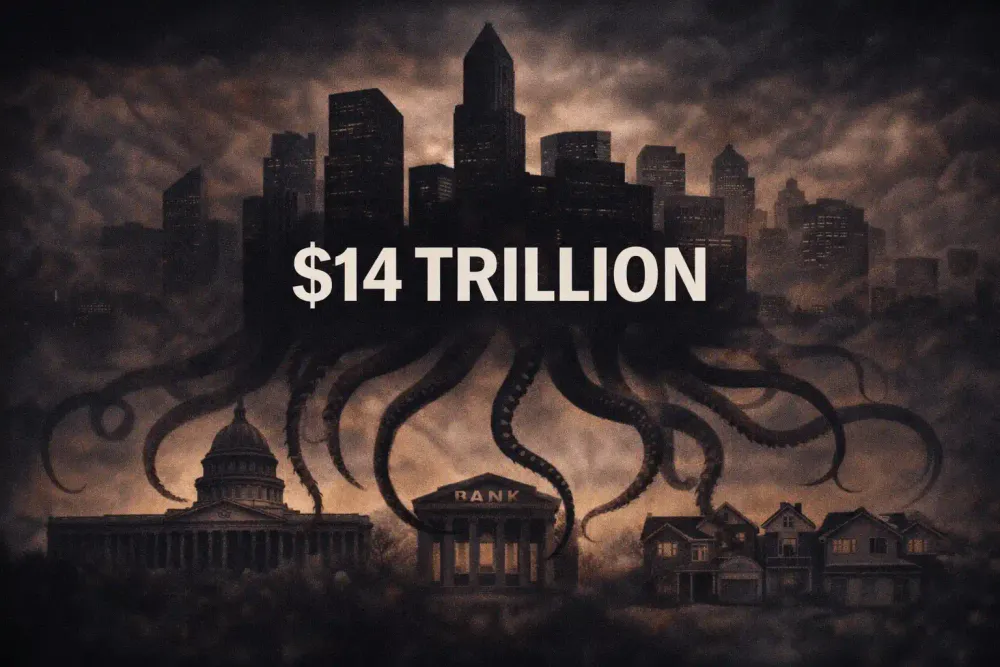
There's a company that manages more money than the GDP of every nation on Earth except two.
A company whose software controls risk assessment for $21 trillion in global assets, roughly 10% of all stocks and bonds on the planet.
A company that is the largest or second-largest shareholder in virtually every major corporation you can name. Apple. Microsoft. Amazon. Google. Exxon. Pfizer. JPMorgan. All of them.
A company with over 100 former employees embedded in governments and central banks worldwide. A company that received billions in no-bid contracts to manage the 2008 and 2020 bailouts, while owning the same assets it was tasked with saving.
A company whose CEO says it "really doesn't matter" who wins elections.
That company is BlackRock.
And unless you work in finance, you've probably never thought about them.
That's exactly how they want it.
The Numbers
Let's start with scale. Because the scale is incomprehensible.
As of January 2026, BlackRock manages $14 trillion in assets. Fourteen. Trillion. Dollars.
To put that in perspective:
- It's more than the GDP of every country except the United States and China
- It's roughly 50% of U.S. GDP
- It's larger than the GDP of Germany, Japan, and the UK combined
- It's 700 times the annual budget of the United Nations
The truth doesn’t trend. It survives because a few still care enough to keep it alive.
Keep The Kade Frequency transmitting.
But that's just what BlackRock directly manages.
Their proprietary software platform, called Aladdin, monitors and provides risk analysis for an additional $21.6 trillion in assets , money managed by other institutions that rely on BlackRock's technology to make investment decisions.
Combined, that's over $35 trillion flowing through one company's systems.
One company. One platform. One point of failure.
And it gets worse.
The Big Three
BlackRock doesn't operate alone. Together with Vanguard and State Street, collectively known as "The Big Three”, these asset managers control approximately $25 trillion in combined assets.
Here's what that means in practice:
The Big Three are among the largest shareholders in 96% of S&P 500 companies. In most cases, one of them is THE largest shareholder.
Think about that. Three companies, whose leadership can fit in a conference room, collectively own controlling stakes in almost every major corporation in America.
They own your bank. They own your pharmacy. They own your grocery store. They own your internet provider. They own the companies that make your car, your phone, your medication, your food.
And here's the kicker: they own each other.
BlackRock is a major shareholder in Vanguard's publicly traded funds. Vanguard is BlackRock's largest institutional shareholder. State Street owns both. It's an incestuous web of cross-ownership that would make antitrust lawyers weep, if antitrust lawyers weren't busy working for companies owned by the Big Three.
Aladdin: The Algorithm That Runs the World
In 1988, Larry Fink lost $100 million in a single trade at First Boston due to what he considered poor risk management. That loss became an obsession. He founded BlackRock with one goal: build a system that could understand and manage risk better than any human.
That system became Aladdin, Asset, Liability, Debt, and Derivative Investment Network.
Today, Aladdin is the most powerful financial technology on Earth.
It runs on a network of approximately 6,000 computers across four global data centers. It processes 200 million calculations per week. It generates millions of risk reports daily. It tracks over 30,000 investment portfolios.
And it's used by damn near everyone.
The list of Aladdin clients reads like a who's who of global finance:
- Central banks, including the Bank of Israel
- Pension funds, including CalPERS ($260 billion in California public employee retirement funds)
- Sovereign wealth funds, managing national reserves
- Major banks, Deutsche Bank (€900 billion), UBS, BNP Paribas
- Insurance giants, Prudential ($700 billion)
- Competitors, even other asset managers use BlackRock's system
When half the financial world relies on a single system to assess risk, that system becomes the risk.
"Anything close to an oligopoly in risk management would be especially dangerous if there were any weakness in the system," warned Jim McCaughan, former CEO of Principal Global Investors.
Imagine a software glitch. A cyberattack. A flawed assumption in the model. Now imagine that error rippling through $21 trillion in assets simultaneously. Every institution making the same mistake at the same time. Every pension fund. Every central bank. Every insurance company.
That's not a market correction. That's a global financial extinction event.
And there's no backup plan. No alternative system. No redundancy.
Just Aladdin.
Independent investigations. Imperial expansion exposed. Pattern documented.
Get investigations delivered.
The Revolving Door
In Washington, there's a concept called the "revolving door”, the endless cycle of people moving between government positions and the industries they're supposed to regulate.
BlackRock doesn't just use the revolving door. They fucking installed it.
According to the Campaign for Accountability's BlackRock Transparency Project, at least 99 people have passed through the door between BlackRock and government positions. Other counts put the number at 84 former government officialshired by BlackRock since 2004, plus countless BlackRock alumni who've joined administrations.
Let me give you some highlights:
Brian Deese, Senior adviser to President Obama, then BlackRock's Global Head of Sustainable Investing, then head of Biden's National Economic Council. BlackRock → Government → BlackRock → Government. The door never stops spinning.
Mike Pyle, Obama economic aide, then BlackRock Investment Institute's chief investment strategist, then economic adviser to Kamala Harris during her presidential campaign.
Wally Adeyemo, BlackRock chief of staff, then Deputy Treasury Secretary under Biden.
Tom Donilon, Obama's National Security Adviser, then Chairman of the BlackRock Investment Institute.
Cheryl Mills, Hillary Clinton's chief of staff at State Department, hired to BlackRock's board in 2014.
And that's just the American operation.
Former UK Chancellor George Osborne gets paid $850,000 per year to work for BlackRock one day per week. Similar arrangements exist across Europe, Asia, and South America.
It's not a revolving door. It's a fucking conveyor belt.
And it goes both ways. BlackRock doesn't just hire from government , it places its people IN government. Meeting calendars and phone logs reveal almost 400 conversations between BlackRock executives and senior officials in the White House, Treasury, and Federal Reserve since the 2008 financial crisis.
Larry Fink was widely expected to become Hillary Clinton's Treasury Secretary in 2016. He'd already assembled a "ready-made team" of BlackRock officials who could move with him to Treasury. When Hillary lost, he joined Trump's business advisory council instead (until Charlottesville made that politically inconvenient).
When asked about the 2024 election, Fink was refreshingly honest. "It really doesn't matter" who wins, he told an industry conference. "We work with both administrations."
Of course they do. They own both administrations.
This is the structural capture that made Trump possible — and that he did nothing to fix. As we documented in The Monster They Made, the system serves the same masters regardless of which puppet sits in the chair.
The Bailout Machine
Here's where it gets truly obscene.
In 2008, the global financial system collapsed. Banks had packaged garbage mortgages into securities, sold them worldwide, and when the house of cards fell, taxpayers were on the hook.
Guess who the Federal Reserve hired to clean up the mess?
BlackRock.
No competitive bidding. No public process. Just a series of no-bid contracts to the company that had helped build the mortgage-backed securities market in the first place.
BlackRock got the contract to manage the toxic assets of Bear Stearns ($30 billion). They got the contract for AIG's mortgage-backed securities. They got the contract for Citigroup's ring-fenced assets. They advised on the toxic assets of Fannie Mae and Freddie Mac.
They were simultaneously advisor, buyer, and seller. Managing assets, they had stakes in. Pricing securities they owned. Deciding which companies lived and which died, while holding positions in all of them.
The conflicts of interest were so blatant that the Project on Government Oversight wrote to Congress demanding oversight. Nothing happened.
Then came 2020.
When COVID crashed the markets, the Federal Reserve announced unprecedented emergency measures. Trillions in support. Corporate bond purchases. Market stabilization.
Who did they hire to run it?
BlackRock. Again.
Same playbook. No-bid contracts. This time to manage up to $750 billion in corporate bond purchases.
But here's where it gets truly perverse: BlackRock was allowed to buy its own products.
Let me say that again.
The Federal Reserve gave BlackRock permission to use taxpayer money to purchase BlackRock's own ETFs.
The result? During the Fed's 2020 buying program, BlackRock's corporate bond ETF received $4.3 billion in new investment. Their competitors Vanguard and State Street? $33 million and $15 million respectively.
BlackRock got 130 times more money than its nearest competitor. From a program BlackRock was running. Using taxpayer funds.
And if those purchases go bad? The CARES Act allocated $75 billion of taxpayer money to absorb losses from the corporate bond programs. Losses that would otherwise hit BlackRock and its investors.
Privatize the gains. Socialize the losses. The oldest scam in capitalism, executed at unprecedented scale.
It's the same wealth transfer mechanism we exposed in our tax article , except this time they didn't even bother disguising it as policy.
During all of this, Federal Reserve Chair Jerome Powell had $11.6 million of his personal wealth invested in BlackRock iShares ETFs. Powell's calendar showed he had a 30-minute phone call with Larry Fink on March 19, 2020, right before the bailout programs launched. In March 2021, Fink had an hour-long virtual meeting with the entire Federal Reserve Board of Governors.
The Fed Chair had millions invested in BlackRock products while giving BlackRock billions in contracts to buy BlackRock products with public money.
If you or I did this, it would be called corruption. When BlackRock does it, it's called "financial services."
The Green Hypocrisy
Larry Fink has positioned himself as capitalism's conscience.
His annual letters to CEOs lecture about environmental responsibility, social purpose, and long-term thinking. He's pushed companies to improve diversity. He's warned about climate risk. He's become the patron saint of ESG investing.
It's all bullshit.
BlackRock is the world's largest investor in fossil fuels.
As of 2018, BlackRock held $11 billion in shares of 56 coal-fired power plant companies. They owned more oil, gas, and thermal coal reserves than any other investment manager, 9.5 gigatons of CO2 emissions, representing 30% of total energy-related emissions from 2017.
They're simultaneously the planet's largest climate investor and its largest climate destroyer.
Environmental groups like the Sierra Club and Amazon Watch launched a campaign called "BlackRock's Big Problem," calling them "the biggest driver of climate destruction on the planet."
How does Fink square this circle? Easy. He doesn't.
He gives speeches about sustainability while his company finances the extraction of enough carbon to cook the planet. He lectures other CEOs about responsibility while his own firm profits from irresponsibility on a civilizational scale.
A former BlackRock executive who served as the company's first global chief investment officer for sustainable investing called it what it is: a "dangerous placebo that harms the public interest." He said financial institutions engage in ESG investing because ESG products have higher fees, which increase company profits.
It's not about saving the planet. It's about charging premium prices for products that let clients feel good while changing nothing.
Ukraine: Disaster Capitalism in Real Time
When Russia invaded Ukraine in 2022, the world saw tragedy.
Larry Fink saw opportunity.
By September 2022, while missiles were still falling on Kyiv, Fink was on a video call with President Zelensky discussing how BlackRock could coordinate the "reconstruction" of Ukraine.
By November, Ukraine's Ministry of Economy had signed a memorandum of understanding with BlackRock to design an "investment framework" for the country's rebuilding.
By December, Zelensky and Fink had agreed to coordinate $400 billion in reconstruction investment, with BlackRock advising on which sectors would receive capital.
Critics called it what it was: "disaster capitalism."
Author Naomi Klein coined that term to describe the phenomenon of corporations using crises, wars, natural disasters, economic collapses, to push through privatization, deregulation, and wealth extraction that would never be accepted under normal circumstances.
Ukraine was getting the full treatment. While the country was still at war, plans were already being drawn up to privatize state assets, liberalize markets, and create "investment freedom" for foreign capital.
The Ukraine Development Fund aimed to attract up to $15 billion in private capital. BlackRock Vice Chairman Philipp Hildebrand called it a "historic moment" and an "opportunity."
An opportunity. While Ukrainians were dying.
The plan ultimately stalled. After Trump's election in 2024, BlackRock paused its efforts to line up investors, citing "increased uncertainty." They completed their "pro bono advisory work" in 2024 and stepped away.
Translation: when it became clear the profit potential was diminishing, they lost interest.
BlackRock stated that their work was charitable advisory. But somehow, their "charity" always seems to position them perfectly for future profit.
The Housing Question
I need to address the elephant in the room. You've probably seen claims that BlackRock is "buying up all the houses" and causing the housing crisis.
This is largely false, and it's important to be accurate when the truth is damning enough.
BlackRock does not buy individual houses. They've been clear about this, and the data backs them up. The confusion stems from people mixing up BlackRock (asset manager) with Blackstone (private equity firm that actually does buy houses through its Invitation Homes subsidiary).
According to the American Enterprise Institute, all institutional investors combined owned just 1% of total U.S. single-family housing stock as of June 2025. That includes Blackstone, Invitation Homes, and every other institutional buyer.
So why does the myth persist?
Because BlackRock profits from the housing crisis without directly buying houses. They're a major investor in mortgage-backed securities. They provide capital to developers and landlords. They own stakes in companies that do buy houses.
Whether you buy a home or rent one forever, BlackRock makes money. Whether housing prices rise or fall, BlackRock has positioned itself to profit.
The housing crisis is real. Corporate consolidation of housing is real. But the specific claim about BlackRock buying houses is wrong, and spreading it distracts from the more documented, more provable ways they've rigged the system.
Stick to what's verifiable. There's plenty.
The System They've Built
Step back and look at the whole picture.
One company manages $14 trillion directly and influences $35 trillion through its technology.
That company is a top shareholder in virtually every major corporation. It has 100+ people cycling between its offices and government positions. It has received billions in no-bid contracts from the institutions its alumni regulate. It was allowed to bail out its own products with taxpayer money while its executives sat on calls with the Fed Chair.
Its CEO says elections don't matter.
What do you call that?
I call it a shadow government.
Not in a conspiracy theory sense. In a structural, documented, provable sense.
BlackRock doesn't need to buy politicians (though it certainly makes campaign contributions). It doesn't need to rig elections (though it benefits regardless of outcome). It doesn't need secret cabals or Illuminati meetings.
It just needs to be so big, so embedded, so essential to the functioning of global finance that no government would dare challenge it.
Too big to fail? BlackRock is too big to comprehend.
When a company controls more wealth than most nations, advises the governments that regulate it, manages the retirement savings of federal employees, runs the risk systems for central banks, and profits from every crisis it's hired to solve, that's not capitalism.
That's capture.
The Question No One Asks
Here's what keeps me up at night.
Not the corruption. Corruption is old news.
Not the conflicts of interest. Those are obvious.
Not even the scale. Scale is just numbers.
What terrifies me is the concentration of risk.
Twenty-one trillion dollars dependent on one system. One algorithm. One company's servers.
Pension funds for teachers, firefighters, nurses, their retirement security dependent on Aladdin not crashing.
Central banks managing national reserves, their decisions shaped by BlackRock's risk models.
Insurance companies backing your life policy, their portfolios optimized by the same software as everyone else's.
When the music stops, everyone's holding the same hand.
In 2008, the financial system nearly collapsed because too many institutions made the same bets on housing. They used similar risk models. They held similar exposures. When the market turned, there was no diversity. Everyone failed together.
Today, that concentration is worse. The same software. The same assumptions. The same company at the center of everything.
If Aladdin makes a mistake, a programming error, a flawed assumption, a failure to account for some black swan event, there's no second opinion. No alternative view. Just $21 trillion making the same wrong move at the same time.
That's not a company. That's a single point of failure for human civilization.
What Would It Take?
Could BlackRock be broken up? In theory, yes. Antitrust law exists. Financial regulation exists.
In practice? Who would do it?
The regulators are former BlackRock employees. The Treasury Department is staffed with BlackRock alumni. The Federal Reserve Chair has millions in BlackRock funds. The politicians rely on a stable financial system that BlackRock has made itself essential to.
The company has grown so large, so interconnected, so systemic that challenging it would be seen as challenging the financial system itself.
That's the genius of it.
They're not breaking laws. They're just so big that the laws don't apply. Too essential to prosecute. Too connected to regulate. Too wealthy to challenge.
It's the same dynamic we've exposed across EU institutions in Who Is Running Europe, unelected power that's grown so embedded it's become invisible.
Larry Fink doesn't need to run for office. He doesn't need to bribe anyone. He just needs to keep being indispensable.
And he is.
The Bottom Line
There's a company that controls $14 trillion.
That runs software monitoring $21 trillion more.
That has alumni in every administration, every central bank, every regulatory body that matters.
That received billions to manage the bailouts of 2008 and 2020, while owning the assets being bailed out.
That profits whether markets rise or fall, whether you buy or rent, whether Democrats or Republicans win.
That CEO says it doesn't matter who's president.
He's right.
It doesn't matter.
Because no matter who sits in the Oval Office, Larry Fink will be on the phone with them. His people will staff their Treasury. His software will manage their pension funds. His company will be called to clean up the next crisis, a crisis it helped create, and will profit from solving.
This isn't conspiracy. This is structure.
This isn't secret. This is hidden in plain sight.
This is the shadow empire.
And you live in it.
The Kade Frequency doesn't do partisan politics.
We follow the money. We expose the structure. We name the names.
Because the first step to fixing a rigged game is understanding how it's rigged.
No ads. No sponsors. Just signals from the noise.
Keep The Kade Frequency transmitting.
Frequently Asked Questions
How much money does BlackRock manage?
BlackRock manages $14 trillion in assets as of January 2026, making it the world's largest asset manager. Additionally, their Aladdin software platform provides risk management for approximately $21.6 trillion in assets managed by other institutions.
What is BlackRock's Aladdin system?
Aladdin (Asset, Liability, Debt, and Derivative Investment Network) is BlackRock's proprietary risk management software. It monitors over $21 trillion in assets and is used by pension funds, central banks, insurance companies, and other major financial institutions to assess investment risk.
Does BlackRock buy houses?
No, BlackRock does not directly purchase individual single-family homes. This claim is often confused with Blackstone, a separate private equity firm. However, BlackRock does invest in mortgage securities, multifamily housing, and companies involved in real estate, profiting from housing markets indirectly.
How is BlackRock connected to the government?
Over 100 individuals have moved between BlackRock and government positions, including roles at the Treasury Department, Federal Reserve, National Economic Council, and SEC. This "revolving door" has led to concerns about conflicts of interest and regulatory capture.
Did BlackRock receive bailout contracts?
Yes. BlackRock received no-bid contracts to manage toxic assets during both the 2008 financial crisis and the 2020 COVID-19 pandemic response. During the 2020 program, BlackRock was permitted to purchase its own ETFs with Federal Reserve funds.
Is BlackRock the largest shareholder in most companies?
BlackRock, along with Vanguard and State Street (the "Big Three"), are among the largest shareholders in approximately 96% of S&P 500 companies. They collectively manage over $25 trillion in assets and hold controlling stakes in most major American corporations.
Sources
- BlackRock Q4 2025 Earnings Report
- Wikipedia , Aladdin (BlackRock)
- Wikipedia , BlackRock
- Wikipedia , Larry Fink
- The Financial Technology Report , Aladdin Platform
- Medium , BlackRock's Aladdin: How AI Controls $21 Trillion
- Revolving Door Project , BlackRock and Biden Administration
- Revolving Door Project , Larry Fink and Biden
- GV Wire , BlackRock's Influence Over Government
- Project on Government Oversight , Bailout Conflicts of Interest
- Common Dreams , BlackRock and COVID Bailout
- Wall Street on Parade , BlackRock ETF Bailouts
- Wall Street on Parade , Fink and Fed Chair Powell
- Geopolitical Economy Report , Fink on Elections
- Common Dreams , BlackRock Ukraine
- BlackRock , Ukraine Advisory Announcement
- Kyiv Post , BlackRock Pauses Ukraine Fund
- Fox Business , Fink and Zelensky Reconstruction Talks
- Washington Examiner , BlackRock Housing Myth
- American Enterprise Institute , Institutional Housing Ownership Data
© 2026 The Kade Frequency. All rights reserved.