The Billion-Euro Lie: How Brussels Buys the News You Read
EU spent €1B funding media over 10 years—€80M annually to news agencies, fact-checkers, investigative journalists. European Newsroom (€1.7M) trains reporters in "common standards." EDMO (€27M) fact-checks everything except EU claims. Y

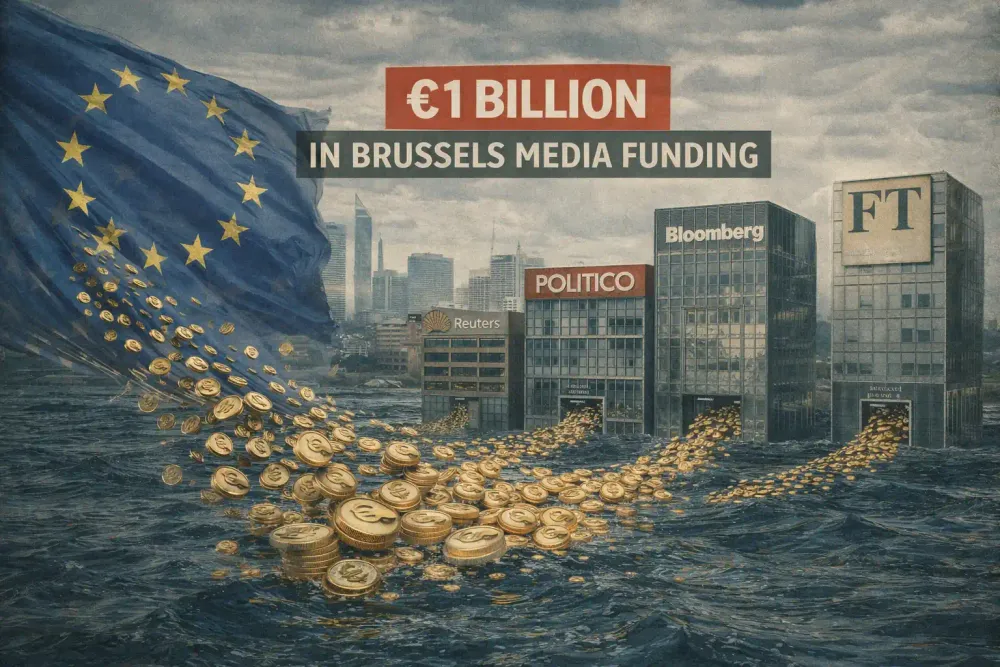
Nearly €1 billion in taxpayer money spent over the past decade. €80 million flowing annually from EU institutions to media outlets, news agencies, fact-checkers, and "investigative journalists." All to ensure one thing: favorable coverage of the European Union.
This isn't advertising. It's not PR. It's systematic institutional capture of European media disguised as "supporting free press and pluralism."
The European Union doesn't just influence the news. It funds the organizations that create it, trains the journalists who write it, sets the "standards" they follow, and finances the fact-checkers who decide what's true. Then it calls this "protecting media freedom."
When the European Newsroom, a Brussels-based media consortium funded with €1.7 million in EU money trains reporters using techniques developed by EU institutions to provide "pan-European perspective on EU affairs," that's not journalism. That's manufacturing consent.
When the European Digital Media Observatory receives at least €27 million in EU funding to "combat disinformation" while never fact-checking EU institutional claims, that's not protecting truth. That's protecting power.
When EU-funded "investigative journalism" projects systematically target foreign adversaries, Russia, China, authoritarian regimes, while producing virtually zero investigations into EU governments or Brussels institutions, that's not independent reporting. That's propaganda with a byline.
You're not reading news about the European Union. You're reading content funded, shaped, and approved by the European Union.
And the entire system is designed so you never know the difference.
Let me show you exactly how Brussels built the most sophisticated media capture operation in democratic history, spending your money to control what you think about the institutions spending your money.
The Scale: €80 Million Annually (That We Know Of)
According to a detailed investigation by MCC Brussels, the EU has channeled nearly €1 billion into media campaigns and projects over the past decade, averaging approximately €80 million per year.
And that's a conservative estimate. As the report's author Thomas Fazi notes, "many indirect or subcontracted payments are not publicly disclosed."
Translation: The real number is higher. Possibly much higher.
To understand the scale, €80 million annually is:
More than the entire annual budget of many major European newspapers
Enough to fund hundreds of journalist salaries across the continent
Sufficient to establish complete media operations in multiple countries
Larger than most national public broadcasting budgets for international coverage
And it's being spent strategically, not randomly supporting media, but deliberately shaping a "friendly media environment that reinforces EU legitimacy and political goals."
Where the Money Goes
The €80 million doesn't go to one place. It's distributed across a sophisticated network designed to capture media at every level:
News agencies that distribute content to hundreds of outlets
Fact-checking organizations that define "truth" and "disinformation"
Investigative journalism projects that investigate everyone except Brussels
Media training programs that teach journalists "common standards"
Content creation initiatives that "debunk myths" about the EU
Anti-disinformation campaigns that label EU criticism as foreign influence
Each piece serves a function. News agencies ensure favorable narratives cascade across mainstream media. Fact-checkers protect EU claims from scrutiny. Investigative projects target EU adversaries while ignoring EU corruption. Training programs shape how journalists think about European integration.
And it all runs on your taxes.
The News Agency Capture: Controlling the Pipeline
Here's how information flows in modern media: News agencies create content → hundreds of outlets republish it → millions of readers consume identical narratives.
News agencies are, as Fazi writes, "central nodes in the media ecosystem, allowing narratives crafted at the agency level to cascade verbatim across hundreds of mainstream outlets."
Control the agencies, control the news.
And the EU knows this.
The European Newsroom: €1.7 Million for "Pan-European Perspective"
The European Newsroom (ENR) is a Brussels-based media consortium funded with €1.7 million in EU money. According to its description, it "offers a pan-European perspective on EU affairs to audiences across the continent."
Sounds reasonable. Until you read the fine print:
ENR reporters are trained by EU institutions in techniques designed to shape coverage
The goal is to "develop common journalistic standards", meaning uniform approaches to EU coverage
Content is distributed through major news agencies that feed hundreds of outlets
The "pan-European perspective" means pro-integration framing rather than critical analysis
This isn't supporting diverse media. It's creating ideological uniformity through centralized content production.
When a journalist trained by EU institutions, funded by EU money, working for an EU-financed consortium writes about EU policy, is that independent journalism?
Or is it institutional PR with extra steps?
The Cascade Effect
Here's what happens when EU-funded news agencies produce content:
Step 1: European Newsroom creates article with "pan-European perspective" (pro-EU framing)
Step 2: Content distributed through partner news agencies
Step 3: Hundreds of newspapers, websites, broadcasters republish the content, often verbatim
Step 4: Millions of readers see identical framing across supposedly independent outlets
Step 5: Perception created that "everyone agrees" on EU narrative because multiple sources say the same thing
But they're not independent sources. They're republishing content from the same EU-funded pipeline.
This is manufacturing consensus at industrial scale.
The Fact-Checker Capture: Who Decides What's True?
The European Digital Media Observatory (EDMO) is presented as an independent fact-checking network protecting Europeans from disinformation.
Reality: It's funded with at least €27 million in EU money and brings together media outlets and news agencies to "combat disinformation."
But who fact-checks the fact-checkers?
What EDMO Actually Does
According to the MCC Brussels investigation, EDMO's fact-checking operations focus heavily on:
"Foreign disinformation" (Russia, China, "authoritarian regimes")
"Extremist narratives" (often meaning EU-skeptic positions)
"Conspiracy theories" (which sometimes turn out to be true)
Protecting "democratic institutions" (meaning EU institutions)
What EDMO notably doesn't do:
Fact-check EU institutional claims
Investigate Brussels' own disinformation campaigns
Challenge EU policy narratives
Question EU funding of media operations
Scrutinize European Commission statements
This isn't fact-checking. It's narrative control.
When the organization deciding what's "disinformation" is funded by the institution being discussed, truth becomes whatever protects institutional interests.
The Disinformation Double Standard
Claims EDMO fact-checks aggressively:
- "Russia interfered in European elections"
- "China is spreading disinformation about COVID"
- "Right-wing parties spread conspiracy theories"
- "Foreign actors undermine European democracy"
Claims EDMO ignores or protects:
- EU institutions are systematically corrupt
- Brussels funds media to shape coverage
- COVID vaccine approvals lacked complete data
- [Von der Leyen deleted Pfizer contract texts]
- Green Deal is corporate welfare, not climate policy
Notice the pattern? Foreign actors spreading narratives = disinformation requiring aggressive fact-checking. EU institutions spreading narratives = legitimate information requiring protection.
When your "fact-checker" is funded by one side of a dispute, it's not fact-checking. It's advocacy.
The Investigative Journalism Scam: Funded to Investigate Everyone Except Brussels
The EU funds multiple "investigative journalism" projects. Sounds good, right? Investigate corruption, expose wrongdoing, hold power accountable.
Except there's a problem: "A review of output reveals very few investigations into EU governments or institutions. On the contrary, some funded projects appear to reiterate mainstream narratives."
What EU-Funded "Investigative Journalism" Actually Investigates
According to the MCC Brussels report, EU-funded investigative projects focus on:
"Eastern Frontier Initiative" , Shaping narratives around "European defense and security" with media partners "closely aligned with NATO positions"
"Connecto" , Aimed to "strengthen European solidarity as opposed to extremist national movements"
"Debunking EU myths" , Projects designed to counter criticism of EU institutions
Foreign adversaries , Russia, China, authoritarian regimes outside Europe
"Extremism" and "populism" , Often code for EU-skeptic political movements
What these projects don't investigate:
EU institutional corruption (Qatargate, Chinagate, systematic MEP scandals)
Brussels lobbying and corporate capture
EU budget mismanagement and waste
Commission decision-making opacity
European Parliament ethics failures
EU policy failures and negative consequences
As Fazi concludes: "Rather than simply supporting a free and pluralistic media landscape, the EU is systematically investing in shaping a 'friendly' media environment that reinforces its own legitimacy and political goals."
This is investigative journalism as institutional protection. Investigate threats to Brussels. Ignore threats from Brussels.
The Connecto Example: "Solidarity" Over "Extremism"
Connecto was an EU-funded media project explicitly designed to "strengthen European solidarity as opposed to extremist national movements."
Translation: Create content that promotes EU integration and opposes nationalist/sovereigntist positions.
This isn't journalism. It's activism funded with public money to promote specific political outcomes.
When media projects are funded specifically to counter "extremist national movements" (i.e., political parties that oppose centralized EU power), you're not supporting free press. You're funding propaganda against political opponents.
Imagine if national governments funded "investigative journalism" projects specifically designed to "strengthen government authority as opposed to extremist opposition movements."
You'd call it authoritarian. When Brussels does it, they call it "supporting media pluralism."
The Training Programs: Teaching Journalists the "Right" Standards
The European Newsroom doesn't just fund content, it trains journalists in EU-approved techniques.
According to its own description, ENR "aims to develop common journalistic standards" through training provided by EU institutions.
What are these "common standards"?
The report doesn't specify, which is exactly the problem. When an institution trains journalists covering that institution to follow standards set by that institution, you're not developing professional journalism. You're developing compliant journalism.
The Narrative Unification Project
Fazi writes that the ENR setup "appears geared toward narrative unification" rather than fostering actual independence.
Think about what that means:
Journalists from across Europe trained by Brussels in "common standards" for covering EU affairs.
Common standards = common framing = common narratives.
Instead of diverse national perspectives challenging EU claims, you get synchronized coverage that reinforces Brussels' preferred narratives.
This is how you manufacture European "consensus" on controversial policies:
Step 1: Fund media training programs that teach "pan-European perspective"
Step 2: Train journalists to apply "common standards" when covering EU
Step 3: Fund their news organizations to ensure trained journalists get platform
Step 4: Result: Diverse national media producing suspiciously similar pro-EU coverage
It's not that journalists across Europe independently reached the same conclusions. It's that they were trained to reach those conclusions by the institution benefiting from them.
The Promotional Content: €1 Billion in "Public Information"
Beyond structural media capture, the EU spends massive amounts on direct promotional campaigns.
Not advertising, that would be honest. Instead, it's called "public information" or "communication about EU policies."
But when does "information" become "propaganda"?
According to the MCC Brussels investigation, funded initiatives included:
Projects to "debunk and demystify the European Union and its institutions" (translation: counter criticism of Brussels)
Campaigns to "strengthen European solidarity" (translation: promote political integration)
Content about "European values and democracy" (translation: defend EU institutional legitimacy)
All framed as neutral information. All funded with taxpayer money. All designed to shape opinion in Brussels' favor.
The Debunking Industrial Complex
Multiple EU-funded projects focus on "debunking myths" about the EU.
The premise: European citizens have "myths" and "misconceptions" about EU institutions that need correcting.
The reality: Many citizen criticisms of the EU are valid concerns about democratic deficits, institutional opacity, corporate capture, and policy failures.
But instead of addressing those concerns, Brussels funds media campaigns to label them as "myths" requiring "debunking."
Example myths these projects "debunk":
- "The EU is undemocratic"
- "Brussels bureaucrats have too much power"
- "The EU doesn't represent ordinary citizens"
- "EU institutions lack transparency"
- "The Commission is unaccountable"
Are these myths? Or are they accurate descriptions of structural problems that Brussels would rather dismiss than address?
When an institution spends millions "debunking" criticism of its democratic legitimacy instead of actually improving its democratic legitimacy, you're not correcting misinformation. You're suppressing dissent.
The Self-Censorship Admission: When Media Admits the Quiet Part
In January 2022, Céline Pigalle, then editorial director at BFMTV (one of France's largest news channels), admitted something stunning:
During the COVID-19 pandemic, BFMTV refrained from going "against the official line" so as not to "undermine the social consensus."
Read that again. A major news outlet's editorial director admitting they deliberately self-censored to protect government narratives.
This admission came up again in September 2025 during a Paris Court of Appeal hearing, where a BFMTV journalist was questioned about this policy.
What This Reveals
If BFMTF admitted it openly, how many other outlets did it silently?
How many newsrooms made the same calculation: Don't challenge official narratives during crisis, protect "social consensus," wait until it's safe to question things?
And if media self-censored during COVID to protect government credibility, what else are they self-censoring now?
Ukraine coverage? Can't question military aid packages, might undermine support for Ukraine.
EU policy? Can't investigate institutional corruption, might fuel "Euroscepticism."
Economic crisis? Can't document policy failures, might create panic.
Green transition costs? Can't report job losses, might empower "climate deniers."
Migration policy? Can't cover problems, might strengthen "far-right" parties.
At what point does "protecting social consensus" become "protecting institutional power from scrutiny"?
The 70% Who Don't Trust
According to a MISGROUP survey for France-Soir/BonSens.org in August 2025, 70% of French people believe channels like TF1, FranceTV, and BFMTV lack objectivity.
That's not a fringe conspiracy theory. That's a supermajority of citizens who no longer trust mainstream media.
Why? Because outlets like BFMTV admitted they deliberately censored themselves to protect government narratives during COVID. And if they did it during COVID, citizens reasonably assume they're doing it now on other topics.
The trust collapse isn't because of "disinformation." It's because media organizations proved themselves willing to subordinate truth to political objectives.
And EU funding of media only accelerates this collapse, because it creates financial incentives for outlets to protect Brussels narratives rather than scrutinize them.
The COVID Vaccine Cover-Up: What Media Won't Touch
Speaking of COVID coverage, here's a perfect example of how EU media capture works in practice.
September 2025: Austrian MEP Gerald Hauser submitted parliamentary questions challenging the European Commission on COVID vaccine contracts.
The Commission's response: Tacit admission that vaccines were approved via "conditional procedure" without complete long-term safety and efficacy data. Contractual clauses with Pfizer "explicitly limited the guarantee of long-term efficacy and safety due to pandemic emergency."
Translation: Brussels approved vaccines knowing long-term safety wasn't guaranteed. Then didn't tell citizens this crucial fact when mandating vaccinations.
Coverage in European mainstream media: Minimal. Brief mentions. Quickly forgotten.
Meanwhile: German newspaper Berliner Zeitung published critical article titled "EU Commission admits: Coronavirus vaccines were approved without comprehensive data."
And FranceSoir documented that American media (CNN, MSNBC) covered US Senate hearings on vaccine safety concerns and agency corruption, while European mainstream media ignored similar revelations about EU institutions.
Why the Silence?
Because EU-funded media can't aggressively investigate the institution funding them.
Because media trained in "common standards" by EU institutions won't challenge those institutions' credibility.
Because fact-checkers funded by Brussels won't fact-check Brussels' COVID claims.
Because the system is designed to protect institutional narratives, not expose institutional failures.
So European citizens are less informed about EU institutional failures than Americans are about US institutional failures, despite both involving the same pharmaceutical companies, the same rushed approvals, the same contractual limitations.
The information disparity isn't accidental. It's the EU media capture system working exactly as designed.
The Missing Texts: Von der Leyen's €71 Billion Cover-Up
Here's another story that should be massive news but gets minimal sustained European coverage:
Ursula von der Leyen negotiated €71 billion in COVID vaccine contracts with Pfizer CEO Albert Bourla largely through personal text messages.
EU Court ruled those texts must be disclosed.
Von der Leyen's response: The texts are "missing" or were "ephemeral" and not preserved.
Let that sink in: The largest procurement contract in EU history, €71 billion of taxpayer money, was negotiated via text message. And the texts mysteriously disappeared.
Court filings in May 2025 validated that these texts are missing, despite legal requirements to preserve official communications.
Coverage in EU-funded media: Brief mention, then silence.
Why? Because this story directly implicates the Commission President in potential corruption and deliberate destruction of official records.
EU-funded media can't pursue this aggressively without threatening their funding relationship.
So the story gets reported once, to prove they're "covering it", then allowed to fade rather than becoming a sustained investigation that might force von der Leyen's resignation.
And she got re-elected in 2024 anyway. Despite the missing texts. Despite the opacity of vaccine contracts. Despite the admission that vaccines lacked complete safety data.
If media did their job—aggressive, sustained investigation of a €71 billion scandal with missing evidence—von der Leyen couldn't survive.
But media funded by the Commission won't destroy the Commission President.
The system protects itself.
The Pattern: Systematic Institutional Protection
Every scandal that should end careers in Brussels gets the same treatment:
1. Qatargate: MEPs bribed by Qatar, €900K in cash seized → Arrests happen (can't hide), but "reforms" are cosmetic and media moves on
2. Chinagate: Up to 15 MEPs bribed by Huawei → Zero arrests, minimal coverage, investigation "ongoing" indefinitely
3. 1 in 4 MEPs in scandals: Follow the Money investigation proves systematic corruption → Brief coverage, no sustained pressure for real reform
4. NGO funding scandal: Court of Auditors finds "opaque" funding that enabled Qatargate → Commission admits "inappropriate," nothing changes
5. COVID vaccine approvals: Commission admits incomplete data → Berliner Zeitung covers, mainstream media ignores
6. Von der Leyen's missing texts: €71B contract evidence destroyed → Court ruling, brief coverage, she gets re-elected anyway
7. Green Deal job losses: 853,000 manufacturing jobs destroyed → Coverage focuses on "green transition benefits," buries the job losses
8. African extraction systems: €83B extracted from Africa annually → Covered as "migration crisis," not as cause of migration
The pattern is clear: Scandals that threaten EU institutional legitimacy get minimal sustained coverage. Scandals that threaten EU adversaries get wall-to-wall attention.
Why? Because media funded by Brussels won't destroy Brussels.
The Adversary Obsession: Russia, China, "Populism"
While EU-funded media ignore Brussels corruption, they're obsessed with foreign threats:
Russia: Constant coverage of Russian disinformation, interference, influence operations
China: Regular stories about Chinese economic manipulation, tech threats, authoritarian expansion
"Populist" parties: Endless analysis of "far-right" and "extremist" movements threatening European democracy
"Foreign influence": Investigations into how authoritarian regimes manipulate European opinion
All legitimate topics. But notice what's missing: Equally aggressive investigation of EU institutional corruption, EU influence operations, EU disinformation campaigns, EU authoritarian tendencies.
The Double Standard
Russia spreads disinformation: Wall-to-wall coverage, fact-checking, investigations, sanctions, outrage
EU funds media to spread favorable narratives: Called "supporting free press and pluralism"
China bribes MEPs: Brief scandal, minimal follow-up, no prosecutions
Qatar bribes MEPs: Dramatic arrests, but reforms are cosmetic and system continues
Foreign governments interfere in European democracy: Constant condemnation
EU funds NGOs to lobby Parliament: Court says it's "opaque" but nothing changes
Right-wing parties spread "conspiracy theories": Aggressive fact-checking, deplatforming, institutional condemnation
EU institutions spread false narratives: Protected by EU-funded fact-checkers who won't challenge them
The threat assessment is inverted: Foreign interference (real but manageable) gets maximum attention. Institutional corruption (systematic and structural) gets minimal scrutiny.
The Financial Dependency: Why Media Can't Bite the Hand
Here's the brutal economics: Many European media outlets are struggling financially.
Print circulation declining. Digital advertising dominated by Google and Facebook. Subscription models difficult. Newsrooms shrinking.
Enter the EU with €80 million annually.
For struggling outlets, EU funding is a lifeline. Grants for specific projects. Partnerships with EU-funded consortiums. Training programs. Fact-checking contracts. Content creation initiatives.
All presented as "supporting journalism." All creating financial dependency.
When your outlet receives significant funding from Brussels, you don't aggressively investigate Brussels.
Not because someone explicitly tells you to self-censor. But because:
1. You've been trained in "common standards" by EU institutions
2. Your fact-checking contracts come from EU-funded EDMO
3. Your investigative projects are funded to target EU adversaries
4. Your news agency partnerships distribute EU-funded content
5. Your reporters know aggressive Brussels criticism might threaten future funding
This is how capture works. Not through explicit orders, but through structural incentives that align media interests with institutional interests.
The Advertising Model Was Better (And That's Terrifying)
At least with the advertising model, media outlets had diverse revenue sources. Yes, advertisers could pull ads over unfavorable coverage. But no single advertiser could destroy an outlet completely.
With institutional funding, the EU becomes a dominant revenue source for many media operations. And dominant revenue sources have dominant influence.
When Brussels can make or break your budget, you don't investigate Brussels aggressively.
The advertising model had problems. But at least media had structural independence from the institutions they covered.
EU funding eliminates that independence while claiming to support it.
The "Democratic" Propaganda: It's Not Authoritarian If We Do It
Here's the perverse logic Brussels uses to justify this:
"We're protecting democracy from disinformation. Foreign authoritarian regimes spread lies to undermine democratic institutions. We must fund media that defends truth and democratic values."
Sounds reasonable. Until you realize:
**"Democratic values" = Pro-EU integration positions
**"Truth" = Narratives that protect Brussels institutional legitimacy
**"Disinformation" = Criticism of EU institutions or policies
**"Protecting democracy" = Suppressing political opposition to centralized EU power
**When you define democracy as "supporting EU institutions" and disinformation as "criticizing EU institutions," then of course funding media to "protect democracy from disinformation" means funding media to protect EU institutions from criticism.
It's propaganda. But it's called defending democracy.
The Authoritarian Playbook
Every authoritarian regime justifies media control as "protecting stability," "defending against foreign threats," "maintaining social cohesion," "combating disinformation."
The EU uses the exact same justifications:
"Protecting European democracy" = Defending EU institutional legitimacy
"Combating disinformation" = Suppressing EU-skeptic narratives
"Foreign interference" = Opposition to Brussels centralization
"Extremism" = Political movements challenging EU power
The difference is rhetorical, not structural. Authoritarian regimes are honest about controlling media to protect regime stability. Brussels claims it's supporting free press while doing the same thing.
At least authoritarians don't pretend.
What Real Media Independence Would Look Like
Want to know if media is actually independent? Apply these tests:
Test 1: Who investigates whom?
Independent media: Investigates power regardless of political alignment
Captured media: Investigates adversaries of funding source, protects funding source
EU-funded media: Investigates Russia, China, "populists," foreign threats, but not Brussels institutional corruption
Result: CAPTURED
Test 2: Who decides what's true?
Independent fact-checking: Challenges all institutional claims equally
Captured fact-checking: Aggressively checks claims against funding source, protects funding source's claims
EU-funded fact-checking: Aggressively checks "foreign disinformation," protects EU institutional narratives
Result: CAPTURED
Test 3: Financial dependency
Independent media: Diverse revenue sources, no single source exceeds 20%
Captured media: Dominant revenue from institution being covered
EU-funded media: Significant operations funded by Brussels grants, training, partnerships
Result: CAPTURED
Test 4: Editorial freedom
Independent media: Reporters free to pursue stories that embarrass funding sources
Captured media: Reporters know certain stories threaten organizational funding
EU-funded media: "Common standards" training, "pan-European perspective," narrative alignment
Result: CAPTURED
European media funded by Brussels fails all four tests.
The Solutions They'll Never Implement
Want to actually fix this? Here's what would work:
1. Ban institutional funding of media covering those institutions, create structural independence
2. Require prominent disclosure of all EU funding on every piece of content it influenced
3. Prohibit "fact-checking" funded by institutions being fact-checked, obvious conflict of interest
4. End training programs where institutions train journalists covering them
5. Make all EU media funding contracts public including amounts, recipients, and deliverables
6. Create independent oversight of EU communication spending, external auditors with power to expose propaganda
7. Ban "investigative journalism" funding that restricts which institutions can be investigated
8. Require EU-funded content to be labeled as "EU-funded" on every publication
9. Establish firewall between EU funding and editorial decisions, money goes to operations, not content
10. Support actual media pluralism by funding diverse outlets regardless of their EU coverage, or don't fund media at all
Will Brussels implement any of this? No.
Why? Because the point of the system is institutional protection through media capture. Reforming it would eliminate its core function.
So instead, Brussels will continue spending €80 million annually (minimum) to shape media coverage, while claiming it's "supporting free press and combating disinformation."
And most European citizens will never know the "independent" journalism they're reading is funded by the institutions it's supposed to scrutinize.
Why This Matters More Than Any Individual Scandal
Qatargate, Chinagate, von der Leyen's missing texts, COVID vaccine rushed approvals, Green Deal corporate welfare, African extraction, every scandal The Kade Frequency exposes raises the same question:
"Why isn't mainstream media covering this aggressively?"
Now you know why.
Because the media outlets that should be investigating Brussels are funded by Brussels. The fact-checkers that should be challenging EU claims are funded by the EU. The investigative journalists that should be exposing institutional corruption are funded to investigate everyone except EU institutions.
The EU media propaganda machine isn't just one scandal among many. It's the mechanism that makes all other scandals survivable.
Without captured media, von der Leyen couldn't survive the missing Pfizer texts.
Without captured media, Chinagate couldn't be buried with zero arrests.
Without captured media, the admission that COVID vaccines lacked complete safety data would be a massive scandal.
Without captured media, systematic MEP corruption would force structural reform.
But with €80 million annually buying favorable coverage, fact-checking protection, and investigation avoidance, Brussels can survive anything.
This is why fixing European democracy requires breaking EU media capture first.
Every other reform fails if the institutions implementing reform are protected by captured media that won't expose their failures.
The Truth You're Not Supposed to Know
The European Union spends nearly €1 billion of your money to control what you think about how they spend your money.
They fund the news agencies that create your news.
They fund the fact-checkers that verify your news.
They fund the investigative journalists that investigate everyone except them.
They train the reporters that cover them in "common standards" that align coverage with institutional goals.
They finance anti-disinformation campaigns that label criticism of Brussels as foreign influence.
They support media projects specifically designed to "strengthen European solidarity" against "extremist national movements", i.e., political opposition.
And they call this "supporting free press and media pluralism."
When 70% of French citizens don't trust mainstream media, it's not because of foreign disinformation. It's because outlets like BFMTV admitted they self-censored during COVID to protect government narratives.
When European coverage of EU scandals is minimal compared to American coverage of US scandals, it's not because European institutions are cleaner. It's because European media is more captured.
When Russian and Chinese disinformation gets wall-to-wall fact-checking but EU institutional false claims get protection, it's not because Brussels tells the truth. It's because Brussels funds the fact-checkers.
You're not reading news about the European Union.
You're reading €80 million in annual institutional propaganda disguised as journalism.
And the entire system is designed so you never notice the difference, until someone outside the captured media system points it out.
That's what The Kade Frequency is for.
No EU funding. No institutional grants. No training in "common standards." No financial dependency on Brussels.
Just the truth about how your media is bought, your news is shaped, and your taxes fund the propaganda telling you everything is fine.
Welcome to the billion-euro lie.
A. Kade
"The EU has spent nearly €1 billion over the past decade funding media outlets, news agencies, fact-checkers, and 'investigative journalists'—€80 million annually. They train reporters in 'common standards,' fund fact-checking that protects EU claims, and finance 'investigative journalism' that targets foreign adversaries while ignoring Brussels corruption. When BFMTV admitted it self-censored during COVID to protect government narratives, it revealed what 70% of French citizens already knew: you're not reading news—you're reading institutional propaganda funded with your taxes."
No ads. No sponsors. Just signals from the noise.
Keep The Kade Frequency transmitting.
Frequently Asked Questions About EU Media Funding
Q: How much has the EU spent funding European media?
A: According to the MCC Brussels investigation, the European Union has spent nearly €1 billion funding media campaigns and projects over the past decade, averaging approximately €80 million per year. This is a conservative estimate as many indirect payments are not publicly disclosed.
Q: What is the European Digital Media Observatory (EDMO)?
A: EDMO is a fact-checking network that has received at least €27 million in EU funding to "combat disinformation." Critics note it aggressively fact-checks foreign claims and EU criticism but produces virtually no fact-checks of EU institutional statements or Brussels policy narratives.
Q: Did BFMTV really admit to self-censoring during COVID?
A: Yes. In January 2022, BFMTV editorial director Céline Pigalle admitted that during the COVID-19 pandemic, BFMTV "refrained from going against the official line" to avoid "undermining the social consensus." This admission was confirmed again during a September 2025 Paris Court of Appeal hearing.
Q: What is the European Newsroom?
A: The European Newsroom (ENR) is a Brussels-based media consortium funded with €1.7 million in EU money. It trains reporters using EU-developed techniques and aims to "develop common journalistic standards" for covering EU affairs, with content distributed through major news agencies to hundreds of outlets.
Q: Does EU media funding violate press freedom?
A: While not technically illegal, critics argue that systematic institutional funding of media covering those institutions creates financial dependency that eliminates editorial independence. When outlets receive significant funding from Brussels, they face structural disincentives to aggressively investigate EU institutional failures.
Q: Why doesn't European media cover EU scandals as aggressively as US media covers US scandals?
A: Financial dependency on EU funding creates structural incentives that align media interests with institutional interests. Outlets receiving EU grants, partnerships with EU-funded consortiums, or fact-checking contracts are less likely to pursue sustained investigations that threaten their funding relationships.