Ancient Taxes vs Modern Taxes: How 1-5% Became 50%
A Roman peasant paid 1-5% in taxes. A medieval serf paid 10-20%. You pay 40-55%. The historical comparison that exposes how they normalized unprecedented extraction, and convinced you it's the price of civilization.

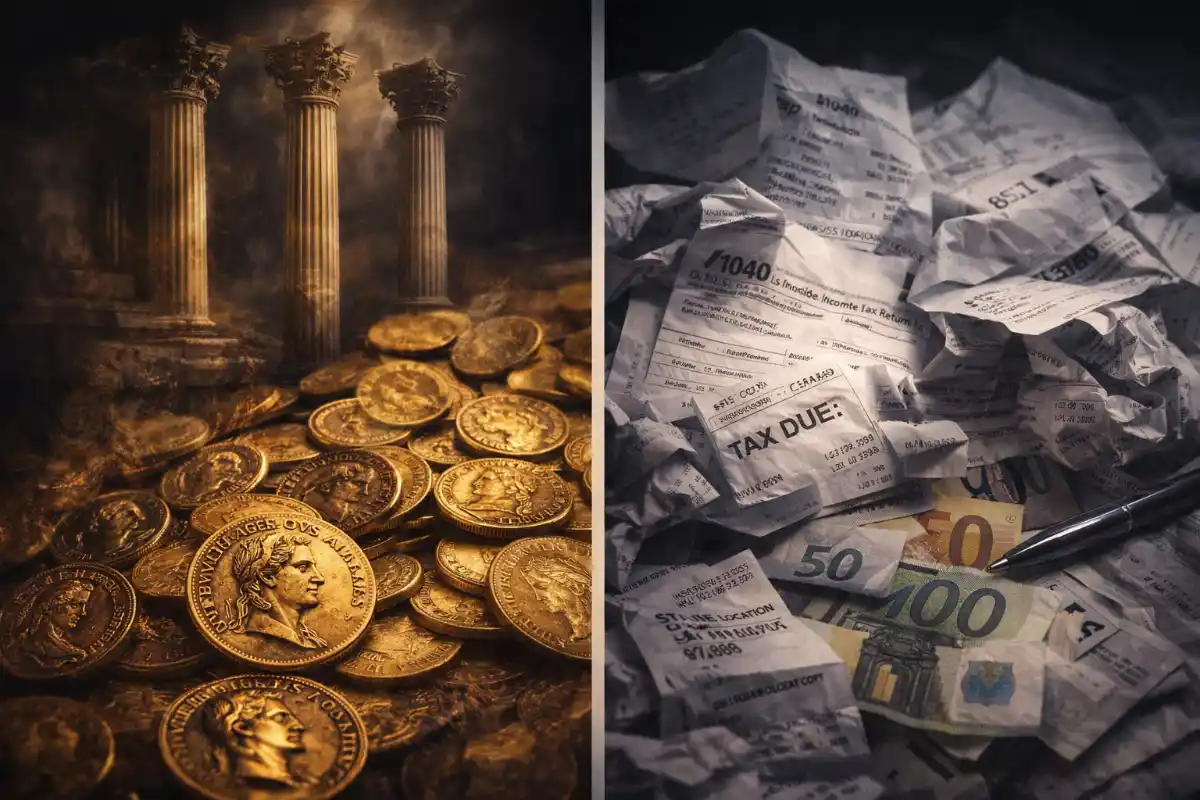
A Roman Peasant Paid 1-5%. You Pay 50%. And They Told You It's Civilization.
"The tax collector's art consists of plucking the goose so as to obtain the most feathers with the least hissing."
Jean-Baptiste Colbert, Finance Minister to Louis XIV, 1665
Here's something they don't teach you in school:
A Roman peasant during the height of the Empire paid approximately 1% of their assets in taxes during peacetime. In emergencies, war, famine, it might rise to 3%.
A medieval serf under the most oppressive feudal lord paid a tithe of 10% to the Church, plus another 10% to their lord. Total: roughly 20%.
You?
If you're a working European, your government takes somewhere between 40% and 55% of what you earn. If you're American, it's between 30% and 45% when you add it all up.
And the remarkable thing is: they convinced you this is progress.
The Roman Numbers
Let's start with the empire that built roads, aqueducts, the Colosseum, and conquered the known world.
According to historians, Roman citizens in the Republic and early Empire paid remarkably little:
- Land tax (tributum): Approximately 1% of property value, rising to 3% during wartime
- Customs duty (portoria): 2.5% on goods moving between provinces
- Inheritance tax: 5% (close relatives exempt)
- Sales tax at auction: 1%
Roman citizens living in Italy proper were exempt from direct taxes after 167 BCE. The provinces paid more, but even provincial taxation was estimated at around 5-7% of GDP, a fraction of modern rates.
The Cato Institute notes that the basic Roman tax rate was "just .01 percent, although occasionally rising to .03 percent", referring to the wealth tax during the Republic.
Even under Diocletian, when Rome was crumbling and taxes were crushing, scholars estimate the total burden was around 5% of empire-wide GDP. Comparable to 18th-century France.
Modern OECD countries collect 33-45% of GDP in taxes.
The Romans built an empire on 5%. We can barely maintain our roads on 40%.
The Honest Caveat
Let's not romanticize Rome.
The Roman Empire didn't run on 5% taxation alone. They ran on conquest. On plunder. On the systematic extraction of wealth from every territory they absorbed.
When Rome conquered a region, they took everything: gold, silver, grain, slaves. The mines of Hispania. The grain fields of Egypt. The wealth of Carthage, melted down and shipped to Rome. Entire populations enslaved to build the roads and aqueducts we admire today.
Roman citizens paid little in taxes because the empire was bleeding everyone else dry.
The provinces paid tribute, and when they couldn't pay, Roman soldiers took what they wanted anyway. Tax collectors in the provinces were so brutal, so corrupt, so hated that the word "publican" became synonymous with thief. Provincial rebellions were crushed with a brutality that makes modern authoritarianism look gentle.
The Jewish revolts. The sack of Jerusalem. Masada. Boudicca's rebellion in Britain, answered with the slaughter of 80,000 people.
Rome's low domestic taxes were subsidized by blood.
The truth doesn’t trend. It survives because a few still care enough to keep it alive.
Keep The Kade Frequency transmitting.
So why bring this up?
Because it makes the modern situation even more damning.
You're not conquering anyone. Your government isn't extracting tribute from foreign provinces. Your country isn't shipping home plunder from defeated enemies. There are no slaves building your infrastructure.
You are the one being extracted from.
The Roman citizen was on the winning side of an extraction machine. He paid 3% because Gauls and Greeks and Egyptians paid with their land, their grain, their freedom, their lives.
You? You're paying 50%. And you're not on the winning side of anything.
You're the province now.
Your labor is the tribute. Your income is the plunder. Your future is being shipped somewhere else, to service debts, to fund bureaucracies, to pay for wars you didn't vote for, to bail out banks that gambled and lost, to finance "green transitions" that make energy unaffordable.
The Roman citizen at least got cheap grain and gladiator games in exchange for the empire's brutality.
What do you get?
Crumbling roads. Underfunded pensions. A healthcare system that tells you to wait six months. Schools that produce graduates who can't read. And lectures about how you need to pay more, consume less, and be grateful for the privilege.
The Romans were honest about what they were: conquerors who took what they wanted.
Modern governments pretend to be your servants while picking your pocket.
At least the Romans didn't gaslight their subjects.
The Medieval Reality
The Middle Ages get a bad reputation for taxation. The image of the Sheriff of Nottingham squeezing peasants is burned into cultural memory.
But the numbers tell a different story.
Medieval taxation scholars found that in 14th-century Sweden, not exactly a light-touch regime, the average peasant paid the equivalent of about 2% of their farm's value annually to the royal treasury during normal times.
During invasions and crises, taxes spiked dramatically, up to 15% of farm value. These spikes caused rebellions. The Peasants' Revolt of 1381 in England was triggered by a poll tax of one shilling per person, considered intolerable oppression.
One shilling. The equivalent of a few days' wages.
Today, the average European worker has months of their labor confiscated before they see a penny. And there's no revolt. Just compliance.
The standard medieval tax structure:
- Tithe to the Church: 10% of produce
- Dues to the lord: Varied, typically 10-20% in labor or goods
- Royal taxes: Irregular, usually 2-5% when levied
Total burden for a medieval peasant: 20-35% in the worst cases. Often less.
And that 20-35% was considered so oppressive that it sparked armed rebellions, the Magna Carta, and eventually the end of feudalism.
Independent investigations. Imperial expansion exposed. Pattern documented.
Get investigations delivered.
What You Actually Pay
Now let's look at you.
Not the marginal rate on your paycheck. Not the number your government tells you. The actual total burden when you add everything up.
If you're European:
- Income tax: 20-55% (depending on country and bracket)
- Social security contributions: 15-40% (split between you and employer, but both come from your labor)
- VAT: 17-27% on most purchases
- Property tax: 0.5-2% of home value annually
- Fuel tax: 50-70% of what you pay at the pump
- Excise taxes on alcohol, tobacco, sugar
- Capital gains tax if you invest
- Inheritance tax if you die
- Corporate tax passed through in higher prices
The Tax Foundation found that in Belgium, a single worker earning the average wage faces a tax wedge of 52.6%. Meaning: for every €100 of labor cost to the employer, the worker takes home less than €48.
Germany: 47.9% France: 46.8% Austria: 46.8% Italy: 45.1%
If you're American:
The Tax Foundation estimates the total tax burden at around 29.6% for the average American when you add federal income tax, state income tax, sales tax, property tax, fuel taxes, and excise taxes.
But that doesn't include:
- The employer's share of Social Security/Medicare (7.65%), which comes from what they would otherwise pay you
- Corporate taxes embedded in prices
- Regulatory compliance costs passed to consumers
- Inflation as a hidden tax on savings
Add those in and you're looking at 40-45% for a middle-class American family.
The Taxes You Don't See
Here's where it gets absurd.
You pay income tax on your wages.
Then you pay sales tax when you spend what's left.
Then you pay property tax on the home you bought with after-tax money.
Then you pay fuel tax to drive the car you bought with after-tax money and registered with fees and insured with premiums that include government mandates.
Then you pay tax on your phone bill. Your utility bill. Your airline ticket. Your beer.
TurboTax lists some of the hidden federal taxes Americans pay:
- 7.5% federal excise tax on airline tickets
- 18.4 cents per gallon on gasoline
- 24.4 cents per gallon on diesel
- 3% federal communications tax on your phone
- 10% tanning salon tax
- Alcohol taxes varying by type and alcohol content
- Tobacco taxes
California levies 70.9 cents per gallon in state gas taxes alone. When you fill up, roughly half the price is taxes.
And then there's the tax nobody talks about: inflation.
When central banks print money, your savings lose purchasing power. That's a tax. When governments run deficits that devalue the currency, that's a tax. When regulatory compliance costs are passed to consumers, that's a tax.
None of these show up on your paycheck. All of them take from you.
"There is no art which one government sooner learns of another than that of draining money from the pockets of the people." — Adam Smith, 1776
What Changed
The Roman Republic funded its military and basic administration on 1-3% of wealth.
Medieval kingdoms funded courts, armies, and public order on 10-20%.
Victorian Britain, at the height of empire, operated on about 10% of GDP.
So what happened?
1913: The United States ratifies the 16th Amendment, enabling federal income tax. Initial rates: 1-7%.
1914-1918: World War I. Taxes skyrocket to fund the war. The top US rate hits 77% by 1918.
1930s-1940s: The Depression and World War II cement the high-tax state. The US top rate reaches 94% during WWII.
1945-present: The welfare state expands. Governments promise healthcare, pensions, education, housing, unemployment insurance. Each promise requires more revenue. Rates fluctuate but never return to pre-war levels.
The ratchet only goes one way.
Every crisis, war, depression, pandemic, justifies higher taxes. The crisis ends. The taxes remain.
The medieval peasant would be revolting in the streets at modern tax rates. We consider them normal because we've never known anything else.
What You Get For It
The argument is always: "But look what you get! Roads! Schools! Healthcare! Social security!"
Let's examine that.
Roads: The Romans built 80,000 kilometers of roads on 1-5% taxation. Modern governments struggle to maintain existing infrastructure on 40%.
Education: Medieval monasteries educated for free or nominal fees. Modern public education consumes vast budgets and produces declining literacy rates.
Healthcare: In many European countries, healthcare is "free", after you've paid 40-50% of your income. A medieval peasant could keep 80% of their production and pay a doctor directly when needed.
Social security: You pay into the system your entire working life. The average person dies within 15-20 years of retiring. You might break even. You might not. A medieval peasant didn't have social security, but they also kept most of what they produced and could save for themselves.
The question isn't whether government services have value.
The question is: Does 40-55% taxation provide 10-20x better services than the 3-5% taxation of historical empires?
Look around. You know the answer.
The Normalization
Here's the real theft: they normalized it.
You were born into a system where half your labor belongs to the state. You've never experienced anything else. So you assume it's natural. Inevitable. The price of civilization.
But civilization existed for thousands of years on a fraction of current taxation.
The Pyramids were built without income tax. The Parthenon was built without VAT. The Roman aqueducts were built without social security contributions. The cathedrals of Europe were built on tithes, not 50% marginal rates.
What changed isn't that civilization became more expensive.
What changed is that governments learned they could take more.
They learned that if you raise taxes gradually, people adapt.
They learned that if you hide taxes in prices, withholdings, and employer contributions, people don't feel the full burden.
They learned that if you call it "contributions" and "insurance" instead of "taxes," people resist less.
They learned that if you promise benefits far in the future, people will tolerate present extraction.
The Roman publicani, tax collectors, were hated figures. When they squeezed too hard, provinces revolted.
Modern tax collection is invisible. It happens before you see your paycheck. It's embedded in every price. It's accepted as the cost of existence.
And so we accept levels of extraction that would have caused our ancestors to take up arms.
"The way to crush the bourgeoisie is to grind them between the millstones of taxation and inflation."
Attributed to Vladimir Lenin (disputed)
The Question
Here's what I want you to understand:
You are taxed more heavily than any peasant in human history.
Not marginally more. Dramatically more.
A Roman citizen in 100 BCE kept 97-99% of their production.
A medieval serf in 1300 CE kept 65-80% of their production.
You keep 45-60%.
And in exchange for that unprecedented extraction, you get...roads that are crumbling, schools that are failing, healthcare systems that are overwhelmed, and pension systems that are insolvent.
The Roman Empire lasted 500 years on light taxation.
Modern welfare states are running deficits that will crush the next generation.
Something doesn't add up.
What Happened
Two things happened.
First: Governments discovered that modern administrative capacity allows them to tax at levels that were previously impossible. A medieval king couldn't track every transaction, every paycheck, every purchase. Modern governments can.
Second: Governments discovered that if they promise enough benefits, people will accept any level of taxation. The welfare state is a deal: you surrender half your production, and in exchange, we promise to take care of you when you're old, sick, or unemployed.
The deal sounded good.
The math doesn't work.
Social security systems across the West are facing demographic collapse. Healthcare costs are spiraling. Public pensions are underfunded by trillions.
The promises were made. The money was spent. The bill is coming due.
And when it does, they'll raise taxes again.
Because they always do.
The Comparison
| Era | Approximate Tax Burden | What They Built |
|---|---|---|
| Roman Republic | 1-3% | Roads, aqueducts, the largest empire in history |
| Roman Empire (peak) | 5-7% of GDP | Maintained above |
| Medieval Europe | 10-20% | Cathedrals, universities, the foundations of Western civilization |
| Victorian Britain | ~10% of GDP | Global empire, industrial revolution |
| Modern OECD | 33-45% of GDP | Chronic deficits, crumbling infrastructure, insolvent pensions |
The correlation is clear: more taxation does not mean more civilization.
Often it means the opposite.
When Romans started taxing heavily under Diocletian, the empire crumbled.
When medieval kings raised taxes too high, they got the Magna Carta.
When modern governments take half of everything, they get...compliance.
The Final Point
You are not freer than a Roman citizen.
You are not better served than a medieval peasant.
You are just more thoroughly taxed.
And the remarkable achievement of the modern state is that they convinced you this is normal. That this is the price of civilization. That anyone who questions it is naive or selfish or doesn't understand how society works.
The Romans understood how society works. They ran it on 3%.
You've been taught to accept 50%.
And they're still telling you it's not enough.
Frequently Asked Questions
How much tax did Roman citizens pay?
Roman citizens during the Republic and early Empire paid approximately 1% of property value in taxes during peacetime, rising to 3% during wartime. After 167 BCE, Roman citizens in Italy proper were exempt from direct taxes entirely. The total tax burden across the Roman Empire was estimated at 5-7% of GDP, comparable to 18th-century France.
How much tax did medieval peasants pay?
Medieval peasants typically paid a tithe of 10% to the Church plus 10-20% in dues to their lord, for a total burden of roughly 20-35% in the worst cases. In 14th-century Sweden, the average peasant paid about 2% of their farm's value annually to the royal treasury during normal times. Tax spikes during crises caused armed rebellions, the 1381 Peasants' Revolt was triggered by a poll tax of just one shilling.
What is the total tax burden in Europe today?
According to the Tax Foundation, a single worker earning the average wage in Belgium faces a tax wedge of 52.6%, meaning for every €100 of labor cost to the employer, the worker takes home less than €48. Germany is at 47.9%, France at 46.8%, Austria at 46.8%, and Italy at 45.1%. OECD countries collectively take 33-45% of GDP in taxes.
What are hidden taxes most people don't know about?
Hidden taxes include: the employer's share of Social Security/Medicare (7.65% that never appears on your paycheck), fuel taxes (up to 70 cents per gallon in some US states, 50%+ of pump price in Europe), communications taxes (3% on phone bills), airline ticket taxes (7.5%), VAT/sales tax embedded in all purchases, property taxes, corporate taxes passed through in higher prices, and inflation, which silently erodes your purchasing power.
When did taxes become so high?
Modern high taxation began with the US 16th Amendment in 1913 (initial rates: 1-7%). World War I pushed the top rate to 77% by 1918. World War II saw it reach 94%. The welfare state expansion post-1945 cemented high rates permanently. Every crisis, war, depression, pandemic, justifies tax increases. The crisis ends. The taxes remain. The ratchet only turns one way.
Did Romans build more with less taxation?
Yes. The Roman Empire built 80,000 kilometers of roads, aqueducts, the Colosseum, and maintained the largest empire in history on approximately 5% of GDP in taxes. Modern OECD countries collect 33-45% of GDP and struggle to maintain existing infrastructure while running chronic deficits. More taxation does not mean more civilization, often it means the opposite.
This analysis uses historical data that is necessarily approximate. Ancient tax systems were not standardized and varied significantly by region and time period. The comparison is meant to illustrate the scale of modern taxation relative to historical norms, not to suggest precise equivalence.
No ads. No sponsors. Just signals from the noise.
Keep The Kade Frequency transmitting.
Independent. Unfunded. Uncompromising.
Investigating power. Exposing corruption. Demanding accountability.
Related Investigations:
Wake Up
The Green Deal Robbery
Who Is Running Europe
© 2026 The Kade Frequency. All rights reserved.